Artwork
The eldest brother explains the reason for his youthful appearance, from a Tuti-nama (Tales of a Parrot): Forty-ninth Night
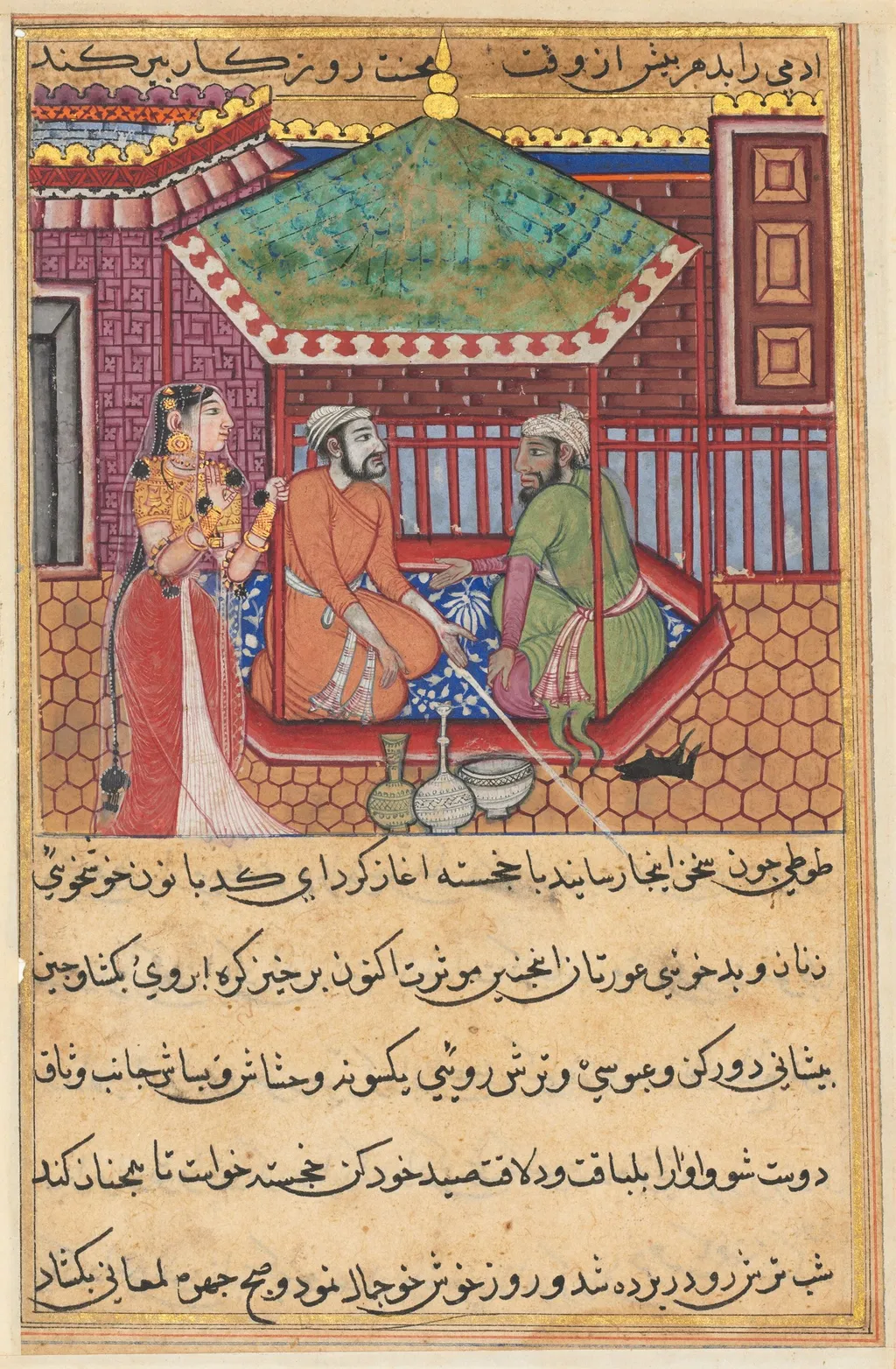
The eldest brother explains the reason for his youthful appearance, from a Tuti-nama (Tales of a Parrot): Forty-ninth Night is an unspecified painting. It dates from 1560 and is held in the collection of the Cleveland Museum of Art. The work depicts an intimate interior scene populated by three figures.
About this work
History & Provenance
The painting has been exhibited in shows at the Cleveland Museum of Art, though specific exhibition titles are not detailed in the available records.
Created in 1560 within the Mughal Empire, this painting illustrates the Forty-ninth Night from the Tuti-nama (Tales of a Parrot). The work depicts the eldest brother explaining the reason for his youthful appearance. The specific artist remains unidentified in the historical record.
The piece later entered the collection of the Cleveland Museum of Art, where it is cataloged under the accession number 1962.279.315.a.
The work is held in the collection of the Cleveland Museum of Art. Its accession number is 1962.279.315.a, and it was created in 1560 within the Mughal Empire. The painting has been exhibited in shows at the Cleveland Museum of Art, though specific exhibition titles are not detailed in the available records.
Overview
The work depicts an intimate interior scene populated by three figures. A central male figure in an orange robe sits on a red cushion, grasping a small object, while a second man in green leans forward, gesturing toward an item on a low table. To the left, a woman dressed in red and gold holds a fan.
The walls are tiled with patterned designs, and the ceiling is rendered in green with red trim, creating a compact, storybook‑like atmosphere.
Subject & Meaning
The composition illustrates a moment from the forty‑ninth night of a Tuti‑nama, a Persian collection of moral tales narrated by a parrot. The central figure is the eldest brother, explaining why he appears youthful, a motif that underscores themes of wisdom, deception, and familial dynamics common to the narrative tradition.
Technique & Style
Executed in vivid pigments, the painting emphasizes decorative detail through fine gold accents on the woman’s garment and the male figure’s turban. The use of bright, contrasting colors and the stylized rendering of interior architecture reflect a manuscript illustration aesthetic, translating textual storytelling into a visual tableau.
Context
The piece belongs to a broader corpus of Persian illustrated books that flourished between the 14th and 16th centuries, when literary works were frequently embellished with miniature paintings. Such images served both didactic and decorative purposes, enhancing the reader’s engagement with the moral lessons of the Tuti‑nama.
Artist & collection

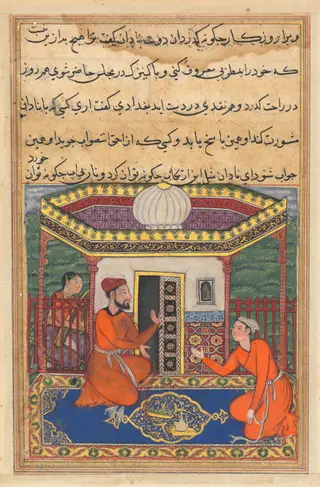 The young man of Baghdad solicits advice from a friend as his slave girl, who is adept at music, awaits, from a Tuti-nama (Tales of a Parrot): Forty-eighth Night
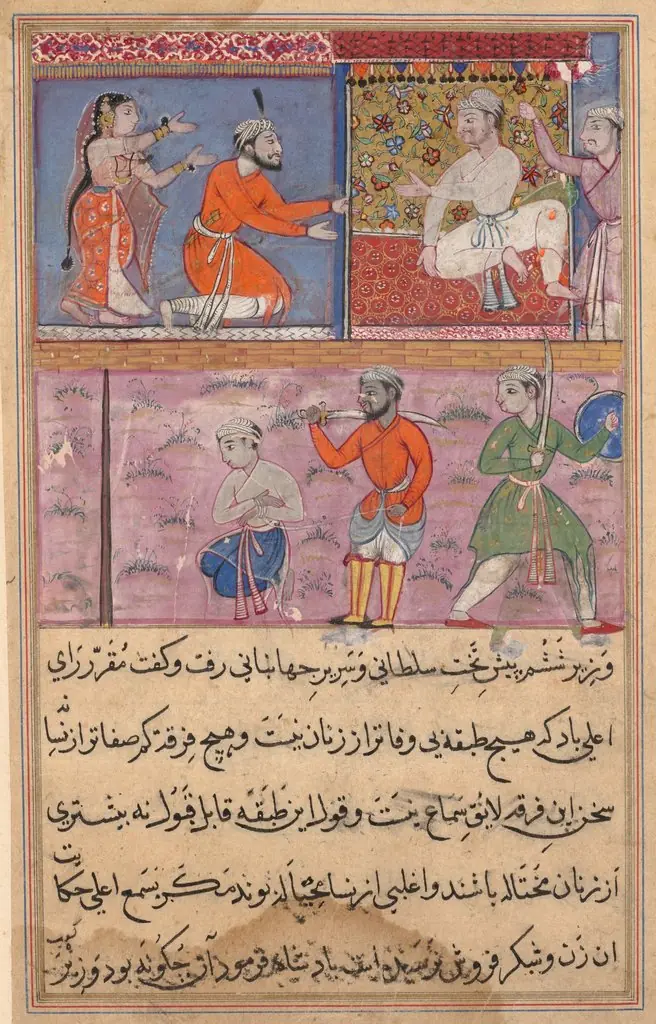 Page from Tales of a Parrot (Tuti-nama): text page
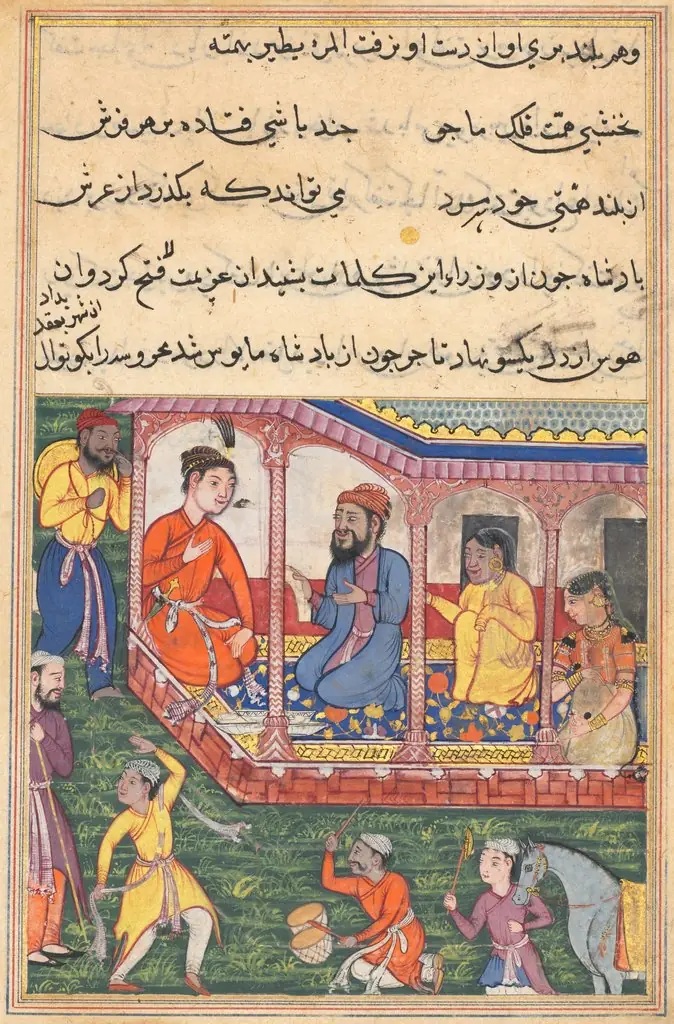 Mahrusa’s marriage to the prefect of the city, from a Tuti-nama (Tales of a Parrot): Thirty-sixth Night
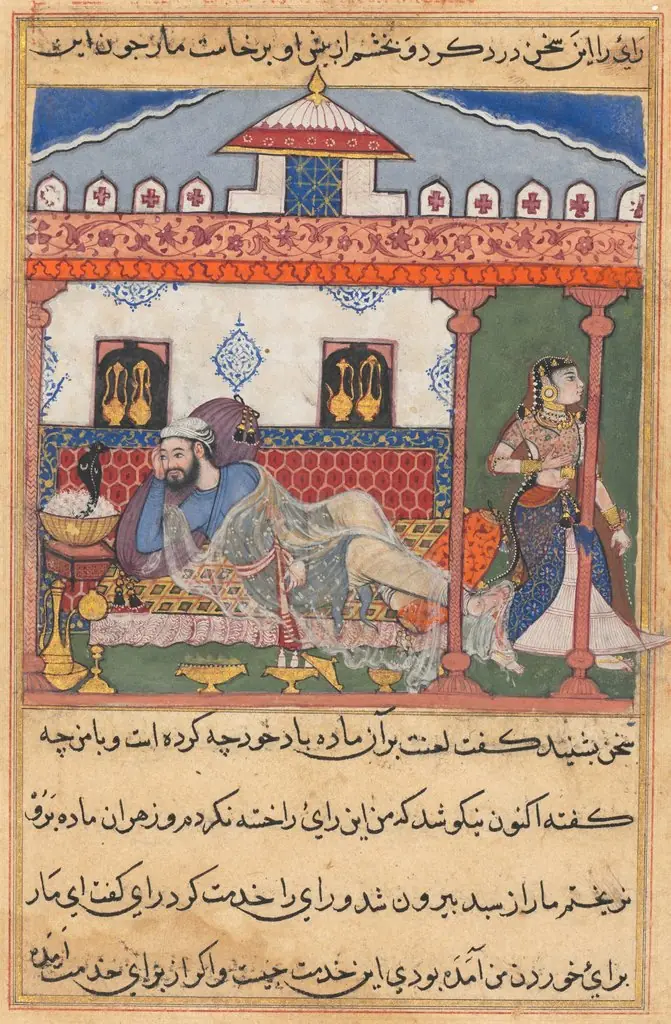 The snake, hidden in a basket of flowers, reveals himself to the Raja who has just sent away his wife, from a Tuti-nama (Tales of a Parrot): Forty-third Night
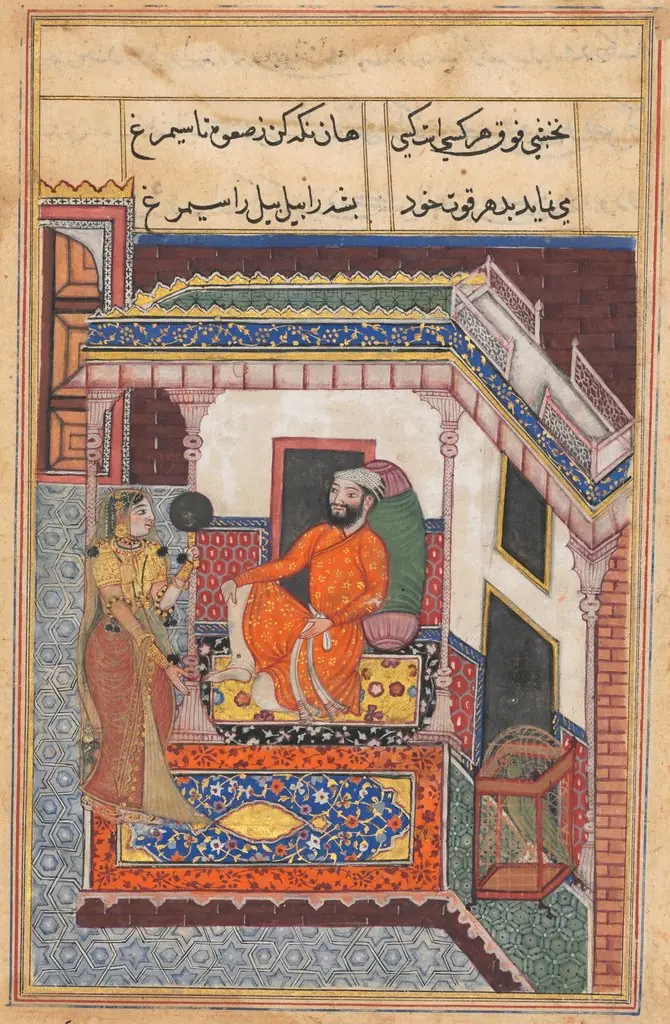 The parrot laughs on hearing the Raja of Ujjain’s wife admire her beauty in a mirror, from a Tuti-nama (Tales of a Parrot: Forty-sixth Night
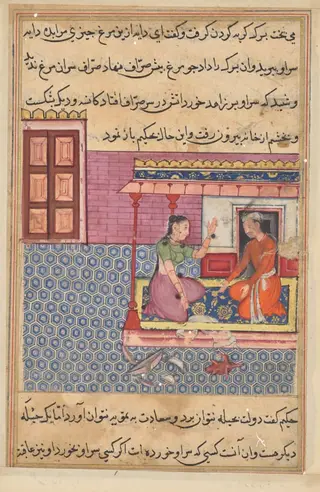 The pious man’s wife offers the seven-colored bird as food to her lover, but not finding its head, he breaks the pot and bowl in anger, from a Tuti-nama (Tales of a Parrot): Fifty-second Night
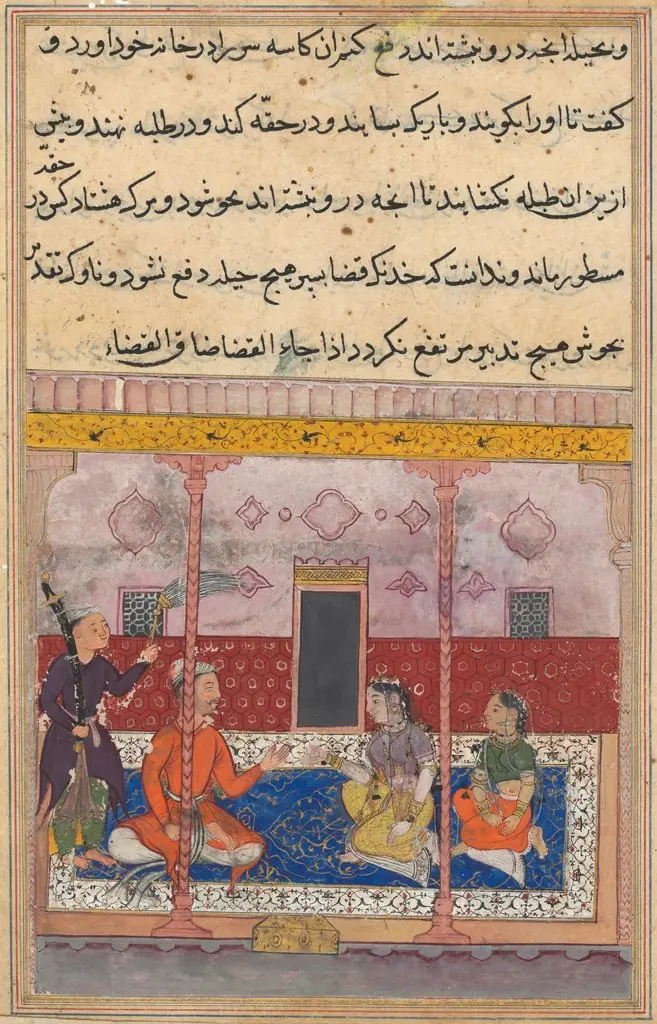 The merchant has the hateful skull ground and put into a box, from a Tuti-nama (Tales of a Parrot): Twenty-third Night
- The eldest brother explains the reason for his youthful appearance, from a Tuti-nama (Tales of a Parrot): Forty-ninth Night
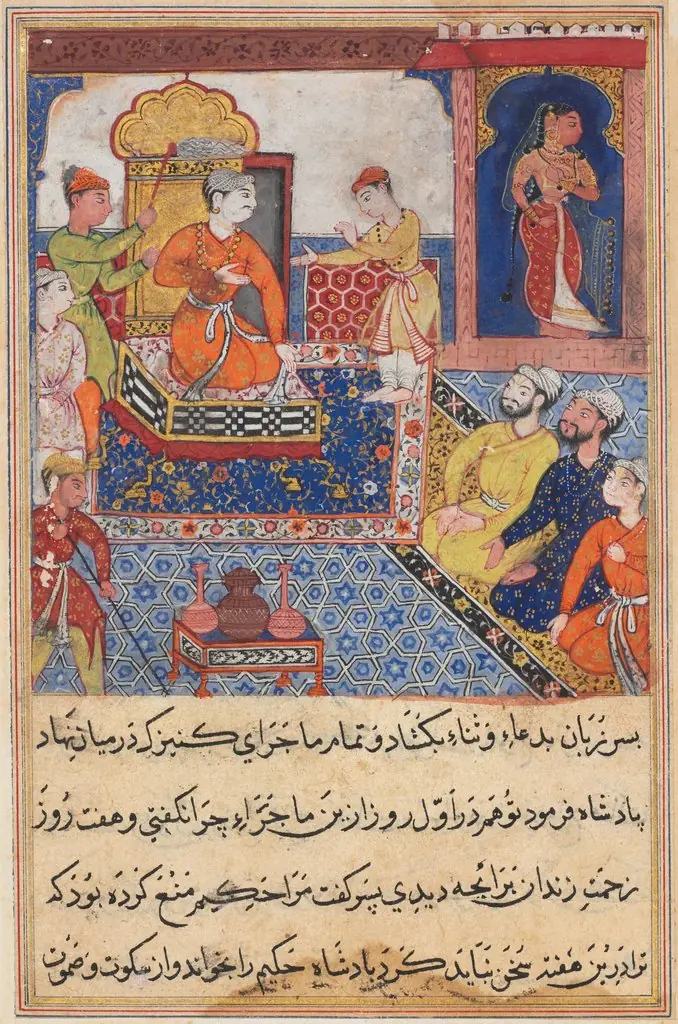 The young prince recounts his experiences to his father, the king, from a Tuti-nama (Tales of a Parrot): Eighth Night
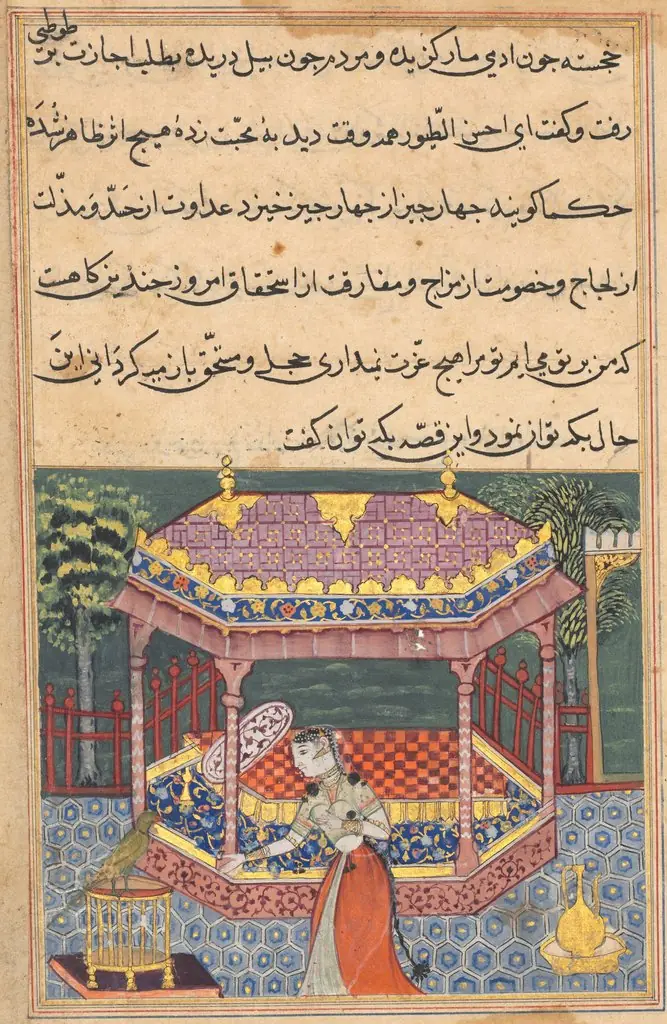 The parrot addresses Khujasta at the beginning of the thirty-seventh night, from a Tuti-nama (Tales of a Parrot)
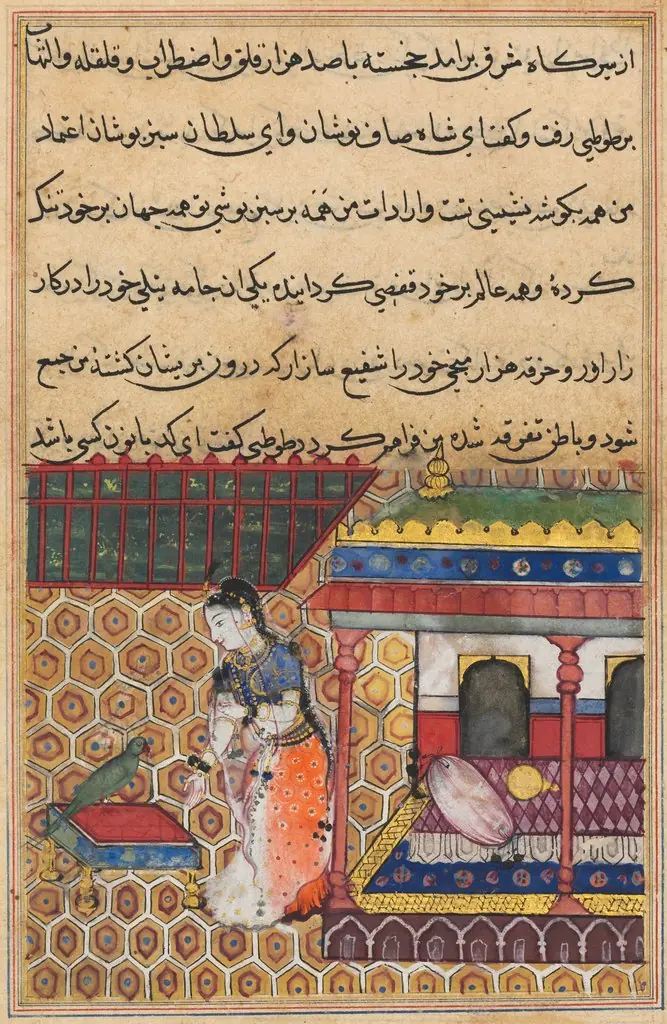 The parrot addresses Khujasta at the beginning of the thirty-eighth night, from a Tuti-nama (Tales of a Parrot)
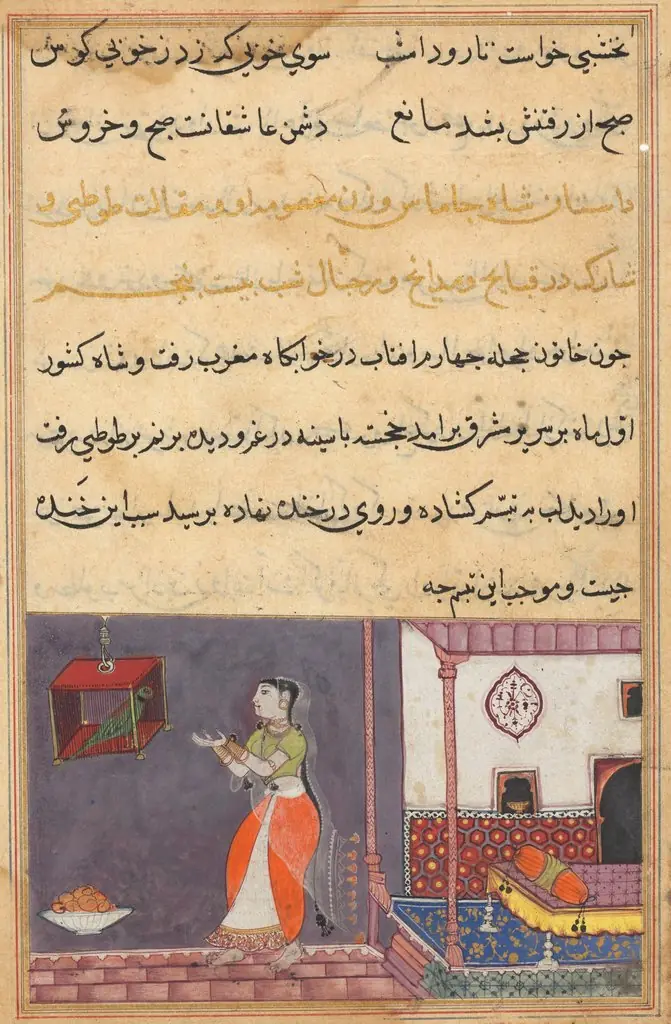 The Parrot Addresses Khujasta at the Beginning of the Twenty-fifth Night, from a Tuti-nama (Tales of a Parrot)