Artwork
Good and Evil
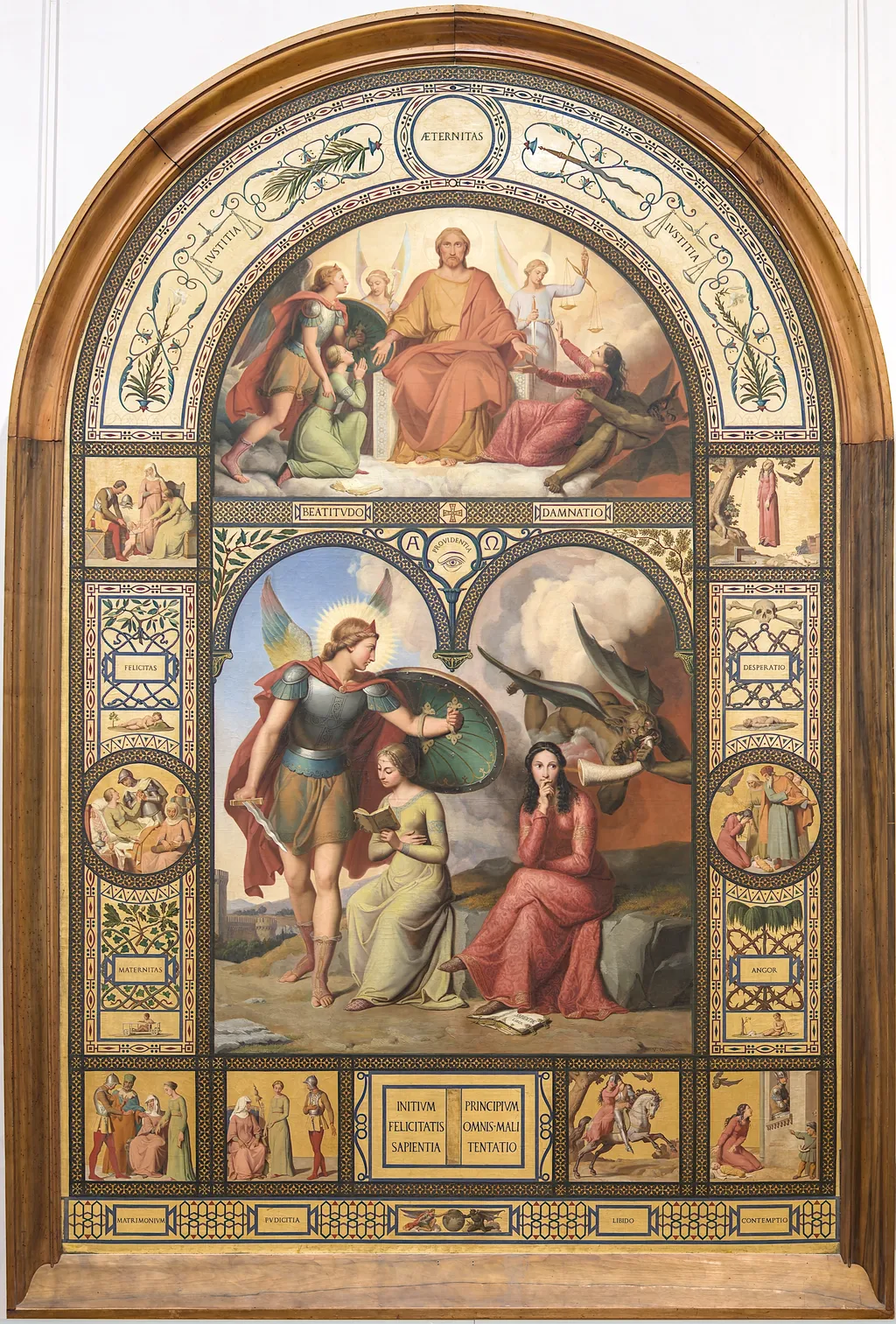
Good and Evil is an unspecified painting by the French Romanticist artist Victor Orsel. It dates from 1830 and is held in the collection of the Museum of Fine Arts of Lyon.
About this work
Subject & Meaning
Although the work employs archaic techniques and themes, it integrates Masonic symbolism, suggesting a layered message beyond its overt religious narrative.
Victor Orsel's Good and Evil (1830) is an allegorical painting that visually contrasts two opposing life paths: a virtuous existence leading to the Kingdom of God and a sinful one resulting in damnation. The composition is divided into distinct halves, utilizing religious imagery, Latin inscriptions, and medieval iconography to emphasize a moral lesson. Specific elements such as angels, weighing scales, and depictions of Jesus Christ appear alongside scenes of combat, suicide, and domestic life to illustrate the consequences of moral choices.
Although the work employs archaic techniques and themes, it integrates Masonic symbolism, suggesting a layered message beyond its overt religious narrative. Critics at the 1833 Salon described the piece as didactic, noting its synthesis of medieval revivalism with contemporary philosophical concerns.
Technique & Style
Executed in tempera on a rigid support, the composition divides vertically into two mirrored halves that narrate opposing moral paths. The left side illustrates a virtuous domestic life crowned by a haloed figure, while the right presents scenes of vice and damnation, including a couple embracing, a chained captive, and a hanging suicide. Stylistic hallmarks include flat, gilded backgrounds, hieratic figural types, and Latin inscriptions that underscore the didactic intent.
The upper zone adopts a semi-circular format reminiscent of a cathedral tympanum, aligning the work with medieval and early Italian Quattrocento models favored by the Nazarene circle. Handling emphasizes linear contouring and localized color rather than volumetric modeling, reinforcing the allegorical clarity.
History & Provenance
Victor Orsel began the painting Good and Evil in Rome in 1829, inspired by a request from the daughter of a close friend to depict a moral narrative. The work was completed in Paris in 1832 following numerous preparatory studies and collaborations with his student, Pierre-Nicolas Périn. First exhibited at the Paris Salon in 1833, the painting was later shown at the Palais Saint-Pierre in Lyon in 1836.
In 1850, Orsel bequeathed the artwork to Périn. It was subsequently donated to the Louvre in 1873 before being transferred to the Luxembourg Museum. The French State formally acquired the piece in 1886, the same year it was assigned to the Museum of Fine Arts of Lyon, where it has remained in the collection since.
Good and Evil (Le Bien et le Mal) is held by the Musée des Beaux-Arts de Lyon, where it entered the collection after the French state acquired it in 1886 and assigned it to the museum's permanent holdings; the work remains on display in that institution.
Context
Victor Orsel's Good and Evil (1830–1832) emerged from a post-revolutionary European context characterized by political instability and a Romantic reaction against classical rationalism. Orsel, described by scholar Henri Dorra as the "French Nazarene," sought to revive Christian morality through an anachronistic return to medieval techniques and Italian Primitives, influenced significantly by his time in Rome and association with Johann Friedrich Overbeck. The work synthesizes these religious revivalist aims with Masonic elements, reflecting the artist's reaction against the secular materialism of the era.
First exhibited at the Paris Salon of 1833, the painting provoked polarized critical responses regarding its didactic intent and archaic style. Théophile Gautier praised its connection to the "angelic school" of Orcagna and Pinturicchio, while others like Le Go aligned it with the Nazarenes. Conversely, detractors such as Auguste Jal labeled it a "profane polyptych," and Athanase Coquerel fils criticized the artist for a perceived lack of genuine religious conviction despite the work's overtly pious imagery.
Legacy
After its debut at the 1833 Paris Salon, Victor Orsel's allegorical painting Good and Evil attracted critical attention for its archaic visual language and didactic moral purpose. Reviewers such as Théophile Gautier placed the work alongside medieval masters and described Orsel's style as akin to the Nazarenes, while other commentators highlighted its paradoxical blend of medieval techniques with contemporary Masonic symbols. The painting entered the collection of the Museum of Fine Arts of Lyon, where it has been conserved continuously since the 19th century, and its reception contributed to a lasting reputation as a key example of early-mid-century French religious allegory.
Overview
Victor Orsel's painting, Good and Evil (Le Bien et le Mal), was initiated in Rome in 1829 and finished in Paris by 1832. This large-scale work serves as a moral allegory, visually dividing human existence into two distinct paths. It depicts the consequences of a virtuous life, leading towards divine reward, in contrast with an evil existence, which culminates in damnation. The artist employed a didactic approach, integrating religious symbols and Latin inscriptions to underscore its ethical message.
Own this work as a print
Artist & collection
Artist
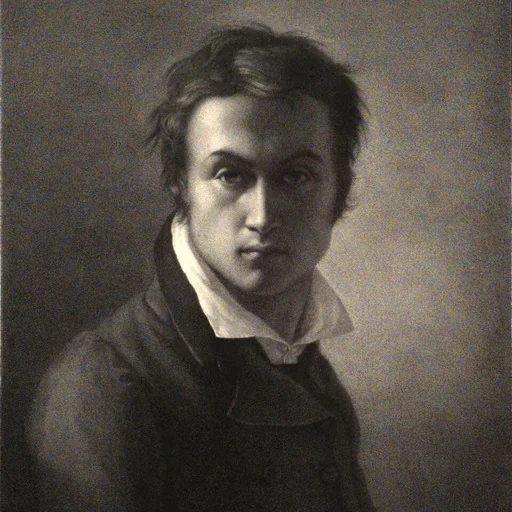
André Jacques Victor Orsel (25 May 1795, Oullins – 1 November 1850, Paris) was a French painter; primarily of religious subjects.

- The Legend of St. Wolfgang
 Getsemanen rukous, Kymin kirkon alttaritaulun luonnos
 Sieben Schmerzen Mariens: Linke Tafel mit Auferstehung Christi
 Triptych of the Holy Family
 The Lodge of St John
 St. Paul the Apostle
 Mary's Passage Across the Mountains
 Copy after Raphael’s ceiling fresco representing ‘Poetry’ in the Stanza della Segnatura (Vatican Palace, Rome,1509-11), 1864
 Jupiter and Hebe
 21 Scenes of the Apocalypse (triptych altarpiece, centre panel)
 Predella pane with Saint Bridget, Saint Christopher, and Saint Kilian from Retable
 Saint John the Baptist in the Wilderness with the Lamb of God, Surrounded by the Symbols of the Evangelists and the Four Fathers of the Church
 The Contest for the Bouquet: The Family of Robert Gordon in Their New York Dining-Room
 The Saithwaite Family
 The Wife of Hasdrubal and Her Children
 Madame Georges Charpentier and her Children
 Family Group of Four on Sofa
 Family Group
 Everhard Jabach (1618–1695) and His Family
 The Family of Mr. Westfal in the Conservatory