Artwork
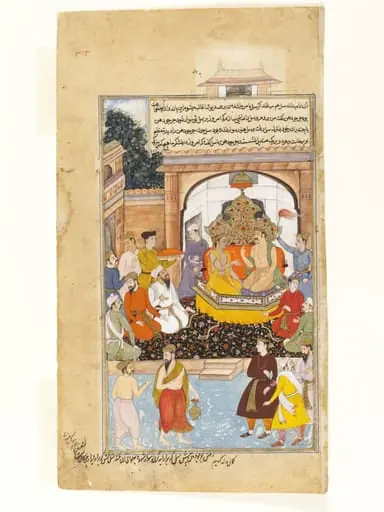
Yaja and Upayaja perform a sacrifice for the emergence of Dhrishtadyumna from the fire, from Adi-parva (volume one) of the Razm-nama (Book of Wars) adapted and translated into Persian by Mir Ghiyath al-Din Ali Qazvini, known as Naqib Khan (Persian, d. 1614) from the Sanskrit Mahabharata
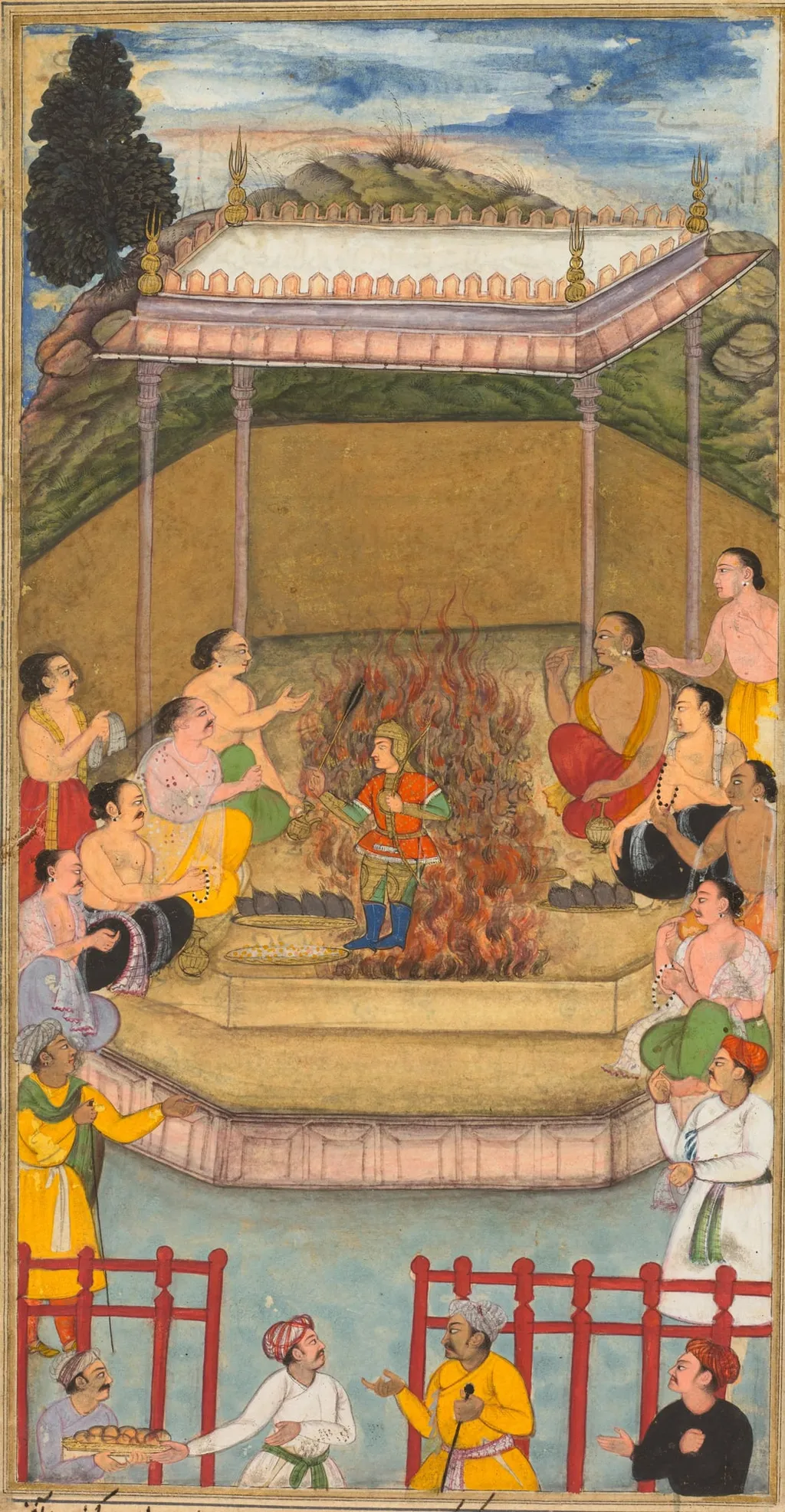
Yaja and Upayaja perform a sacrifice for the emergence of Dhrishtadyumna from the fire, from Adi-parva (volume one) of the Razm-nama (Book of Wars) adapted and translated into Persian by Mir Ghiyath al-Din Ali Qazvini, known as Naqib Khan (Persian, d. 1614) from the Sanskrit Mahabharata is an unspecified painting by the Mughal Painting artist Bilal Habshi. It dates from 1598 and is held in the collection of the Cleveland Museum of Art.
- Accession no.
- 2013.305
- Credit line
- Gift in honor of Madeline Neves Clapp; Gift of Mrs. Henry White Cannon by exchange; Bequest of Louise T. Cooper; Leonard C. Hanna Jr. Fund; From the Catherine and Ralph Benkaim Collection
About this work
Overview
It depicts the ritual birth of Dhrishtadyumna, a warrior summoned through fire sacrifice, as performed by the Brahmins Yaja and Upayaja.
This painting illustrates a pivotal moment from the Adi-parva of the Razm-nama, a 16th-century Persian translation of the Mahabharata commissioned by the Mughal court. It depicts the ritual birth of Dhrishtadyumna, a warrior summoned through fire sacrifice, as performed by the Brahmins Yaja and Upayaja. The scene is rendered in the Mughal miniature style, with intricate detail and vivid pigments, and includes an inscription identifying the artist as Habshi, likely an African artist active in the imperial atelier.
Subject & Meaning
King Drupada, seeking vengeance after losing half his kingdom to Drona, commissioned a sacred fire ritual to produce a warrior destined to kill his enemy. The Brahmins Yaja and Upayaja, having been generously compensated, conducted the rite on the banks of the Ganges. From the flames emerged Dhrishtadyumna, fully armed, symbolizing divine intervention in human conflict.
The scene underscores the belief that cosmic order could be invoked through precise ritual, linking royal ambition with spiritual authority.
Technique & Style
The artist employed fine brushwork and mineral-based pigments to render the scene with precision. Flames blaze in warm oranges and reds between the seated priests, contrasting with the cool blues and greens of the surrounding enclosure. Dhrishtadyumna emerges in detailed armor, his form sharply defined against the radiant fire.
The composition balances symmetry and movement, characteristic of Mughal court painting, while the naskh script beneath provides textual context in elegant Arabic calligraphy.
History & Provenance
Commissioned under Emperor Akbar, the Razm-nama was produced in the imperial atelier between 1582 and 1586. This folio, attributed to Habshi, an artist identified by his epithet meaning 'Ethiopian', reflects the cosmopolitan nature of the Mughal workshop, which included artists from Persia, Central Asia, and Africa. The painting’s survival in a bound manuscript highlights its role as both religious narrative and imperial propaganda, legitimizing Mughal patronage of Indian epics.
Context
Fire sacrifice, rooted in Vedic tradition, was a ritual reserved for Brahmins and central to Indo-Aryan religious practice. The Mahabharata’s inclusion in Persian translation reflects Akbar’s broader policy of cultural synthesis, bridging Hindu and Islamic traditions. The Mughal court’s interest in Indian epics was not merely aesthetic but political, using these stories to assert legitimacy over a diverse realm and to frame imperial power as divinely sanctioned.
Legacy
The Razm-nama remains one of the most significant illustrated manuscripts of the Mughal era, preserving both Indian narrative traditions and Persian artistic forms. Habshi’s contribution, as one of the few named African artists in the imperial workshop, offers rare insight into the diversity of Mughal artisans. This folio continues to serve as a key document for understanding cross-cultural exchange, religious syncretism, and the role of visual art in legitimizing political authority in early modern South Asia.
Artist & collection
Artist
Bilal Habshi painted like he was translating a dream, fast, fluid, and full of movement.

 Bhisma
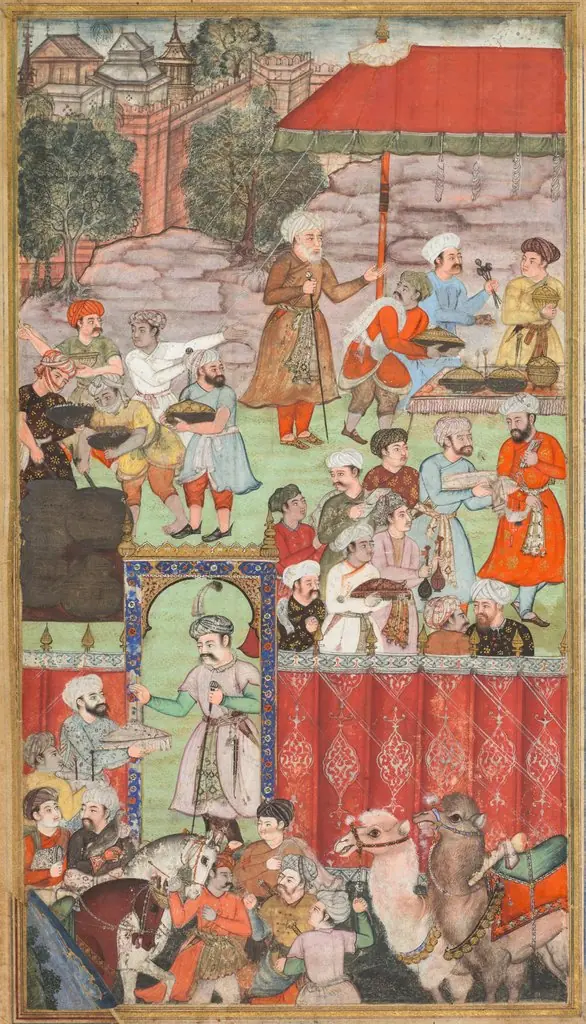 A feast for Babur hosted by his half-brother Jahangir Mirza in Ghazni in May 1505, from a Babur-nama (Memoirs of Babur)
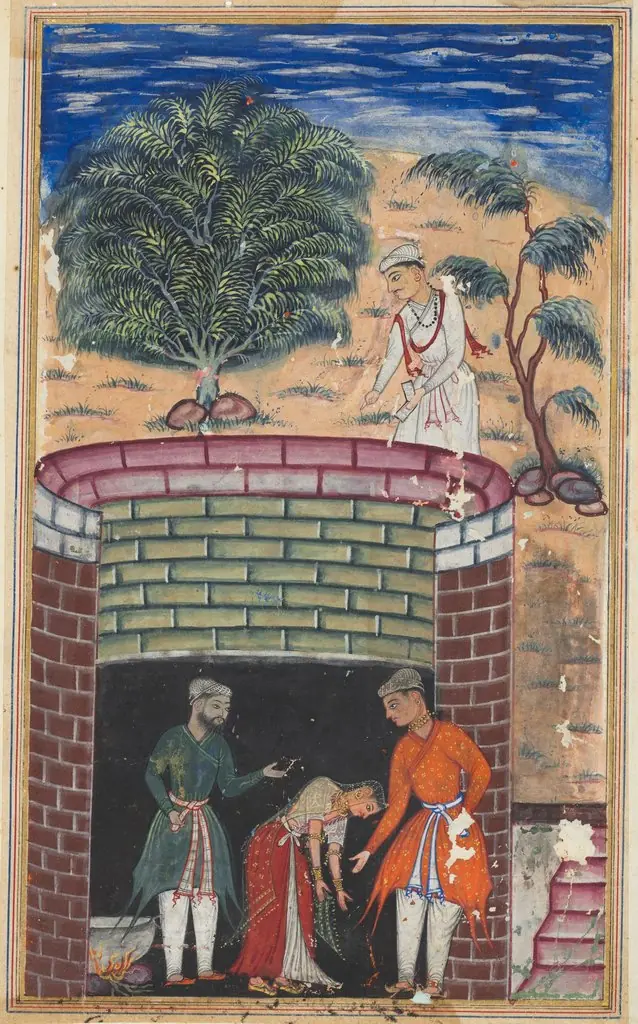 The daughter of the king of the jinns bows before the King of Kings who has just undergone the ordeal of passing through the boiling oil to emerge as a youth, from a Tuti-nama (Tales of a Parrot): Seventh Night
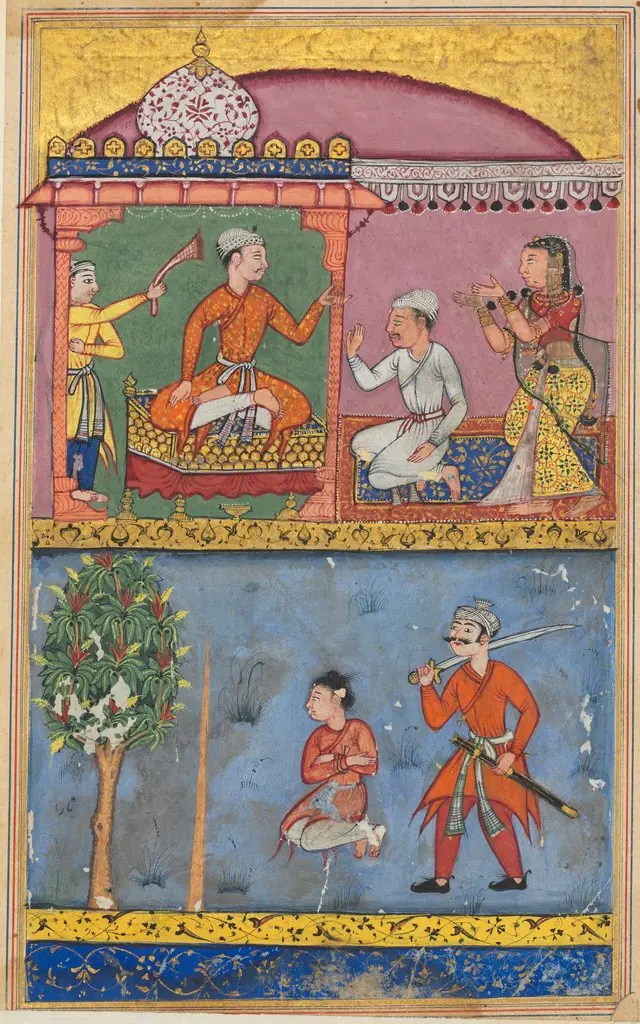 The handmaiden appeals for justice and the prince is taken to the execution site for the fourth time, from a Tuti-nama (Tales of a Parrot): Eighth Night
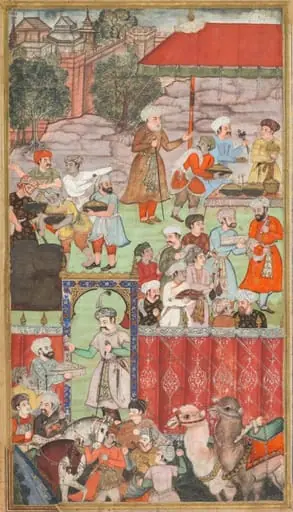 A feast for Babur hosted by his half-brother Jahangir Mirza in Ghazni in May 1505, from a Babur-nama (Memoirs of Babur)
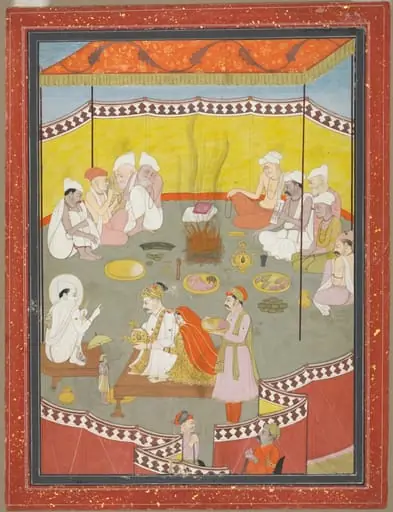 King Bali gives a gift of land to Vamana
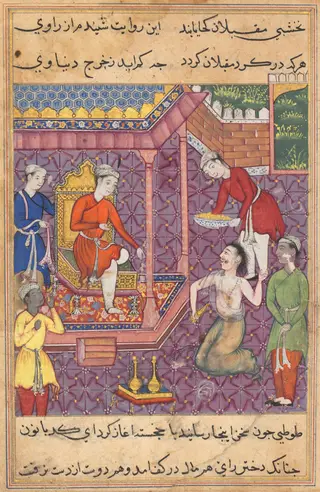 The magician disguised as a Brahman returns to claim his “daughter-in-law,” from a Tuti-nama (Tales of a Parrot): Thirty-fifth Night
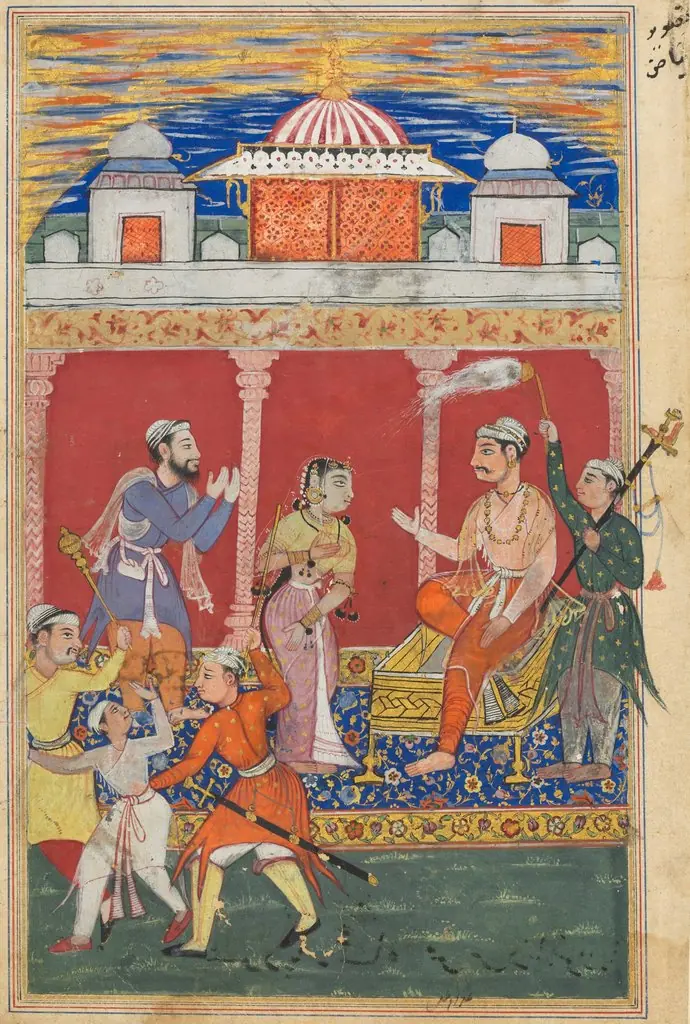 The prince’s ordeal continues, he is ordered away to be executed for the fifth time, from a Tuti-nama (Tales of a Parrot): Eighth Night
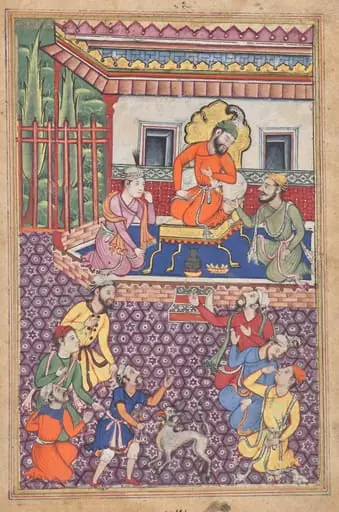 The court of the Raja of Ujjain, from a Tuti-nama (Tales of a Parrot): Forty-sixth Night
- Yaja and Upayaja perform a sacrifice for the emergence of Dhrishtadyumna from the fire, from Adi-parva (volume one) of the Razm-nama (Book of Wars) adapted and translated into Persian by Mir Ghiyath al-Din Ali Qazvini, known as Naqib Khan (Persian, d
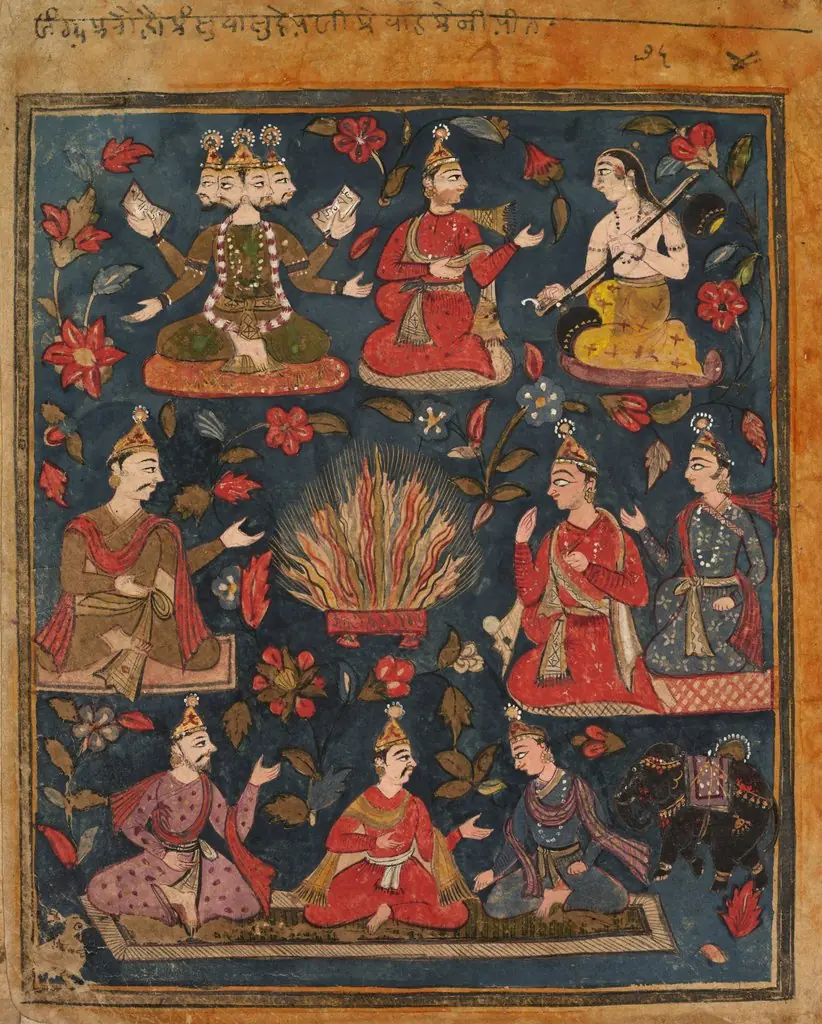 Sacrificial Fire, from the "Tula Ram" Bhagavata Purana
 Duryodhana and Salya