Movement
Literary realism
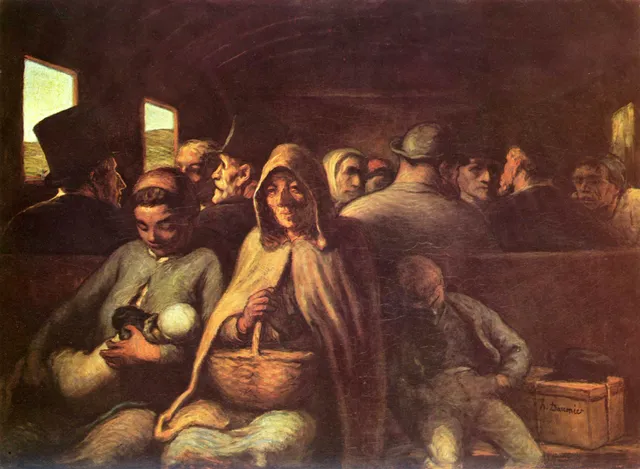
Literary realism is an art movement of the 1830–1900 period. The gallery holds 1 work in this movement. Browse Literary realism paintings, portraits, pictures and artworks from the world's public-domain museum collections.
Realism emerged in France around 1848–1850, in the unsettled aftermath of the February Revolution, as a deliberate revolt against the exoticism, heroics, and heightened emotion of Romanticism. Its artists and writers shared a single conviction: that the proper subject of serious art was contemporary life, observed honestly and without idealization. The critic and novelist Champfleury helped name and defend the movement, championing Gustave Courbet from 1848 and editing the short-lived journal *Le Réalisme* (1856–57). The label was always as literary as it was visual—Courbet's circle overlapped with the world of Balzac, of Flaubert (whose *Madame Bovary* appeared in 1857), and later Émile Zola, all of whom turned an unflinching, documentary eye on ordinary society. Painting and prose advanced the same program in parallel.
Visually, Realism is defined by its refusal of the grand manner. Mythological, religious, and historical subjects gave way to peasants, laborers, and the urban poor, often rendered at the monumental scale once reserved for history painting. Palettes tend to be sober and earthbound, surfaces frank and unpolished, compositions matter-of-fact. Figures are neither flattered nor moralized; their dignity comes from being shown plainly, with weight and presence.
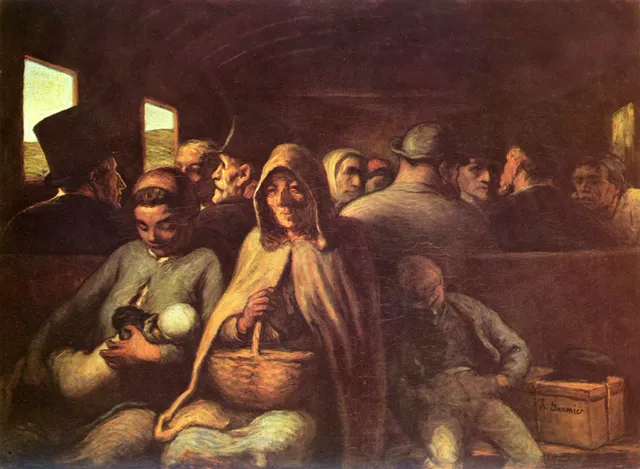
Courbet is the movement's founder, staging his own "Pavilion of Realism" beside the 1855 Exposition Universelle with a printed manifesto after the jury balked at his work. His *A Burial at Ornans* (1849–50) and *The Stonebreakers* (1849) announced the new seriousness. Jean-François Millet ennobled rural labor in *The Gleaners* (1857), while Honoré Daumier, the great satirist and printmaker, brought Realism to modern city life. His *The Third-Class Carriage* (ca. 1862–64), held in this collection, seats the viewer among a nursing mother, an old woman, and a sleeping boy in a crowded railway car—poverty observed with grave, sculptural compassion.
Realism's insistence on the seen and the present reshaped European art. It fed directly into Naturalism and the social realism of later decades, and its commitment to contemporary subjects and direct observation prepared the ground for Impressionism, which inherited the Realists' modern eye while trading their dark tonality for light and color.
Works
Frequently asked questions
What is Literary realism?
Literary realism is an art movement. A 19th-century movement — primarily in fiction, but with close parallels in painting — that sought to represent life as it was actually lived by ordinary people, without idealization.
When did Literary realism take place?
Literary realism dates from 1830–1900.
Where can I see Literary realism works?
Literary realism works in the collection are held by National Gallery of Canada.