Artist
Subject
Cult Object
Cult Object is a subject in art. The gallery holds 200 works in this subject in art, including works by Hugo Kołłątaj, Leon Alexandru Biju and Robert Filliou George Brecht.
A cult object is any material thing made or set apart to be venerated within a religious or ritual practice — the focus of worship rather than of mere display. The category is functional rather than formal: a marble figure of a god and a marble portrait of a citizen may be carved by the same hand, yet only the former, installed in a sanctuary and tended with ritual, is a cult image. Across the ancient world such objects served as the dwelling-place of a deity's presence, and in several traditions — Egypt, Greece, Rome, India — the image was washed, dressed, fed, and carried in procession on feast days, as though alive.
In ancient Greece the supreme cult statue was the chryselephantine type, built of gold and ivory plaques over a wooden armature. The most celebrated were the work of Phidias in the mid-fifth century BCE: the roughly twelve-metre seated Zeus at Olympia, counted among the Seven Wonders, and the towering Athena Parthenos housed in the Parthenon, whose interior was designed expressly to frame it. Both are wholly lost, known only through copies, coins, and description. Alongside such colossal images stood humbler cult objects — Egyptian amulets with apotropaic power, and the anatomical votive offerings of clay or bronze that Greek and Roman worshippers dedicated to deities like Hathor or Asклepios in petition or thanksgiving.
Christianity transformed rather than abolished the cult object. The Orthodox icon became the principal devotional image of the Eastern Church, understood as a window to the holy rather than an idol — a distinction defended through the iconoclastic controversies and affirmed at the Second Council of Nicaea in 787. The catalogue's Transylvanian holdings belong to a vivid late chapter of this tradition: reverse-painted glass icons that flourished after a wooden image of the Mother of God at Nicula Monastery, painted in 1681 by Luca of Iclod, was reported to weep in 1699, turning the village into a pilgrimage centre and its peasants into glass painters. Works such as the catalogue's Nativity, the Archangels Michael and Gabriel, and the Six Hierarchs show the resulting folk idiom — luminous vermilion, cerulean, and amber, Romano-Cyrillic inscriptions, naïve yet fervent.
In the modern museum these objects undergo a final shift: severed from rite, the cult image is reframed as art, its aura recast as aesthetic value — the very tension the category names.
Key artists
Overview
A cult object is any material item venerated within a religious or ritual practice. Ranging from ancient Egyptian amulets and Greek votive offerings to African ceremonial masks and South Asian divine images, these objects serve a primary original function of religious veneration rather than aesthetic display. In the practice of religion, a cult image specifically is a human-made object worshipped for the deity, spirit, or daemon it embodies or represents. In museum and art historical contexts, the term identifies works whose purpose was devotional, often distinguishing the principal revered image in a temple from secondary decorative images.
Iconography & meaning
The iconography of cult objects centers on their role as physical vessels for the divine. In several traditions, including the ancient religions of Egypt, Greece, Rome, and India, cult images undergo daily rituals of being washed, dressed, and offered food. Processions outside the temple on feast days are also a common feature, allowing public encounters with the otherwise sequestered deity. Anthropologists note that such images are typically regarded as representations of deities rather than deities themselves, though opponents of religious images have historically charged that practitioners worship the object directly. In Abrahamic religions, cult images are often identified as idols, and their veneration is condemned as idolatry, the worship of hollow forms. The Book of Isaiah articulates this paradox by criticizing those who worship the work of their own hands. Judaism is strictly aniconic, forbidding any physical depiction of God and deeming idolatry one of the gravest sins. Christianity makes an exception for the veneration of icons, drawing a firm distinction between veneration and adoration, while early Christian tradition sought to avoid the paradox of man-made idols through the concept of acheiropoietoi, images not made by human hands.
Across movements & periods
The treatment and theology of the cult object have shifted dramatically across movements and cultures. In ancient Egypt and the Near East, temples housed a primary cult image, typically a small gold figure kept in the inner sanctuary naos, which was exclusively accessed by priests. Large stone images of pharaohs decorated temple exteriors, while smaller cult objects populated private homes. Greek and Roman temples placed the cult image in the cella, which sometimes allowed limited access for general worshippers. Greek cult statues were predominantly anthropomorphic, ranging from primitive wooden xoana to colossal chryselephantine statues. The ancient Hebrew religion rejected cult images entirely, a monotheistic aniconism also reflected in Akhenaten's Atenism, where the Aten was represented only as a sun-disk with rays ending in hands, and temples were built as open courts for direct solar worship. In Christianity, the introduction of venerable icons sparked centuries of controversy, culminating in the Byzantine Iconoclasm of the eighth and ninth centuries before the reestablishment of icon veneration in Eastern Orthodoxy.
Notable depictions
Notable ancient cult objects include the lost chryselephantine statues of classical Greece, such as the Statue of Zeus at Olympia and Phidias's Athena Parthenos in the Parthenon, both colossal works of ivory and gold over a wooden framework. Fragments of two similar chryselephantine statues from Delphi have been excavated. A rare surviving original is the bronze Piraeus Athena, which measures 2.35 metres high including its helmet. Other significant forms include the xoanon, a primitive wooden image, and the palladium, a wooden image of great antiquity upon which the safety of a city depended, such as the one stolen from Troy by Odysseus and Diomedes. The Temple of Dendur, completed by 10 B.C. during the reign of Augustus, provides a complete architectural context for Egyptian cult practice. Built of Aeolian sandstone and measuring 12.50 metres in length, the temple housed the cult of the goddess Isis in its sanctuary, where statues of the main deities were kept in shrines and brought out during festivals.
Legacy
The legacy of the cult object persists in both religious practice and cultural terminology. The word idol entered Middle English in the thirteenth century from Old French, adapted in Ecclesiastical Latin from the Greek eidolon, meaning appearance, which is a diminutive of eidos, meaning form. While the term idol remains pejorative in most English contexts, it carries no hostile implication in Indian English, where it remains synonymous with cult image. Modern Kemetism continues the use of cult images as practiced in ancient Egypt. In contemporary art, the visual language of the cult object has been recontextualized, as seen in Kehinde Wiley's 2017 painting Mary, Comforter of the Afflicted I, which draws from Catholic iconography to depict a young Black woman in the place of the Virgin Mary, using the codes of traditional cult imagery to raise questions about visibility and value.
Works
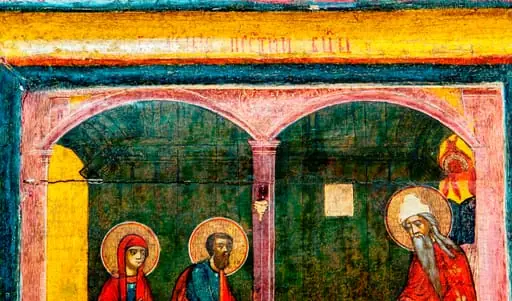
 Icoana reprezintă Nașterea Mântuitorului Iisus Hristos. Icoana este împărțită patru secvențe: Nașterea Mântuitorului este în centrul icoanei. Pruncul Iisus Hristos, înfășat în scutece este ținut în legănuț de Maica Domnului și de Dreptul Iosif, logodnicul Fecioarei Maria. În registrul superior este ilustrată venirea magilor după steaua cea călăuzitoare. În colțul drept, este un înger îmbrăcat în cămașă roz, aplecându-se din Ceruri, pentru a privi și a mângâia bucuria Nașterii Pruncului. În registrul inferior este ilustrată îmbăierea Pruncului de către câteva tinere fecioare. Alături este Dreptul Iosif care se arată nedumerit de Taina minunată a Nașterii Domnului și de păstrarea Fecioriei Maicii Domnului și după Naștere. În centrul icoanei este steaua cea călăuzitoare cu un mănunchi de raze luminoase, aducătoare de vestea cea bună. Urcând spre dreapta, întâlnim un ciobănel păstor cu oile. Elementele de arhitectură sunt foarte minuțios realizate, creându-se atmosfera Nazareth-ului. Este o alternanță cromatică luminoasă și vie de roșu zmeuriu, roz, albstru turcoaz-smarald, galben chihlimbar, gri și brun. Cerurile sunt deschise. Icoana este foarte bogată în narațiune. Registrele se întrepătrund armonios. Inscripția din româno-chirilică se traduce Nașterea ICXC Iisus Hristos.
 Sfinții Arhangheli Mihail și Gavriil sunt reprezentați împreună, fiind mai-marii voievozi ai oștilor cerești. În această icoană, primul este Sfântul Arhanghel Gavriil, îngerul aducător de dar și bunăvestire, iar al doilea este Sfântul Arhanghel Mihail, numit slujitorul Legii. Sfinții Arhangheli sunt înveșmântați în tunică-sacos galbenă chihlimbar, cu mânecile largi gri-antracit, cu mantiile roșii vermillon, aripile roșii-gri antracit. Sfântul Mihail are pantalonii de oștean albaștrii bleu-ciel și ține în mâna dreaptă balanța faptelor bune și a fărădelegilor și în mâna stângă are spada dreptății și a credinței. Fondul icoanei este cerul albastru bleu-ciel ceruleum în registrul superior și un câmp de nouri albi-albaștri, asemenea unor mandorle, în registrul de mijloc. Cromatica armonioasă este alcătuită din: roșu vermillon, albastru bleu-ciel și ceruleum, galben chihlimbar, gri antracit, brun, bronziu, alb, negru. Inscripția din româno-chirilică se traduce Mihail și Gavriil. Icoana este din Nordul Transilvaniei, Nicula.
 Icoana este mai rară, prin tematica iconografică abordată. Este un prăznicar cu 6 sfinți ierarhi, mucenici, arhidiaconi. Sunt împărțiți în două registre, a câte trei grupuri, înscrise între coloane, pe sub arcade de Biserică. În registrul superior sunt cei trei Ierarhi Vasile cel Mare, Grigorie de Dumnezeu-Cuvântătorul și Ioan Gură-de-Aur. Cei Trei Sfinți Ierarhi Vasile cel Mare, Grigorie de Dumnezeu Cuvântătorul și Ioan Gură-de-Aur slujesc și săvârșesc Sfânta Liturghie împreună. Sunt înveșmântați în veșminte liturgice: sacos albastru ceruleum și roz putred-stacojiu, cu linii albe, felon roșu vermillon-orange, epitrahil ocru-galben și verde-lime cu câte trei-patru cruci negre. Sfinții ierarhi Binecuvântează cu mâna dreaptă și țin în mâna stângă Sfânta Evanghelie închisă. În registrul al doilea, cel inferior, sunt Sfântul Mare Mucenic Dimitrie Izvorâtor de Mir, Sfântul Mare Ierarh Nicolae făcător de minuni și Sfântul Mare Arhidiacon Ștefan. Se remarcă sacosul de zale gri-argintii ale Sfântului Dimitrie, care ține în mâna dreaptă o cădelniță, iar Sfântul Ștefan Binecuvântează cu crucea, pe care o ține în mâna dreaptă. Fondul întregii icoane este cerul albastru cobalt-ceruleum, împodobit cu stele albe și roșii, elemente astrale. Cromatica este luminoasă și armonioasă: verde văratic, verde lime, alb, orange, roșu vermillon, roz-stacojiu, galben-ocru, galben chihlimbar, bej, crem, albastru cobalt și ceruleum, negru. Este o icoană specifică picturii de Țara Oltului, cu un desen fin cu conturul negru și cromatica pastelată. Inscripția din româno-chirilică se traduce Sf Vasile Sf Grigorie Sf Ioan Sf Dimitrie Sf Nicolae Sf Ștefan.
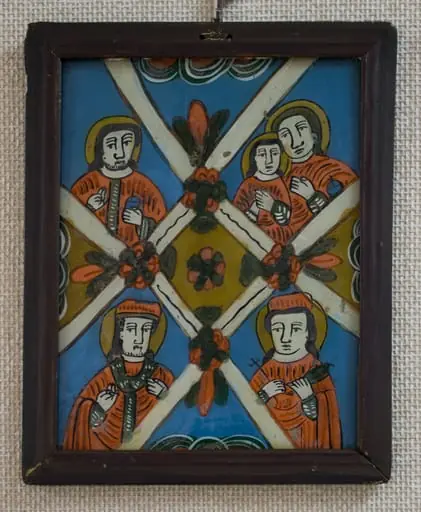
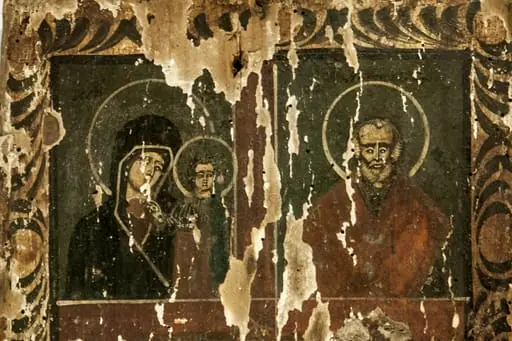 Un câmp central sub formă de cruce, împarte spațiul pictural în patru casete dreptunghiulare care conțin următoarele scene: Stânga sus Maica Domnului cu Pruncul tipul Kazanskaia. Este reprezentată până la piept, nu se văd mâinile, înveșmântată cu maforion negru cu galon alb. Are chipul îndurerat, privirea tristă, capul ușor înclinat spre Prunc. Iisus – Emanuel, binecuvintează cu dreapta, privirea îndreptată lateral, către sfântul Nicolae..Chiton brun deschis, himation verde. Dreapta sus - Sf. Nicolae în veșminte simple, capul descoperit, cărunt, cu barba rotundă și scurtă, privind la rândul său către pruncul Iisus. Înveșmântat cu sacos verde și omofor mare orange, care îi acoperă umerii. În casetele de jos sunt redați doi sfinți în vârstă, în picioare, în veșminte preoțești, întorși unul către altul, cu privirea îndreptată către scenele din registrul superior. Inscripția ce denominează primul dintre ei a fost ștearsă, cel de al doilea posibil sfântul Savatie?. Icoana are un vădit caracter popular, naiv. Spațiul cruciform pictat cu roșu, fondul scenelor verde închis, 2/3 din fondul scenelor de jos galben-orange. Nimburi trasate cu alb, inscripții caligrafice, litere cursive, cu negru. Compoziția este încadrată de un chenar cu decor vegetal, motive ample de factură populară, specifice spațiului slav.
 Icoana îl reprezintă pe Sfântul Arhanghel Gavriil, un voievod al puterilor cerești, al doilea în rangul arhanghelilor, după Sfântul Arhanghel Mihail, cunoscut ca mesager al veștilor frumoase. Misiunea Sfântului Gavriil este de a vesti mântuirea omenirii. Sfântul Gavriil este îmbrăcat în cămașă albă de înger cu verde, cu mantie roșie vermillon, cu interiorul căptușit cu verde de China. Cu chipul angelic și foarte tânăr, sfântul are mâinile în gestul de a arăta calea și dăruind crinul, simbolul BuneiVestiri, Maicii Domnului sau totodată, primind o crenguță înflorită din Rai, din mâna Maicii Domnului. Sfântul Gavriil este încadrat într-un medalion auriu, pe un fond gri, îmbogățit cu flori roșii - ruje înfrunzite. Este o tematică rară, pictată la Nicula, din Nordul Transilvaniei. Motivul zăluței albe este prezent în pictura icoanei, abia-întrezărit, în veșmântul sfântului.
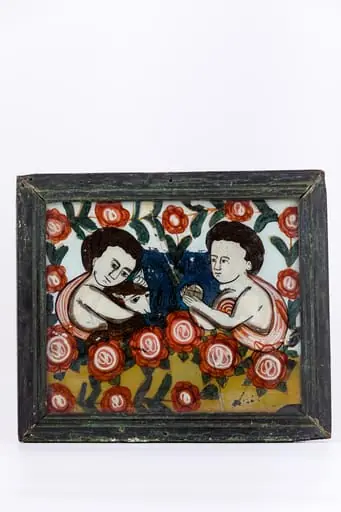 Icoana îi reprezintă dimpreună pe Mântuitorul Iisus Hristos și Sfântul Ioan Botezătorul, copii fiind, verișori, redați semi-profil, înfășurați cu câte o mantie roșie vermillon, dar cu umerii goi de copilași. Copilul Iisus ține în mâini, globul pământesc cu crucea deasupra, asemnea unui chivot de biserică, iar copilul Ioan ține un mieluț. Mieluțul este Însuși Mântuitorul Iisus Hristos, care Se va Jertfi pentru toată lumea, reprezentată de chivotul bisericii pe globul pământesc. Iată Mielul! - sunt cuvintele Sfântului Mare Prooroc Ioan Botezătorul și Înaintemergătorul Domnului nostru Iisus Hristos. Fondul icoanei este albastru bleumarin adânc și profund, în centrul icoanei, și bleu-ciel senin, pe margini, în registrul inferior este un câmp luminos de galben-ocru. În marginile icoanei, fondul este alb-albastru bleu-ciel foarte deschis și senin, înconjurat de elemente decorative fitomorfe - 16 trandafiri și bujori, ruje, roșii, cu frunze verzi. Cromatica este armonioasă și senină: roșu vermillon, albastru bleumarin, albastru bleu-ciel, galben-ocru; alb, negru. Icoana este de Gherla.
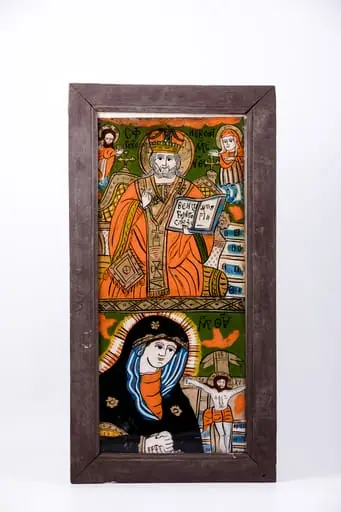 Icoaauri
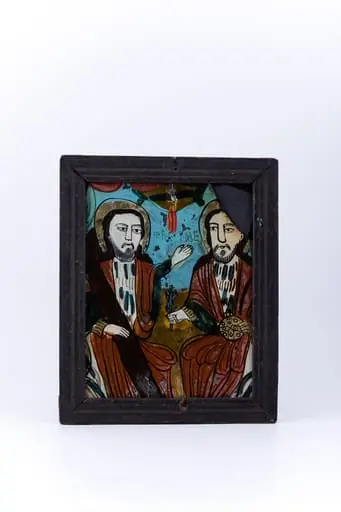 Icoana reprezintă Sfânta Treime. Dumnezeu-Tatăl are globul pământesc bronziu pe genunchi și arătă cu mâna dreaptă, în care are sceptrul împărătesc cu crucea, Bincuvântând întreaga lume. Dumnezeu-Fiul are Crucea pe umărul drept. Dumnezeu-Tatăl și Dumnezeu-Fiul sunt înveșmântați în roșu vermillon-acajou, cu sacosuri albe, dungate cu liniuțe subțiri albastre. Amândoi-dimpreună se sprijină cu picioarele pe o mandorlă de nouri albi-gri, rotunzi și bogați, fiind așezați ca pe un tron împărătesc. Deasupra, în registrul superior este un spațiu luminos de auriu de chihlimbar, din care pe un mănunchi de raze luminoase, se pogoară Sfântul Duh, sub forma porumbelului alb. Astfel este prezentă întreaga Sfântă Treime. Între Dumnzeu-Tatăl, Fiul și Sfântul Duh este un spațiu galben-auriu. Fondul icoanei este cerul albastru cerulem-regal, încadrat de un chenar decorativ geometrizant format din semicercuri roșii, asemenea unor petale de ruje. Inscripția din româno-chirilică se traduce Treime. Cromatica este luminoasă și armonioasă: roșu vermillon-acajou, verde văratic-mușchi de pădure, albastru ceruleum-regal, auriu-bronziu, galben-chihlimbar, gri, brun, alb, negru. Icoana este din Nordul Transilvaniei, Nicula.
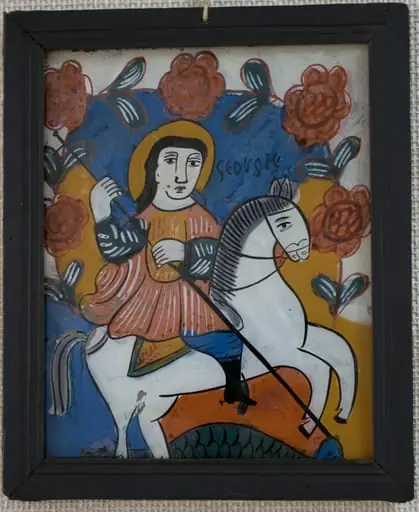 Icoana este pictată "în oglindă", pe un suport de sticlă de formă dreptunghiulară în ax vertical. Tema iconografică: Sfântul Gheorghe omorând balaurul. Sfântul, călare pe cal alb, este plasat în centrul icoanei. Veșminte ostășești, cizme înalte, tunică scurtă, roșie, cu mâneci verzi, pantaloni albaștri, bufanți.Capul descoperit, părul lung, negru, revărsat pe umeri. Aureola trasată cu mâna liberă. În mână ține o suliță lungă pe care o înfige în gura balaurului reptilian, verde, simbolizând zonele inferioare, ale păcatului. În jumătaea superioară o ghirlandă de trandafiri dispusă în arcadă deasupra sfântului. Icoana are caracteristici specifice picturii niculene: stângăcia, simplitatea și primitivismul desenului; compoziția sumară,este mai încărcată totuși decât la icoanele niculene din prima perioadă. Paleta cromatică sobră, culorile intense:alb, orange, roșu, verde, albastru, negru. Rama profilată, de culoare neagră, dosul din scândură subțire de brad.
 Icoaceil
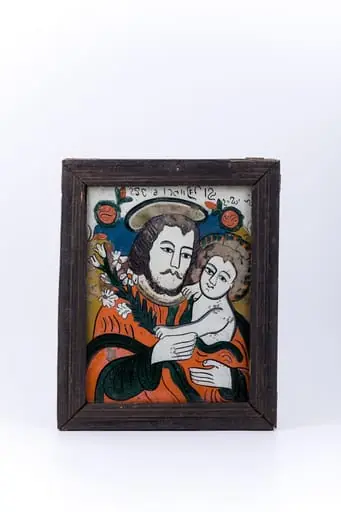 Icoana îi reprezintă pe Sfântul și Dreptul Iosif, Logodnicul PreaCuratei Fecioarei Maria, cu Pruncul Iisus Hristos în brațe. Icoana este mai rară, din punctul de vedere al tematicii compoziționale abordate. Sfântul Iosif este înveșmântat cu un hiton - tunică roșie vermillon, cu mânecile și bordura verde mușchi-de-pădure sau nuanță de China. Pruncul Iisus este dezbrăcat, dar acoperit de veșmântului protector al Sfântului Iosif. În mâna dreaptă Dreptul Iosif Logodnicul ține o ramură de crin, simbolul Fecioriei și a BuneiVestiri. Crinul este ținut împreună cu mânuța Pruncului Sfânt. Aureola Sfântului Iosif este mai aparte, asemenea sfinților catolici. Fondul icoanei este cerul albastru regal, în registrul superior, un câmp luminos de galben-bronziu, în registrele inferior și mediu, pe laterale și un chenar decorativ geometrizant alb-ivoriu. În registrul superior, asemenea unei arcade de boltă, este o ghirlandă de ruje roz - 2 elemente florale. Inscripția din româno-chirilică se traduce Sf Iosif și Iisus. Cromatica este armonioasă și luminos-pastelată: roșu vermillon, verde mușchi-de-pădure, albastru regal, alb-ivoriu, crem, bej, nisipiu, galben-ocru, bronziu, alb, negru. Icoana este din Nordul Transilvaniei, Nicula.
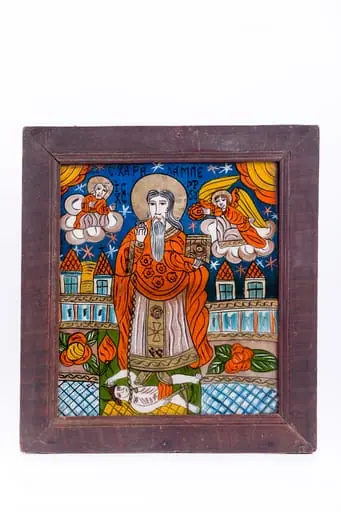 Sfântul Haralambie este cunoscut ca și făcător-de-minuni, vindecător de boli și ocrotitor al caselor familiilor creștine. Central este pictat Sfântul, îmbrăcat cu veșminte liturgice, arhierești, cu sacos roșu vermillon și bej-rozaliu, cu elemente decorative florale brune și epitrahil brun-stacojiu-roz, cu trei cruci și aureolă. Cu mâna dreaptă binecuvântează și cu mâna stângă ține Sfânta Evanghelie închisă. Tot cu mâna dreaptă, binecuvântând, ține și în lanț ciuma, reprezentată antropomorfic și zoomorfic - o vietate goală și diavol, cu trăsături umane. Ciuma, simbolizând boala incurabilă și moartea, are coarne de diavol, fiind, totodată și păcatul, patima, aducătoare de moartea duhovnicească. Fondul este cerul albastru cobalt strălucitor de senin, cu elemente decorative astrale - stele albe și roșii. Compoziția iconografică este îmbelșugat-echilibrată cu elemente de arhitectură. În registrul superior sunt Dumnezeu-Tatăl Binecuvântând și Îngerul păzitor, cu aripile galbene de lumină, ocrotind, fiind pe mandorle de nouri albi-crem-bej. Cromatica este armonioasă și luminoasă: roșu vermillon, brun-rozaliu, albastru cobalt și blau-ciel, verde spanac-avocado, kaki, cafeniu, galben-ocru, alb, negru. Icoana este de Țara Oltului. Inscripția din româno-chirilică se traduce Sfântul Haralambie IC XC MP Iisus Hristos Maica Domnului. Chiar dacă în inscripție scrie MP Maica Domnului este pictat Sfântul Înger ocrotind.
 Temaapul
 Icoai"(a
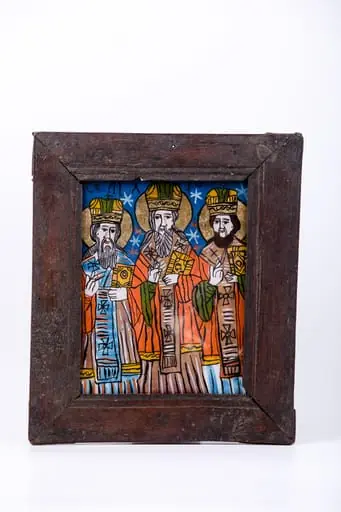 Cei Trei Sfinți Ierarhi Vasile cel Mare, Grigorie de Dumnezeu Cuvântătorul și Ioan Gură-de-Aur slujesc și săvârșesc Sfânta Liturghie împreună. Sunt înveșmântați în veșminte liturgice: sacos crem-albastru-alb-crem, felon roșu vermillon, epitrahil albastru-verde cu câte patru cruci negre. Sfântul Vasile cel Mare are Sfânta Evanghelie în mâna dreaptă. Sfântul Ierarh Grigorie de Dumnezeu Cuvântătorul Binecuvântează. Fondul registrului superior este cerul albastru-regal, bogat ornamentat cu elemente astrale - stele roșii și albe. Cromatica este luminoasă și armonioasă: verde văratic, alb, roșu vermillon, galben-ocru, bej, crem, albastru regal și bleu-ciel, negru. Este o icoană specifică picturii de Țara Oltului, cu un desen fin cu conturul negru și cromatica pastelată. Inscripția din româno-chirilică se traduce Vasile Grigorie Ioan.
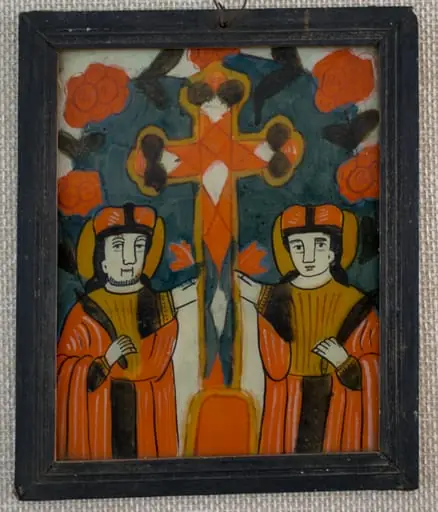 Icoana este pictată pe dosul unei bucăți de sticlă de formă dreptunghiulară în ax vertical. Crucea(tipul calvarului, cu brațele treflate)susținută în partea de jos de cei doi împărați, Constantin și mama sa Elena, (cea care a descoperit crucea la Ierusalim).este plasată sub o arcadă semicirculară de trandafiri roșii. Corpul crucii ornamentat cu motive geometrice policrome(alb, roșu, negru, galben).Sfinții (3/4) sub brațele orizontale ale crucii, o susțin cu cîte o mână(diformă), în cealaltă mână țin câte un sceptru vegetal. Fețele sunt butucănoase, veșmintele identice(galben, negru și roșu), mitrele rotunde, aureolele trasate liber. Câmpul despărțit în două zone de o arcadă de trandafiri roșii(ruje): albastru de Prusia sub arcadă, alb în rest. Desenul este schematic, naiv, Paleta cromatică este dominată culorile calde(roșu, galben, orange) contrastul cu câmpul albastru.creând perspectivă cromatică. Rama este alcătuită din patru stinghii brune, îmbinate oblic; dosul este nou, din lemn subțire de brad.
 Icoana este pictată pe dosul unei bucăți de sticlă dreptunghiulară, în ax vertical; Sf. Dumitru, izvorâtorul de mir, care se prăznuiește pe 26 octombrie, este unul din sfinții reprezentați ca războinici, deși din viața lui nu se deduc fapte de arme. Semnificația este cea a războiului nevăzut cu patimile.În concepția populară Sf. Dimitrie este cel care dezleagă iarna, corespondentul Sf. Gheorghe care leagă iarna și dezleagă primăvara. Reprezentările lor sunt deasemenea asemănătoare, fie călare, Sf. Gheorghe pe cal alb și Sf. Dimitrie pe cal roșu. Aici Sf. Dimitrie 3/4, este redat ușor din semiprofil, în picioare, în mâna dreaptă cu o suliță iar în stânga avînd o cruce. Mantie roșie, lungă, cămașă verde închis, zale.Chipul este realizat în manieră naivă, expresiv.Părul lung, negru este revărsat pe umeri. Câmp bleu, cu un chenar din flori mari, roșii cu frunze în aceeași nuanță de verde pe care zugravul a mai utilizat-o. Inscripția este pe fond alb, într-un chenar dreptunghiular plasat în spatele aureolei. Pictura are caracteristicile specifice picturii niculene:stângăcia, simplitatea și primitivismul desenului; compoziția sumară, culorile intense. Rama- 4 șipci de brad profilate, culoarea lemnului natur.
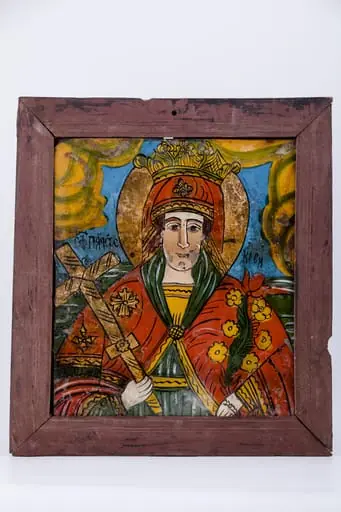 Sfânta Mare Cuvioasă Parascheva de la Iași are crucea în mâna dreaptă și ramură înflorită, cu 6 flori galbene și una roșie în vârf în mâna stângă. Este îmbrăcată în veșmânt roșu vermillon, cu interiorul căptușit cu verde și galben. Peste maforionul roșu, sfânta cuvioasă are aureolă. Fondul icoanei este cerul albastru regal, cu o arcadă de lumină galbenă, în registrul superior și bronziu, în jurul chipului și aureolei Sfintei Paraschiva și o alternanță de câmpuri verzi, dispuse paralel, în registrul mediu și inferior. Este o icoană cu aer cald, tomnatic, de octombrie 14, Praznicul Sfintei Cuvioase Parascheva. Inscripția din româno-chirilică se traduce Sf Paraschiva. Cromatica este armonioasă: roșu vermillon, albastru regal, verde văratic și forest, brun-cafeniu, negru, galben chihlimbar, ocru, bronziu, gri, negru, alb. Icoana este din Țara Oltului.
 Icoambla
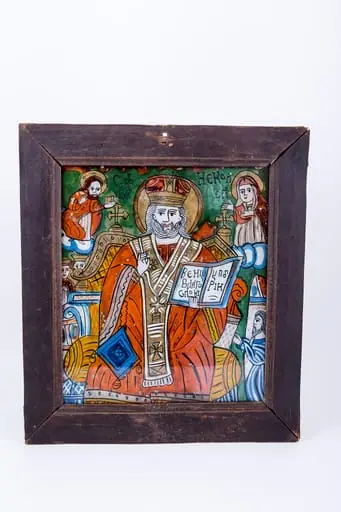 Sfântul Mare Ierarh Nicolae Făcătorul de minuni este redat central, fiind așezat pe un tron arhieresc, ținând în mâna stângă Sfânta Evanghelie deschisă și binecuvântează cu mâna dreaptă. Veșmintele arhierești liturgice ale sfântului ierarh sunt într-o alternanță cromatică de orange-albastru regal-brun-bronziu și alb și negru. Epitrahilul, patrafirul este brun-bronziu, cu patru cruci pe el, sacosul orange-roșu vermillon. Poartă mithră și are aureolă. În registrul superior îndepărtat sunt Dumnezeu-Tatăl și Maica Domnului, care binecuvântează și ocrotesc întreaga narațiune iconografică. Pe fondul verde, Mântuitorul și Maica Domnului au veșminte brune-crem și roșu-vermillon-orange. În registrul inferior sunt cele trei fete salvate de la sărăcie și păcat și tatăl fetelor mulțumind, în genunchi, pentru ajutorul primit. Inscripția din româno-chirilică se traduce Sf Nicolae ICXC MP Iisus Hristos Maica Domnului. Icoana are o cromatică puternic-vie, specifică Țării Oltului: roșu vermillon-orange, verde spanac-avocado, albastru regal, brun, gri,bronziu, alb, negru.
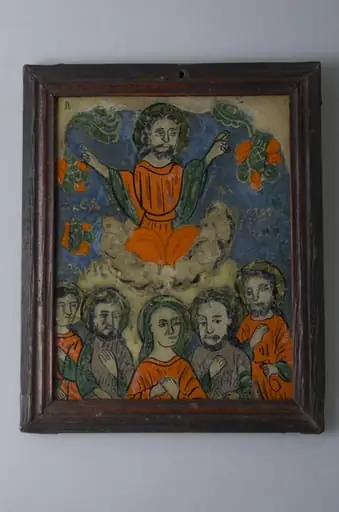 În registrul superior central, este reprezentat Iisus cu brațele larg deschise și binecuvântând, plutind pe norii slavei. În registrul inferior este redată central Fecioara Maria încadrată de grupul apostolilor, în dreapta ei Sfântul Petru cu cheia în mână, alături de un alt sfânt apostol, în stânga ei sfinții Pavel și Ioan. În registrul superior, de o parte și de cealaltă a lui Iisus este redat pe fundalul albastru elemente florale. Icoana are o ramă din lemn de brad cu elemente profilate pe latura interioară, grunduită. Cromatică: albastru; roșu pal; verde; oliv; negru și foiță de aur.
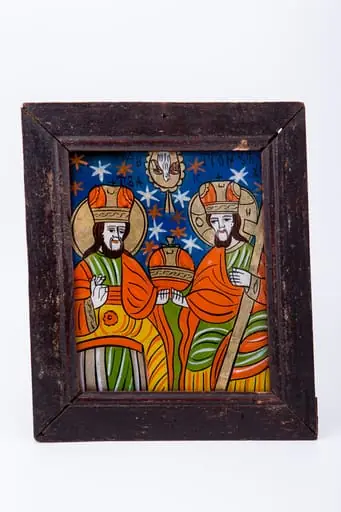 Sfânta Treime prezentă în această icoană este inedită pentru că Dumnezeu-Tatăl și Dumnezeu-Fiul sunt foarte asemănători. Fiul după Chiul și Asemănarea! Sunt înveșmântați în roșu vermillon, galben și verde. Dumnezeu-Fiul are mantia roșie peste umăr - omofor și ține Crucea Răstignirii în mână. Dumnezeu-Tatăl și Dumnezeu-Fiul susțin împreună sfera globului pământesc cu mâinile. În registrul superior, deasupra, este Sfântul Duh care se Pogoară sub forma unui porumbel alb, prin Cerurile deschise, pe un mănunchi de stele bronzii. Fondul este cerul albastru ceruleum cu elemente astrale: stele roșii și albe. Cromatica este armonioasă, luminoasă și puternic-vie, speifică Țării Oltului: roșu vermillon, verde, ocru, galben chihlimbar, albastru ceruleum, roșu stacojiu, alb, negru. Inscripția din româno-chirilică se traduce Sfânta Treime Dumnezeu Tatăl.
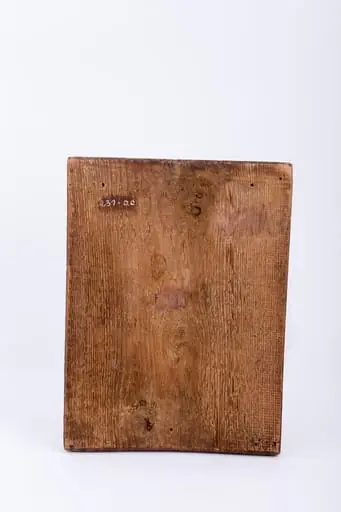 Sfânta Mare Cuvioasă Parascheva de la Iași are crucea și ramura de finic în mâna dreaptă. Este îmbrăcată în veșmânt roșu vermillon, cu interiorul căptușit cu negru și griuri. Peste maforionul roșu, sfânta cuvioasă are aureolă. Fondul icoanei este cerul întunecat. Este o icoană cu aer cald, tomnatic, de octombrie 14, Praznicul Sfintei Cuvioase Parascheva. Inscripția din româno-chirilică, de pe fondul întunecat al icoanei, se traduce Sfânta Parascheva. Are mâna stângă deschisă înspre privirea noastră, transmițând energia harică, mâna fiind în legătură cu ramura de finic, în formă de flacără. Icoana este foarte frumos realizată artistic și estetic, finețea nuanțelor cromatice și expresivitatea sfintei cuvioase remarcându-se într-un mod deosebit. Cromatica: roșu vermillon, brun-cafeniu, negru, ocru, gri, alb. Întreaga compoziție iconografică este încadrată de o ramă roșie-vermillon, portocalie, reliefată din aceeași bucată de lemn.
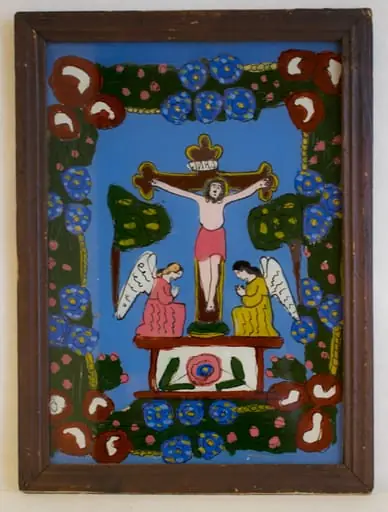 Icoana redă tema Răstignirii combinată cu Plângerea de influență apuseană, catolică. Desenul este executat probabil fără tipar, cu un instrument de scris cu cerneala sau tuș. Isus răstignit pe cruce plasată deasupra pietrei mormântului, plâns de doi îngeri cu profiluri diforme, este încadat de un chenar greoi compus din ramuri groase și elemente florale divers colorate(roz, roșu, albastru, galben). De o parte și de alta a lui Isus doi copaci cu coroane globulare, diforme..Desenul este foarte naiv. Isus are ochii deschiși, părul este bogat, mânile și picioarele diforme.Aureola se "scurge" pe lângă capul lui Isus. În jurul mijlocului veșmânt roz. Crucea treflată, pictată cu brun, chenar ocru galben și inscripția INRI pe fond alb. Îngerii au părul ondulat,(unul blond, unul brunet) sunt înveșmântați în roz și galben, veșminte de inspirație catolică.. Mormântul decorat cu o floare roz. Câmul icoanei bleu închis. Pe spate a avut lipită o hârtie mai groasă care servea drept dos. Rama este profilată, lăcuită, de culoare cafeniu închis.
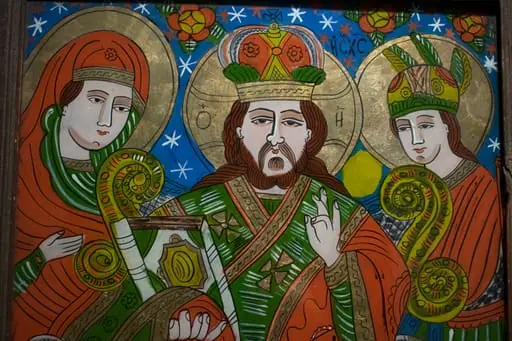 Icoacrip
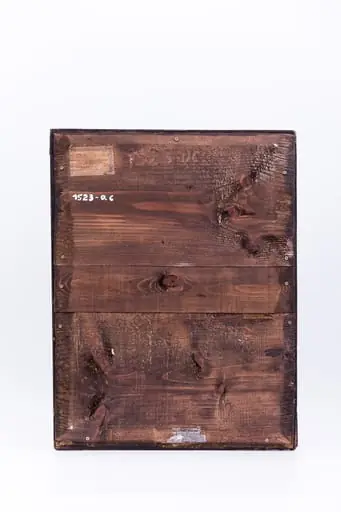 Icoana este deosebită, prin tematica iconografică abordată: Încoronarea Maicii Domnului. În centrul icoanei este Maica Domnului Împărăteasă, pe tron arhieresc, cu Pruncul iisus Hristos în brațe. Maica Domnului este îmbrăcată în veșmânt albastru bleumarin, iar Pruncul Iisus Hristos este înveșmântat cu alb-albastru. Pruncul Iisus ține în mână globul pământesc. În dreapta Maicii Domnului este Sfântul Mare Ierarh Nicolae făcător de minuni, îmbrăcat în veșminte arhirești, cu mantie roșie vermillon, mithră, cârjă mitropolitană. În stânga Maicii Domnului este Sfântul Mare Prooroc Ioan Botezătorul și Înaintemergătorul Domnului Iisus Hristos. Sfântul Ioan Botezătorul are și culoarea verde în combinația cromatică a veșmântului. Verdele este culoarea Sfântului Ioan. În registrul superior, sunt Sfinții Arhangheli Mihail și Gavriil, așezând coroana de Împărăteasă a Cerurilor pe capul Maicii Domnului. Aripile Sfinților Îngeri sunt galbene. Se remarcă mandorle de nouri albi-gri, în registrul superior. În registrul inferior, este un postament cărămiziu. Cromatica este armonioasă: roșu vermillon, orange, cărămiziu, galben chihlimbar, albastru ceruleum, cobalt, bleu-ciel, alb, negru, verde de China. Inscripția din româno-chirilică se traduce: IC XC MP Iisus Hristos Maica Domnului Sfântul Nicolae Sf Ioan Botezătorul Pocăiți-vă. Icoana este de Valea Sebeșului.
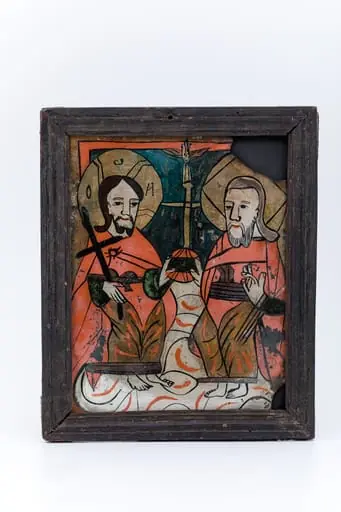 Icoana reprezintă Sfânta Treime. Dumnezeu-Tatăl și Dumnezeu-Fiul susțin împreună globul pământesc cu o cruce mare deasupra, apărând ca un sfânt chivot, ca pe o Biserică țin Pământul. Dumnezeu-Fiul, fiind alături, ține Crucea pe umărul drept. Dumnezeu-Tatăl are aureola în formă de triunghi echilateral, simbolizând Sfânta Treime. Dumnezeu-Tatăl și Dumnezeu-Fiul sunt îmbrăcați în veșminte în combinație de roz-corai, brun-bronziu, negru. Sfântul Duh se pogoară prin deschiderea Cerurilor. Fondul icoanei este cerul albastru ultramarin, cu influențe ușoare de indigo. În registrul inferior sunt nori albi, cu striații corai. Cromatica este armonioasă: roz-corai, albastru ultramarin bleu-marin, alb, gri-antracit, brun-bronziu, kaki, ocru-muștar, alb, negru. Alăturarea cromatică: roz corai, albastru ultramarin și brun-bronziu este excepțională. Inscripția din româno-chirilică se traduce Sfânta Treime. Icoana este din Nordul Transilvaniei, Nicula.
 Icoana îl reprezintă pe sfântul Gheorghe omorînd balaurul, într-o reprezentare caracteristică picturii târzii de la Nicula. Sfântul, călare pe calul alb,este plasat în centrul icoanei, tiparul fiind aproximativ același ca cel utilizat în perioada de înflorire a picturii pe sticlă la Nicula. Veșmintele sunt asemănătoare celor ale soldaților chezaro-crăiești, cizme înalte cu pinteni, tunică scurtă și largă, roșie, pantaloni bufanți, albaștri.Capul este descoperit,părul lung, negru, lăsat pe umeri.Chipul are trăsături butucănoase, nasul lung, gura mică, ochii negri, cu umbre gri. Nimb realizat cu bronz auriu. . În mână ține o suliță lungă terminată cu o cruce, cu care omoară balaurul, diform, verde, simbolizând zonele inferioare, ale păcatului, minimalizat ca dimensiuni pentru a accentua puterea binelui. Calul diform, are picioarele din față ridicate, coama și coada negre, șaua împodobită. Scena este încadrată de o ghirlandă de flori (ruje) Câmpul este policrom: alburiu între flori și ramă, roșu între chenarul de flori și umerii sfântului, și sub picioarele calului și ocru în rest. Icoana are caracteristicile specifice picturi târzii de la Nicula: câmpul policolor, culori discordante, abundența detaliului, decor floral abundent, sticla de proveniență industrială, folosirea bronzului în locul foiței de aur. Rama profilată, îmbinată oblic la colțuri, este vopsită cu cafeniu. Stinghia verticală din dreapta lipsește. Pe spate are un dos tot din lemn. Sfântul Gheorghe era considerat sfântul cel mai mare peste turme, câmpuri și hergheliile de cai. Se mai considera că descuie primăvara și leagă iarna.
 Sfântul Arhanghel Mihail, alături de Sfântul Arhanghel Gavriil, este unul dintre mai-marii voievozi ai oștilor cerești. În această icoană, Sfântul Arhanghel Mihail, slujitorul Legii este reprezentat singur. Sfântul Mihail este îmbrăcat în haine de oștean militar, cavaler, vestă de zale, cu solzi aurii, cu tunică albastră cu ocru-bronziu și mantie roșie. Are în mâna dreaptă sabia dreptății, iar în mâna stângă ține Potirul și o balanță, cu care cântărește faptele bune și fărădelegile, mereu fiind un drept judecător, dorindu-se după modelul Marelui Judecător, Mihail egal, asemenea Lui Dumnezeu. Are aripile foarte mari de culoare brun-bronzie, aureolă, fiind foarte tânăr. Fondul icoanei este ocru luminos în registrul superior. Cromatica armonioasă și foarte luminoasă este alcătuită din: roșu vermillon-stacojiu, orange, galben, ocru, albastru cobalt, gri, auriu- bronziu. Inscripția din româno-chirilică se traduce Arhanghelul Mihail. Icoana este din Mărginimea Sibiului.
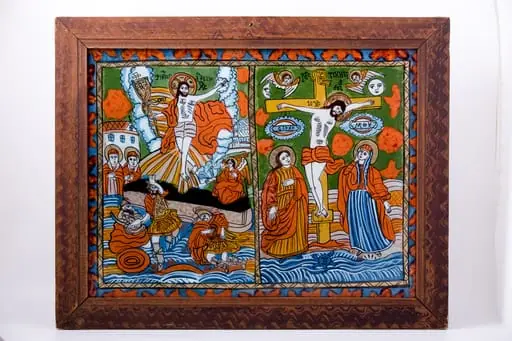 IcoaXC I
 Icoai es
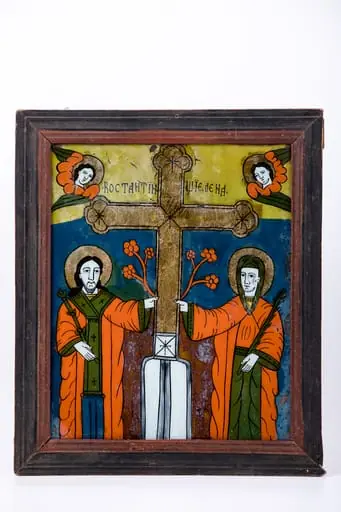 În centrul icoanei este Crucea albă la bază și bronzie în rest, cu capetele brațelor împodobite trilobat, iar în dreapta crucii este Sfântul Împărat Constantin, și în stânga este Împărăteasa Elena, mama sa. În spatele Crucii, sunt flori roșii agățătoare și unduitoare dintr-o grhirlandă de trandafiri. Crucea găsită este susținută cu bucurie de cei doi sfinți. Veșmintele Sfinților Constantin și Elena sunt într-o combinație de roșu vermillon și verde-iarbă de vară. Spațiul albastru-galben de lumină, din fondul icoanei, duce gândul la Crucea de lumină apărută pe cer In hoc signo vinces - prin acest semn vei învinge. Fondul icoanei este cerul albastru cobalt, lumina galbenă și o panglică albă, în josul crucii. În registrul superior, în colțurile stânga-dreapta sunt 2 îngeri serafimi. Cromatica este armonioasă, bogată și senină: roșu vermillon, galben-ocru, albastru cobalt, verde-iarbă de vară nuanță spanac-avocado, alb, negru. Icoana este de Nicula. Inscripția din româno-chirilică se traduce Constantin Elena.
 Icoamare
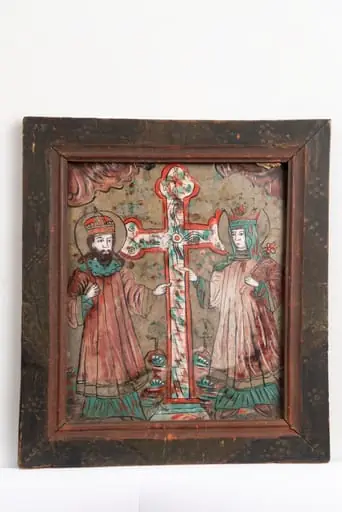 Icoana îi reprezintă pe Sfinții Împărați Constantin și Elena, pictați frontal, în picioare, ținând împreună în mână Crucea Răstignirii, ce domină central compoziția. Împărăteasa Elena ține în mâna stângă o ramură, îar împăratul Constantin are în mâna dreaptă un sceptru. Fondul icoanei e pictat integral doar în partea superioară unde apar în colțuri două ornamente din registrul vegetal, în rest e pictat cu laviuri colorate și decorat cu flori realizate din puncte, fiind vizibil fondul din hârtie argintată. Cromatica icoanei se compune din tonuri de roșu, alb, albastru, maro și gri. Rama icoanei e profilată, bicromă (latura interioară roșie, iar cea exterioară verde, decorată cu motive florale și geometrice) și e formată din îmbinarea a patru baghete de lemn. Sticla are un fragment lipsă, de mici dimensiuni, în partea stângă-sus.
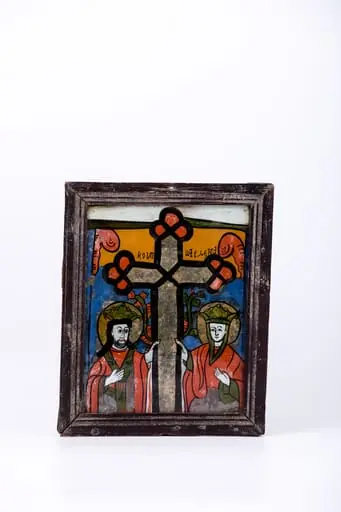 În centrul icoanei este Crucea gri-petrol, cu capetele brațelor împodobite roșu-trilobat, iar în dreapta crucii este Sfântul Împărat Constantin și în stânga este Împărăteasa Elena, mama sa. În spatele Crucii, este un vrej agățător și unduitor dintr-o grhirlandă de trandafiri, cu flori, spini și frunze și spațiul albastru regal unit cu cel galben-chihlimbar creează un izvor tainic de lumină. Crucea găsită este susținută cu bucurie de cei doi sfinți. Veșmintele Sfinților Constantin și Elena sunt într-o combinație de roșu vermillon și verde-iarbă de vară. Spațiul albastru-galben de lumină duce cu gândul la Crucea de lumină apărută pe cer In hoc signo vinces - prin acest semn vei învinge. Fondul icoanei este cerul albastru, lumina galbenă și o panglică alb-ivorie, în laterală superioară. Întreaga compoziție este încadrată armonios de un chenar decorativ geometrizant format din volute roșii. Cromatica este armonioasă, bogată și senină: roșu vermillon, galben-chihlimbar, albastru regal, verde-iarbă de vară, ivoriu, alb, negru. Icoana este de Nicula. Inscripția din româno-chirilică se traduce Constantin Elena.
 Mântuitorul Iisus Hristos, fiind răstignit pe Cruce, are în stânga pe Sfântul Împărat Constantin cel Mare, în locul uceniculuil cel iubit, care a stat lipit de pieptul Învățătorului, la Cina cea de Taină, mai precis, în locul Sfântului Apostol și Evanghelist Ioan Teologul, Evanghelistul Iubirii și în dreapta pe Sfânta Împărăteasă Elena, mama Sfântului Constantin, în locul Maicii Domnului Îndurerate, Jalnică și Plângătoare. Veșmintele Sfinților Împărați sunt sacosuri albastre cobalt și mantii roșii vermillon. Mântuitorul Iisus Hristos Răstignit pe Cruce are o țesătură verde-gri-antracit în jurul mijlocului și a coapselor. Fondul icoanei este cerul albastru bleu-ciel senin și în registrul inferior, în spatele Crucii este un spațiu galben-chihlimbar, prefigurând Lumina Învierii Domnului Iisus Hristos. Întreaga tematică iconografică este încadrată de un chenar decorativ fitomorf, format dintr-o ghirlandă de bujori și trandafiri, 4 ruje. Cromatica este armonioasă: roșu vermillon, albastru ceruleum, cobalt și bleu-ciel, gri antracit, verde forest, galben chihlimbar alb, negru. Inscripția din româno-chirilică se traduce Constantin cu Elena. Icoana este mai rară, datorită abordării tematicii iconografice. Icoana este din Nordul Transilvaniei, Nicula.
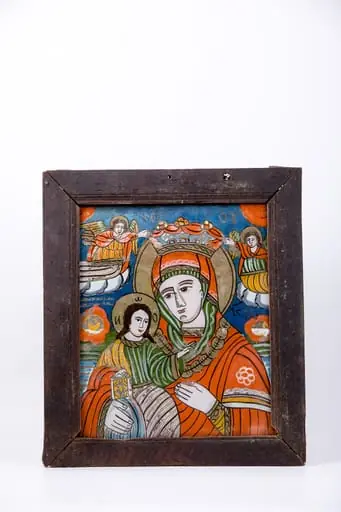 Maica Domnului Împărăteasă ține în brațe lipit pe umărul drept, pe Pruncul Iisus Hristos, care are în mâna dreaptă Sfânta Evanghelie închisă și cu mâna stângă arată înspre Maica Domnului. Maica Domnului arată calea cu mâna dreaptă, deci este Hodighitria. Maica Domnului este înveșmântată în mantie cu maforion roșu vermillon, cu interiorul verde și sacos cu mânecile galbene, poartă coroniță de împărăteasă și aureolă. Pruncul Iisus Hristos este înveșmântat în verde kaki și auriu ocru-brun-bronziu, cu coroană și aureolă. Maica Domnului poartă la gât o salbă din bănuți de aur. În registrul superior, de-a dreapta și de-a stânga Maicii Domnului, sunt Sfinții Arhangheli Mihail și Gavriil, pe câte o mandorlă de nouri rotunzi albi-crem, susținând dimpreună cu mâinile coroana de Împărăteasă a Maicii Domnului. Fondul icoanei este cerul de culoarea albastru regal. Cromatica este luminoasă, vie și armonioasă: roșu vermillon, alb, albastru regal și bleu-ciel, verde-văratic și spanac-avocado, kaki, auriu, ocru-brun-bronziu, galben-chihlimbar, negru. Inscripția din româno-chirilică se traduce MP IC XC Maica Domnului Iisus Hristos. Icoana este de Șcheii Brașovului, Țara Oltului.
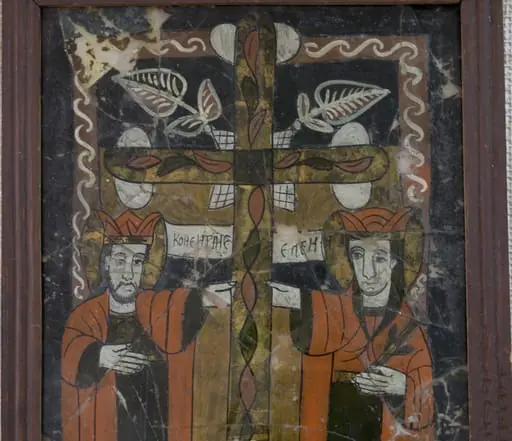 Pictură în oglindă, pe spatele unei bucăți de glajă, ax vertical.Sfinții Împărați Constantin și Elena, 3/4 , în picioare, semiprofil, sub brațele crucii pe care a fost răstignit Isus( găsită de Împărăteasa Elena la Ierusalim) Amândoi au plete castanii, lăsate pe umeri, coroane înalte, veșminte identice, simple, lungi, cămăși verzi și mantii roșii. Plasarea personajelor sub brațele crucii, în jumătatea inferioară, pe fond ocru sugerează complementaritatea celor două planuri(terestru și ceresc). Împărăteasa ține în mână o ramură verde, element ce o însoțește în majoritatea reprezentărilor populare. Fețele sunt ușor diforme, ochii negri. Crucea dreaptă, plasată în centrul compoziției, decorată cu frunze și o spirală în partea de jos, creează simetrie. La întretăierea brațelor crucii elemente vegetale cu contur alb. Chenarul specific icoanelor de Nicula, linia albă(zăluțe, funie) pe fond roșcat. Icoana este caracteristică perioadei de înflorire a picturi pe sticlă de la Nicula. Rama profilată, din lemn de brad, pictată cu o culoare roșcată. Dosul subțire. Sticla spartă în mai multe fragmente.
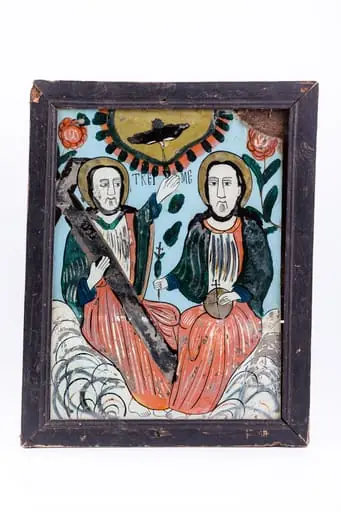 Icoana reprezintă Sfânta Treime. Dumnezeu-Tatăl are globul pământesc, pe genunchi și în mâna dreaptă are o cruce de mână. Dumnezeu-Fiul este alături, ține Crucea pe umărul drept și cu mâna stângă arată înspre Sfântul Duh, Pogorându-se ca un porumbel, astfel reunindu-Se Sfânta Treime. Dumnezeu-Tatăl și Dumnezeu-Fiul sunt îmbrăcați în veșminte în combinație de albastru cobalt, gri cenușiu-antracit și roșu vermillon. Se remarcă desenul fin al broderiei mânecii Tatălui Ceresc. Sfântul Duh se pogoară din miezul galben-solar, deschiderea Cerurilor, cu raze de lumină. Inscripția din româno-chirilică se traduce Treime. În registrul superior, fondul icoanei este cerul albastru bleu-ciel senin, cu câte o rujă - trandafir roșu - în colțurile din stânga și dreapta. În miezul rujelor este semnul zăluței albe, șerpuitoare. În registrul inferior sunt câmpuri de nouri albi-gri, mandorle peste mandorle. Cromatica este luminoasă și armonioasă: roșu vermillon, albastru bleu-ciel, albastru cobalt, alb, gri-antracit, ocru-muștar, alb, negru. Icoana este de Nicula.
 Icoana cu tematica iconografică Botezul Domnului Iisus Hristos este realizată pe trei registre: în registrul central, Domnul Iisus Hristos primește Botezul, în râul Iordanului, din partea Sfântului Mare Prooroc și Înaintemergător Ioan Botezătorul, care se află în stânga Mântuitorului. Mântuitorul este înfășurat cu o pânză de culoare roșie vermillon împrejurul șoldurilor și a coapselor, și are mâinile împreunate pe piept, în semn de supunere, ascultare, smerenie, de bună-voie venind la Botez. În dreapta Lui, este un înger evlavios, cu aripile galbene-aurii de lumină, care Îl așteaptă pe mandorlă de nouri albi-albaștri bleu-ciel, cu un ștergar transparent gata să înveșmânteze Trupul Domnului. Sfântul Ioan Botezătorul este îmbrăcat cu o mantie roșie și un himation alb-albastru sau o haină din păr. Cerurile de culoare albastru sunt deschise și din mijlocul unei mandorle de nouri alb-albaștri se pogoară porumbelul, simbolul Sfântului Duh, pe creștetul Mântuitorului. Cromatica este specifică Țării Oltului: roșu vermillon, albastru cobalt-ceruleum, galben chihlimbar și solar, verde-văratic, brun, crem, rozaliu, alb, negru. Cerul albastru-cobalt și văzduhul verde-văratic sunt bogat ornamentate cu elemente florale - ruje roșii, cu frunze albastre. Întreaga icoană este încadrată pe laterale de chenar decorativ geometrizant bronziu, cu ruje roșii și frunze albastre. Inscripția din româno-chirilică se traduce Botezul Lui IC XC Iisus Hristos. Icoana este de Țara Oltului.
 Sunt reprezentați Sfinții Împărați Constantin și Elena(1/1), susținând crucea pe care a fost răstignit Isus, cruce găsită de Împărăteasa Elena la Ierusalim. Crucea, dreaptă, aurită, simplă. Cei doi sfinți, sf. Elena din stânga și sf Constantin din dreapta, plasați sub brațele crucii, o susțin cu câte un braț. Sunt reprezentați cu veșminte împărătești, coroane pe cap, deschise, aurite, la fel cu nimbul delimitat cu alb. Împăratul Constantin are în mâna stângă un sceptru iar împărăteasa o ramură . Amândoi redați tineri, Împăratul cu păr și barba castanii, scurte. Înveșmântați cu tunici cu poale lungi, brodate cu motive fitomorfe, cu galoane late, aurite, delimitate de șiraguri perlate. Fond aurit, inscripția de culoare albă în partea de sus. Proporțiile sunt respectate, fețele expresive, detaliile lucrate minuțios, ceea ce indică un zugrav experimentat și școlit.
 Icoaori
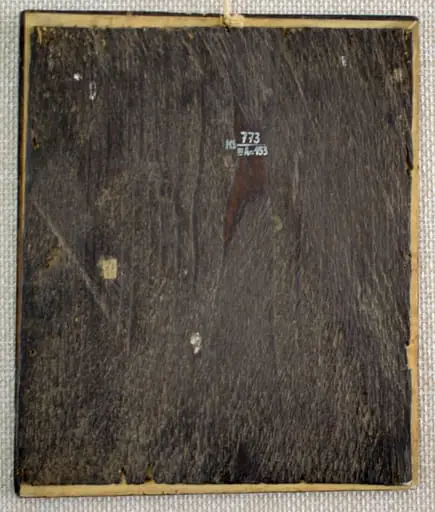 Icoana este pictată "în oglindă", pe un suport de sticlă de formă dreptunghiulară în ax vertical. Cuvioasa Parascheva, 3/4, redată din ușor semiprofil, ține în mâna dreaptă o ramura verde, sinuoasă, în stânga o cruce. Fața butucănoasă, ochii căprui, sprâncenele arcuite, gura marcată cu roșu, bărbia pătrată, părul castaniu, lung, revărsat pe umeri. Pe cap poartă o tocă înaltă tripartită. Este înveșmîntată cu o mantie roșie și cămașă albastră. În jurul capului, aureolă realizată cu bronz auriu. Câmp bicolor(1/2 superior -bleu, 1/2 inferior ocru) două ramuri de trandafiri dispuși pe laturile verticale, întâlnindu-se deasupra capului sfintei. Desenul stângaci, dar destul de îngrijit, corola de flori, predominanța culorii roșii, abundența detaliului, fondul bicolor, utilizarea bronzului auriu, sunt caracteristici ale fazei târzie a picturii din centrele Nicula și Gherla. Rama subțire din lemn de brad, de culoare închisă, este completată cu un "dos" nou din scândură de brad.. Țăranii considerau că sfânta Parascheva păzește de grindină și de dureri de cap.
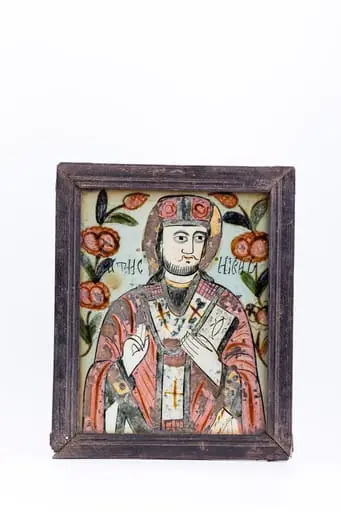 Sfântul Mare Ierarh Nicolae Făcătorul de minuni ține în mâna stângă Sfânta Evanghelie închisă și binecuvântează cu mâna dreaptă. Veșmintele arhierești liturgice ale sfântului ierarh sunt într-o alternanță cromatică de roșu vermillon, verde, ocru și gri-cenușiu antracit, cu broderie galbenă pe margini. Epitrahilul-patrafirul este gri-alburiu cu marginile verzi și trei cruci galben-aurii. Fondul icoanei este albastru bleu-ciel foarte senin. Întreaga compoziție este încadrată în spațiul cerului senin de o ghirlandă de ruje - elemente decorative fitomorfe, 6 trandafiri roșii, cu bobocei și frunze verzi. Icoana este de Nicula, Nordul Transilvaniei. Cromatica este armonioasă, specifică centrului de la Nicula: roșu vermillon, albastru bleu-ciel, galben-ocru-muștar, verde de China, alb, brun, negru, gri. Inscripția din româno-chirilică se traduce Sfântul Nicolae.
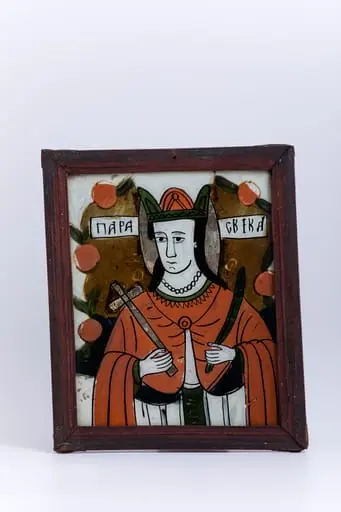 Sfânta Mare Cuvioasă Parascheva de la Iași are crucea bronzie în mâna dreaptă, binecuvântând, și o ramură de finic verde, în mâna stângă. Este îmbrăcată în veșmânt roșu vermillon-corai cu interiorul căptușit cu verde-mușchi de pădure-kaki. Sacosul este cu danteluță, guleraș și dungi, cu fibulă. Sfânta Cuvioasă are părul negru lung, lăsat pe umeri, coroană roșie cu verde-brad și aureolă bronzie-argintie și poartă lănțișor la gât. Fondul icoanei este cerul albastru ultramarin în registrul mijloc și inferior și un câmp auriu în registrul superior și un chenar neregulat, alb-zinc, ancadrator întregii compoziții. Întreaga compoziție iconografică este încadrată de un chenar decorativ fitomorf, format dintr-o ghirlandă de 5 ruje rotunde corai, asemenea unor boboci de merișori, cu frunze verzi. Inscripția din româno-chirilică se traduce Parascheva. Cromatica este armonioasă: roșu vermillon-cărămiziu, corai, albastru ultramarin-bleumarin, verde alge, mușchi de pădure, bej-crem, bronziu-argintiu, negru, alb zinc. Icoana este din Nordul Transilvaniei, Nicula.
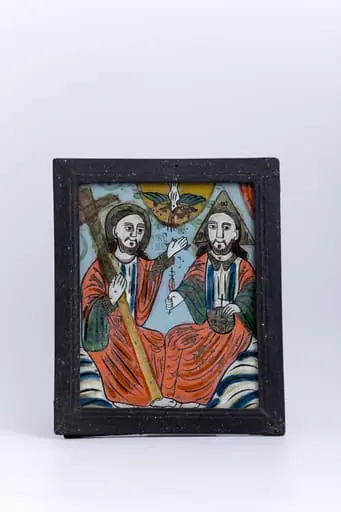 Icoana reprezintă Sfânta Treime. Dumnezeu-Tatăl are globul pământesc albastru pe genunchi și arătă către Fiul Iisus Hristos Binecuvântând lumea. Dumnezeu-Fiul are Crucea galbenă-aurie pe umărul drept și arătă către Dumnezeu-Tatăl. Dumnezeu-Tatăl și Dumnezeu-Fiul sunt înveșmântați în roșu vermillon și verde smarald cu albastru cobalt. Deasupra, în registrul superior este un soare galben, din care pe un mănunchi de raze luminoase, se pogoară Sfântul Duh, sub forma porumbelului alb. Astfel este prezentă întreaga Sfântă Treime. Între Dumnezeu-Tatăl și Fiul este un spațiu luminos de galben. Fondul icoanei este cerul albastru cobalt-regal, înconjurat de lumina galbenă-solară. Cromatica este luminoasă și armonioasă: roșu vermillon, albastru regal și cobalt, galben chihlimbar, verde smarald, gri, alb, negru.Inscripția din româno-chirilică se traduce Treime. Icoana este din Nordul Transilvaniei, Nicula.
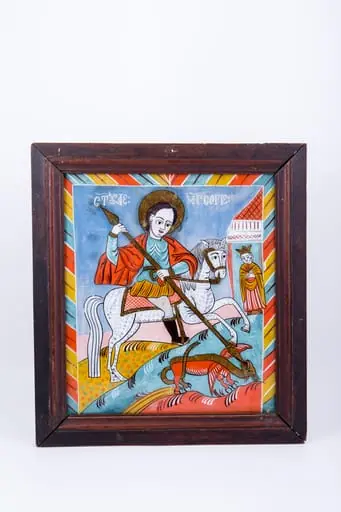 Sfântul Mare Mucenic Gheorghe este așezat călare pe un cal alb cu pete albastre gri, omorând balaurul roșu-bronziu cu creastă, solzi și coadă lungă, cu lancea, pe care o ține cu amândouă mâinile, înfingându-i-o animalului în gâtlej. În partea stângă a Sfântului Gheorghe, în registrul îndepărtat, este pictată domnița salvată și ocrotită de marele mucenic, cu mâinile mulțumindu-i cu sfială și recunoștință sfântului purtător de biruință. Fondul este albastru. În registrul inferior, fondul este verde, cu linii ondulatorii albe, cele două registre în centrul icoanei ușor întrepătrundu-se. Mantia Sfântului Mucenic Purtător de Biruință este roșie, având cămașa de cavaler cu zale. Culoarea roșie este caracteristică mucenicilor și martirilor. Chenarul decorativ geometrizant cu tușe-benzi paralele, oblice, alternative roșii, albastre și ocru încadrează armonios întreaga tematică iconografică. Cromatica este armonioasă; roșu vermillon, roz, albastru-gri, ocru, verde, bronziu, alb și negru. Inscripția din româno-chirilică se traduce Sfântul Gheorghe. Icoana este rafinată prin acuratețea desenului, compoziția echilibrată și armonia cromatică.
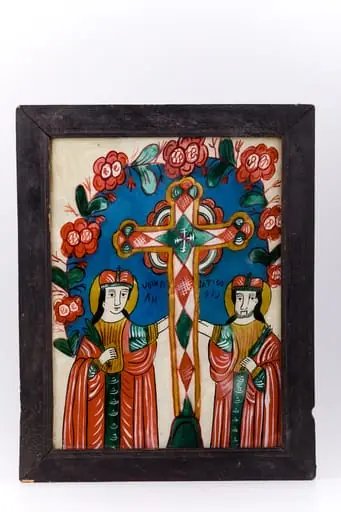 În centrul icoanei este Crucea, iar în dreapta crucii este Sfânta Împărăteasă Elena, și în stânga este Împăratul Constantin. Veșmintele sfinților împărați sunt pictate cu roșu vermillon și ocru-muștar și mânecile și epitrahile-patrafire vernil-gri. Poartă coroane împărătești și aureole de sfinți, mantiiile de împărați le au prinse la gât cu fibulă. Crucea este alb-crem cu elemente decorative geometrizante romboidale roșii-verzi și are capetele brațelor cu elemente decorative trilobate roșii vermillon-vernil. Fondul este cerul albastru ceruleum-regal foarte senin. Împrejurul Crucii este un spațiu luminos de alb-ivoriu Întreaga compoziție iconografică este încadrată de un chenar decorativ geometrizant alb-luminos și un chenar fitomorf, format dintr-o ghirlandă de 7 ruje - trandafiri și bujori roșii vermillon și 2 boboci de măceș - cu frunze gri-verzui. Cromatica este armonioasă: roșu vermillon-stacojiu-rose, albastru cobalt-regal, ocru-muștar, bronziu, brun, galben-chihlimbar, verde brad, vernil-gri, alb, negru. Inscripția în româno-chirilică se traduce Constantin și Elena. Icoana este din Nordul Transilvaniei, Nicula.
 Sfânta Mare Cuvioasă Parascheva de la Iași are crucea aurie-bronzie în mâna dreaptă și ramură de finic verde brad în mâna dreaptă. Este îmbrăcată în veșmânt roșu vermillon, cu interiorul căptușit cu gri antracit, alb ivoriu și galben-solar. Sacosul este alb ivoriu crem-bej, cu danteluță și guleraș galben. Sfânta Cuvioasă are părul negru lung, lăsat pe umeri, coroană roșie și aureolă. Fondul icoanei este cerul albastru bleu-ciel-alburiu senin, în registrul superior și un câmp înalt luminos de grâu galben-copt, în registrul mediu și inferior. Întreaga compoziție iconografică este încadrată de un chenar decorativ fitomorf, format dintr-o ghirlandă de 2 ruje - trandafiri roșii și bujori roșii. Inscripția din româno-chirilică se traduce Paraschiva. Cromatica este armonioasă: roșu vermillon, albastru bleu-ciel, verde forest, bej-crem, galben chihlimbar, ocru, muștar, negru, alb. Icoana este din Nordul Transilvaniei, Nicula.
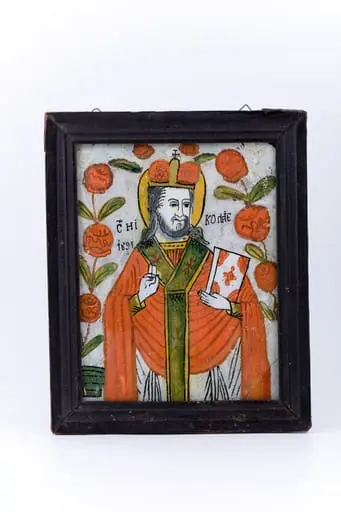 Sfântul Mare Ierarh Nicolae, făcător de minuni, îmbrăcat în veșminte liturgice, de ierarh, sacos alb cu dungi subțiri negre și epitrahil-patrafir verde văratic, cu marginea galbenă și cu trei cruci roșii-acajou. Ține în mâna stângă Sfânta Evanghelie închisă și cu mâna dreaptă Binecuvintează. Este unul dintre cei mai populari și iubiți sfinți, ocrotitor al caselor, familiilor și copiilor. Are barbă sură, părul lung și mithră arhierească bej-brună și aureolă. Fondul icoanei este cerul bleu-ciel senin alburiu, încadrat de un chenar decorativ fitomorf, format dintr-o ghirlandă de 8 ruje roșii-orange. Întreaga tematică iconografică este încadrată de un chenar decorativ geometrizant alb. Inscripția din româno-chirilică se traduce Sf Nicolae. Icoana este datată 1891. Cromatica este armonioasă: roșu-vermillon-orange, albastru bleu-ciel-alburiu, galben-chihlimbar, crem, bej, crem, bronziu, alb zinc, negru. Icoana este din Nordul Transilvaniei, Nicula.
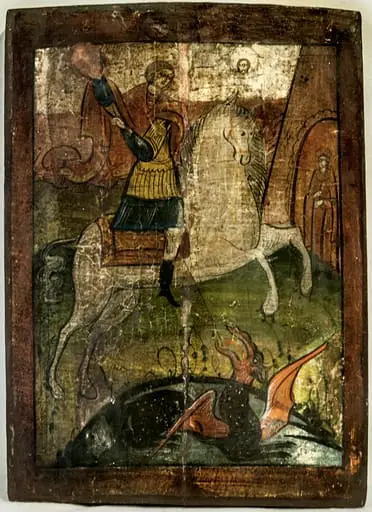 Tema iconografică este "Sfântul Gheorghe omorând balaurul". În prim plan, Sf. Gheorghe, în veșminte ostășești, călare pe un cal alb, cambrat, ridicat în două picioare, omoară balaurul plasat în registrul inferior. Veșmintele sfântului au o tentă țărănească(tunica albastră acoperită 3/4 de lorica argintie, pantaloni albi, cu motiv floral, cizme înalte. Calul are ambii ochi vizibili, coama bogată, coada în fuior. Partea dinspre privitor a ansamblului cal cu călăreț este supradimensionată, creând o impresie optică de înălțare a sfântului. În partea dreaptă, fata de împărat pe care o salvează sfântul, sub portalul palatului. privind scena. Veșminte lungi, simple, coroană împărătească. Înveșmântată în haine simple, lungi, cu coroană pe cap, privește scena cu brațele la piept. În colțul din stânga dreapta sus, Iisus Hristos așa cum apare pe sfântul Keramion. Nimbul cruciger. Balaurul plasat în registrul inferior asemănător unui grifon, corp diform, terminat cu o coadă în săgeată, aripile și capul roșii. Motiv mai elaborat decât în alte icoane unde redarea balaurului este minimizată. Compoziția este dinamică, chipurile expresive, gesturile bine realizate. Linia desenului variază, contribuind la efectul optic. Fondul foiței argintii(superior), relief din benzi late în tonuri de brun, brun roșcat, galben, alb, verde, cu elemente de vegetație. Bordura roșiatică lată, specifică icoanelor de tip krashnuska. Inscripție pe chenar, în partea superioară.
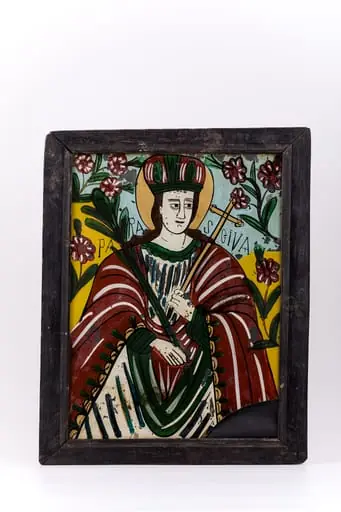 Sfânta Mare Cuvioasă Parascheva de la Iași are crucea brun-bronzie în mâna stângă și o ramură de finic verde în mâna dreaptă. Este îmbrăcată în veșmânt roșu vișiniu-stacojiu, cu interiorul căptușit cu verde-forest și franjuri brun-bronzii. Sacosul este alb-zinc cu danteluță, guleraș verde și dungi albastre. Sfânta Cuvioasă are părul negru lung, lăsat pe umeri, coroană roșie cu verde-brad și aureolă brun-bronzie. Fondul icoanei este cerul albastru bleu-ciel deschis, în registrul superior și un câmp galben-solar de grâu copt, în registrul inferior. Întreaga compoziție iconografică este încadrată de un chenar decorativ fitomorf, format dintr-o ghirlandă de 8 ruje vișinii, cu petale albe și frunze verzi. Inscripția din româno-chirilică se traduce Paraschiva. Cromatica este armonioasă: roșu vișiniu-stacojiu, albastru cobalt-ceruleum și bleu-ciel, verde forest, bej-crem, bronziu, galben-solar, negru, alb zinc. Icoana este din Nordul Transilvaniei, Nicula.
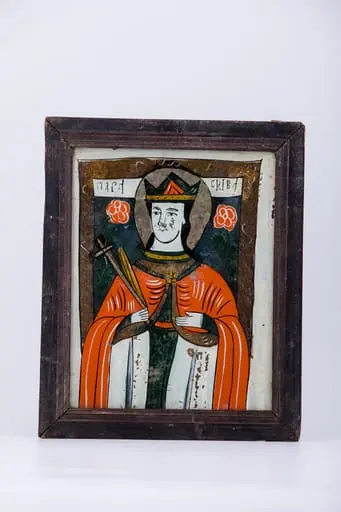
 Sfânta Paraschiva încoronată este reprezentată frontal, 3/4, Nimbul trasat cu roșu depășește linia chenarului și partea superioară a coroanei. Tehnica iluminării treptate cu elemente specifice: accentuarea zonei ochilor, tonurile de pământ ale umbrelor. Tunica decorată cu motive fitomorfe ample incizate în stratul de foiță. Mantie închisă în față, cu decor linar și bordură lată cu motive geometrice 3 șiruri de incizii în grund). Pe cap, umeri lăsat pe spate, un maforion de culoare deschisă. În mâna dreaptă, Sfânta ține o cruce mică, rusească, (6 brațe)în stânga un rotulus desfășurat cu inscripția scrisă în limba slavonă: Cred în unul Dumnezeu… alte inscripții: pe chenar de o parte și de alta a nimbului: Chipul Sf. Mucenițe Parascheva Vineri, în colțul stâng al icoanei ѾOН pe nimbul cruciger al lui Iisus, reprezentat ca pe sfântul Keramion. Cromatica: Chenar roșu cu două linii galbene și mărginit cu brun; fond - foița metalică decorată prin incizare, cu chenar multiplu din motive geometrice reteate. Tip Krashnuskha. Pe spate, un timbru al miliței RPR.
 Sfânta Mare Cuvioasă Parascheva de la Iași are crucea brun-bronzie și o ramură de finic galbenă în mâna dreaptă. Este îmbrăcată în veșmânt roșu vermillon, cu interiorul căptușit cu albastru-gri-antracit și brun-bronziu. Sacosul este alb-zinc cu danteluță și guleraș verde-galben. Sfânta Cuvioasă are părul negru lung, lăsat pe umeri, coroană roșie cu verde-brad și aureolă. Fondul icoanei este cerul albastru ultramarin bleu-marin întunecat. Întreaga compoziție iconografică este încadrată de un chenar decorativ geomatrizant brun-bronziu, cu linia șerpuitoare, specifică centrului de la Nicula. Fondul de ansamblu al icoanei este alb-zinc. Inscripția din româno-chirilică se traduce Paraschiva. Cromatica este armonioasă: roșu vermillon, albastru ultramarin bleumarin, verde forest, bej-crem, bronziu, negru, alb zinc. Icoana este din Nordul Transilvaniei, Nicula.
 Mântuitorul Iisus Hristos, fiind răstignit pe Cruce, are în stânga în locul ucenicului cel iubit, care a stat lipit de pieptul Învățătorului, la Cina cea de Taină, mai precis, în locul Sfântului Apostol și Evanghelist Ioan Teologul, Evanghelistul Iubirii și în dreapta în locul Maicii Domnului Îndurerate, Jalnice și Plângătoare câte o ramură înaltă de trandafiri, cu boboci și frunze. Mântuitorul Iisus Hristos Răstignit pe Cruce are o țesătură verde în jurul mijlocului și a coapselor. Crucea este brună. Fondul icoanei brun-negru întunecat, iar în spatele Crucii, este un spațiu galben-chihlimbar, prefigurând Lumina Învierii Domnului Iisus Hristos. Întreaga tematică iconografică este încadrată de un chenar decorativ geometrizant, alb-roșu vermillon-acajou. Cromatica este armonioasă: roșu vermillon-acajou, brun-maro, verde brad, galben chihlimbar, bronziu, alb, negru. Inscripția din româno-chirilică se traduce Restignirea Lui IC XC Iisus Hristos. Icoana este din Nordul Transilvaniei, Nicula.
 Sfânta Mare Cuvioasă Parascheva de la Iași are crucea cărămizie în mâna stângă, binecuvântând, și o ramură de finic verde, nuanța algelor în mâna dreaptă. Este îmbrăcată în veșmânt roșu vermillon-orange cu interiorul căptușit cu verde-smarald și franjuri brun-bronzii. Sacosul este alb-crem cu danteluță, guleraș și dungi albastre. Sfânta Cuvioasă are părul negru lung, lăsat pe umeri, coroană roșie cu verde-brad și aureolă brun-bronzie. Fondul icoanei este cerul albastru regal în registrul superior-mijloc și un câmp galben-chihlimbar, în registrul inferior. Întreaga compoziție iconografică este încadrată de un chenar decorativ fitomorf, format dintr-o ghirlandă de 4 ruje mari orange-cărămizii cu frunze verzi. Inscripția din româno-chirilică se traduce Paraschiva. Cromatica este armonioasă: roșu vermillon-orange, albastru cobalt-ceruleum, verde alge, mușchi de pădure, bej-crem, bronziu, galben-solar, negru, alb zinc. Icoana este din Nordul Transilvaniei, Nicula.
 Sfântul Mare Mucenic Gheorghe este așezat călare pe un cal alb-zinc, omorând balaurul negru-gri-antracit, cu coadă lungă de reptilă și solzi aurii, cu lancea, pe care o ține în amândouă mâinile. Fondul icoanei este cerul albastru bleu-ciel senin, în registrul superior și câmpuri ocru-aurii, cu dungi negre, în cel inferior, în centrul icoanei ușor întrepătrundu-se toate culorile. Mantia Sfântului Mucenic Purtător de Biruință este albastru-cobalt, având pantaloni albaștri, cizme negre și cămașă-tunică de cavaler roșie vermillon. Coiful de ostaș este roșu vermillon și aureola aurie. Icoana este încadrată de un chenar decorativ fitomorf, format dintr-o ghirlandă înflorită de flori de măr și măceș, 8 ruje roșii, cu frunze galbene și verzi. Ziua de praznic a Sfântului Gheorghe este în 23 aprilie, primăvara, justificându-se pentru încă o dată prezența ghirlandei înflorie. Cromatica este armonioasă; roșu vermillon, albastru bleu-ciel și cobalt, verde smarald și brad forest, galben-ocru, brun, crem, auriu, alb și negru. Inscripția din româno-chirilică se traduce Sfântul Gheorghe. Icoana este din Nordul Transilvaniei, Nicula.
 Intru co
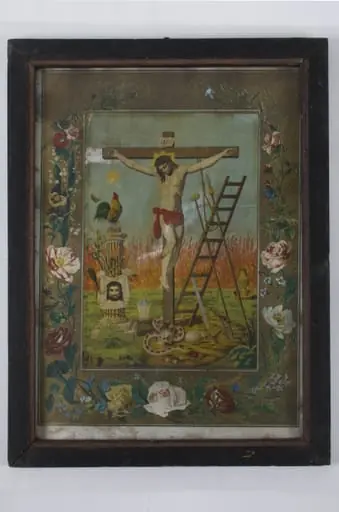 Icoană pe carton, conținând o imagine centrală și un chenar dreptunghiular. Chenarul are fondul auriu și are pictat motive vegetale și florale. Scena din interior reprezintă o abordare originală a Răstignirii. Fondul este de culoare verde-gri (culoarea oului de rață). În partea de jos este iarbă de culoare verde deschis, nuanță caldă, iar între cele două nuanțe de verde este dispusă pe toată lungimea imaginii centrale o perdea de flăcări. În centrul imaginii este Iisus răstignit pe cruce, picioarele sunt bătute cu un singur cui, ceea ce indică faptul că este o icoană romano-catolică sau greco-catolică. La stânga, la dreapta și sub cruce sunt toate simbolurile patimilor și ale răstignirii. Sub cruce este craniul lui Adam, un șarpe, la botul căruia este "fructul oprit", de culoare roșie în pictură. La stânga crucii este un stâlp cu două postamente pătrate succesive, pe stâlp este un cocoș. De stâlp sunt legate cu o sfoară obiecte referitoare la Patimile lui Iisus: trestia cu care a fost batjocorit, o făclie, un bici și marama Sf. Veronica cu chipul Mântuitorului. Între stâlpi și cruce este un felinar. La dreapta crucii este o scară de care sunt sprijinite
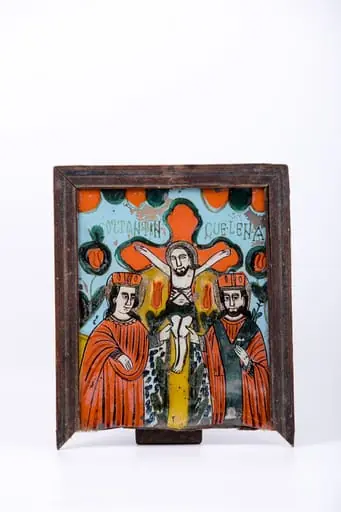 În centrul icoanei este Crucea roșie-galbenă, pe care este Răstignit Mântuitorul Iisus Hristos, iar în stânga crucii este Sfântul Împărat Constantin, și în dreapta este Împărăteasa Elena, mama sa. Deasupra fiecăruia este inscripționat numele, inversat. În spatele Crucii este un spațiu galben izvorâtor de lumină și două elemente florale, asemenea unor martori - îngeri păzitori. Crucea găsită este susținută cu bucurie de cei doi sfinți. Veșmintele Sfinților Constantin și Elena sunt într-o combinație de roșu vermillon și gri antracit. Spațiul galben de lumină duce gândul la Crucea de lumină apărută pe cer In hoc signo vinces - prin acest semn vei învinge. Icoana este bogat ornamentată de culoare, lumină și detalii semnificative, elemente decorative geometrizante. Fondul icoanei este cerul senin, albastru bleu-ciel deschis. Întreaga compoziție este încadrată armonios de un chenar decorativ geometrizant roșu stacojiu și fitomorf, format din rujele de Nicula. Cromatica este armonioasă și senină: roșu vermillon, galben-chihlimbar, albastru bleu-ciel, gri antracit, alb, negru. Icoana este de Nicula. Inscripția din româno-chirilică se traduce Constantin Elena. De menționat este că în icoană apare Mântuitorul Iisus Hristos Răstignit pe Crucea, susținută de Sfinții Constantin și Elena. Icoana este deteriorată, lipsindu-i partea inferioară a ramei.
 Sfântul Mare Mucenic Dimitrie, martir creștin din cetatea Tesalonic, sfânt militar din secolul al III-lea, este reprezentat în veșminte de cavaler, cu tunică-hiton, sacos galben-ocru și mantie roșie vermillon. Sfântul Dimitrie are mantie roșie vermillon-cărămizie și ține în mâna stângă crucea și în mâna dreaptă spada dreptății. Fondul icoanei este alb-zinc, pe margini, și galben-solar, în interiorul icoanei, cu un chenar decorativ fitomorf, format dintr-o ghirlandă din 5 ruje roșii vermillon. Cromatica este armonioasă: roșu vermillon-cărămiziu, verde-brad, galben-solar, ocru, brun, alb zinc, negru. Inscripția din româno-chirilică se traduce Dimitrie. Icoana este din Nordul Transilvaniei, Nicula.
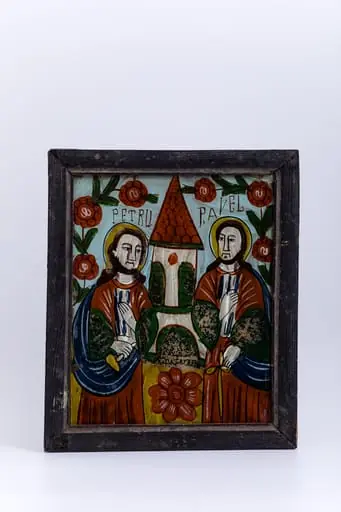 Icoana îi reprezintă pe cei doi Apostoli Sfinții Petru și Pavel, Petru cu cheile Împărăției Cerești în mână și pe Pavel cu sabia Cuvântului în mână, susținând împreună chivotul unei biserici, simbolul Bisericii sobornicești și apostolești. Biserica este situată în registrul îndepărtat, dar este redată în așa fel încât să fie înțeleasă ca și cum ar fi dusă pe umeri de Sfinții Apostoli. Au mantiile roșii vermillon, și veșmintele cu sacos-uri verzi și albastre cobalt. Fondul icoanei este cerul albastru bleu-ciel, în partea superioară, pe margini, și un câmp galben-chihlimbar, în spațiul de miez. În registrul inferior, fondul este un rând de galben chihlimbar-muștar, pe latura superioară. Cheile și crucea sunt simboluri puternice. Se creează astfel un triunghi de semnificații teologice: crucea-chivotul de biserică-cheile Raiului. Chipurile sunt foarte expresive, cu trăsături fine. Inscripția din româno-chirilică se traduce Petru Pavel. Compoziția este rezistentă și cromatica armonioasă: roșu vermillon-stacojiu, albastru cobalt, ultramarin și bleu-marin, verde văratic, galben chihlimbar, brun, gri, alb zinc, negru, auriu. Inscripția din româno-chirilică se traduce Petru Pavel. Icoana este din Nordul Transilvaniei, Nicula.
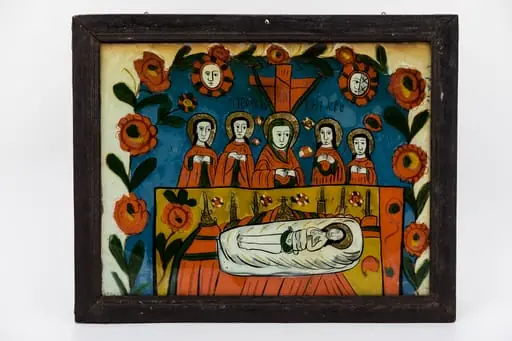 Icoana reprezintă Punerea în mormânt a Mântuitorului Iisus Hristos. Prohodul Domnului. Trupul Mântuitorului Iisus Hristos, fiind coborât de pe cruce, este învelit în țesătura giulgiului alb-gri, cu fire diafane galbene de lumină, amintind de Lumina Învierii. Maica Domnului împreună cu Sfinții Iosif din Arimateea, Nicodim și două femei mironosițe aducătoare de mir țin în brațe trupul Mântuitorului. Compozițional se creează astfel o imagine concentrică de corabie, cu Crucea Răstignirii ca și catarg, corabia prefigurând Biserica. Giulgiul și îmbrățișarea celor apropiați, uniți întru dragoste și suferință, reprezintă axa orizontală perpendiculară pe Cruce. Compoziția este echilibrată, simetrică și circulară. Maica Domnului este îmbrăcată în veșmânt cu maforiom roșu vermillon, cu sacos roșu vermillon și interiorul căptușit cu verde văratic. Fondul icoanei este cerul albastru ceruleum-cobalt, în registrul superior și de mijloc și un spațiu de galben-chihlmbar, în registrul inferior, în jurul mormântului Mântuitorului Iisus Hristos. Întreaga compoziție iconografică este încadrată de un chenar decorativ geometrizant alb, dublat de un chenar fitomorf, format dintr-o ghirlandă de 10-12 ruje roșii vermillon, cu interiorul galben-verde. În ghirlanda de ruje, sunt intercalate cele două elemente astrale martore: Soarele și Luna. Simetric și armonios, sunt 6 sfeșnice cu lumânări arzânde, lângă Trupul Mântuitorului Iisus Hristos, învăluit în giulgiu. Cromatica este armonioasă și luminos-pastelată: roșu vermillon, albastru cobalt, ceruleum, verde văratic-forest, galben chihlimbar, alb și negru. Inscripția din româno-chirilică se traduce Îngroparea Lui IC XC Iisus Hristos. Icoana este din Țara Oltului, Șcheii Brașovului.
 În centrul icoanei este Crucea aurie-bronzie, iar în dreapta crucii este Sfântul Împărat Constantin, și în stânga este Împărăteasa Elena, mama sa. Deasupra fiecăruia este inscripționat numele. În spatele Crucii, lipit de cruce, este un soare stilizat - Soarele alb al dreptății. Crucea găsită este susținută cu bucurie de cei doi sfinți. Veșmintele Sfinților Constantin și Elena sunt într-o combinație de roșu vermillon și verde kaki. Soarele din spatele Crucii și spațiul galben de lumină duce cu gândul la Crucea de lumină apărută pe cer In hoc signo vinces - prin acest semn vei învinge. Icoana este bogat ornamentată de culoare, lumină și detalii semnificative, elemente decorative geometrizante șerpuitoare și ondulatorii. Fondul icoanei este cerul de noapte, albastru ultramarin bleumarin întunecat. Întreaga compoziție este încadrată armonios de un chenar decorativ geometrizant roșu stacojiu-vișiniu cu linia albă șerpuitoare, specifică centrului de la Nicula. Cromatica este armonioasă și bogată: roșu vermillon, roșu stacojiu-vișiniu, galben-chihlimbar, albastru ultramarin bleumarin, verde kaki, ocru, alb, negru. Icoana este de Nicula. Inscripția din româno-chirilică se traduce Constantin Elena. Icoana este crăpată și lipită.
 Sfânta Mare Cuvioasă Parascheva de la Iași are crucea în mâna stângă și ramură de finic verde brad în mâna dreaptă. Este îmbrăcată în veșmânt roșu vermillon, cu interiorul căptușit cu verde forest-gri antracit, alb ivoriu și galben-solar. Sacosul este albastru cobalt cu dungi albe subțiri, cu danteluță și guleraș galben. Sfânta Cuvioasă are părul negru lung, lăsat pe umeri, coroană roșie-albastră și aureolă. Fondul icoanei este cerul albastru bleu-ciel înspre alburiu, în registrul superior și un câmp înalt luminos de grâu galben-copt, de nuanță chihlimbar închis, în registrul mediu și inferior. Întreaga compoziție iconografică este încadrată de un chenar decorativ fitomorf, format dintr-o ghirlandă de 4 ruje - trandafiri roșii și bujori roșii. Inscripția din româno-chirilică se traduce Paraschiva. Cromatica este armonioasă: roșu vermillon, albastru bleu-ciel, alburiu, cobalt, verde forest, bej-crem, negru, galben chihlimbar, ocru, muștar, negru, alb. Icoana este din Nordul Transilvaniei, Nicula.
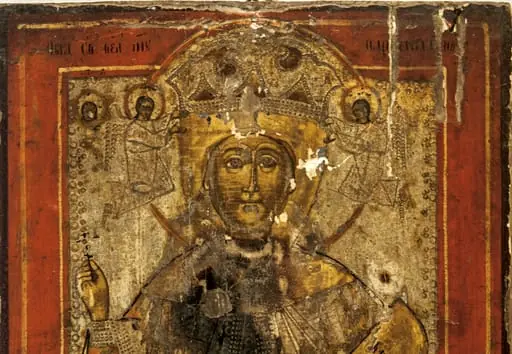 Sfânta Paraschiva este reprezentată frontal, 3/4, încoronată de doi arhangheli (după prescurtările de pe aureole) Nimbul trasat cu roșu depășește linia chenarului și partea superioară a coroanei. Ochii Sfintei, fin trasați, sunt îndreptați spre privitor, impunând un aer sever. Tehnica iluminării treptate cu elemente specifice: accentuarea zonei ochilor, tonurile de pământ ale umbrelor. Tunica decorată cu motive florale ample de culoare deschisă, incizate în stratul de grund. Mantie închisă în față, cu decor linar și bordură lată cu motive geometrice (4 rânduri de puncte și cerculețe incizate în grund). Pe cap, umeri lăsat pe spate, un maforion de culoare deschisă. În mâna dreaptă, Sfânta ține o cruce mică, rusească, în stânga un rotulus desfășurat cu inscripția scrisă în limba slavonă: Cred în unul Dumnezeu… alte inscripții: pe chenar de o parte și de alta a nimbului: Chipul Sf. Mucenițe Parascheva Vineri, în colțul stâng al icoanei IS HR și ѾOН pe nimbul cruciger al lui Iisus, reprezentat ca pe mahrama Veronicăi. Cromatica: Chenar roșu cu două linii galbene și mărginit cu brun; fond - foița metalică decorată prin incizare și ștanțare; Stratul pictural prezintă zgârieturi, arsură.În partea de sus un cui bătut necorespunzător. Pe spate, un bilet, cu ștampila Miliția oraș Deta, cu însemnarea: "Abandonate".
 Sfânta Mare Cuvioasă Parascheva de la Iași are crucea brun-bronzie în mâna dreaptă, binecuvântând, și o ramură de finic în mâna stângă. Este îmbrăcată în veșmânt roșu vermillon, cu interiorul căptușit cu gri și brun-bronziu. Sacosul este alb-zinc cu danteluță și guleraș gri-verzui. Sfânta Cuvioasă are părul negru lung, lăsat pe umeri, coroană roșie cu gri-verzui și aureolă. Fondul icoanei este cerul albastru cobalt, acajou-stacojiu și alb. Întreaga compoziție iconografică este încadrată de un chenar decorativ fitomorf, format dintr-o ghirlandă formată din două frunze mari de finic, dispuse acoperitor asemenea unei arcade-bolți. Fondul de ansamblu al icoanei este alb-zinc, cu linii ondulatorii paralele gri-verzui. Inscripția din româno-chirilică se traduce Paraschiva. Cromatica este armonioasă: roșu vermillon, orange, albastru cobalt, acajou stacojiu, verde forest, gri-verzui, bej-crem, bronziu, negru, alb zinc. Icoana este din Nordul Transilvaniei, Nicula.
 Icoana cu tematica iconografică Botezul Domnului Iisus Hristos este realizată pe registre: în registrul central, Domnul Iisus Hristos primește Botezul, în râul Iordanului, din partea Sfântului Mare Prooroc și Înaintemergător Ioan Botezătorul, care se află în stânga Mântuitorului. Mântuitorul este înfășurat cu o pânză de culoare gri-cenușiu împrejurul șoldurilor și a coapselor, și are mâinile împreunate pe piept, în semn de supunere, ascultare, smerenie, de bună-voie venind la Botez. În dreapta Lui, este un înger evlavios, în picioare, care Îl așteaptă pe mal, cu un ștergar cenușiu-antracit gata să înveșmânteze Trupul Domnului. Sfântul Ioan Botezătorul este îmbrăcat cu o mantie roșie vermillon și un himation alb gri-punctiform sau o haină din păr. Cerurile albastre sunt deschise și din mijlocul unei mandorle izvorăște o rază de lumină, pe care se pogoară porumbelul, simbolul Sfântului Duh, pe creștetul Mântuitorului. Cromatica este specifică Nordului Transilvaniei: albastru ceruleum, roșu vermillon, galben-ocru, gri, antracit, alb, negru. Arcada sau aureola de ruje roșii încadrează armonios întreaga compoziție iconografică.
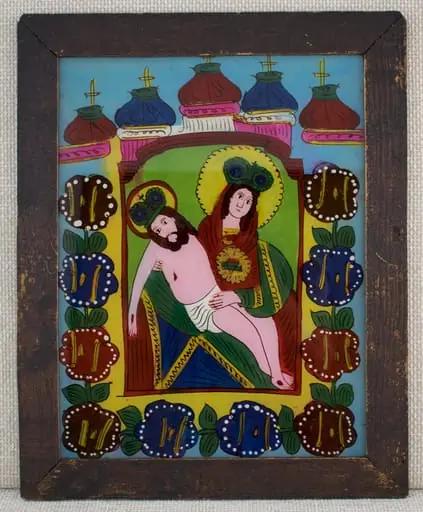 Temă de insiprație catolică foarte rar întâlnită în pictura pe sticlă din Transilvania, corespondentul scenei plângerii, a prohodului. Desenul este executat probabil fără tipar, într-un stil naiv, cu un instrument de scris cu cerneala.Culorile sunt stridente, dar se observă o oarecare măiestrie.Pietà este o pictură care o reprezintă pe Madona ținându-și fiul mort pe genunchi sau în brațe. Există numeroase reprezentări plastice ale scenei „Pietà”.Central, pe un fond verde deschis, este redată Fecioara Maria ținând pe brațe trupul lui Isus după ce a fost coborât de pe cruce. Amândoi au coroane mari împărătești, bipartite, de culoare verde, proiectate ă fondul nimbului galben mărginit de o linie roșie la Isus, dantelat la Maică. Ochii mari, deschiși. Fecioara are părul creț, castaniu, Este înveșmântată cu un veșmât policrom/roșu, verde și albastru)pe pe piept fiind redată sfânta inimă(a lui Isus) într-un cerc incandescent galben. Isus are corpul diform, poartă un veșmânt alb în jurul mijlocului. Pe membre și coastă se văd urmele supliciului. Carnația este roz.Scena este încadrată de o zonă galbenă, urmată de chenarul lat, specific: laturile inferioare - flori mari pe fond albastru, în partea de sus de 5 turle de biserici inspirate din pictura rusească.Florile chenarului sunt rotunde, de culoare bleumarin, grena, roșie, cu șirururi de puncte albe și lini galbene, frunzele mici, verzi, câmpul chenarului albastru bleu. Paleta cromatică variată, culorile stridente. Pe spate a avut lipită o hârtie mai groasă care servea drept dos. Rama este simplă, din lemn de brad prelucrat rudimentar, de culoare cafenie.
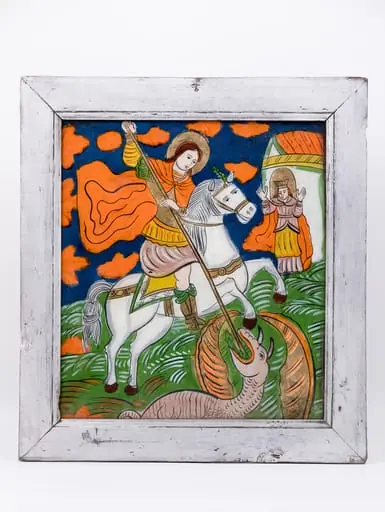 Sfântul Mare Mucenic Gheorghe este așezat călare pe un cal alb, cu elemente de harnașament galbene și verzi și șa galbenă lime, omorând balaurul gri cu creastă, solzi și coadă lungă și aripile orange, cu lancea, pe care o ține cu amândouă mâinile, înfingându-i-o animalului în gâtlej. În partea stângă a Sfântului Gheorghe, în registrul îndepărtat, este pictată domnița salvată și ocrotită de marele mucenic, cu mâinile ridicate, atât de teamă și spaimă, cât și de mulțumire către sfântul purtător de biruință. Fondul icoanei este alb cu ruje roșii și cerul albastru bleu-ciel în registrul superior. În registrul inferior, fondul este verde, cu linii fine albe, cele două registre în centrul icoanei ușor întrepătrundu-se. Mantia Sfântulu Mucenic Purtător de Biruință este roșie vermillon-orange-fluturândă având cămașa de cavaler cu zale. Culoarea roșie este caracteristică mucenicilor și martirilor. În stânga sunt elemente de arhitectură, astfel spațializându-se narațiunea iconografică. Cromatica este armonioasă: roșu vermillon, orange, albastru ultramarin bleumarin, galben-ocru, verde văratic, verde brad, alb și ngru. Pe fondul cerului albastru ultramarin bleumarin întunecat, bogat ornamentat cu elemente stilizate astrale și florale - ruje roșii este inscripția în româno-chirilică Sf Gheorghe. Icoana este din Țara Oltului. Rama este gri-argintie.
 În centrul icoanei este Crucea aurie, cu vrejul de ramificații fitomorfe orange, iar în stânga crucii este Sfântul Împărat Constantin și în dreapta este Împărăteasa Elena, mama sa. Crucea găsită este susținută cu bucurie de cei doi sfinți. Veșmintele Sfinților Constantin și Elena sunt într-o combinație de roșu vermillon, galben și orange. Spațiul albastru senin, din cerul din fondul icoanei, duce cu gândul la Crucea de lumină apărută pe cer In hoc signo vinces - prin acest semn vei învinge. În registrul inferior, este un câmp decorativ geometrizant alternativ de roșu-orange-roz-gri. În registrul superior, în colțurile stânga-dreapta sunt 2 îngeri serafimi. Cromatica este armonioasă: roșu vermillon, roz, galben-ocru, albastru cobalt, ceruleum, alb, negru. Icoana este de Țara Oltului. Inscripția din româno-chirilică se traduce Sf Constantin Elena.
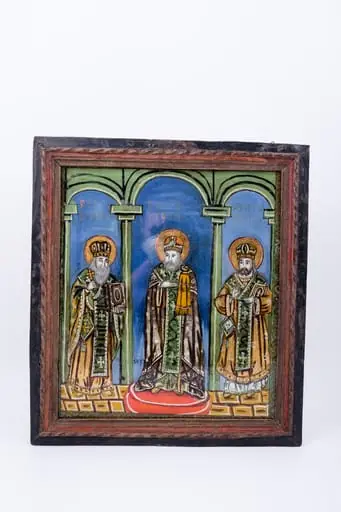 Cei Trei Sfinți Ierarhi Vasile cel Mare, Grigorie de Dumnezeu Cuvântătorul și Ioan Gură-de-Aur slujesc și săvârșesc Sfânta Liturghie împreună. Sunt înveșmântați în veșminte liturgice: sacos, felon și epitrahil verde, brun-ocru, kaki, brun-bronziu cu câte patru cruci pe mijlocul patrafirului. Sfântul Vasile cel Mare binecuvântează cu crucea în mâna dreaptă și ține în mâna stângă Sfânta Evanghelie. Sfântul Ioan Gură-de-Aur este în mijloc, așezat cu picioarele pe o pernă rotundă roșie, are mâna dreaptă lipită la piept, în semn de evlavie și cu mâna stângă ține cârja arhierească, Sfântul Grigorie binecuvântează cu mâna dreaptă și ține în mâna stângă Sfânta Evanghelie. Fondul este albastru ceruleum în registrul superior, în registrul inferior este un caroiaj brun-ocru-galben chihlimbar. Cromatica este armonioasă și săracă în nuanțe: verde smarald, absint, kaki, alb, roșu vermillon, albastru, alb, negru. Este o icoană specifică picturii de Valea Sebeșului, cu un desen fin cu conturul negru și cromatica pastelată. Inscripția din româno-chirilică se traduce Sfântul Vasile Sfântul Ioan Sfântul Grigorie.
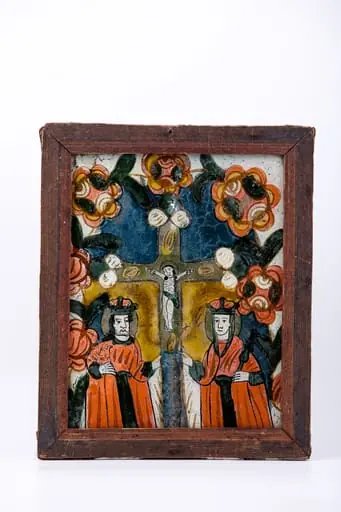 În centrul icoanei este Crucea albastră-galbenă, pe care este Răstignit Mântuitorul Iisus Hristos, iar în dreapta crucii este Sfântul Împărat Constantin și în stânga este Împărăteasa Elena, mama sa. În spatele Crucii este un spațiu galben izvorâtor de lumină. Crucea găsită este susținută cu bucurie de cei doi sfinți. Veșmintele Sfinților Constantin și Elena sunt într-o combinație de roșu vermillon și gri antracit. Spațiul galben de lumină duce gândul la Crucea de lumină apărută pe cer In hoc signo vinces - prin acest semn vei învinge. Icoana este bogat ornamentată de culoare, lumină și detalii semnificative, elemente decorative geometrizante - ovaluri galbene de lumină și brațele crucii au terminații trilobale albe. Fondul icoanei este cerul albastru ceruleum. Întreaga compoziție este încadrată armonios de un chenar fitomorf, format din rujele de Nicula, 7 trandafiri mari roșii cu striații galbene. Cromatica este armonioasă și senină: roșu vermillon, galben-chihlimbar, albastru cerulauml, gri antracit, alb, negru. Icoana este de Nicula. De menționat este că în icoană apare Mântuitorul Iisus Hristos Răstignit pe Crucea, susținută de Sfinții Constantin și Elena.
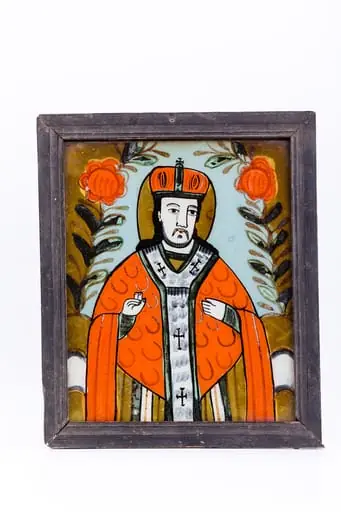 Sfântul Mare Ierarh Nicolae Făcătorul de minuni binecuvântează cu mâna dreaptă. Veșmintele arhierești liturgice ale sfântului ierarh sunt într-o alternanță cromatică de roșu vermillon, verde, ocru și gri-alburiu, cu elemente decorative geometrizante rotunde și ovoidale, fin sugerate și schițate. Epitrahilul-patrafirul este gri-alburiu cu marginile verzi și patru cruci negre. Fondul icoanei este albastru bleu-ciel foarte senin, în registrul superior și un câmp ocru-galben, alternativ dispus, în registrul inferior. Întreaga compoziție este încadrată în spațiul cerului senin de o ghirlandă de ruje - elemente decorative fitomorfe, doi trandafiri roșii, cu frunze verzi. Icoana este de Nicula, Nordul Transilvaniei. Cromatica este armonioasă, tomnatică, specifică centrului de la Nicula: roșu vermillon, albastru bleu-ciel, galben-ocru-muștar, verde de China, alb, brun, negru, gri.
 Icoaenel
 Icoana îi reprezintă pe Sfinții Apostoli din Soborul celor doi Apostoli Sfinții Petru și Pavel, Petru cu cheile Împărăției Cerești și pe Pavel cu sabia Cuvântului, susținând împreună chivotul unei biserici, simbolul Bisericii sobornicești și apostolești. Toți Apostolii, 12 la număr, au în mână Sfânta Scriptură. Au mantiile roșii și veșmintele în combinație de roșu vermillon, gri-nisipiu ivoriu și galben chihlimbar-solar. Fondul icoanei este cerul verde cu ruje roșii. Rujele simbolizează și stelele și trandafirii Împărăției Cerești. Deasupra Sfinților Apostoli este Dumnezeu-Tatăl care îi veghează, din Cerurile deschise, trimițându-i în toată lumea să propovăduiască Sfânta Evanghelie, numindu-i pescari de oameni. Dumnezeu-Tatăl este simbolizat de Ochiul-Divn înscris în triunghiul echilateral al Sfintei Treimi. Chipurile sunt foarte expresive, cu trăsături fine. Compoziția este rezistentă și cromatica foarte armonioasă: roșu vermillon, verde spanac-avocado, galben chihlimbar-solar-ocru, brun, gri, alb, negru, auriu. Întreaga tematică iconografică este încadrată de un chenar decorativ-geometrizant bleu-marin ceruleum cu elemente fitomorfe, florale stilizate, pete cromatice - ruje. Icoana este de Șcheii Brașovului, Țara Oltului. Inscripția din româno-chirilică se traduce Petru Pavel.
 Sfântul Mare Ierarh Nicolae, făcător de minuni, este îmbrăcat în veșminte liturgice, de ierarh, sacos roșu-vermillon, ocru și verde, cu epitrahil-patrafir crem-bej, cu o cruce mare galbenă, asemenea unui engolpion. Sfântul Nicolae ține în mâna dreaptă Sfânta Evanghelie închisă și cu stânga Binecuvântează. Este unul dintre cei mai populari și iubiți sfinți, ocrotitor al caselor, familiilor și copiilor. Are barbă sură și mithră arhierească și aureolă. Fondul este albastru ceruleum, cu elemente astrale - stele roșii și albe. În dreapta și stânga Sfântului Ierarh, așezat pe un tron arhieresc, sunt doi îngeri-serfimi. Tronul arhieresc al Sfântului Nicolae este bogat ornamentat cu elemente decorative geometrizante arhitecturale albastre, cu o pernă rulou galbenă, cu ciucuri. Veșmântul Sfântului Nicolae este deosebit și prin elementele ornamental-decorative drapaje, cute și falduri delicate și ingenue. Cromatica este armonioasă și serafic-diafană: roșu vermillon, orange, albastru ceruleum regal, verde mușchi de pădure, ivoriu, gri, ocru, bej, negru, alb. Icoana este de Șcheii Brașovului.
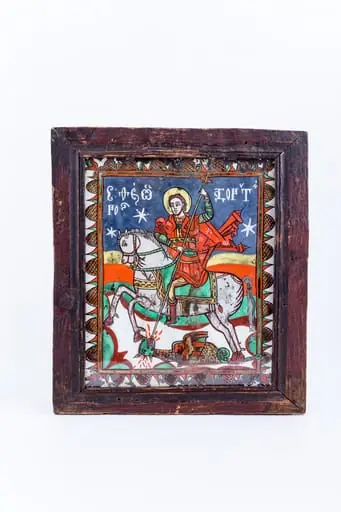 Sfântul Mare Mucenic Teodor Tiron este așezat călare pe un cal alb, omorând balaurul brun cu lancea, pe care o ține în amândouă mâinile. Balaurul este pictat cu brun-acajou, roșu vermillon și verde absint, cu solzi, cu foc și sânge ieșind din răcnetul lui. Fondul este albastru, în registrul superior și galben-ocru și roșu vermillon în cel inferior, în centrul icoanei ușor întrepătrându-se toate culorile. Câmpurile de culori sunt paralele, arătându-se inclusiv și tricolorul românesc ca și fundal de spațiu geografic al narațiunii. Mantia Sfântului Mucenic militar este roșie, având pantalonii galbeni, strecurați în cizmele roșii de cavaler. Ceea ce este specific icoanelor de Valea Sebeșului sunt și floricelele albe foarte mici, de pe veșmântul roșu al mucenicului militar. Cerul albastru ceruleum este împodobit cu stele albe mari, element caracteristic mai mult Țării Făgărașului și Țării Oltului. Fiind o icoană de Valea Sebeșului, cu influențe din Făgăraș, imaginea picturală este armonioasă, cu un desen simplu, curat, tușele de culoare sunt mai mari, raportate la dimensiunile lucrării. Cromatica este armonioasă; roșu vermillon, albastru ceruleum, galben-ocru, verde-absint, brun-roșcat acajou, alb și negru. Pe fondul cerului albastru ceruleum este inscripția în chirilică Sf Teodor Tiron. Icoana este rafinată prin acuratețea desenului, compoziția echilibrată și armonia cromatică, impactul vizual fiind puternic prin alăturarea verde-absint, alb, acajou. Întreaga tematică iconografică este încadrată de un chenar decorativ fitomorf, incluzând și motivul ghindei și a conului de brad.
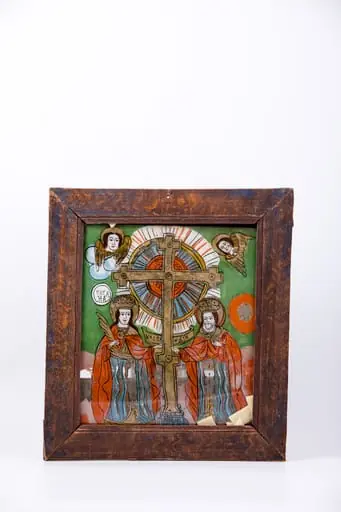 În centrul icoanei este Crucea bronzie, cu capetele brațelor împodobite trilobat, iar în stânga crucii este Sfântul Împărat Constantin și în dreapta este Împărăteasa Elena, mama sa. În spatele Crucii, este un soare mare roșu, circular, cu raze de lumină galbene și albastre, dispuse radiar. Crucea găsită este susținută cu bucurie de cei doi sfinți. Veșmintele Sfinților Constantin și Elena sunt într-o combinație de roșu vermillon, galben și albastru. Spațiul alb-galben de lumină, din fondul icoanei, duce cu gândul la Crucea de lumină apărută pe cer In hoc signo vinces - prin acest semn vei învinge. Fondul icoanei este cerul verde-văratic, în registrul superior, iar în registrul inferior, este un câmp roz-gri-acajou. În registrul superior, în colțurile stânga-dreapta sunt 2 îngeri serafimi. Cromatica este armonioasă: roșu vermillon, roz, galben-ocru, albastru cobalt, verde-iarbă de vară nuanță spanac-avocado, alb, negru. Icoana este de Țara Oltului. Inscripția din româno-chirilică se traduce Constantin Elena.
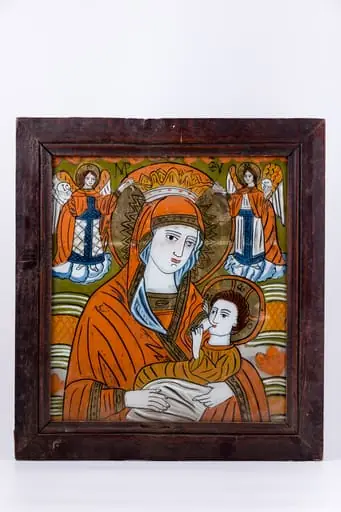 Maica Domnului ține în brațe Pruncul Iisus Hristos, pe care Îl alăptează, din sânul stâng, din dreptul inimii. Pruncul Iisus Hristos ține duios sânul cu ambele mânuțe. Maica Domnului este înveșmântată în mantie cu maforion roșu vermillon și sacos albastru dungat, asemenea unei ii cu gulerașul dantelat, poartă maforion, coroniță de împărăteasă și aureolă. Pruncul Iisus Hristos este înveșmântat în ocru-orange și gri-ivoriu, cu aureolă. În registrul superior, sunt Sfinții Arhangheli Mihail și Gavriil, ținând aureola Maicii Domnului cu mâinile. Sfinții Îngeri Arhangheli au picioarele pe mandorle de nouri alb-albaștri. Fondul icoanei este văzduhul de culoare verde văratic, împodobit cu elemente stilizat-florale, pete de roșu, ruje, în registrul superior. În registrul inferior, este un câmp luminos de verde-orange și galben-ocru. Cromatica este vie, senină și luminoasă: roșu vermillon, alb, albastru cobalt și bleu ciel, verde văratic, mușchi de pădure, verde brad, galben-ocru, alb, negru. Inscripția din româno-chirilică se traduce MP IC XC Maica Domnului Iisus Hristos. Este o icoană de Țara Oltului.
 În centrul icoanei este Crucea brun-bronzie, nisipie, cu aripi din elemente vegetale - frunze de finic verzi-corai și bej. În dreapta crucii este Sfânta Împărăteasă Elena, și în stânga este Împăratul Constantin, invers inscripției. Veșmintele sfinților împărați sunt pictate cu roșu vermillon-cărămiziu-corai, verde-smarald. Poartă coroane împărătești și aureole de sfinți, mantiiile de împărați le au prinse la gât cu fibulă. Crucea este bronzie și are capetele brațelor cu elemente decorative trilobate albe-verzi cu cruce neagră. Fondul este cerul albastru cobalt, cu un câmp galben-solar, în registrul din sptaele Crucii, amintind de Soarele Dreptății - Mântuitorul Iisus Hristos. Prin Acest Semn vei învinge! In Hoc signo vinces! Compoziția iconografică este încadrată de un chenar decorativ geometrizant - ramă de fereastră, de culoare nisipie-bej, sable, cu linia albă șerpuitoare. Inscripția din româno-chirilică se traduce Constantin Elena. Cromatica este armonioasă: roșe vermillon, cărămiziu, corai, albastru cobalt, verde smarald, forest, bej, crem, bronziu, galben solar, alb, negru. Icoana este din Nordul Transilvaniei, Nicula.
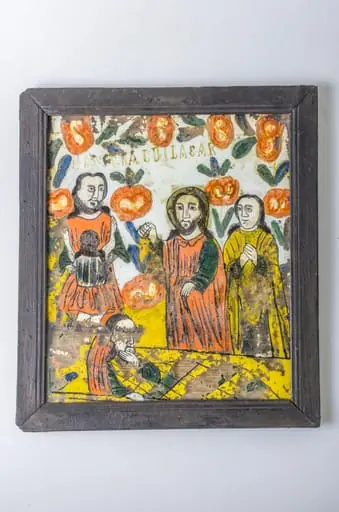 Figura centrală a icoanei este Iisus stând în fața mormântului sărmanului Lazăr, pe care îl învie, ridicând semnificativ , dreapta cu degetele strânse. La picioarele lui Iisus, Lazăr stă întins în mormânt cu corpul acoperit de fașele obișnuite pentru stilul de înmormântare, capul ridicat trezindu-se, mâna stângă adusă spre bărbie. În stânga lui Iisus, se remarcă o figură bărbătească luând în brațe un copil, reprezentat din spate, simbolizând probabil, intrarea în sânul lui Avram al sărmanului Lazăr, semn al intrării în rândul drepților (sufletul fiind reprezentat sub formă de copil). În dreapta lui Iisus un apostol. Cromatica: bleu, roșu, galben, verde. În partea superioară e scris „Învierea lui Lazăr”. Pe spate, icoana este întărită cu o placă din lemn de esență moale.
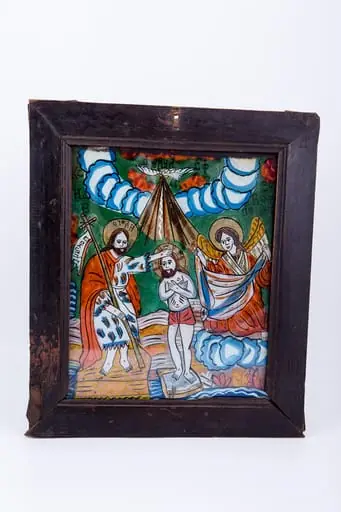 Domnul Iisus Hristos primește Botezul, în râul Iordanului, din partea Sfântului Mare Prooroc și Înaintemergător Ioan Botezătorul, care se află în dreapta Mântuitorului. Mântuitorul este înfășurat cu o pânză de culoare roșie împrejurul șoldurilor și a coapselor. În stânga Lui, este un înger evlavios, care Îl așteaptă cu un ștergar alb-roșu-albastru gata să înveșmânteze Trupul Domnului. Sfântul Ioan Botezătorul este îmbrăcat cu o mantie roșie și un himation alb-brun sau o haină din păr de cămilă. Cerurile de culoare verde, asemenea Duhului Sfânt, sunt deschise și izvorăște o rază de lumină, pe care se pogoară porumbelul, simbolul Sfântului Duh, pe creștetul Mântuitorului. Mandorla de nouri rotunzi, care permite deschiderea Cerurilor au o alternanță cromatică de alb și albastru bleu-ciel. Cromatica este specifică Țării Oltului: auriu, roșu vermillon, verde spanac-avocado, albastru bleu-ciel, bej, gri, ocru, brun-nisipiu, alb, negru. Inscripția din româno-chirilică se traduce Botezul Lui IC XC Iisus Hristos Sfântul Duh Ioan.
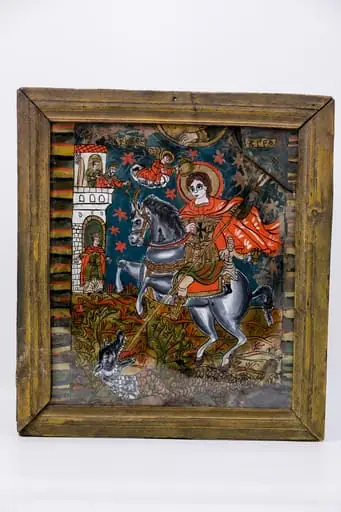 Sfântul Mare Mucenic Gheorghe este așezat călare pe un cal alb-gri, cu elemente de harnașament bronzii și șa roșie, omorând balaurul gri-gaben-verde cu creastă, solzi și coadă lungă, cu lancea, pe care o ține cu amândouă mâinile, înfingându-i-o animalului în gâtlej. În partea dreaptă a Sfântului Gheorghe, în registrul îndepărtat, este pictată domnița salvată și ocrotită de marele mucenic, cu mâinile ridicate, atât de teamă și spaimă, cât și de mulțumire către sfântul purtător de biruință. În registrul superior este Dumnezeu-Tatăl Binecuvântând cu mâna dintr-o deschidere a Cerurilor și un înger serafim care aduce Sfântului Gheorghe cununa de mucenic. În balconul castelului sunt două personaje cu cheile turnului în mână și pe șaua calului, în spatele Sfântului Mare Mucenic Gheorghe este un personaj foarte mic, îmbrăcat în haine arăbești, având în mână o candelă-amforă-cădelniță. Fondul icoanei este cerul albastru-gri-întunecat cu elemente astrale, stele roșii și câmpuri brune-kaki cu elemente vegetale roșii vermillon, în registrul inferior. Mantia Sfântulu Mucenic Purtător de Biruință este roșie-fluturândă având cămașa de cavaler cu zale și o cruce neagră de cavaler pe piept. Culoarea roșie este caracteristică mucenicilor și martirilor. Atât în dreapta, cât și în stânga sunt elemente de arhitectură, astfel spațializându-se narațiunea iconografică. Cromatica este armonioasă; roșu vermillon, albastru-gri întunecat, galben-ocru, verde văratic, verde brad, kaki, bronziu, alb și negru. Inscripția din româno-chirilică se traduce Sfântul Gheorghe. Icoana este din Țara Oltului. Icoana este mai rară, datorită diversității personajelor.
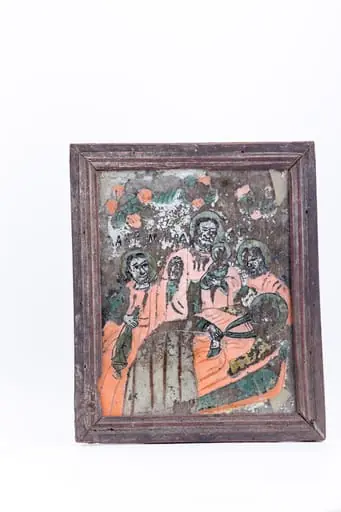 Icoana reprezintă Nașterea Maicii Domnului, 8 septembrie. Sfânta Maică Ana este redată întinsă pe un pat și lângă ea este Sfântul Părinte Ioachim, cu Pruncuța Maria în brațe. În stânga și în drepta lor, este câte o fecioară, martore și asistente ajutoare la naștere. În registrul superior, asemenea unei arcade-bolți de biserică este o ghirlandă de 3 ruje - trandafiri mari roșii cu frunze verzi. Cromatica este armonioasă: roșu vermillon, brun, verde, negru, alb. Icoana este de Nicula. Inscripția din româno-chirilică se traduce MP Maica Domnului.
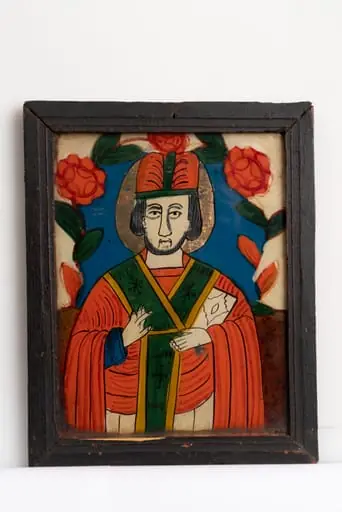 Sfinții Apostoli Petru și Pavel sunt reprezentați frontal, în picioare. În stânga compoziției e pictat sfântul Apostol Petru, ținând cheia raiului în mâna dreaptă, în timp ce mâna stângă o ține la piept. Sfântul Apostol Pavel, pictat în dreapta scenei, are în mâna stângă o sabie, simbolizând probabil "sabia duhului", iar mâna dreaptă o ține la piept. Între cei doi sfinți apare pictat un ornament cu rujel. Cromatica se compune din tonuri de roșu vermillon, verde, albastru, ocru galben, gri, maro și foiță aurie. Rama icoanei e profilată, băițuită, și e formată din îmbinarea a patru baghete de lemn.
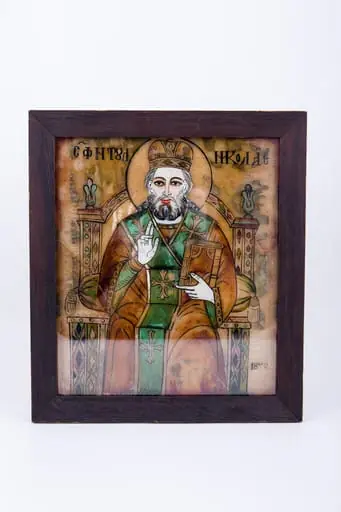 Sfântul Mare Ierarh Nicolae Făcătorul de minuni este redat central, așezat fiind pe un tron arhieresc, ținând în mâna stângă Sfânta Evanghelie închisă și binecuvântează cu mâna dreaptă. Veșmintele arhierești liturgice ale sfântului ierarh sunt într-o alternanță cromatică de brun cafeniu și verde spanac-avocado, kaki și negru. Epitrahilul, patrafirul este verde, cu patru cruci gri pe el, sacosul brun-maron. Poartă mithră și are aureolă. Fondul este brun-gri-bronziu. Inscripția din româno-chirilică se traduce Sfântul Nicolae. Icoana are o cromatică armonioasă și sobră: gri, brun, verde spanac-avocado, verde kaki, alb, negru, roșu. Icoana este de Laz, Valea Sebeșului și datată 1872.
 Mântuitorul Iisus Hristos, fiind răstignit pe Cruce, având în dreapta pe Maica Domnului Îndurerată și în stânga pe ucenicul cel iubit Sfântul Apostol și Evanghelist Ioan. Mântuitorul Iisus Hristos Răstignit pe Cruce are o țesătură verde-forest în jurul mijlocului și a coapselor. Crucea este orange. În registrul superior sunt elementele astrale: Soarele și Luna. Fondul icoanei este cerul albastru ultramarin bleumarin întunecat de noapte și tristețe și galben-solar în spatele Crucii, prefigurând Lumina Învierii Domnului Iisus Hristos. Cerul este bogat ornamentat cu elemente astrale - soarele și luna, stilizate floral. În spațiul inferior, este un câmp galben solar de lumină. Cromatica este armonioasă: roșu vermillon, orange, albastru ultramarin bleumarin, gri antracit, galben solar, brun, crem, bej, bronziu, alb, negru. Icoana este din Nordul Transilvaniei, Nicula.
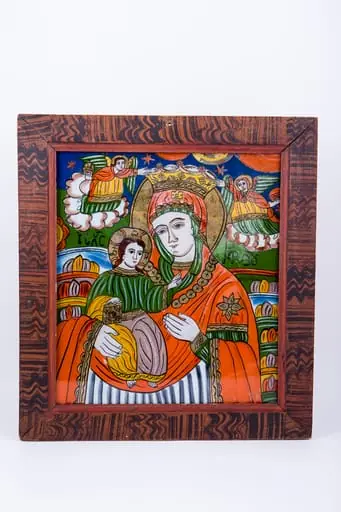 Maica Domnului Împărăteasă a Cerurilor, ține Pruncul Iisus Hristos, în brațe. Maica Domnului este îmbrăcată cu mantie cu maforion roșu vermillon, cu interiorul căptușit cu verde închis și albastru dungat cu alb. Poartă aureolă, coroniță de împărăteasă și salbă aurie din bănuți. Pruncul Iisus Hristos este îmbrăcat cu brun și verde și are aureolă și Sfânta Evanghelie închisă în mâna dreaptă și binecuvântează cu mâna stângă. În registrul superior sunt ocrotitori și păzitori Sfinții Arhangheli Mihail și Gavriil, cu mâinile atingând coronița Maicii Domnului Împărătese. Cromatica este armonioasă, caldă și luminoasă: roșu vermillon, verde spanac-avocado, galben-chihlimbar-ocru, albastru ceruleum bleu-ciel, brun, gri, alb, negru. Inscripția din româno-chirilică se traduce Maica Domnului MP Iisus Hristos IC XC. Icoana este de Șcheii Brașovului, Țara Oltului.
 Icoa
Icoa În centrul icoanei este Crucea, iar în stânga crucii este Sfântul Împărat Constantin, și în dreapta este Împărăteasa Elena, mama sa. Deasupra fiecăruia este inscripționat numele inversat. Veșmintele sfinților împărați sunt pictate cu roșu vermillon, roz, brun, bej, verde kaki. Poartă coroane împărătești și aureole de sfinți, mantiiile de împărați le au prinse la gât cu fibulă. În spatele fiecăruia este câte un înger păzitor. În registrul superior, deasupra crucii, sunt ramuri de finic. Fondul este verde, culoarea Sfântului Duh, la Pogorâre, cu stele albe și roșii, reprezentând cerul și văzduhul de Duh Sfânt. În registrul inferior este o alternanță de câmpuri paralele, cromatizate cu albastru și alb, cu pete și tușe de roșu. Cromatica este armonioasă și puternic vie și pastelată: roșu vermillon, verde spanac-avocado, kaki, roz, brun, bej, albastru, alb, negru. Inscripția dn româno-chirilică se traduce IC XC Iisus Hristos Sf Constantin Sf Elena. Icoana reprezintă pictura Țării Oltului.
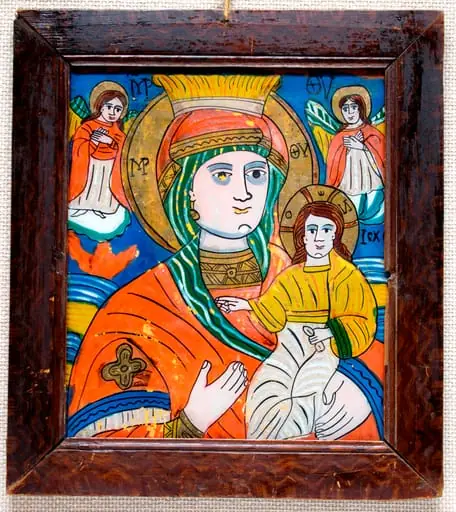 Repr
Repr Mântuitorul Iisus Hristos, fiind răstignit pe Cruce, are în dreapta pe ucenicul cel iubit, care a stat lipit de pieptul Învățătorului, la Cina cea de Taină, mai precis, pe Sfântul Apostol și Evanghelist Ioan Teologul, Evanghelistul Iubirii și în stânga pe Maica Domnului Îndurerată, Jalnică și Plângătoare. Veșmintele Maicii Domnului sunt albastre și gri (albastrul este culoarea Maicii Domnului). Sfântul Ioan este îmbrăcat în verde și gri. Mântuitorul Iisus Hristos are o țesătură gri-nisipiu în jurul mijlocului și a coapselor. În registrul îndepărtat sunt elemente de arhitectură, reprezentându-se astfel spațialitatea narativă, cetatea Ierusalimului. Cromatica este armonioasă: roșu-cărămiziu, albastru ceruleum, verde, gri, nisipiu, bej, ivoriu-fildeș, alb, negru. Inscripția din româno-chirilică se traduce Iisus Hristos regele iudeilor, Maria, Sfântul Ioan. Rama este colorată jumătate cu cărămiziu, jumătate cu crem și colțurile ornamentate cu pătrate decorative de verde-kaki. Icoana este datată 1867.
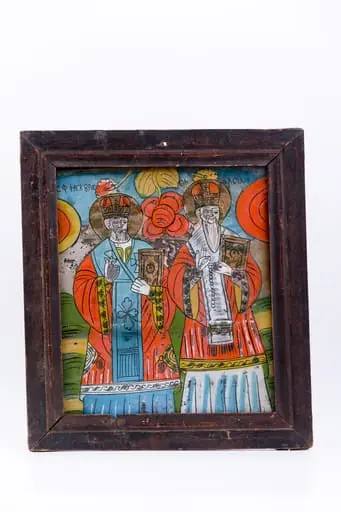 Icoana îi reprezintă pe Sfântul Ierarh Nicolae și Sfântul Vasile cel Mare, amândoi ierarhi, în veșminte liturgice arhierești, binecuvântând. Sfântul Mare Ierarh Nicolae, făcător de minuni, este îmbrăcat în veșminte liturgice, de ierarh, sacos roșu-vermillon, cu epitrahil-patrafir albastru bleu-ciel. Sfântul Nicolae are în mâna stângă Sfânta Evanghelie închisă și cu mâna dreaptă Binecuvântează. Este unul dintre cei mai populari și iubiți sfinți, ocrotitor al caselor, familiilor și copiilor. Are barbă sură, mithră arhierească și aureolă. Alături este Sfântul Ierarh Vasile cel Mare, în veșminte roșii vermillon, cu interiorul galben, sacos gri-albăstrui și epitrahil gri. Fondul este albastru bleu-ciel cu elemente decorative fitomorfe ruje galbene și roșii. Cromatica este armonioasă și pastelată: roșu vermillon, albastru bleu-ciel, verde, galben-ocru, negru, alb. Icoana este de Țara Oltului. Inscripția din româno-chirilică se traduce Sf Nicolae Sf Vasile.
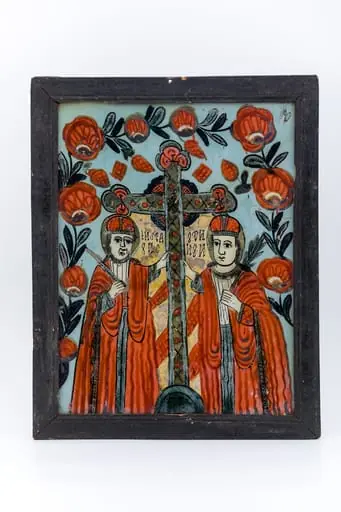 În centrul icoanei este Crucea bronzie, iar în stânga crucii este Sfânta Împărăteasă Elena, și în dreapta este Împăratul Constantin. Veșmintele sfinților împărați sunt pictate cu roșu vermillon și gri-albăstrui. Poartă coroane împărătești și aureole de sfinți, mantiiile de împărați le au prinse la gât cu fibulă. Crucea este bronzie și are capetele brațelor cu elemente decorative trilobate roșii vermillon somon. În spatele Crucii sunt elemente fitomorfe și o cunună de Rusalii. Fondul este cerul albastru bleu-ciel regal senin. Întreaga compoziție iconografică este încadrată de un chenar decorativ fitomorf, format dintr-o bogată ghirlandă de trandafiri-bujori, formată din 9 ruje roșii cu bobocei. În interiorul icoanei este un spațiu galben luminos cu umbre roșii paralele. Cromatica este armonioasă: roșu vermillon-somon, albastru bleu-ciel regal, gri, bej, crem, bronziu, brun, ocru, alb, negru. Inscripția în româno-chirilică se traduce Constantin și Elena. Icoana este din Nordul Transilvaniei, Nicula.
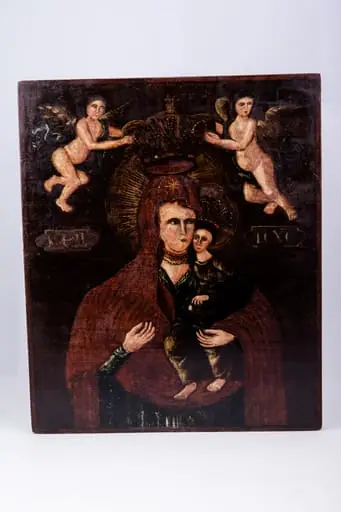 Maica Domnului ține în brațe Pruncul Iisus Hristos, care arată cu mâna dreaptă înspre Maica Domnului, prezentându-ne-o. Maica Domnului este înveșmântată în mantie cu maforion roșu-stacojiu, cu interiorul negru. Maica Domnului are aureola în raze luminoase de soare. Pruncul Iisus Hristos este înveșmântat cu sacos și omofor brun spre negru, cu coroană și aureolă pe cap. Fondul icoanei este negru întunecat, în contrast fiind cu lumina chipurilor și cromatica veșmintelor. În registrul superior sunt doi îngeri îndreptați spre coroana stilizată a Maicii Domnului, făcând gestul Încoronării. Îngerii sunt pictați asemenea unor putti, din pictura barocă. Cromatică este armonioasă: roșu stacojiu, brun, acajou, brun-ocru, brun, bej, alb, verde-olive, negru. Inscripția din româno-chirilică se traduce MP IC XC Maica Domnului Iisus Hristos. Icoana este pictată în manieră barocă și are atmosfera catolică.
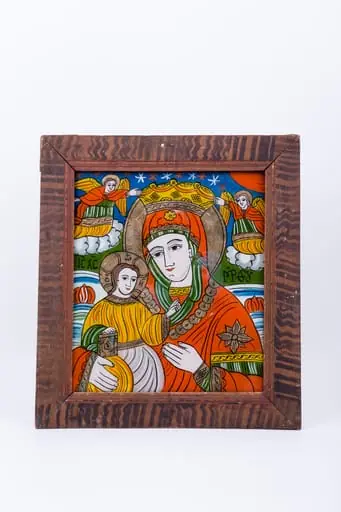 Maica Domnului Împărăteasă a Cerurilor, pe tron așezată, îl ține în brațe pe Pruncul Iisus Hristos. Maica Domnului este îmbrăcată cu mantie cu maforion roșie vermillon, cu interiorul căptușit cu verde și cu marginile manșetelor galben-aurii. Poartă aureolă și coroniță de împărăteasă, salbă aurie la gât. Pruncul Iisus Hristos este îmbrăcat cu ocru, verde și gri, are aureolă și ține pe genunchi Sfânta Evanghelie închisă și arată către Maica Domnului. În registrul superior îndepărtat sunt ocrotitori și păzitori Sfinții Arhangheli Mihail și Gavriil, așezați cu picioarele pe nori rotunzi, albi. Tematica este deosebită și frecvent întâlnită în Țara Oltului. Cromatica este armonioasă, caldă și luminoasă: roșu vermillon, verde spanac-avocado, galben-ocru, albastru bleu-ciel, alb, negru. Inscripția din româno-chirilică se traduce Maica Domnului MP Iisus Hristos IC XC
 Icoajumă
 Sfântul Mare Mucenic Gheorghe este așezat călare pe un cal alb cu harnașament bogat, omorând balaurul gri-cenușiu cu creastă, solzi și coadă lungă, cu lancea, pe care o ține cu amândouă mâinile, înfingându-i-o animalului în gâtlej. În partea dreaptă a Sfântului Gheorghe, în registrul îndepărtat, este pictată domnița salvată și ocrotită de marele mucenic, cu mâinile ridicate, atât de teamă și spaimă, cât și de mulțumire către sfântul purtător de biruință. Fondul este albastru, în registrul superior, cerul cu flori mari roșii, pete de culoare - ruje - asemenea unor simboluri floral-astrale, des-folosite în pictura icoanelor din Țara Oltului. În registrul inferior, fondul este verde și galben, cu linii ondulatorii albe, cele două registre în centrul icoanei ușor întrepătrundu-se. Mantia Sfântului Mucenic Purtător de Biruință este roșie, având cămașa de cavaler cu zale. Culoarea roșie este caracteristică mucenicilor și martirilor. În registrul îndepărtat sunt elemente de arhitectură, astfel spațializându-se narațiunea iconografică. Deasupra Sfântului Gheorghe este cerul deschis, asemenea unei ferestre, și un soare uriaș, din care iese mâna Lui Dumnezeu-Tatăl care îl binecuvântează și îl ajută în lupta purtată și un înger care ocrotește de pe o mandorlă mică de nouri rotunzi albi. Fiind o icoană de Șcheii Brașovului, imaginea picturală este armonioasă, cu un desen simplu, curat, tușele de culoare sunt mai mari, raportate la dimensiunile lucrării. Cromatica este armonioasă; roșu vermillon, albastru ceruleum, galben-ocru, verde spanac-avocado, alb și ngru. Pe fondul cerului albastru ceruleum este inscripția în româno-chirilică Sf Gheorghe. Icoana este rafinată prin acuratețea desenului, compoziția echilibrată și armonia cromatică.
 În centrul icoanei este Crucea, iar în dreapta crucii este Sfânta Împărpteasă Elena și în stânga este Împăratul Constantin, fiul său. Veșmintele sfinților împărați sunt pictate cu roșu vermillon, ocru, brun, alb și verde absint. Deasupra fiecăruia este inscripționat numele, inversat. În spatele Crucii, lipit de cruce, sunt ramuri de finic, asemenea unor raze de soare, amintind de semnul luminos apărut pe cer In hoc signo vinces - prin acest semn vei învinge. Crucea ste împodobită pe brațele vertical și orizontal, cu un vrej lung de flori și frunze, ca o ghirlandă de Rusalii. Icoana este o bogăție de culoare, lumină și detalii semnificative. Crucea este împodobită cu elemente fitomorfe: vrej-tulpină agățătoare, frunze și flori. În spatele crucii sunt doi îngeri serafimi. Icoana este de Țara Oltului. Inscripția în româno-chirilică se traduce Sf Împ Constantin Sf Împ Elena. Cromatica este armonioasă și bogată: roșu vermillon, galben-ocru, albastru ceruleum, verde kaki-olive, absint, brun, alb, negru.
 Sfânta Mare Cuvioasă Parascheva de la Iași are crucea în mâna stângă, binecuvântând, și o ramură mare de finic verde, în mâna dreaptă. Este îmbrăcată în veșmânt roșu vermillon-cărămiziu, cu interiorul căptușit cu verde-mușchi de pădure, verde de China, înspre gri-antracit. Sacosul este alb-crem cu danteluță și guleraș și dungi gri-verzui. Sfânta Cuvioasă are părul negru lung, lăsat pe umeri, coroană roșie cu gri-antracit, cu radiații verzi, ca de catifea și aureolă. Fondul icoanei este cerul albastru regal-ceruleum, în registrul superior și un câmp galben-chihlimbar, în registrul inferior. Întreaga compoziție tematic-iconografică este încadrată de un chenar decorativ fitomorf, format din 3 ruje roșii mari, cu frunze verde-brad. Cromatica este armonioasă: roșu vermillon-cărămiziu, alb-zinc, albastru regal-ceruleum, crem-bej, galben-chihlimbar, verde mușchi-de-pădure, verde de China, gri-verzui, gri-antracit, bej-crem, bronziu, negru, alb zinc. Inscripția din româno-chirilică se traduce Paraschiva. Icoana este din Nordul Transilvaniei, Nicula.
 În centrul icoanei este Crucea, iar în dreapta crucii este Împăratul Constantin și în stânga este Împărăteasă Elena, mama sa. Veșmintele sfinților împărați sunt pictate cu roșu vermillon, roz, ocru, brun, alb și bronziu. Deasupra fiecăruia este inscripționat numele. Pe brațele Crucii sunt elemente forale și vegetale, realizate prin petale punctiforme roșii. Deasupra Sfinților Împărați sunt volutele și drapajele unor draperii roșii și galbene, care au menirea să încadreze în spațiu și timp tematica iconografică. Icoana este de Țara Oltului. Inscripția în româno-chirilică se traduce Sfântul Constantin Sfânta Elena. Fondul este albastru-violaceu, iar în registrul inferior există un caroiaj alb-gri-negru. Cromatica este armonioasă și bogată: roșu vermillon, roz, orange, galben-ocru, albastru violaceu, verde kaki, brun, alb, negru.
 Sfântul Mare Mucenic Teodor Tiron este așezat călare pe un cal alb, ținând Crucea în mâna dreaptă. Mantia Sfântulu Mucenic Teodor este roșie-vermillon, pantalonii verzi, cămașa de cavaler verde, cu năsturei și găetane. Fondul este albastru ceruleum și în registrul inferior este roșu vermillon, cărămiziu. Întreaga compoziție iconografică este presărată de elemente fitomorfe-geometrizante, formate din petale albe. Cromatica este armonioasă; roșu vermillon, cărămiziu, ocru, verde spanac-avocado, albastru ceruleum, alb și ngru. Icoana este de Nicula. Inscripția din româno-chirilică se traduce Sf Teodor.
 Icoana este impărțită de o cruce neagră pe care este pictat Isus răstignit, deasupra cu Dumnezeu Tatăl iar in părți cu Sf. Constantin și Elena; sunt patru registre: Maica Domnului indurerată; Sf. Nicolae și Sf. Gheorghe cu balaurul.
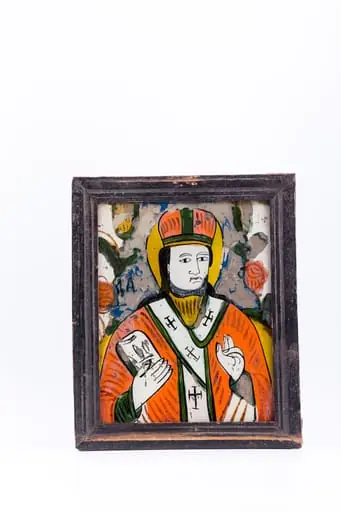 Sfântul Mare Ierarh Nicolae Făcătorul de minuni ține în mâna dreaptă Sfânta Evanghelie închisă și binecuvântează cu mâna stângă. Veșmintele arhierești liturgice ale sfântului ierarh sunt într-o alternanță cromatică de roșu vermillon, galben și verde. Epitrahilul-patrafirul este alb cu marginile verzi și patru cruci brune. Fondul icoanei este alb-albăstrui-gri în registrul superior și un câmp galben-solar în registrul inferior. Întreaga compoziție este încadrată în spațiul cerului senin de o ghirlandă de ruje - elemente decorative fitomorfe, patru trandafiri roșii-galbeni, cu frunze verzi. Inscripția din româno-chirilică se traduce Sf Nicolae. Icoana este de Nicula, Nordul Transilvaniei.
 Icoana este împărțită pe două tematici iconografice: Sfântul Mare Ierarh Vasile și Sfânta Treime. Sfântul Vasile cel Mare este îmbrăcat în veșminte arhierești în combinația de roșu-zmeuriu, albastru cobalt, verde și alb. Are barba și părul lungi. Poartă mitrhră arhierească și aureolă. Binecuvântează cu mâna dreaptă și ține în mâna stângă Sfânta Evanghelie închisă. Dumnezeu-Fiul ține Crucea pe umărul stâng, Dumnezeu-Tatăl are globul pământesc și dimpreună susțin coroana Împărăției Cerești. Dumnezeu-Tatăl și Dumnezeu-Fiul sunt înveșmântați în roșu vermillon-zmeuriu, albastru cobalt și verde, cu bogăție de detalii decorativ-ornamentale fine și minuscule pe veșmintele împărătești, dungi albe. În registrul îndepărtat superior este cerul auriu cu o mandorlă de nouri rotunzi albaștri.
 Sfântul Mare Mucenic Gheorghe este așezat călare pe un cal alb cu pete gri, acoperit cu elemente de harnașament verzi și gri omorând balaurul cu lancea neagră, pe care o ține în amândouă mâinile. Balaurul este pictat cu verde forest și kaki și gri cenușiu-antracit verzui și având corp de reptilă, cu coadă de diavol. Fondul icoanei este cerul albastru bleu-ciel-ceruleum și galben-solar în exterior și în cel inferior, în centrul icoanei ușor întrepătrundu-se toate culorile. Tunica Sfântului Mucenic Purtător de Biruință este roșie-vermillon, având pantalonii albaștri-ceruleum și cămașa de cavaler cu mânecile verzi. În registrul superior, icoana este încadrată de un chenar decorativ, format dintr-o ghirlandă de 5 ruje roșii. Cromatica este armonioasă: roșu vermillon, albastru-bleu-ciel, cobalt și ceruleum, ocru, galben solar și chihlimbar, verde kaki și forest, gri antracit, alb și negru. Inscripția din româno-chirilică se traduce Gheorghe. Icoana este din Nordul Transilvaniei, Nicula.
 Icoana reprezintă Nașterea Mântuitorului Iisus Hristos. Icoana este împărțită în cinci secvențe: Nașterea Mântuitorului este în centrul icoanei. Pruncul Iisus, înfășat în scutece este ținut în brațe de Maica Domnului și de Dreptul Iosif, logodnicul Fecioarei Maria, stând alături de legănuțul din iesle și animale domestice din grajd, cai și boi. În registrul superior este ilustrată venirea magilor după steaua cea călăuzitoare și fuga în Egipt. În registrul inferior este ilustrată pruncuciderea de către Irod Antipa. În centrul icoanei este steaua cea călăuzitoare cu un mănunchi de raze luminoase, aducătoare de vestea cea bună. Este o alternanță cromatică de roșu vermillon, alb, galben citrone și albastru cobalt. Cerurile sunt deschise. Icoana este foarte bogată în narațiune. Registrele se întrepătrund armonios. Cromatica este luminoasă, vie și directă: roșu-galben-alb-albastru, legate de auriul aureolelor, stelei, chenarului decorativ. Inscripția în chirilică se traduce Nașterea ICXC Iisus Hristos. Icoana este pictată în Țara Oltului. Icoana este datată 1884.
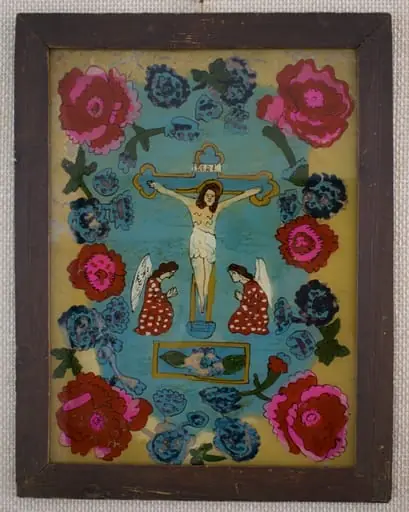 Icoana redă tema Răstignirii combinată cu Plângerea de influență apuseană, catolică. Crucea pe care este răstignit Iisus este plasată la mică distanță deasupra pietrei mormântului(redată ca un dreptunghi plan, decorat cu o floare). La baza crucii de doi îngeri, îngenuncheați, cu profiluri diforme, părul ondulat, negru, înveșmântați cu haine roșii cu buline albe.Isus nu are barbă, părul este bogat, până la umeri, mâinile și picioarele diforme.Elementele anatomice schițate.Crucea treflată este bleu cu chenar ocru galben și inscripția INRI pe fond alb. Scena este încadrată de un o ghirlandă bogată de flori roz, care separă câmpul în dpuă zone de culoare: bleu murdar central, galben ocru în afara chenarului. Florile chenarului au conturul mărunt dantelat, pe colțuri fiind câte o floare roz cu degradeuri de roșu, mai mare, median două mai mici, restul fiind de culoare albastră, ramuri și boboci, sugerând trandafiri. Desenul este foarte naiv. Pe spate a avut lipită o hârtie mai groasă care servea drept dos. Rama este simplă, din lemn de brad prelucrat rudimentar, culoare cafenie. Stratul pictural ușor exfoliat.
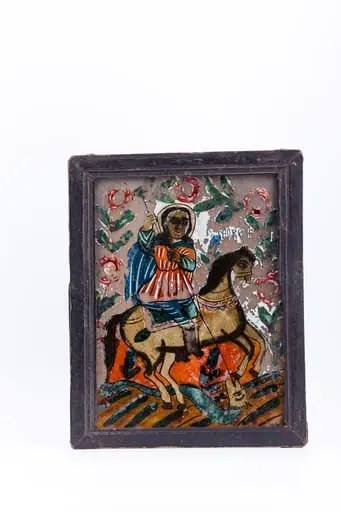 Sfântul Mare Mucenic Gheorghe este așezat călare pe un cal brun-maro-cafeniu, omorând balaurul cu solzi de bronz gri-pământiu cu lancea, pe care o ține cu amândouă mâinile. Balaurul este pictat cu brun-pământiu, având solzi bronzii. Fondul este albastru ceruleum și cobalt, în registrul superior cu elemente decorative fitomorfe, formate din ruje roșii, în cel inferior fiind câmpuri paralele de maro, brun, cafeniu-negru, în centrul icoanei ușor întrepătrundu-se toate culorile. Mantia Sfântului Mucenic Purtător de Biruință este albastră regal, fluturândă, având pantalonii albaștri și cămașa de cavaler, tunica roșie. În registrul superior, icoana este încadrată de o ghirlandă decorativă, formată din 4 ruje - trandafiri roșii, cu frunze verzi. Cromatica este armonioasă, formată fiind din roșu vermillon, albastru cobalt, verde brad, maro, brun, gri, alb și negru. Inscripția din româno-chirilică se traduce Sf Gheorghe. Icoana este deteriorată, fiind absențe cromatice.
 Sfântul Mare Mucenic Gheorghe este așezat călare pe un cal alb cu pete gri, cu elemente de harnașament galbene și verzi și șa roșie, omorând balaurul verde închis cu creastă, solzi și coadă lungă, cu lancea, pe care o ține cu amândouă mâinile, înfingându-i-o animalului în gâtlej. În partea dreaptă a Sfântului Gheorghe, în registrul îndepărtat, este pictată domnița salvată și ocrotită de marele mucenic, cu mâinile ridicate, atât de teamă și spaimă, cât și de mulțumire către sfântul purtător de biruință. Fondul icoanei este alb cu ruje roșii și cerul albastru bleu-ciel în registrul superior. În registrul inferior, fondul este verde, cu linii ondulatorii galbene și roșii, cele două registre în centrul icoanei ușor întrepătrundu-se. Mantia Sfântului Mucenic Purtător de Biruință este roșie-fluturândă având cămașa de cavaler cu zale. Culoarea roșie este caracteristică mucenicilor și martirilor. Atât în dreapta, cât și în stânga sunt elemente de arhitectură, astfel spațializându-se narațiunea iconografică. Cromatica este armonioasă; roșu vermillon, albastru bleu-ciel, galben-ocru, verde văratic, verde brad, alb și ngru. Pe fondul cerului albastru regal și ceruleum este inscripția în româno-chirilică Sf Gheorghe. Icoana este de Nicula.
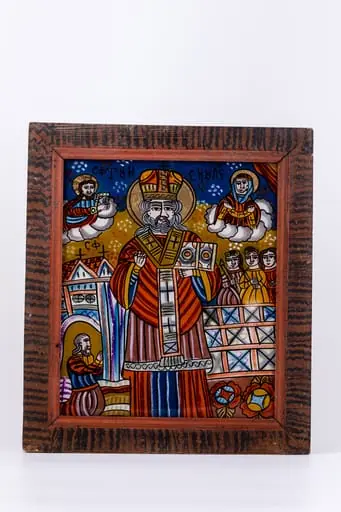 Sfântul Mare Ierarh Nicolae, făcător de minuni, îmbrăcat în veșminte liturgice, de ierarh, sacos roz-stacojiu, felon roșu vermillon-stacojiu, cu interiorul albastru și epitrahil-patrafir gri-bronziu, cu patru cruci negre brodate. Ține în mâna stângă Sfânta Evanghelie și cu mâna dreaptă Binecuvântează. Este unul dintre cei mai populari și iubiți sfinți, ocrotitor al caselor, familiilor și copiilor. Are barbă sură și mithră arhierească și aureolă. În registrul superior, sunt Dumnezeu-Tatăl Binecuvântând și Maica Domnului Ocrotind. Fondul este cerul albastru cobalt-ceruleum, împodobit cu elemente astrale - punctiflorale roșii și albe și un câmp luminos galben-auriu, în registrul mediu. În registrul mediu și inferior, sunt cele trei fete salvate și ajutate de Sfântul Nicolae și tatăl lor îngenuncheat, mulțumind pentru minunea săvârșită. Desenul este fin conturat. Cromatica este armonioasă: roșu vermillon, stacojiu-roz putred, albastru ceruleum și cobalt, galben muștar ocru, bronz, brun, bej, crem, auriu, alb, negru. Inscripția în chirilică se traduce Sfântul Nicolae. Icoana este de Țara Oltului.
 Icoana îi reprezintă pe cei doi Apostoli Sfinții Petru și Pavel, dimpreună cu Soborul de Sfinți Apostoli. Petru cu cheile Împărăției Cerești în mână și pe Pavel cu sabia Cuvântului în mână, susținând împreună chivotul unei biserici, simbolul Bisericii sobornicești și apostolești. Au mantiile roșii și veșmintele în combinație de roșu vermillon, albastru cobalt dungat cu alb și galben solar. Fondul icoanei este cerul albastru ceruleum cu elemente astrale - stele albe și roșii. În grup strâns, în spatele Sfinților Petru și Pavel sunt încă 7 sfinți apostoli și ucenici și un înger cu aripile galbene de lumină. Toți susțin împreună chivotul unei biserici mari. Deasupra Sfinților Apostoli este Dumnezeu-Tatăl care îi veghează, din Cerurile deschise, trimițându-i în toată lumea să propovăduiască Sfânta Evanghelie, numindu-i pescari de oameni. Dumnezeu-Tatăl este prezent prin Ochiul Dumnezeiesc înscris în semnul triunghiului echilateral al Sfintei Treimi, care privește din Cerurile deschise, prin mandorla de nouri albi-albaștri. Chipurile sunt foarte expresive, cu trăsături fine. Compoziția este rezistentă și cromatica foarte armonioasă: roșu vermillon, verde spanac-avocado, galben solar ocru, albastru ceruleum, cobalt, bleu-ciel, brun, gri, alb, negru, auriu. Icoana este de Țara Oltului. Inscripția din româno-chirilică se traduce Petru Pavel.
 Icoana reprezintă Învierea Domnului Iisus Hristos. Mântuitorul Iisus Hristos, ieșind din mormânt, Înviind, Binecuvântând zdrobește ușile iadului. Mântuitorul este înfășurat cu o țesătură verde kaki-gri în mijlocul coapselor și a mijlocului și cu mantia roșie vermillon pe umeri. În dreapta mormântului gri, deschis, sunt doi ostași romani, uimiți. Icoana de Nicula are o cromatică armonioasă: galben-solar, roșu vermillon, alb, albastru cobalt, verde brad-pădure, negru, gri cenușiu. Fondul icoanei este cerul albastru cobalt-ceruleum, în registrul superior și un câmp galben-ocru, cu brun-maro cu pete crem, în registrul inferior, realizându-se, astfel sugestiv, intrarea și ieșirea din pământul morții și a păcatului. Întreaga compoziție iconografică este încadrată de un chenar decorativ geometrizant roșu vermillon și de unul fitomorf, format dintr-o ghirlandă cu două flori-narcise cu frunze unduitoare. Cromatica este armonioasă: roșu vermillon, galben chihlimbar, albastru cobalt-ceruleum, brun, maro, bej, verde smarald, kaki, negru, gri, alb. Inscripția în româno-chirilică se traduce IC XC Iisus Hristos. Icoana este din Nordul Transilvaniei, Nicula.
 "Isu
"Isu Sfânta Mare Cuvioasă Parascheva de la Iași are crucea albă-orange în mâna stângă, binecuvântând, și o ramură de finic verde, nuanța verde smarald în mâna dreaptă. Este îmbrăcată în veșmânt roșu vermillon-orange cu interiorul căptușit cu verde-smarald, cu marginea-bordură galbenă și franjuri verzi. Sacosul este alb-crem cu danteluță, guleraș și dungi albastre-orange. Sfânta Cuvioasă are părul negru lung, lăsat pe umeri, coroană roșie cu verde-brad și aureolă brun-bronzie. Fondul icoanei este cerul albastru bleu-ciel în registrul superior-mijloc și un câmp galben-chihlimbar, ancadrator întregii compoziții. Întreaga compoziție iconografică este încadrată de un chenar decorativ fitomorf, format dintr-o ghirlandă de 9 ruje mari orange-cărămizii cu frunze verzi. Inscripția din româno-chirilică se traduce Paraschiva. Cromatica este armonioasă: roșu vermillon-orange, albastru cobalt-ceruleum, verde smarald, mușchi de pădure, bej-crem, bronziu, galben-chihlimbar, negru, ocru, alb zinc. Icoana este din Nordul Transilvaniei, Nicula.
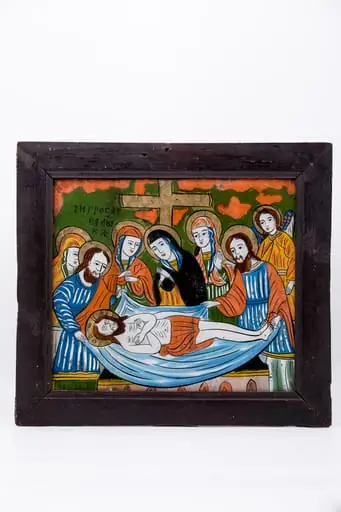 Icoana reprezintă Prohodul Domnului. Punerea în mormânt a Mântuitorului Iisus Hristos. Trupul Mântuitorului Iisus Hristos, fiind coborât de pe cruce, este învelit în țesătura giulgiului alb-albastru. Maica Domnului împreună cu Sfinții Iosif din Arimateea, Nicodim și trei femei mironosițe aducătoare de mir țin în brațe trupul Mântuitorului. Martor și aproape este Îngerul care va striga bucuria Învierii Domnului. Compozițional se creează astfel o imagine concentrică de corabie, cu Crucea Răstignirii ca și catarg, corabia prefigurând Biserica. Giulgiul și îmbrățișarea celor apropiați, uniți întru dragoste și suferință, reprezintă axa orizontală, perpendiculară pe Cruce. Compoziția este echilibrată, simetrică și circulară. Maica Domnului este îmbrăcată în veșmânt cu maforiom negru, cu sacos galben și interiorul căptușit cu albastru ceruleum. Veșmintele Sfinților și Mironosițelor sunt în combinație de roșu vermillon, albastru cu linii albe, galben solar și verde-văratic. Fondul icoanei este văzduhul verde-văratic, plin de Duhul Sfânt și un chenar decorativ sugerat ca și ancadrament, format din elemente florale stilizate - ruje roșii. Cromatica este armonioasă: roșu vermillon, albastru cobalt, ceruleum, verde văratic-forest, galben solar-chihlimbar, alb și negru. Inscripția din româno-chirilică se traduce Îngroparea Lui IC XC Iisus Hristos. Icoana este din Țara Oltului.
 Sfânta Mare Cuvioasă Parascheva de la Iași are crucea în mâna dreaptă, stă așezată pe un tron împărătesc, și cu mâna stângă deschisă înspre noi dăruiește pace și liniște, asemenea unei binecuvântări. Este îmbrăcată în veșmânt roșu vermillon, cu interiorul căptușit cu albastru, galben-chihlimbar și dungi albe, cu manșete pictate cu albastru și galben. Faldurile veșmântului și drapajele, cât și bogăția dungulițelor albe ornamentale împodobesc frumos întreaga tematică iconografică. Peste maforionul roșu închis la gât cu o fibulă rotundă, sfânta cuvioasă are coroniță și aureolă. Fondul icoanei este împărțit în registrul superior cer albastru bleu-ciel foarte deschis și senin și câmp galben, luminos, de grâu vara. În registrul superior, icoana este încadrată de un chenar floral, format dintr-o ghirlandă de trandafiri sălbatici, ruje roșii și lalele închise. În registrul superior, colțul din dreapta și stânga Sfintei PreaCuvioase, este câte un Înger Arhanghel, Mihail și Gavriil, îndreptându-și privirea și ocrotirea înspre Sfânta Parascheva. Trupurile Arhanghelilor se confundă, la un moment dat, cu ornamentele geometrizante ale tronului împărătesc, așadar trupurile Arhanghelilor reprezintă tronul sfintei. Cerul albastru este înstelat cu elemente florale roșii și albe, stelele având forma florilor, iar floarea din partea dreaptă a Sfintei PreaCuvioase se subînțelege ca fiind un heruvim. Ghirlanda de deasupra este paralelă și simetrică cu ruloul de pernă de pe tron. Icoana este foarte frumos realizată artistic și estetic, finețea nuanțelor cromatice și expresivitatea sfintei cuvioase remarcându-se într-un mod deosebit. Cromatica este senină și vie: roșu vermillon, bleu ciel, galben chihlimbar, verde kaki, gri, alb, brun, negru. Icoana este de Țara Oltului. Inscripția din româno-chirilică se traduce Sfânta Paraschiva.
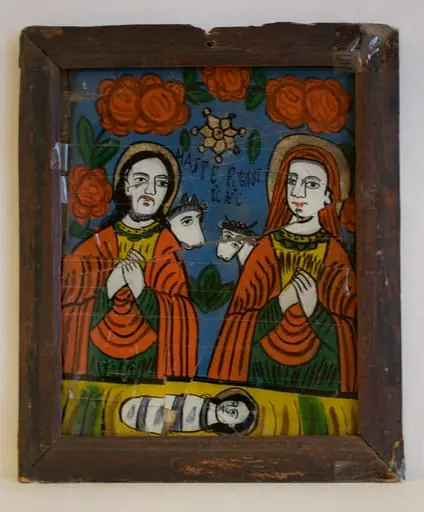 Naștiu s
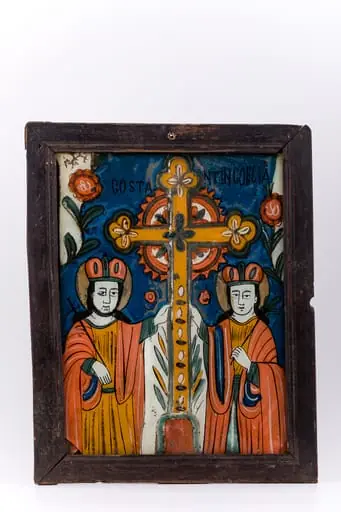 În centrul icoanei este Crucea, iar în stânga crucii este Sfânta Împărăteasă Elena, și în dreapta este Împăratul Constantin. Veșmintele sfinților împărați sunt pictate cu roșu vermillon și gri-antracit și epitrahile-patrafire gri-antracit. Poartă coroane împărătești și aureole de sfinți, mantiiile de împărați le au prinse la gât cu fibulă. Crucea este roșie-vermillon cu gri și are capetele brațelor cu elemente decorative trilobate roșii vermillon-cărămiziu. Fondul este cerul albastru bleu-ciel foarte senin, înspre alburiu. Împrejurul Crucii este un spațiu luminos de galben-chihlimbar. Întreaga compoziție iconografică este încadrată de un chenar decorativ fitomorf, format dintr-o ghirlandă de 7 ruje - trandafiri și bujori roșii vermillon și 2 boboci de măceș - cu frunze gri-verzui. Cromatica este armonioasă: roșu vermillon-cărămiziu, albastru bleu-ciel înspre alburiu, gri-antracit, bronziu, brun, galben-chihlimbar, ocru, alb, negru. Inscripția în româno-chirilică se traduce Constantin și Elena. Icoana este din Nordul Transilvaniei, Nicula.
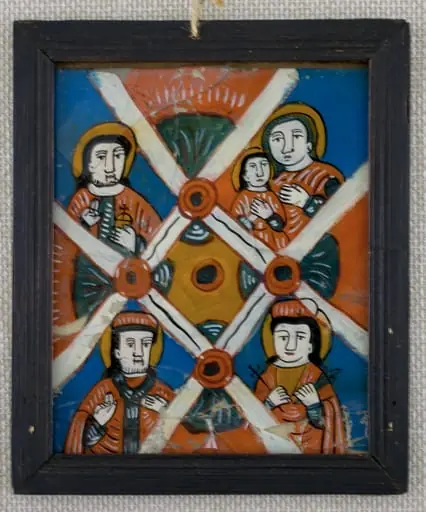 Icoa
Icoa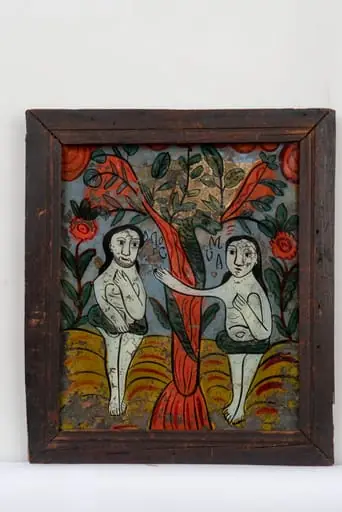 În stânga și-n dreapta pomului cunoștinței binelui și răului sunt reprezentați în picioare Adam și Eva. Scena imortalizează momentul în care Eva îi întinde mărul lui Adam. Șarpele, care e pictat încolăcit în jurul pomului, are capul îndreptat către urechea Evei, ispitind-o . Adam are mână stângă la gât, evidențiind locul unde s-a oprit înghițitura neascultării. Icoana e ornată pe margini cu ruje. Cromatica se compune din tonuri de roșu vermillon, verde, albastru, ocru galben, gri și negru. Rama icoanei e profilată, băițuită, și e formată din îmbinarea a patru baghete de lemn.
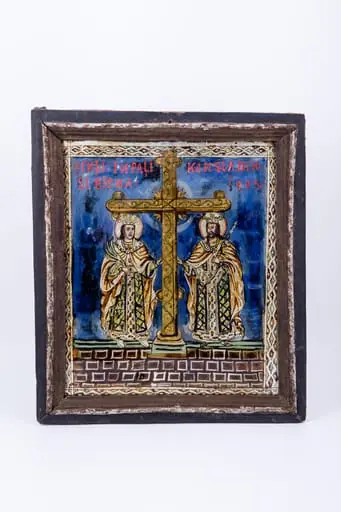 În centrul icoanei este Crucea, iar în stânga crucii este Sfântul Împărat Constantin, și în dreapta este Împărăteasa Elena, mama sa. Deasupra fiecăruia este inscripționat numele. În spatele Crucii, lipit de cruce, este un soare stilizat - Soarele dreptății. Soarele din spatele Crucii duce gândul la Crucea de lumină apărută pe cer In hoc signo vinces - prin acest semn vei învinge. Icoana este specifică Văii Sebeșului, tușele de culoare fiind mărturii clare. Inscripțiile în româno-chirilică sunt traduse Sfinții Împărați Constantin Elena. Veșmintele sfinților împărați sunt pictate cu brun, verde, kaki, absint, bronziu, alb și negru. Simbolurile, din mâinile împăraților sunt pene de scris, instrumente de scris, condei și aripă de înger, armele cu care s-au luptat pentru Creștinism, mucenici ai mărturisirii. Cromatica este armonioasă: verde, galben-ocru, kaki, brun, absint, olive, bej, bronziu, alb, negru. Compoziția este puternică în impactul vizual: cerul albastru cobalt și pardoseala în caroiaj, cafeniu-bej-brun, din registrul inferior. Caroiajul reprezintă o lespede de fundație puternică - reprezentând credința creștin-ortodoxă, un zid de nedărâmat. Icoana este de Laz, fiind datată 1905.
 Sfântul Mare Mucenic Gheorghe este așezat călare pe un cal alb-gri, omorând balaurul verde-gri-antracit cu lancea, pe care o ține în amândouă mâinile. Fondul icoanei este cerul cobalt-senin, în registrul superior și alb-bej-bronziu în cel inferior, în centrul icoanei ușor întrepătrundu-se toate culorile. Tunica Sfântului Mucenic Purtător de Biruință este roșie vermillon, cu mânecile verzi, având pantalonii gri, cizme negre și tunică roșie-vermillon. Întreaga compoziție iconografică este încadrată de un chenar decorativ fitomorf, format dintr-o ghirlandă de 7 ruje - trandafiri sălbatici și bujori roșii și roz cu petale și pistil alternativ colorate cu albastru cobalt, roz și roșu vermillon. Ghirlanda excelează prin delicatețea desenului și bogăția cromatică armonioasă. Ziua de praznic a Sfântului Gheorghe este în 23 aprilie, primăvara, justificându-se pentru încă o dată prezența ghirlandei înflorite. Inscripția din româno-chirilică se traduce S. Georgie. Cromatica este armonioasă; roșu vermillon, roz, albastru cobalt, ceruleum, cobalt, gri antracit, ocru, bronziu, brun, crem, alb și negru. Icoana este din Nordul Transilvaniei, Nicula.
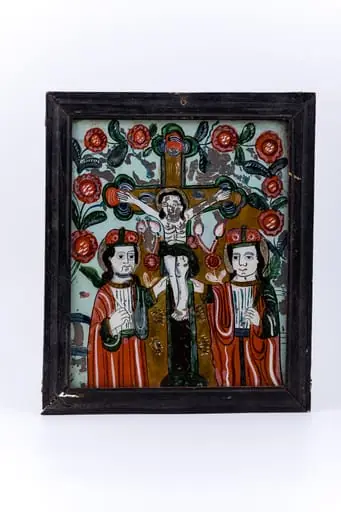 Mântuitorul Iisus Hristos, fiind răstignit pe Cruce, are în dreapta pe Sfântul Împărat Constantin cel Mare, în locul uceniculuil cel iubit, care a stat lipit de pieptul Învățătorului, la Cina cea de Taină, mai precis, în locul Sfântului Apostol și Evanghelist Ioan Teologul, Evanghelistul Iubirii și în stânga pe Sfânta Împărăteasă Elena, mama Sfântului Constantin, în locul Maicii Domnului Îndurerate, Jalnică și Plângătoare. Veșmintele Sfinților Împărați sunt sacosuri albe, cu dungi albastre-verzi și mantii roșii vermillon, cu mânecile largi și verzi. Mântuitorul Iisus Hristos Răstignit pe Cruce are o țesătură verde-forest în jurul mijlocului și a coapselor. Fondul icoanei este cerul albastru bleu-ciel înspre alburiu senin și deschis, în registrul superior și galben-chihlimbar, în spatele Crucii, un spațiu galben-solar, prefigurând Lumina Învierii Domnului Iisus Hristos. Întreaga tematică iconografică este încadrată de un chenar decorativ fitomorf, format dintr-o ghirlandă de bujori și trandafiri, 10 ruje. Cromatica este armonioasă: roșu vermillon, albastru bleu-ciel, albastru cobalt, gri antracit, galben-chihlimbar, verde forest, alb zinc, negru. Icoana este mai rară, datorită abordării tematicii iconografice. Icoana este din Nordul Transilvaniei, Nicula.
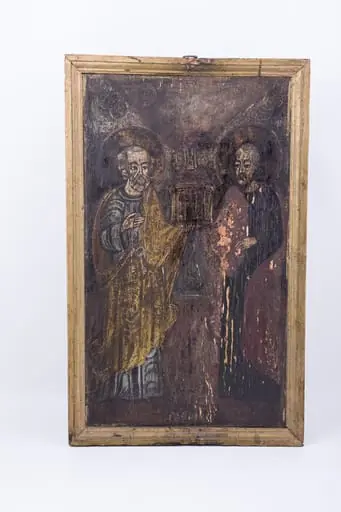 Icoana îi prezintă pe Sfinții Apostoli Petru și Pavel. Sfântul Petru, înveșmântat în verde și roșu, are în mâna dreaptă cheile Împărăției Cerești și în mâna stângă Sfânta Evanghelie. Apostolul Pavel, este înveșmântat în roșu și galben, are sabia și spada Cuvântului. Prezentarea celor doi apostoli este una simetrică și echilibrat-compozițională. Sfinții Apostoli susțin cu mâinile o Biserică, simbolul bisericii apostolice și sobornicești, un chivot sfințit. Chipurile sunt foarte expresive, cu trăsături fine. Cromatica este armonioasă: roșu vermillon, albastru bleu-ciel, brun, galben-ocru, alb, negru. Inscripția este indescifrabilă.
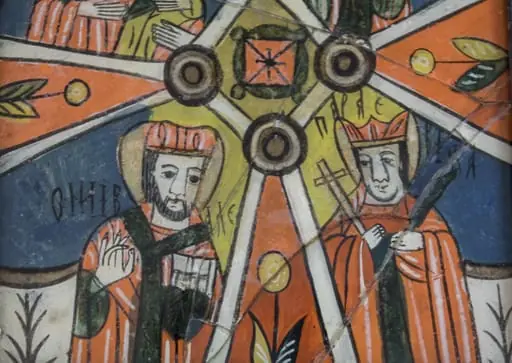 Icoaoasă
 Icoana îi reprezintă alături, față în față, ca într-o oglindă, pe Pruncul Iisus Hristos și Pruncul Ioan, cel care avea să fie Sfântul Ioan Botezătorul și Înaintemergătorul Domnului nostru Iisus Hristos. Cei doi copilași erau veri, cu o diferență de șase luni între ei. Pruncul Iisus Hristos are în mânuțe globul pământesc cu o cruce deasupra, asemenea unui chivot sfințit, iar Pruncul Ioan are în brațe un mieluț, arătând către Mântuitorul Iisus Hristos: „Iată mielul!”. Sunt înfășurați amândoi cu câte o țesătură roșie-cărămizie-roz, culoarea pătimirii și a jertfei. În interiorul icoanei este un composit de albastru ultramarin bleu-marin și galben luminos. Întreaga tematică iconografică este încadrată de un chenar decorativ fitomorf, format dintr-o ghirlandă de trandafiri, 5 duble și 4 ruje roșii, bobocei de trandafirași, În centru icoanei, între cei doi copilași este un fruct de măceș. Icoana este de Nicula, având o cromatică luminoasă: roșu vermillon-cărămiziu-roz, albastru ultramarin și bleumarin, bleu ciel și ceruleum, galben chihlimbar, verde brad, alb, negru. Inscripția din româno-chirilică se traduce: Ioan IC XC Iisus Hristos. Icoana este din Nordul Transilvaniei, Nicula.
 Sfântul Mare Ierarh Nicolae Făcătorul de minuni este redat central, pe tron arhieresc, ținând în mâna stângă Sfânta Evanghelie deschisă și binecuvântează cu mâna dreaptă. Veșmintele arhierești liturgice ale sfântului ierarh sunt într-o alternanță cromatică de orange-verde-albastru-ocru-brun-bronziu și alb și negru. Epitrahilul, patrafirul este brun-bronziu, cu patru cruci pe el, sacosul orange-roșu vermillon. Poartă mithră și are aureolă. În registrul superior îndepărtat sunt Dumnezeu-Tatăl și Maica Domnului, care ating aureola Sfântului Nicolae. Pe fondul verde, Mântuitorul și Maica Domnului au veșminte brune și roșii și sunt așezați pe mandorle de nouri albi-albaștri. Inscripția din româno-chirilică se traduce Sf Nicolae ICXC MP Iisus Hristos Maica Domnului. În registrul inferior, la picioarele Sfântului Ierarh sunt tatăl mulțumitor și îngenuncheat și cele trei fete salvate, prin minune, de sărăcie și păcat. Icoana are o cromatică puternic-vie, spcifică Țării Oltului: roșu vermillon, orange, verde spanac-avocado, albastru ceruleum și bleu-ciel, bru, gri, alb, negru.
 Icoana este pictată pe dosul unei bucăți de sticlă dreptunghiulară, în ax vertical; Icoana reprezintă Botezul lui Isus Hristos, care se prăznuiește pe 6 ianuarie("Boboteaza") Isus Hristos, cu picioarele goale în apa Iordanului(redată prin câteva linii oblice), cu un ștergar verde în jurul mijlocului, brațele încrucișate pe piept, primește botezul cu apă de la Sfântul Ioan Botezătorul, care ține în mâna dreaptă o cruce . Acesta este înveșmântat cu o mantie roșie cu partea de jos a mânecilor verde. În mâna stângă, cu care îl botează pe Hristos, apare o mână mică, probabil reprezentarea mâinii lui Dumnezeu care coboară dintr-un nor de foc în care este zugrăvit și Duhul Sfânt în formă de porumbel alb, cu aripile verzi, coborînd deasupra lui Isus. De partea cealaltă a lui Isus se află Arhanghelul Gavriil, cu părul revărsat pe umeri, în veșminte asemănătoare cu ale Sf. Ioan, ținînd un ștergar în mâini. Aureolele realizate cu foiță de aur. Câmp bleu, flori mari, roșii pe tulpini înalte, sunt înghesuite în spațiul rămas. Icoana are caracteristicile specifice picturii niculene, dar este evidentă faza de decadență(redarea figurilor, spațiul aglomerat, culorile, suportul). Rama profilată, culoarea lemnului natur.
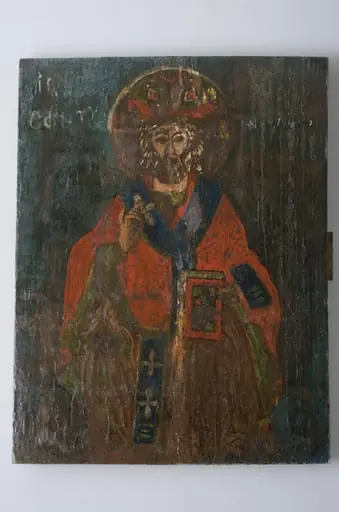 Icoana este pictată pe lemn, reprezentându-l pe Sfântul Nicolae cu veșminte arhierești (felon roșu, omofor albastru și mitră pe cap), ținând Evanghelia închisă cu mâna stângă și binecuvântând cu mâna dreaptă. Cromatică: roșu, albastru, verde, maro închis.
 Sfântul Mare Ierarh Nicolae, făcător de minuni, îmbrăcat în veșminte liturgice, de ierarh, sacos gri și felon roșu vermillon, epitrahil-patrafir brun-bronziu cu patru cruci. Ține în mâna stângă Sfânta Evanghelie închisă și cu dreapta Binecuvântează. Este unul dintre cei mai populari și iubiți sfinți, ocrotitor al caselor, familiilor și copiilor. Are barbă sură-albă și mithră arhierească și aureolă. Fondul este albastru-regal gri senin. În registrul superior sunt Dumnezeu-Tatăl Binecuvântând și Maica Domnului Ocrotind cu luminosul Acoperământ. Desenul este stângaci și cromatica vie-puternică și luminoasă: roșu vermillon, orange, gri, ocru, albastru regal-gri deschis. Inscripția din româno-chirilică se traduce Sf Nicolae. Icoana este de Mărginimea Sibiului.
 Scen
Scen Icoaobli
 Sfântul Mare Mucenic Gheorghe este așezat călare pe un cal alb cu șaua roșie, omorând balaurul, cu coadă de reptilă, cu lancea, pe care o ține în mâna dreaptă. Balaurul este pictat cu verde întunecat spre negru și alb-gri, având solzi și coadă de reptilă. Fondul icoanei este cerul albastru-bleu ciel înspre alburiu, în registrul superior și galben-lemon în cel inferior, în centrul icoanei ușor întrepătrundu-se toate culorile. Mantia Sfântului Mucenic Purtător de Biruință este roșie-vermillon, înspre roz, având pantaloni albaștri și cizme negre. Flori mari asemenea unor pete roșii vermillon, rujele echilibrează întreaga compoziției. În registrul superior, icoana este încadrată de un chenar decorativ, format dintr-o ghirlandă de 5 ruje roșii, mari, cu frunze verzi-albăstrii. Inscripția din româno-chirilică se traduce Gheorghe. Cromatica este armonioasă: roșu vermillon, roz, albastru bleu-ciel, cobalt, verde forest, smalald, gri, galben-lemon, alb și negru. Icoana este din Nordul Trandilvaniei, Nicula.
 Sfântul Mare Mucenic Gheorghe este așezat călare pe un cal alb, cu pete gri, omorând balaurul verde cu lancea, pe care o ține cu amândouă mâinile. Balaurul este pictat cu verde-brad, având corpul de reptilă. Fondul este albastru bleu-ciel, în registrul superior și roșu-galben-verde, în cel inferior, în centrul icoanei ușor întrepătrundu-se toate culorile. Tunica Sfântului Mucenic Purtător de Biruință este roșie cu verde, având pantalonii albaștri și cămașa de cavaler roșie. Mantia fluturândă a Sfântului Mucenic este albastră. În registrul superior, pe cer, sunt 6 elemente florale roșii cu frunze lungi verzi, echilibrând întreaga compoziție. Rujele din ghirlanda decorativ-ancadratoare au motivul zăluței albe în interior. Fiind o icoană de Nicula, imaginea picturală este armonioasă, cu un desen simplu, curat. Cromatica este armonioasă; roșu vermillon, albastru bleu-ciel și cobalt, verde brad, ocru, brun, gri, alb și negru. Inscripția din româno-chirilică se traduce Gheorghe. Icoana este rafinată prin acuratețea desenului, compoziția echilibrată și armonia cromatică. Icoana este de Nicula-Gherla.
 Icoana Îl reprezintă pe Iisus Hristos pe tron arhieresc, Învățător și Împărat, Binecuvântând, având alături pe Maica Domnului și pe Sfântul Mare Mucenic Gheorghe. Reprezentarea aceasta este asemănătoare cu tematica iconografică numită Deisis. Deisis este o tematică fundamentală din iconografia bizantină, reprezentându-L pe Domnul Iisus Hristos în ipostasul de Mare Judecător, fiind Împărat pe Tron, având în dreapta pe Maica Domnului și în stânga pe Sfântul Ioan Botezătorul și Înaintemergătorul Domnului. Această tematică este nucleul Judecății De Apoi. Mântuitorul Iisus Hristos Mare Judecător are în mâna stângă Sfânta Evanghelie deschisă și cu mâna dreaptă binecuvântează. De data aceasta, în locul Sfântului Ioan Botezătorul este Sfântul Gheorghe. Mântuitorul Iisus Hristos are veșminte roșii, cu interiorul galben-verde, cu epitrahil albastru, cu două cruci negre brodate. Tronul arhieresc este bogat ornamentat cu elemente decorative geometrizante aurii, sugerând arhitectura unui palat, Împărăția Cerurilor într-o metaforă picturală. În registrul superior, înspre interiorul icoanei, pe fondul de verde-văratic al văzduhului plin de Sfântul Duh sunt prezente elementele astrale: stele albe și roșii. Alături sunt Maica Domnului, în partea dreaptă a Mântuitorului și Sfântul Mare Mucenic Gheorghe Purtător de Biruință, în partea stângă. Cromatica este armonioasă: roșu vermillon, albastru regal, galben-chihlimbar, verde-văratic spanac-vocado, brun, acajou, crem, alb, negru. Icoana este de o frumusețe deosebită. După stilul picturii, desen și cromatică, compoziție și minuțiozitatea detaliului este o icoană din Țara Oltului. Inscripția din româno-chirilică se traduce IC XC Iisus Hristos.
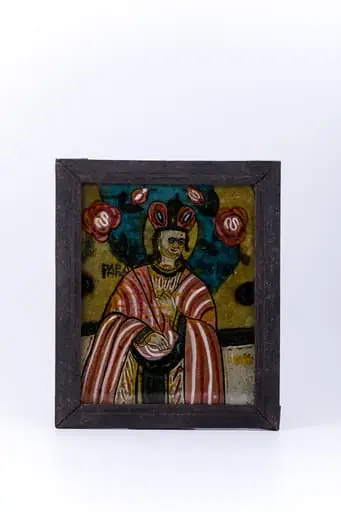 Sfânta Mare Cuvioasă Parascheva de la Iași are crucea brun-neagră în mâna stângă, binecuvântând, și o ramură de finic verde, nuanța de brad în mâna dreaptă. Este îmbrăcată în veșmânt roșu vermillon-trandafiriu cu dungi albe, cu interiorul căptușit cu verde-mușchi de pădure și modele galbene. Sacosul este alb-crem cu danteluță, guleraș și dungi galbene. Sfânta Cuvioasă are părul negru lung, lăsat pe umeri, coroană roșie cu verde-brad și aureolă brun-bronzie. Fondul icoanei este cerul albastru cobalt în registrul superior-mijloc și un câmp crem-galben, ancadrator întregii compoziții. Întreaga compoziție iconografică este încadrată de un chenar decorativ fitomorf, format dintr-o ghirlandă de 2 ruje mari roșii vermillon, 2 boboci de măceș, cu frunze verzi. În registrul inferior este un spațiu crem-nisipiu, sable. Inscripția din româno-chirilică se traduce Paraschiva. Cromatica este armonioasă: roșu vermillon-trandafiriu, albastru cobalt-ceruleum, verde brad, mușchi de pădure, bej-crem, bronziu, galben-solar, negru, alb zinc. Icoana este din Nordul Transilvaniei, Nicula.
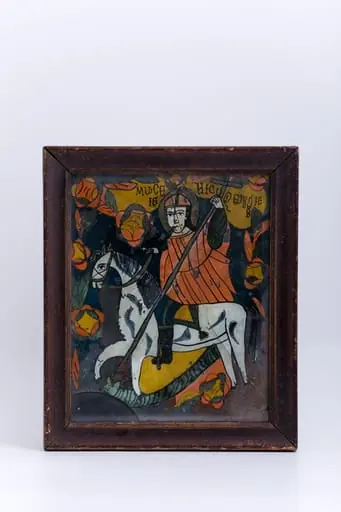 Sfântul Mare Mucenic Gheorghe este așezat călare pe un cal alb acoperit cu elemente de harnașament galbene și verzi și omorând balaurul cu lancea bronzie, pe care o ține în mâna stângă. Balaurul este pictat cu verde smarald-gri și kaki și gri cenușiu-antracit verzui și având corp de reptilă, cu coadă de diavol. Fondul icoanei este cerul albastru ultramarin-bleumarin și galben-chihlimbar în exterior și în cel inferior, în centrul icoanei ușor întrepătrundu-se toate culorile. Tunica Sfântului Mucenic Purtător de Biruință este roșie-vermillon-orange, având pantalonii albaștri-ultramarin. În registrul superior, icoana este încadrată de un chenar decorativ, format dintr-o ghirlandă de 8 ruje orang-galben. Cromatica este armonioasă: roșu vermillon, orange, albastru-regal, cobalt și ceruleum, ocru, galben chihlimbar, verde kaki și smarald, gri antracit, alb și negru. Inscripția din româno-chirilică se traduce Mucenicu Gheorghe. Icoana este din Nordul Transilvaniei, Nicula.
 Icoana reprezintă Prohodul Domnului. Punerea în mormânt a Mântitorului Iisus Hristos. Trupul Mântuitorului Iisus Hristos, fiind coborât de pe cruce, este învelit în țesătura giulgiului alb-verde-gri. Maica Domnului împreună cu Sfinții Iosif din Arimateea, Nicodim și două femei mironosițe aducătoare de mir țin în brațe trupul Mântuitorului. Compozițional se creează astfel o imagine concentrică de corabie, cu Crucea Răstignirii ca și catarg, corabia prefigurând Biserica. Giulgiul și îmbrățișarea celor apropiați, uniți întru dragoste și suferință, reprezintă axa orizontală, perpendiculară pe Cruce. Compoziția este echilibrată, simetrică și circulară. Maica Domnului este îmbrăcată în veșmânt roșu vermillon-corai, cu sacos alb-crem, cu dungulițe albastre. Veșmintele Sfinților și Mironosițelor sunt în combinație de roșu vermillon și verde-forest. Mironosițele sunt înveșmântate în galben-chihlimbar - culoarea luminii și a Mirului. Ele sunt vestitoarele Învierii Domnului Iisus Hristos. Fondul icoanei este cerul albastru regal și un spațiu de galben-chihlimbar-verde-maro, în registrul inferior. Întreaga tematică iconografică este încadrată de un chenar decorativ fitomorf, format dintr-o ghirlandă din 2 ruje mari roșii vermillon. Cromatica este armonioasă: roșu vermillon, albastru cobalt, regal, bleu-ciel alburiu, verde văratic-forest, galben chihlimbar, maro, alb și negru. Inscripția din româno-chirilică se traduce Îngroparea. Icoana este din Nordul Transilvaniei, Nicula.
 În centrul icoanei este Crucea, iar în dreapta crucii este Sfântul Împărat Constantin și în stânga este Împărăteasa Elena, mama sa. Deasupra fiecăruia este inscripționat numele. Veșmintele sfinților împărați sunt pictate cu roșu vermillon, kaki și verde mușchi de pădure. Poartă coroane împărătești și aureole de sfinți, mantiiile de împărați le au prinse la gât cu fibulă. Fondul este albastru regal, culoarea cerului. În registrul inferior este un câmp luminos de galben-ocru și o pardoseală într-un caroiaj alb-negru. Crucea este mare cât întreaga suprafață a icoanei, având în spate două aripi verzi din ramuri de măslin, finic, laur. Cromatica este armonioasă: roșu vermillon, albastru ceruleum, bleu-ciel, regal, brun, galben-ocru, albastru, verde mușchi de pădure, alb, negru. Inscripția din româno-chirilică se traduce Constantin Elena. Icoana reprezintă pictura de Nicula.
 Sfântul Mare Mucenic Gheorghe este așezat călare pe un cal alb-zinc cu pete gri, omorând balaurul gri-verde smarald, cu coadă lungă de reptilă, cu lancea, pe care o ține în amândouă mâinile. Fondul icoanei este cerul albastru ceruleum-cobalt, în registrul superior și câmpuri brune-cafenii, cu pete punctiforme bej-crem, în cel inferior, în centrul icoanei ușor întrepătrundu-se toate culorile. Mantia Sfântului Mucenic Purtător de Biruință este verde-smarald, având pantalonii albi-gri, cizme negre și cămașa-tunică de cavaler roșie orange-corai. Icoana este încadrată de un chenar decorativ fitomorf. În registrul superior-îndepărtat este chipul domniței salvate și păzite de Sfântul Gheorghe. Cromatica este armonioasă: orange-corai, albastru ceruleum și cobalt, verde brad forest, galben-chihlimbar, ocru, brun, crem, auriu, alb și negru. Inscripția din româno-chirilică se traduce Gheorghe. Icoana este din Nordul Transilvaniei, Nicula.
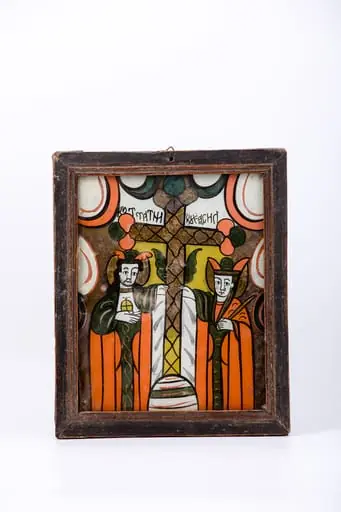 În centrul icoanei este Crucea galben-bronzie, împodobită decorativ cu linii șerpuitoare negre. În dreapta crucii este Sfântul Împărat Constantin și în stânga este Împărăteasa Elena, mama sa, cu numele lor deasupra inscripționate. În spatele Crucii este un spațiu galben izvorâtor de lumină. Crucea găsită este susținută cu bucurie de cei doi sfinți. Veșmintele Sfinților Constantin și Elena sunt într-o combinație de roșu vermillon și verde kaki-brun. Spațiul galben de lumină duce gândul la Crucea de lumină apărută pe cer In hoc signo vinces - prin acest semn vei învinge. Icoana este bogat ornamentată de culoare, lumină și detalii semnificative, elemente decorative geometrizante - romburi ondulatorii negre și brațele crucii au terminații trilobale roșii, verzi și gri. Fondul icoanei este alb și brun-bronziu. Întreaga compoziție este încadrată armonios de un chenar decorativ geometrizant, format din semisfere alb-roz. Cromatica este armonioasă și senină: roșu vermillon, roz, galben-chihlimbar, verde kaki, brun-bronziu, gri antracit, alb, negru. Icoana este de Nicula. Inscripția din româno-chirilică se traduce Sf Constantin Sf Elena.
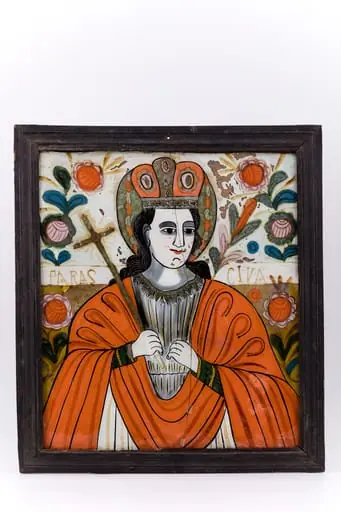 Sfânta Mare Cuvioasă Parascheva de la Iași are crucea în mâna dreaptă și ramură de finic verde brad, cu frunze roz și roșii în mâna stângă. Este îmbrăcată în veșmânt roșu vermillon, cu interiorul căptușit cu verde și galben, cu sacosul alb ivoriu, cu dungi crem-bej. Sacosul este alb ivoriu crem-bej, cu danteluță și guleraș galben. Sfânta Cuvioasă are părul negru lung, ondulat, lăsat pe umeri, coroană roșie și aureolă. Fondul icoanei este cerul albastru bleu-ciel-alburiu senin, în registrul superior și un câmp înalt luminos de grâu galben-copt, în registrul mediu și inferior, de culoare ocru-muștar. Întreaga compoziție iconografică este încadrată de un chenar decorativ fitomorf, format dintr-o ghirlandă de 6 ruje - trandafiri sălbatici și bujori roșii, cu petale și pistil alternativ colorate cu albastru cobalt, roz și roșu vermillon. Ghirlanda excelează prin delicatețea desenului și bogăția cromatică armonioasă. Inscripția din româno-chirilică se traduce Paraschiva. Cromatica este armonioasă: roșu vermillon, roz, albastru bleu-ciel, cobalt, verde forest, bej-crem, negru, galben chihlimbar, ocru, muștar, negru, alb. Icoana este din Nordul Transilvaniei, Nicula.
 Împlinindu-se trei ani de la Nașterea PreaCuratei Fecioare Maria, drepții ei părinți Ioachim și Ana, păstrându-și făgăduința, o aduc în dar Lui Dumnezeu pe cea născută. Împreună cu rudeniile din Nazaret și cu cetele de fecioare tinere, cu făclii aprinse, părinții au dat-o în Biserică în Ierusalim, pe Prunca Maria arhiereului Zaharia, care a dus-o în Sfânta Sfintelor. PreaCurata Fecioara Maria Prunca este înveșmântată în roșu și este micuță de trei anișori, cu trăsături mature de înțelepciune duhovnicească. Veșmintele Sfinților Părinți sunt albastre și roșii, ocru și stacojii. Maica Domnului Prunca Maria este ținută de mânuță de Sfinții Părinți Ioachim și Ana. Fondul este albastru regal în interior, galben-luminos pe margini și alb, exterior, cele trei straturi fiind dispuse concentric. Inscripția din româno-chirilică se traduce Sf Maria. Întreaga compoziție este armonizată și prin încadrarea în chenarul decorativ fitomorf, format din ghirlanda de 7 ruje - trandafiri roșii. În spatele Mariei este o floare, care amintește de Sfântul Arhanghel Gavriil, aducător de BuneleVestiri. Cromatica este armonioasă: roșu vermillon, albastru regal și bleu-ciel, cobalt, galben-chihlimbar, ocru, alb, negru.
 Sfântul Mare Ierarh Nicolae Făcătorul de minuni este redat central, așezat pe tron arhieresc, ținând în mâna stângă Sfânta Evanghelie deschisă și binecuvântează cu mâna dreaptă. Veșmintele arhierești liturgice ale sfântului ierarh sunt într-o alternanță cromatică de roșu vermillon-verde-ocru și alb și negru. Epitrahilul, patrafirul este verde, cu patru cruci pe el, sacosul roșu vermillon. Poartă mithră și are aureolă. În registrul inferior în colțul din stânga Sfântului Nicolae este tatăl celor trei fete, salvate de sărăcie și desfrânare, îngenuncheat, mulțumind prin ajutor. În colțul din dreapta Sfântului sunt cele trei fete cu coronițe pe cap, coronițele simbolizând atât bogăția materialnică, cât și cumințenia și curățenia sufletească. În registrul superior, dreapta sfântului, este Mântuitorul Dumnezeu-Fiul binecuvântând și în partea stângă este Maica Domnului ocrotind. Inscripția din româno-chirilică se traduce Sf Nicolae ICXC MP Iisus Hristos Maica Domnului. Cromatica este specifică Țării Oltului: roșu vermillon, verde de China, galben chihlimbar, ocru, albastru ceruleum, alb, negru.
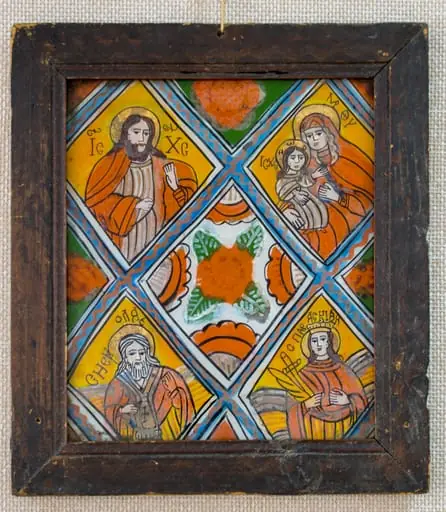 Icoa cu
 Desenul este executat probabil fără tipar, cu un instrument de scris cu cerneala.Culorile sunt stridente, dar se observă o oarecare măiestrie. Tema combină Răstignirea cu Plângerea de inspirație catolică. Isus răstignit pe crucea plasată deasupra pietrei mormântului, la picioare doi îngeri, îngenuncheați. Desenul este foarte naiv, chipul lui Isus invadat de barbă și păr, profilurile celor doi îngeri diforme. Crucea este treflată, verde cu chenar violet, cu inscripția INRI scrisă invers în partea de sus. Cei doi îngeri au părul creț, negru, înveșmântați unul cu albastru, celălalt cu roșu, aripile albe. Piatra de mormânt, încadrată de două coline verzi, decorată cu o floare mov. Fondul pe care se profilează scena este galben orange cu chenar roșu. Chenar marginal lat, pe laturile inferioare de flori mari pe fond albastru-bleu, iar în partea de sus de 5 turle de biserici inspirate din pictura rusească(fond verde) Paleta cromatică variată, culorile stridente. Pe spate a avut lipită o hârtie mai groasă care servea drept dos. Rama este simplă, din lemn de brad prelucrat rudimentar, de culoare cafenie, decorată cu un motiv vălurit dispus longitudinal.
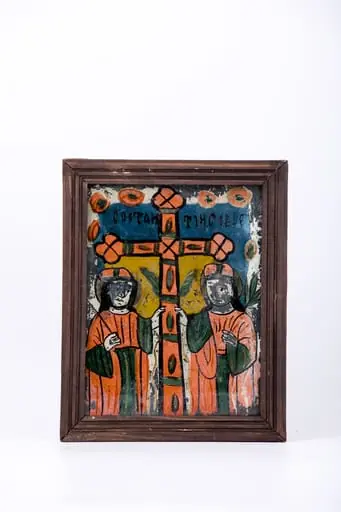 În centrul icoanei este Crucea pictată cu roșu vermillon și ornamentată cu 7 elemente ovoidale gri antracit și brațele au terminații trilobate. În dreapta crucii este Sfântul Împărat Constantin, și în stânga este Împărăteasa Elena, mama sa. Deasupra fiecăruia este inscripționat numele. În spatele Crucii, lipit de cruce, sunt două aripi ca de înger, stilizate sub formă de elemente vegetale. Veșmintele Sfinților Constantin și Elena sunt într-o combinație de roșu vermillon și gri antracit. Spațiul galben de lumină din spatele crucii duce gândul la Crucea de lumină apărută pe cer In hoc signo vinces - prin acest semn vei învinge. Icoana este bogat ornamentată de culoare, lumină și detalii semnificative, elemente decorative geometrizante și fitomorfe. Fondul icoanei este cerul de noapte, albastru ultramarin bleumarin întunecat. Întreaga compoziție este încadrată armonios de un chenar decorativ fitomorf-geometrizant, format din ruje roșii. Cromatica este armonioasă și bogată: roșu vermillon, galben-chihlimbar, albastru ultramarin bleumarin, gri antracit, alb, negru. Icoana este de Nicula. Inscripția din româno-chirilică se traduce Constantin Elena. Icoana este deteriorată, având absențe cromatice.
 Icoana îl reprezintă pe Mântuitorul Iisus Hristos, copil fiind, redat semi-profil, înfășurat cu o mantie roșie vermillon, dar cu umerii goi de copilaș, ținând în mâini, globul pământesc cu crucea deasupra, asemnea unui chivot de biserică. Fondul icoanei este albastru cobalt, în centrul icoanei, creându-se un adânc veșnic. În marginile icoanei, fondul este alb-ivoriu, înconjurat de elemente decorative fitomorfe - 8 trandafiri, ruje, roșii, cu frunze verzi. În registrul inferior este galben-solar.
 Icoana o prezintă pe Maica Domnului cu capul orientat spre dreapta cu coroana pe cap; pe bratul sting Isus copil. Decorul este reprezentat de motive florale pe fundal: trandafiri; Cromatică: roșu; verde; galben; alb; fond albastru.
 Sfântul Mare Mucenic Gheorghe este așezat călare pe un cal alb cu șa galbenă-ocru-brună, omorând balaurul alb-albastru-gri cu creastă roșie-acajou, solzi și coadă lungă, cu lancea, pe care o ține cu amândouă mâinile, înfingându-i-o animalului în gâtlej. Fondul este cerul albastru bleu-ciel senin și văzduhul vernil, în registrul superior. În registrul inferior, fondul este brun-ocru și albastru cobalt, cu linii ondulatorii albe-negre, cele două registre în centrul icoanei ușor întrepătrundu-se. Mantia Sfântului Mucenic Purtător de Biruință este roșie-brună-acajou, având cămașa de cavaler cu zale. Culoarea roșie este caracteristică mucenicilor și martirilor. Cerul albastru este acoperit cu elemente fitomorfe - flori ocru-roșii. Icoana, fiind din Mărginimea Sibiului, are desenul mai neglijent, cromatica vie puternică, fauvistă. Cromatica este armonioasă: roșu vermillon-stacojiu, albastru-cobalt, bleu-ciel, vernil, roz, brun, galben-ocru, gri, alb, negru. Vernilul superior și albastrul cobalt inferior sunt împodobite armonios, simetric și echilibrant - compozițional cu crenguțe de măr înflorite - elemente fitomorfe.
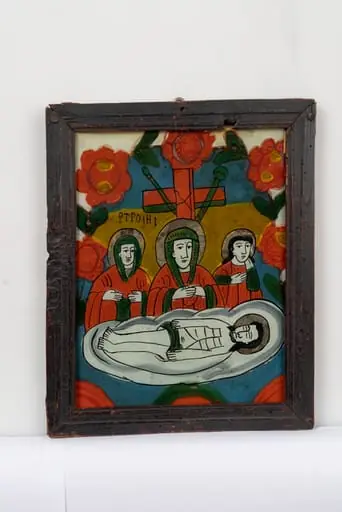 Tema icoanei face parte din ciclul Patimilor Mântuitorului și înfățișează Prohodul Domnului. Alături de Hristos așezat pe piatră sunt reprezentate doar trei personaje. Maica Domnului, în centru, cu mâinile împreunate la piept, are de-o parte un apostol, iar de cealaltă parte una dintre femeile mironosițe, probabil Maria Magdalena. În spate se profilează crucea lui Hristos și însemnele patimilor - sulița și buretele. Un șirag de rozete ornamentează fondul icoanei. Cromatica icoanei se compune din tonuri de roșu vermillon, ocru galben, alb, verde, albastru, negru și gri. Rama icoanei e profilată, băițuită și e formată din îmbinarea a patru baghete de lemn.
 În centrul icoanei este Crucea galbenă, cu terminațiile brațelor trilobate pictate cu roșu-alb-gri, iar în dreapta crucii este Sfântul Împărat Constantin, și în stânga este Împărăteasa Elena, mama sa. În spatele Crucii, este cerul albastru regal, încadrat de o ghirlandă de 4 ruje. Crucea găsită este susținută cu bucurie de cei doi sfinți. Veșmintele Sfinților Constantin și Elena sunt într-o combinație de roșu vermillon, gri antracit. Fondul icoanei este cerul albastru-cobalt, în registrul superior, iar în registrul inferior, este un câmp de galben luminos. În registrul superior, este o boltă-cupolă-arcadă albă luminoasă. Cromatica este armonioasă: roșu vermillon, galben-ocru, albastru regal, gri antracit, alb, negru. Icoana este de Nicula. Inscripția din româno-chirilică se traduce Constantin cu Elena. Postamentul Crucii este realizat printr-un caroiaj alb-negru.
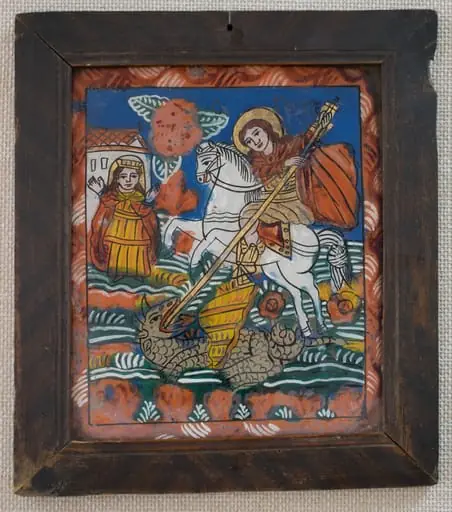 Icoana îl reprezintă pe sfântul Gheorghe omorând balaurul. Sfântul, călare pe cal alb, plasat central. Veșmintele sunt asemănătoare celor ale soldaților chezaro-crăiești, cizme înalte, tunică scurtă, zale, mantie roșie fluturând în vânt. Are capul descoperit, plete lungi, castanii, ochi mari, gura roșie, trăsăturile bine definite, expresive. În mână ține o suliță lungă, cruciformormă,aurită, cu care omoară balaurul înaripat, căzut la pământ, scoțînd limbi ascuțite. Calul este alb, capul mic, coada înnodată. Relieful este realizat prin linii albe) și vrâste de culoare(verde, galben,roșu), marcate cu motive fitomorfe. Câmp albastru închis, înviorat de o floare roșie cu frunze delimitate de nervuri albe. În partea stângă, în plan îndepărtat, în fața palatului sugerat printr-o clădire simplă,albă, înaltă, cu acoperiș de olane roșii, se află fata de împărat pe care o salvează sfântul conform legendei. Întreaga compoziție este încadrată de un chenar rectangular de culoare roșie, traversat longitudinal de o linie spiralată ale cărei meandre sunt însoțite de blicuri albe și verzui. Desenul complicat, tușa groasă, culorile intense, asemănător vitraliilor. Umplerea cu culoare neglijentă indică o producție de serie. Rama din lemn de brad este vopsită în cafeniu închis și decorată cu u motiv în formă de V Dosul este realizat din două scândurele de brad dispuse orizontal.
 Sfântul Mare Ierarh Grigorie Cuvântătorul de Dumnezeu, sau Sfântul Grigorie Teologul sau de Nazianz. Este unul din cei Trei Sfinți Ierarhi, alături de Sfântul Vasile cel Mare și Sfântul Ioan Gură-de-Aur. Sfântul Grigorie are Sfânta Liturghie a Darurilor înainte Sfințite, care se săvârșește în timpul Postului Mare. Este îmbrăcat în veșminte liturgice arhierești, sacos roșu vermillon, epitrahil verde, nuanță de spanac-avocado, cu patru cruci. Poartă mithră și aureolă. Ține în mâna stângă Sfânta Evanghelie deschisă și binecuvintează cu mâna dreaptă. Fondul este albastru ceruleum cu stele albe. Icoana este de Țara Oltului. Cromatica este armonioasă: roșu vermillon, verde spanac-avocado, albastru ceruleum, nergu, alb. Inscripția din româno-chirilică se traduce Sf Grigorie.
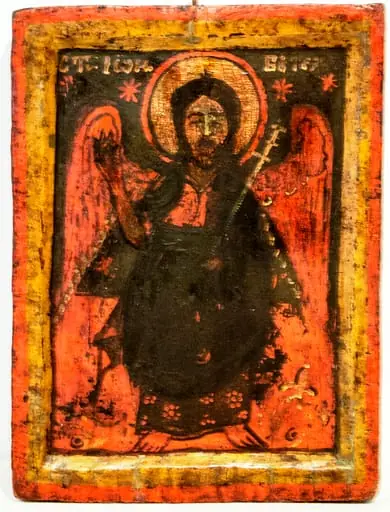 Icoana repictată este reprezentarea târzie a Sfântului Ioan Botezătorul, redat frontal, în picioare, în ipostaza îngerească. Sfântul binecuvintează cu dreapta ridicată. Pictura este destul de naivă cu elemente necanonice(Sfântul are veșmânt lung, decorat cu motive florale). Mâinile și picioarele sunt stângaci executate, cu culoare neagră peste fondul roșu din partea inferioară. Aripile roșii.Aureolă galbenă, chenar lat, roșu. Fond întunecat, cu motive astrale de culoare roșie. Chenarul în relief pictat cu galben și roșu. Nu există date în legătură cu pictura originală, probabil în momentul în care a fost scris textul cu creionul icoana era deja deteriorată.
 Maica Domnului ține în brațe Pruncul Iisus Hristos. Maica Domnului este înveșmântată în mantie cu maforion roșu vermillon și interiorul căputușit cu galben, bronz, și decorat cu multe striații albe. Mantia este foarte acoperitoare, mâinile Maicii Domnului fiind ascunse sub veșmânt. Pruncul Iisus Hristos este ținut în veșmântul maternității. Icoana este pictată după modelul Maicii Domnului Sporirea minții - icoană rusească, făcătoare de minuni. În locul îngerilor, lateral stânga-dreapta sunt flori, simetrice, pe câmpuri paralele, alternativ-cromatizate cu brun, gri și galben. Fondul icoanei este albastru ultramarin bleumarin întunecat, cu un chenar decorativ geometrizant, care conține și linia albă șerpuitoare. Cromatica este armonioasă și semnificativă: roșu vermillon, galben-chihlimbar, gri, ocru, brun, bej, abastru ultramarin bleumarin, alb, negru. Inscripția din româno-chirilică se traduce Sf Maică Maria. Icoana este de Nicula.
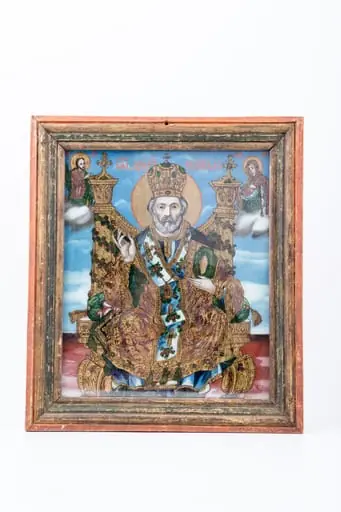 Sfântul Mare Ierarh Nicolae Făcătorul de minuni este redat central, pe un tron arhiresc, ținând în mâna stângă Sfânta Evanghelie închisă și binecuvântează cu mâna dreaptă. Veșmintele arhierești liturgice ale sfântului ierarh sunt într-o alternanță cromatică de brun, bronziu, verde-albastru-ocru, absint, smarald și alb și negru. Epitrahilul, patrafirul este albastru-verde, turcoaz-smarald cu opt cruci pe el, sacosul brun-bronziu. Poartă mithră și are aureolă. Tronul este bogat ornamentat cu detalii de elemente arhitectonice, reprezentând simbolic Împărăția Cerurilor. Este pictat tronul asemenea unui munte, supradimensionat. În registrul superior, sunt Mântuitorul Iisus Hristos în colțul din dreapta sfântului ierarh și Maica Domnului în colțul din stânga Sfântului Nicolae, din ambele părți primind binecuvântare și ocrotire. Fondul este deosebit, Cerul ca o mare nemărginită, un albastru turcoaz-smarald ca de ape vălurite. Inscripția din româno-chirilică se traduce IC XC Iisus Hristos Sfântul Nicolae MP Maica Domnului. Rama este bicromă și reliefată: brun cafeniu și roșu acajou.
 Icoana este împărțită în două ferestre: Mântuitorul Iisus Hristos Pantocrator Binecuvântând cu mâna dreaptă și având în mâna stângă globul pământesc cu cruce, asemenea unui chivot și în cea de-a doua parte este Sfântul Mare Ierarh Nicolae făcător de minuni, Binecuvântând cu mâna dreaptă și ținând în mâna stângă Sfânta Scriptură închisă. Mântuitorul și Sfântul Ierarh sunt îmbrăcați în veșminte asemănătoare: sacos verde și felon-mantie-omofor gri-petrol. Sfântul Nicolae este după Chipul și Asemănarea Mântuitorului Iisus Hristos. Chipurile sunt expresive și trăsăturile fețelor au finețea privirilor pătrunzătoare. Cromatica, specifică Văi Sebeșului, este discretă și armonios-austeră: verde, kaki, gri, brun, petrol, acajou, brun, negru, alb. Icoana este de Laz, Valea Sebeșului. Inscripția din româno-chirilică se traduce IC XC Iisus Hristos Sf Nicolae.
 În centrul icoanei este Mântuitorul Iisus Hristos binecuvântând mâncarea, la masă, alături de 4 ucenici și apostoli, din cei 12. Cu mâna dreaptă Mântuitorul Iisus Hristos ține Pâinea și Binecuvântează cina și pe ucenici. Este Timpul Euharistiei! Pe masă sunt așezate Potirul, pâinea, tacâmuri și farfurioare gri, pe o față de masă albastră ceruleum-regal cu marginile verzi-smarald, într-o expunere de arc de cerc, asemenea unui curcubeu de lumină. Cina este Cerul - prefigurarea Împărăției Cerurilor. Personajele au chipurile expresive, veșmintele personajelor și faldurile feței de masă au volume și drapaje. Veșmintele sunt pictate într-o alternanță cromatică de roșu vermillon, verde-brad închis înspre gri-antracit. Mântuitorul Iisus Hristos este înveșmântat în galben-chihlimbar, hainele din lumina harică a Învierii Domnului. Fondul icoanei este cerul albastru bleu-ciel-ceruleum, în registrul superior și galben-chihlimbar, în registrul inferior. În registrul superior, pe cerul albastru, icoana este încadrată de un chenar decorativ fitomorf, format dintr-o ghirlandă din 3 ruje mari roșii, cu frunze verzi smarald. Ghirlanda este armonios dispusă în paralel cu arcul de cerc al mesei cu fața de masă albastră. Cromatica este armonioasă, vie, luminoasă: roșu vermillon, verde smarald-brad, albastru bleu-ciel, ceruleum, galben chihlimbar, gri antracit, auriu, alb, negru. Inscripția din româno-chirilică se traduce Cinina de T. Icoana este din Nordul Transilvaniei, Nicula.
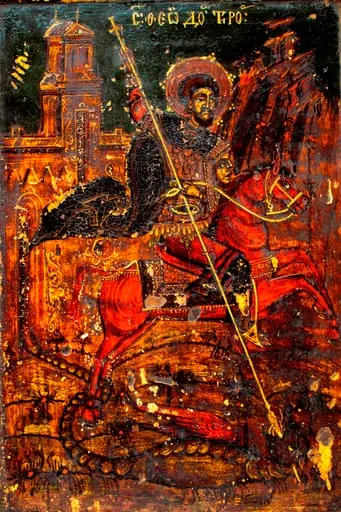 Sfântul Sfântul Teodor Tiron călare pe un cal roșu, omorând balaurul.Redat ca sfânt militar, cizme înalte, tunică 3/4 roșie, lorica scurtă, mantie bleumarin fluturând în vânt, pantaloni mulați. Capul descoperit, părul bogat,ondulat, scurt, castanii, expresia chipului sobră. Nimb mărginit de o linie galbenă,dublată la exterior de formațiuni punctiforme albe, în formă de floare.Pe scut o figură antropomorfă, în relief. În mână ține o suliță lungă, subțire, cruciformă, cu care omoară balaurul, cu o coadă lungă, încolăcită pe după picoarele calului, aripi mari, deschise, roșii, capul mic. Calul este bine proporționat, coada este înnodată, șaua și harnașamentul decorate fin cu alb. Pe fundal relief muntos,culmi abrupte în partea dreaptă. În cea stângă, sunt pictate zidurile unei biserici înalte. Linia albă, cu care este executat conturul și decorurile stilizate, fitomorfe foarte fină. Fond de culoare albastru verzui, marginea excizată fiind pictată jumătate cu roșu, cealaltă exterioară grena. Inscripția sus.- litere albe, caligrafice și prescurtări. Pictura este întunecată, cu urme de murdărie, fum și mici lacune ale stratului pictural. Pe cantul superior - cui de metal ,vechi. Compoziția este armonioasă, proporțiile respectate, desenul fin, paleta cromatică, dominată de tonuri calde în contrast cu fondul metalizat. De numele Sfântului Teodor este legată sărbătoarea populară a Sântoaderului, ce se ține în prima săptămână a postului Mare(Sâmbăta lui Toader; Tudorusale)
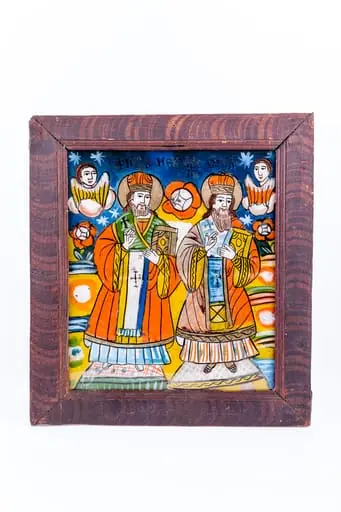 Sfinții Ierarhi Nicolae făcătorul de minuni și Vasile cel Mare sunt reprezentați împreună, binecuvântând cu mâna dreaptă și ținând în mâna stângă Sfânta Evanghelie. Sunt îmbrăcați în veșmânt-sacos și cu felon roșu vermillon și epitrahil albastru, verde, galben-ocru. Împreună slujesc și săvârșesc Sfânta Liturghie. În registrul îndepărtat superior, este pictat cerul albastru cu stele albe și ruje mari roșii. În registrul superior, în colțurile din stânga și din dreapta, este câte un înger pe o mandorlă. Cromatica este armonioasă: roșu vermillon, verde, albastru, galben-ocru, alb. Sfinții arhierei poartă și mithră arhierească. Amândoi Sfinții Ierarhi au aureole aurii. Rama este pictată cu tușe negre pe maro-roșcat, alternanță de brunuri. Este o icoană specifică picturii de Țara Oltului, din centrul Șcheii Brașovului. Din inscripția româno-chirilică se traduce Sf Nicolae Sf Vasile. În registrul inferior, fondul este format din câmpuri alternative de galben, albastru și verde.
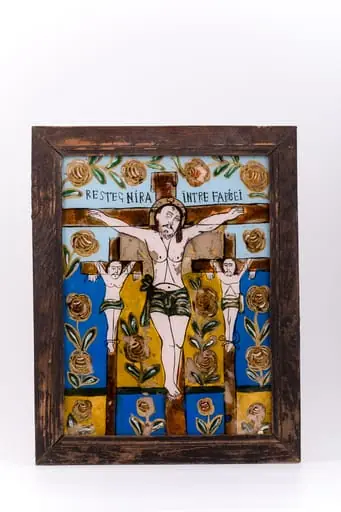 Mântuitorul Iisus Hristos, fiind răstignit pe Cruce, în prim plan, are în dreapta și în stânga pe cei doi tâlhari, numiți în icoană farisei. Mântuitorul Iisus Hristos are o țesătură verde-brad cu dungulițe crem-bej în jurul mijlocului și a coapselor. Are aureolă aurie. Cei doi tâlhari, răstigniți pe crucile lor, sunt redați în registrul inferior, plan îndepărtat. Fondul icoanei este format 9 casete geometric și simetric segmentate de brațele celor trei cruci. Fondul icoanei este format așadar din o casetă superioară din albastru bleu-ciel senin-alburiu, patru casete albastre regal și patru casete galbene-chihlimbar. Întreaga compoziție iconografică este încadrată de un chenar decorativ fitomorf, format din 17 ruje roșii, dispuse pretutindeni în imaginea icoanei. Cromatica este armonioasă: roșu vermillon, albastru ceruleum, regal, bleu-ciel, verde-brad, galben-chihlimbar, brun, crem, bej, alb, negru. Inscripția din româno-chirilică se traduce Restignirea între farisei. Icoana este din Nordul Transilvaniei, Nicula, având o tematică iconografică mai rar structurată compozițional astfel.
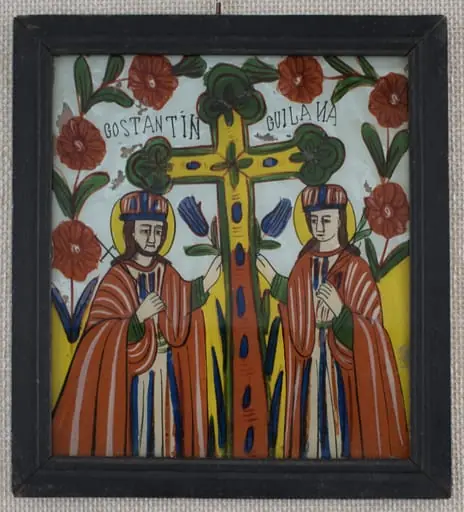 Icoana este pictată pe spatele unei bucăți de sticlă dreptunghiulară, în ax vertical. Compoziția îi reprezintă pe Sfinții Împărați Constantin și Elena, în picioare, din ușor semiprofil, sub brațele crucii pe care o susțin, crucea pe care a fost răstignit Isus, găsită de Împărăteasa Elena la Ierusalim. Amândoi au plete castanii, lăsate pe umeri, coroane sub formpă de tocă, veșminte identice , cămăși pictate policrom (alb, roșu, verde) și mantii roșii cu falduri bogate, trasate cu alb. Sf. Constantin ține în mâna liberă o cruce iar mama sa o ramură verde. Crucea, plasată în centrul compoziției, pictată policrom, are brațele trilobate, corpul decorat cu motive geometrice și sacrale. În partea de jos sunt sugerate frunze, amintind de ipostaza de pom al vieții. Câmp bicolor, jumătatea inferioară - galben intens caracteristic Niculei târzii, partea de sus alb-bleu, două tulpini sinuoase de flori roșii(ruje) care se apropie în partea superioară a crucii.Linie de desen roșie. Rama profilată este vopsită cu negru și încheiată oblic;dosul este din lemn subțire de brad; Culoarea este exfoliată pe unele locuri;
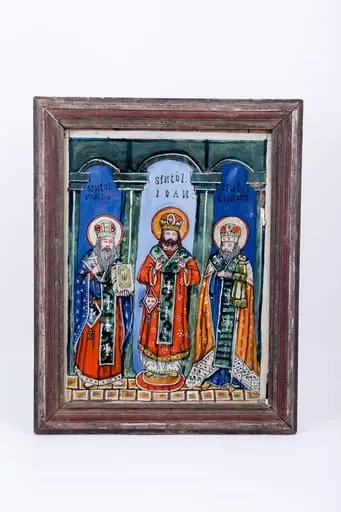 Cei Sfinți Trei Ierarhi Vasile cel Mare, Grigorie de Dumnezeu Cuvântătorul și Ioan Gură-de-Aur slujesc și săvârșesc Sfânta Liturghie împreună. Sunt înveșmântați în veșminte liturgice: sacos, felon și epitrahil mithră și aureolă. Cromatica veșmintelor este vie și luminoasă: roșu vermillon, orange-cărămiziu, galben-ocru și albastru ceruleum și bleu-ciel, verde și alb. Sfântul Vasile cel Mare are crucea în mâna dreaptă și binecuvântează și în mâna stângă ține Sfânta Evanghelie închisă. Sfântul Ioan Gură-de-Aur, central, tânăr cu barba brunetă, binecuvântează cu ambele mâini și are pe bedernița romboidală un chip de sfânt, element antrpomorf. Alături este Sfântul Grigorie care ține în mâna stângă cârja-sceptrul arhiepiscopală și binecuvântează. Fondul întregii tematici iconografice este albastru ceruleum în exterior și central bleu-ciel. Sfinții trei ierarhi sunt încadrați de coloane și arcade-bolți, schițându-se astfel structura arhitecturală de biserică. În registrul inferior este un un caroiaj alb-ocru, o lespede de fundație puternică - reprezentând credința creștin-ortodoxă. Cromatica este luminoasă și armonioasă: roșu vermillon, orange, verde spanac-avocado, galben-ocru, brun, albastru ceruleum și bleu-ciel, gri, alb și negru. Este o icoană de Valea Sebeșului. Inscripiția din româno-chirilică se traduce: Sfântul Vasilie Sfântul Ioan Sfântul Grigorie. Icoana este datată 1908.
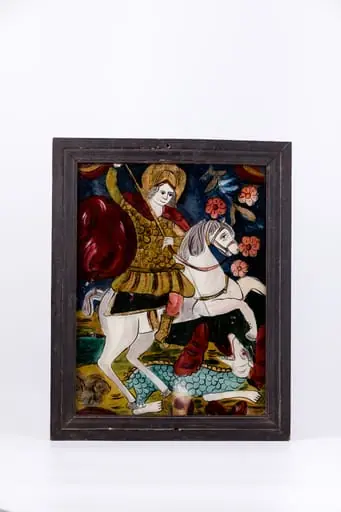 Sfântul Mare Mucenic Gheorghe este așezat călare pe un cal alb cu șa neagră, omorând balaurul alb-albastru-gri cu creastă roșie-acajou, solzi și coadă lungă, cu lancea, pe care o ține cu amândouă mâinile, înfingându-i-o animalului în gâtlej. Fondul este cerul albastru ultramarin bleumarin în registrul superior. În registrul inferior, fondul este brun-ocru și albastru cobalt, cu linii ondulatorii verzi, cele două registre în centrul icoanei ușor întrepătrundu-se. Mantia Sfântulu Mucenic Purtător de Biruință este roșie-vișinie stacojie, având cămașa de cavaler cu zale. Culoarea roșie este caracteristică mucenicilor și martirilor. Cerul albastru este acoperit cu elemente fitomorfe - flori de măr roz-roșii. Icoana, fiind din Mărginimea Sibiului, are desenul mai neglijent, cromatica puternică, fauvistă. Cromatica este armonioasă: roșu vișiniu-stacojiu, albastru, bleu-ultramarin bleumarin, roz, brun, galben-ocru, gri, alb, negru. Icoana este din Mărginimea Sibiului.
 Icoana îl reprezintă pe Pruncul Ioan Botezătorul, cel care avea să fie Sfântul Ioan Botezătorul și Înaintemergătorul Domnului nostru Iisus Hristos. Pruncul Ioan are în brațe un mieluț alb-brun, arătând către Mântuitorul Iisus Hristos: „Iată mielul!”. Îl ține în brațe cu tandrețe, aplecându-se peste el ocrotitor. Cu mâna stângă ține Crucea Jertfei brun-maro, cu un stindard verde. Este înfășurat cu o țesătură brun-neagră, culoarea pocăinței, jertfei și muceniciei. În interiorul icoanei este un composit de albastru bleu-ciel senin și galben chihlimbar. Întreaga tematică iconografică este încadrată de un chenar decorativ fitomorf, format dintr-o ghirlandă de trandafiri dubli și bujori - 15 ruje roșii stilizate. Icoana are o cromatică luminoasă: roșu vermillon, albastru bleu-ciel și ceruleum, galben chihlimbar, verde brad-forest, brun, maro, alb, negru, auriu. Icoana este Nordul Transilvaniei, Nicula.
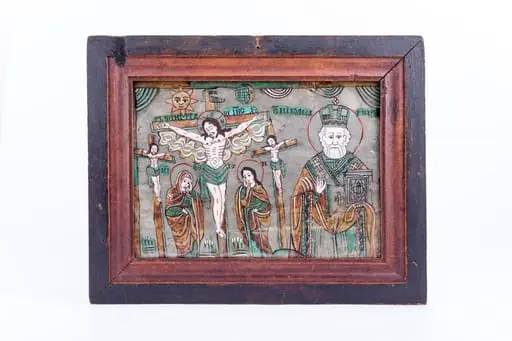 Mântuitorul Iisus Hristos, fiind răstignit pe Cruce, are în stânga pe ucenicul cel iubit, care a stat lipit de pieptul Învățătorului, la Cina cea de Taină, mai precis, pe Sfântul Apostol și Evanghelist Ioan Teologul, Evanghelistul Iubirii și în dreapta pe Maica Domnului Îndurerată, Jalnică și Plângătoare. Veșmintele Maicii Domnului sunt pământii-bronzii cu verde kaki. Sfântul Ioan este îmbrăcat în brun și kaki. Mântuitorul Iisus Hristos are o țesătură verde în jurul mijlocului și a coapselor și trupul îi este plin de răni sângerânde. În planul superior sunt simboluri astrale: soarele, deasupra Maicii Domnului, luna, deasupra Sfântului Ioan. În planul îndepărtat sun cei doi tâlhari răstigniți pe crucile lor. În cea de-a doua parte a icoanei este Sfântul Mare Ierarh Nicolae făcătorul de miuni și ocrotitor al copiilor. Ține în mâna stângă Sfânta Evanghelie închisă și cu dreapta Binecuvântează. Este unul dintre cei mai populari și iubiți sfinți, ocrotitor al caselor, familiilor și copiilor. Are barbă lungă, albă și mithră arhierească și aureolă. Este îmbrăcat în veșminte liturgice, de ierarh, sacos verde-brad, felon bronziu-kaki, epitrahil-patrafir gri-petrol cu patru cruci. Cromatica este armonioasă, dar foarte îngândurată și tristă: gri-petrol, verde-brad, kaki, brun închis, bronziu, roșu sângeriu, alb, negru. Inscripția din româno-chirilică se traduce Răstignirea Lui Iisus Hristos IC XC MP Maica Domnului Sf Nicolae. Icoana este de Laz, Valea Sebeșului, având două tematici iconografice.
 Icoana îl reprezintă pe Mântuitorul Iisus Hristos, copil fiind, având în mânuțe globul pământesc cu o cruce deasupra, asemenea unui chivot sfințit, galben cu verde. Copilașul este înfășurat cu o țesătură roșie vermillon-roz și negru. În interiorul icoanei este un composit de albastru ceruleum și galben chihlimbar luminos. Întreaga tematică iconografică este încadrată de un chenar decorativ fitomorf, format dintr-o ghirlandă de trandafiri, 3 ruje roșii, cu motivul zăluței albe în interior, pe latura inferioară a icoanei și un boboc de măceș în spatele Copilașului Iisus. Inscripția din româno-chirilică se traduce Cristos. Icoana este de Nicula, având o cromatică luminoasă: roșu vermillon, roz, albastru bleu-ciel și ceruleum, galben chihlimbar, verde brad, alb, negru. Icoana este din Nordul Transilvaniei, Nicula.
 Icoana îi reprezintă împreună pe Sfântul Mare Ierarh Nicolae, Sfântul Ioan Botezătorul și Sfântul Mare Mucenic Teodor Tiron. Veșmintele Sfântului Nicolae sunt sacos gri și roșu vermillon, cu patrafir-epitrahil auriu cu verde, două bedernițe verzi, de o parte și de alta a veșmântului. În mijloc, este Sfântul Ioan Botezătorul și Înaintemergătorul Domnului Iisus Hristos îmbrăcat cu un himation alb-gri-negru, din păr de cămilă, și o mantie roșie, purtând crucea biruinței. Alături este Sfântul Mare Mucenic Teodor Tiron, îmbrăcat cu haine de oștean-militar, tunică și vestă de zale aurie, cu mantie roșie cu interiorul galben, de lumină. În mâna dreaptă are spada credinței. Fondul icoanei este albastru cobalt, în registrul superior și roz, în registrul inferior. Pe latura inferioară, icoana este încadrată de elemente florale - trei ruje mari, trandafiri roșii, cu frunze verzi. Inscripția din româno-chirilică se traduce Sf Nicolae Sf Ioan Botezătorul Sf Teodor Tiron. Icoana este de Țara Oltului.
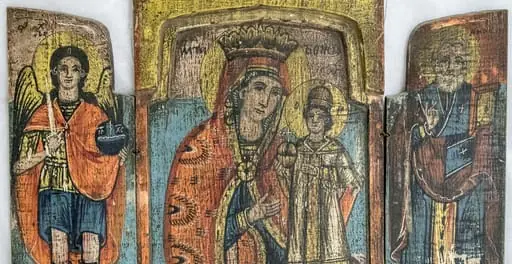 Pe p4527
 Sfânta Mare Cuvioasă Parascheva de la Iași are o cruce și ramură de finic verde, nuanța algelor în mâna dreaptă. Este îmbrăcată în veșmânt roșu vermillon-corai cu interiorul căptușit cu verde-mușchi de pădure și bordură galbenă-chihlimbar. Sacosul este alb-crem cu danteluță, guleraș și dungi. Sfânta Cuvioasă are părul negru lung, lăsat pe umeri, coroană roșie-roz cu verde-brad și aureolă brun-bronzie. Fondul icoanei este cerul albastru cobalt în registrul superior-mijloc și un câmp alb-crem, ancadrator întregii compoziții. Întreaga compoziție iconografică este încadrată de un chenar decorativ fitomorf, format dintr-o ghirlandă de 5 ruje mari orange-cărămizii cu frunze verzi. Cromatica este armonioasă: roșu vermillon-orange, corai, albastru cobalt-ceruleum, verde alge, mușchi de pădure, bej-crem, bronziu, galben-solar, negru, alb zinc. Icoana este din Nordul Transilvaniei, Nicula.
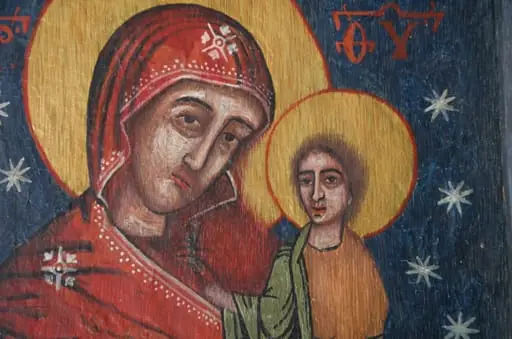 Icoana este pictată pe lemn și o reprezintă pe Maica Domnului „Îndrumătoarea” (Hodighitria), „Cea care arată calea”, cu Pruncul în brațe. Conform Tradiției Bisericii, tema a fost pictată pentru prima dată de Sfântul Apostol și Evanghelist Luca, în timpul vieții pământești a Fecioarei Maria. Maica Domnului poartă un maforion roșu și arată cu mâna dreaptă înspre Fiul său, acesta, la rândul Lui, arătând cu mâna stângă înspre Maica Sa. Pe fundal sunt pictate stele. Rama are trei chenare pictate în albastru, verde și roșu. Icoana prezintă în partea superioară câte o balama pe latura stângă și cea dreaptă, probabil deservind în trecut rolul de triptic. Cromatică: fond albastru închis; roșu; verde; portocaliu; galben; alb.
 Icoana este împărțită în 6 ferestre, de prăznicar, pe trei registre, două câte două: Sfinții Mari Ierarhi Spiridon Tămăduitor de boli, Vasile cel Mare, Grigorie de Dumnezeu Cuvântătorul, Ioan Gură-de-Aur, Nicolae făcător de minuni. Sfinții sunt încadrați de coloane și arcade de bolți de biserică. Au veșminte arhierești cu sacos, felon, mithră, aureolă și epitrahil-patrafir. Țin în mâna dreaptă Sfânta Scriptură închisă și Binecuvântează cu mâna stângă. Cromatica este armonioasă și vie, puternică, specifică Țării Oltului; roșu vermillon, albastru regal, bleu-ciel, verde spanac-avocado, galben-ocru, brun, bej, cafeniu, negru, alb, auriu. Inscripția din româno-chirilică se traduce Sf Spiridon Sf Vasile Sf Grigorie Sf Ioan Sf Nicolae. Icoana este de Șcheii Brașovului, Țara Oltului.
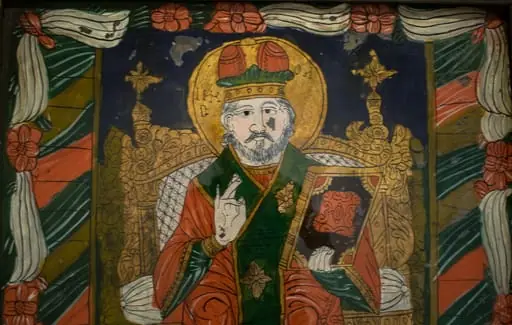 Icoana este pictată în oglindă, pe o foaie de glajă de formă dreptunghiulară în ax vertical. Sfântul Nicolae redat ca arhiereu, așezat pe un tron aurit, ține Evanghelia închisă în mâna stângă în timp ce cu dreapta binecuvintează. Evanghelia este de dimensiuni mari, redată în spațiu, cu margini aurite și decorațiuni roșii pe fond bleumarin. Sfântul ca Mare Arhiereu, poartă mitră înaltă, bipartită, omofor mare, verde intens decorat cu cruci aurite, stihar albastru , mânecuțe aurite, sacos roșu cărămiziu cu galon aurit la gât, mâneci și poale. De ambele mâini are atârnată câte o bederniță care are doar desenul schițat pe fondul sacosului. Chipul este sobru, barba albă, scurtă, părul scurt, ondulat. În jurul capului are un nimb aurit pe care este scrisă dezordonat inscripția. Tronul, de factură vădit barocă, are spătarul înalt, cu lemnul aurit, cu sculpturi abundente,(motive fitomorfe stilizate și motive geometrice) Spătarul este tapițat cu alb, decorat cu o rețea de linii întretăiate. Sfântul stă cu picioarele pe un postament de piatră. Câmp verde intens în partea de jos, albastru ultramarin în registrul superior. Pe laturile verticale este pictată câte o bandă lată, cu vrâste oblice în culori alternante: verde, auriu, roșu. Întreaga compoziție este încadrată de un chenar realizat dintr-o draperie albă stilizată strânsă din loc în loc cu flori roșii,la colțuri cu ghinde roșii. Desenul este caligrafic, fin, foarte minuțios, vădit inspirat din miniatura manuscriselor. Compoziția este echilibrată, paleta cromatică sobră(alb, albastru, roșu, verde, gri), armonioasă, rezultată din combinarea culorilor complementare cu auriul foiței. Rama este alcătuită din patru șipci drepte, îmbinate oblic la colțuri, colțul stâng jos fiind întărit cu un cui metalic. Culoare brun închis. Dosul- lemn subțire de brad, fixat pe spate cu bucăți de piele.
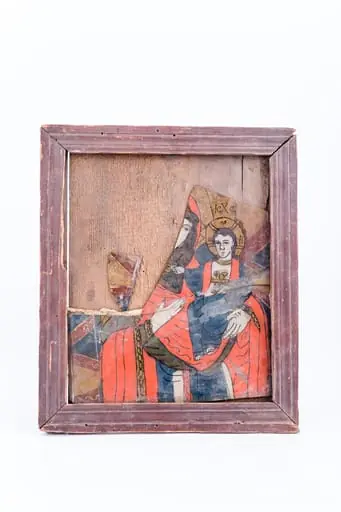 Maica Domnului ține în brațe Pruncul Iisus Hristos arătându-L ca fiind Calea, Adevărul și Viața. Este Maica Domnului Hodighitria. Maica Domnului este înveșmântată în mantie cu maforion roșu vermillon și interiorul căputușit cu albastru și sacos verde - nuanță de spanac-avocado. Pruncul Iisus Hristos este înveșmântat în albastru ceruleum, cu aureolă. Fondul icoanei este albastru cu un chenar decorativ geometrizant, format din romburi și triunghiuri albastru și ocru. Cromatică: roșu vermillon, verde, abastru, alb, ocru-brun-bronziu. Inscripția din româno-chirilică se traduce MP IC XC Maica Domnului Iisus Hristos. Icoana este de Țara Oltului. Este spartă.
 Maica Domnului este înveșmântată în maforiom roșu vermillon, cu interiorul verde-brad-smarald, cu aureolă aurie împodobită cu coroniță de trandafiri, din 4 ruje. Pruncul Iisus Hristos este înveșmântat în alb-nisipiu - verde brad și ocru și are, de asemenea, aureolă aurie, împodobită cu cunună de trandafiri, din 3 ruje. Pruncul Iisus Binecuvântează, arătând înspre Maica Domnului. Fondul icoanei este cerul albastru bleu-ciel senin, împodobit cu 2 elemente florale - ruje roșii cu frunze smarald. Cromatica este armonioasă: roșu vermillon, galben-ocru, crem, bej, albastru ceruleum și bleu-ciel, verde smarald, alb, negru. Icoana este de Nicula. Inscripția din româno-chirilică se traduce IC XC MP Iisus Hristos Maica Domnului.
 Icoana este o reprezentare narativă, scena centrală arătând fiind căderea în păcat a lui Adam și a Evei și izgonirea lor din Rai. Narațiunea este înscrisă într-un cerc, care este decorat cu o bordură verde. În centrul Grădinii Raiului este pomul cunoașterii, pe care se încolăcește viclenia și minciuna șarpelui. În jurul pomului cunoașterii sunt Adam și Eva îmbrăcați cu elemente de vegetație în jurul mijlocului și a coapselor. Inscripție din româno-chirilică se traduce Adam Eva. Raiul este pictat cu lumină galbenă, verdele Duhului Sfânt și rozul fercirii înflorite. Grădina Raiului este în centrul lumii întregi, în toată diversitatea ei. Fondul icoanei este alb, cu elemente decorative geometrizante floral-stilizate, reprezentând 6 ruje - bujori și trandafiri. Icoana este de Nicula. Cromatica este armonioasă: roșu vermillon, roz, verde brad, galben solar, brun, negru, alb.
 Icoae jo
 Icoana Schimbarea la Față reprezintă pentru teologia ortodoxă punctul-cheie în privința privirii și vederii Chipului Lui Dumnezeu. Compoziția iconografică Îl înfățișează pe Hristos stând nemișcat, învăluit în Slava și Pacea, izvorâte din El Însuși. Iisus Hristos este străjuit de Sfântul Mare Proroc Ilie Tesviteanul în stânga și de Profetul Moise, în dreapta. Mântuitorul Iisus Hristos între cei doi Moise și Ilie formează un cerc perfect, ce se află sub vălul de lumină necreată, Lumina Sfântului Duh. Veșmintele sunt realizate în combinație de roșu vermillon, verde kaki și fine dungi albe. În icoana aceasta, cele trei personaje din registrul inferior lipsesc, dar nu întâmplător sunt trei elemente vgetale, martore la Schimbarea la Față a Mântuitorului, care amintesc de Petru, Ioan și Iacob. Mandorlele de nouri albi rotunzi despart și unesc registrele. Mântuitorul Iisus Hristos, în nimbul auriu-bronziu, învăluit în Lumina necreeată, este deasupra vârfului Muntelui Tabor al Galileii. Cromatica este picturală și armonioasă: roșu vermillon, verde spanac-avocado, kaki, brun, bej, albastru ultramarin-gri, indigo, alb, negru. Inscripția din româno-chirilică se traduce Schimbarea la Față. Tematica iconografică abordată este foarte rară în pictura pe sticlă.
 Deisis este o tematică fundamentală din iconografia bizantină, reprezentându-L pe Domnul Iisus Hristos în ipostasul de Mare Judecător, fiind Împărat pe Tron, având în dreapta pe Maica Domnului și în stânga pe Sfântul Ioan Botezătorul și Înaintemergătorul Domnului. Această tematică este nucleul Judecății De Apoi. Iisus Hristos este înveșmântat în veșminte arhirești liturgice roșii și albastre, cu elemente decorative florale punctiforme albe. Are engolpion cu cruce la gât, bederniță, ține în mâna stângă Sfânta Evanghelie închisă și binecuvântează cu mâna dreaptă. Maica Domnului are veșmântul asemănător cu cel al Lui Dumnezeu Învățător, Împărat și Judecător. Sfântul Ioan Botezătorul are veșmântul verde. Tronul arhieresc este bogat ornamentat geometrizant, având detalii verzi și gabene, brune, ocru și bronzii. Fondul este auriu cu elemente astrale - stele roșii. Icoana este de Țara Făgărașului. Cromatica este armonioasă: roșu vermillon, albastru cobalt, galben-auriu-bronziu, verde spanac-avocado, alb, negru. Inscripția din româno-chirilică se traduce IC XC Iisus Hristos MP Maica Domnului Sf Ioan. Icoana este de o noblețe aparte, detaliile decorative și faldurile veșmintelor, expresivitatea trăsăturilor sunt impresionante.
 Icoana este segmentată în patru ferestre, icoană cruce, reprezentându-i pe Sfântul Mare Mucenic Gheorghe purtător de biruință, de două ori, pe diagonală, pe Sfântul Mare Ierarh Nicolae făcător de minuni și vindecător de boli, pe Sfânta Mare Cuvioasă Parascheva, de la Iași. Au veșminte roșii vermillon, epitrahilul Sfântului Nicolae este verde smarald, fondul Sfintei Parascheva este orange, fondul Sfântului Gheorghe din dreapta registrul inferior este verde. Întreaga tematică iconografică este încadrată de un chenar decorativ geometrizant, dantelat, din foiță aurie. Registrul superior are fondul albastru ultramarin, iar registrul inferior fondul este rozaliu pal. Interiorul crucii este un rotund verde-absint. Icoana excelează prin combinațiile cromatice luminoase și foarte vii. Inedită este și prezența dublă, în ipostasuri diferite, pe diagonală, a Sfântului Mare Mucenic Gheorghe. Icoana este de Țara Oltului. Are rama colorată în cafeniu și roșu, în interior. Inscripția din româno-chirilică se traduce SF Gheorghe Sf Nicolae Sf Parascheva Sf Gheorghe.
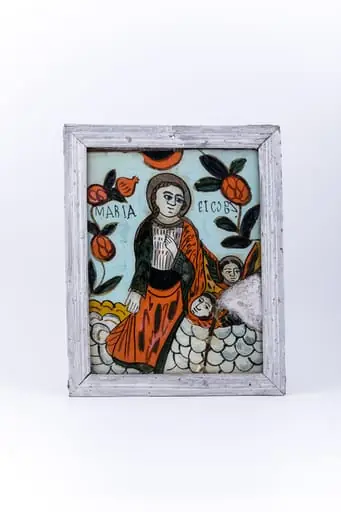 Icoana o reprezintă pe Sfânta Maria, înveșmântată cu mantie roșie vermillon, cu cămașă albă cu guleraș, cu sacos roșu-negru. În partea stângă a Sfintei sunt doi îngerași. Fondul icoanei este cerul albastru bleu-ciel senin, înspre alburiu. În registrul inferior, este un câmp vălurit alb-gri, cu spații luminoase galben-ocru. Întreaga compoziție iconografică, rară prin tematica abordată, este încadrată de un chenar decorativ fitomorf, format din 3 ruje roșii și două meceșe. Inscripția din româno-chirilică se traduce Sfânta Maria. Cromatica este armonioasă și luminos-pastelată: roșu vermillon, albastru bleu-ciel, galben-ocru, brun, gri, negru, alb. Icoana este din Nordul Transilvaniei, Gherla.
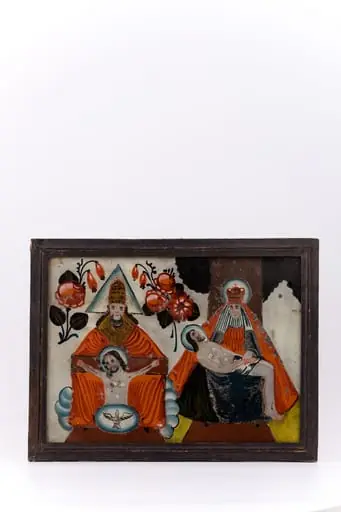 Icoana are o tematică iconografică foarte rară: în cea dintâi parte, este Sfânta Treime: Mântuitorul Iisus Hristos Răstignit pe brațele Lui Dumnezeu-Tatăl și ținut în veșmântul roșu al Pătimirii și Jertfei. Dumnezeu-Tatăl, Împărat al Cerurilor, are pe cap coroană și aureolă triunghiulară, reprezentând Sfânta Treime. Sfântul Duh este reprezentat prin porumbelul alb. Sfânta Treime are în registrul inferior o mandorlă de nouri rotunzi albi-albaștri și în registrul superior o ghirlandă din trandafiri și ramuri cu măceșe, simbolizând Grădina Raiului. În cea de-a doua parte, în dreapta, este Maica Domnului Împărăteasă ținând în brațe pe genunchi Trupul Mântuitorului Iisus Hristos, coborât de pe Cruce, plâns, jelit. Este asemenea unei Piete. Icoana este deosebită și foarte rară, prin compoziția tematică și viziunea iconografică greco-catolică. Fondul icoanei este alb-ivoriu-crem, în registrul superior și galben-solar, în registrul inferior. Cromatica este armonioasă: roșu vermillon-trandafiriu, brun-roșcat-acajou, galben-solar, albastru bleu-ciel, gri, alb , negru. Icoana este din Nordul Transilvaniei, Nicula.
 Icoana reprezintă Nașterea Mântuitorului Iisus Hristos. Pruncul Iisus, nu este înfășat în scutece, este un copilaș mai măricel, care are în dreapta pe Maica Domnului și pe Dreptul Iosif, logodnicul Fecioarei Maria, iar în stânga cei trei magi, venind cu daruri. În registrul superior este steaua cea călăuzitoare, aducătoare de vestea cea bună. În registrul superior îndepărtat sunt un păstor cu o oiță, căreia îi cântă din fluier și doi îngeri care deschid Cerurile pentru a pătrunde steaua călăuzitoare și aducătoare de veste bună. Este o alternanță cromatică de gri, brun-bronziu, alb, petrol și albastru bleu-ciel. Cerurile sunt deschise. Registrele se întrepătrund armonios. Cromatica este armonioasă: gri, brun-bronziu, alb, petrol și albastru bleu-ciel. Inscripția din româno-chirilică se traduce Nașterea Lui Iisus Hristos ICXC. Icoana este pictată în Laz, Valea Sebeșului. Ceea ce este indedit și deosebit la această icoană este chenarul decorativ geometrizant format dintr-o linie șerpuită albă, împrumutată parcă din icoanele de Nicula, aici având semnificația idee de povestire, scriere, ninsoare.
 Icoana reprezintă Nașterea Mântuitorului Iisus Hristos. Pruncul Iisus, înfășat în scutece, are în dreapta pe Maica Domnului și pe Dreptul Iosif, logodnicul Fecioarei Maria. În registrul superior este steaua cea călăuzitoare, aducătoare de vestea cea bună. Sunt prezente, deasupra Pruncului Iisus înfășat în iesle și două animale domestice din grajd. În registrul superior îndepărtat sunt elemente de arhitectură, spațializând astfel întreaga narațiune iconografică, zidurile unui grajd sau case cu ferestruică și acoperiș. Este o alternanță cromatică de roșu vermillon, alb, auriu, verde smarald-turcoaz, albastru regal, brun maro. Cromatica este greu de descifrat, fiind mari pierderi de culoare: roșu vermillon-alb-brunuri, tonuri de verde, smarald-turcoaz, albastru, legate de auriul aureolelor, stelei. În pictura de Nicula cromatica este preponderent autumnală și foarte naturală. Inscripția în chirilică se traduce Nașterea ICXC Iisus Hristos.
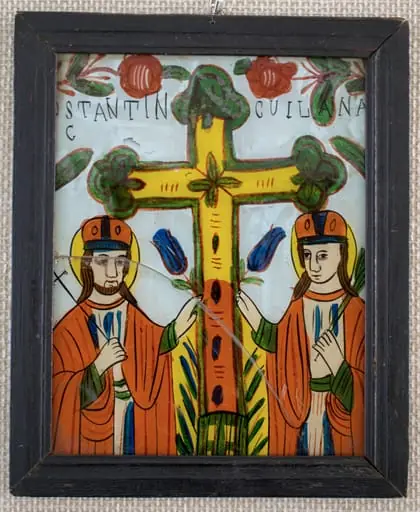 Icoana este pictată "în oglindă", pe un suport de sticlă de formă dreptunghiulară în ax vertical.Compoziția îi reprezintă pe Sfinții Împărați Constantin și Elena 3/4, în picioare, din ușor semiprofil, sub brațele crucii pe care o susțin, crucea pe care a fost răstignit Isus, găsită de Împărăteasa Elena la Ierusalim. Amândoi au plete castanii, lăsate pe umeri, coroane sub formă de tocă, veșminte identice(cămașă albă cu vrâste verzi, și mantii roșii). Sf. Constantin ține în mâna liberă o cruce, mama sa o ramură verde. Fețele diforme, ochii negri cu umbre gri. Crucea, axul de simetrie al compoziției, pictată multicolor, are brațele trilobate . Câmp alb, cu excepția zonei ocru de la baza crucii. Chenar din tulpini de ruje roșii, dispus pe cadrul rectangular. Icoana este caracteristică fazei târzii a picturii din zona Nicula-Gherla, caracterizată prin aglomerarea compoziției cu elemente florale și decorative, fețele diforme, câmpul bicolor, lipsa foiței, calitatea mai prostă a materialelor. Paleta cromatică este totuși armonioasă.Suportul pictural crăpat.. Rama profilată, din lemn de brad, pictată cu negru și încheiată oblic; Pictura ușor exfoliată;Dosul - placaj.
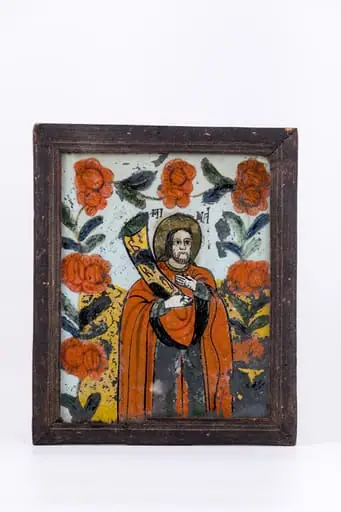 Icoana este foarte rară pentru că îl reprezintă pe Sfântul Mare Mucenic Mina, ocrotitorul celor păgubiți. Este îmbrăcat în veșminte preoțești, cu felon roșu vermillon și sacos gri cenușiu-antracit. Are în mâna dreaptă desfășurat un hrisov de cuvânt de înțelepciune și învățătură. Cu mâna stângă arată totodată înspre inima sa, cu închinăciune către toți și înspre cuvintele hrisovului. Fondul icoanei este împărțit în două registre complementare: cerul albastru bleu-ciel senin și câmpul galben luminos de grâu. Întreaga tematică iconografică este încadrată de un chenar decorativ fitomorf, format dintr-o ghirlandă de 7 ruje - trandafiri și bujori în floare. Icoana este din Nicula-Gherla, la interferența celor două centre de pictură. Inscripția din româno-chirilică se traduce Mina.
 Maica Domnului este înveșmântată în maforiom roșu vermillon-corai, cu interiorul negru-gri antracit, cu dungulițe subțiri roșii, cu sacosul-hitonul crem cu dungi paralele albastre bleu-ciel. Maica Domnului are aureola aurie senină, împodobită cu o ghirlandă din 5 trandafirași corai. Maica Domnului arată calea care este Mântuitorul Iisus Hristos - Calea, Adevărul și Viața. Pruncul Iisus Hristos este înveșmântat în alb-crem și galben-chihlimbar și are, de asemenea, aureolă aurie. Pruncul Iisus ține în mâna stângă un hrisov înfășurat și cu mâna dreaptă arată înspre Maica Domnului. Fondul icoanei este cerul albastru ceruleum. Întreaga tematică iconografică este încadrată de un chenar decorativ fitomorf, format dintr-o ghirlandă din 4 ruje duble, roșii vermillon-cărămizii. Inscripția din româno-chirilică se traduce MP IC XC Maica Domnului Iisus Hristos. Cromatica este armonioasă: roșu vermillon-corai, albastru bleu-ciel, galben-chihlimbar, verde vprativ-kaki, auriu-bronziu, alb, negru. Icoana este din Nordul Transilvaniei, Gherla.
 Maica Domnului este înveșmântată în cămașă femeiască tradițională, presupusă iie cu câmpuri verticale alternativ pictate cu roșu vermillon și verde, cu danteluță aurie la baza gâtului, cu maforion roșu vermillon, poartă coroniță de împărăteasă și aureolă. Maica Domnului are gâtul neacoperit cu veșmânt și pe sub maramă se observă părul șaten castaniu. Este mai puțin frecventă această atitudine vestimentară a Maicii Domnului, asemănătoare femeilor din vremea aceea. Icoana este de la Poiana Sibiului, pictată în manieră specifică Mărginimii Sibiului. Pruncul Iisus Hristos este înveșmântat în roșu vermillon și verde și auriu la gulerașul cămășii populare, cu coroană și aureolă. Pruncul Iisus o ține pe Maica Domnului cu mânuța pe după gât, într-o tandrețe mângâietoare, lipindu-și capetele, unul de celălalt. Este a atitudine a Maicii Domnului Eleusa. Fondul icoanei este cerul de culoarea albastru ultramarin. Întreaga icoană este încadrată de un chenar decorativ geometrizant și floral compact, un ușor baroc, de culoare brun-roșcat-verde. Cromatică: roșu vermillon, albastru, verde de China, auriu, ocru-brun-bronziu, alb, negru, roșu stacojiu, brun-roșcat. Icoana este aparte și prin compoziție și prin veșminte. Chipurile au o delicatețe și o tandrețe emoționante. Inscripția din româno-chirilică se traduce MP Maica Domnului IC XC Iisus Hristos.
 Pictură în oglindă, pe spatele unei bucăți de sticlă, ax vertical. Cuvioasa Paraschiva, redată în stilul specific Niculei:într-o mână o cruce împodobită cu raze și motive florale, în cealaltă o ramură verde. Chipul este trasat cu lejeritate, fața prelungă, expresivă. Pe cap poartă o tocă înaltă, stil occidental. Părul lung, ondulat , cade pe umeri. Veșminte în culori vii(galben, roșu, verde, alb).Câmp alb-gri, decorat cu același motiv floral care se repetă la cruce, o rozetă în culorile alb și verde. Icoana are caracteristicile specifice picturii niculene: stângăcia, simplitatea și primitivismul desenului; compoziția sumară, redusă la extrem, ornamentica de factură populară, intensitatea culorilor. Stratul pictural exfoliat. Rama profilată de culoare neagră, este completată cu un "dos" subțire.
 Tema icoanei face parte din ciclul Pascal și înfățișează Pogorârea la Iad a Domnului. În plan central apare reprezentat biruitor Iisus Hristos, ținând în mâna stângă un steag cu cruce, iar cu dreapta îl prinde pe Adam. În dreapta lui Hristos e pictat sfântul Ioan Botezătorul, arătând cu mâna dreaptă spre Mântuitorul. Compoziția e încadrată în partea superioară cu un brâu ornat cu motivul torsadei. Cromatica icoanei se compune din tonuri de roșu vermillon, alb, verde, albastru, maro și gri. Rama icoanei e profilată, băițuită și e formată din îmbinarea a patru baghete de lemn. Sticla este spartă, iar din suport lipsește colțul din stânga-sus și colțul din dreapta-jos.
 Tema icoanei face parte din ciclul Pascal și înfățișează Învierea Domnului. În plan central apare reprezentat Iisus Hristos biruitor, deasupra unor nori stilizați, ținând în mâna dreaptă un steag cu cruce, iar cu stânga binecuvintează. În partea stângă a compoziției e pictat un paznic, iar în dreapta apare un înger cu un filacter deschis în mână. Cromatica icoanei se compune din tonuri de roșu vermillon, alb, ocru galben, verde, albastru, negru și gri. Rama icoanei e simplă, băițuită și e formată din îmbinarea a patru baghete de lemn. Sticla este spartă în partea dreaptă.
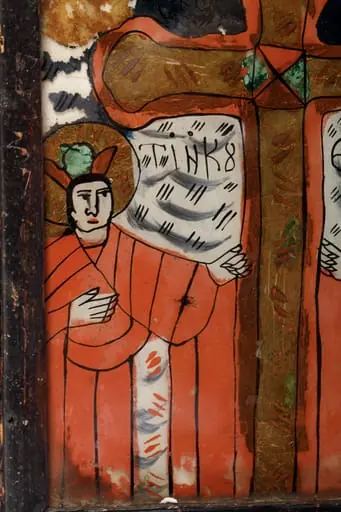 Icoană pictată pe sticlă reprezentând pe Sf. Constantin și Elena, față, în picioare, sub brațele unei cruci. Fețele sunt realizate cu nasuri groase, pleoape și sprâncene paralele, iar faldurii veșmintelor sunt convenționale. În colorit predomină roșul, care se regăsește în hainele sfinților, în chenarul crucii și în fundalul din partea inferioară. Crucea este pictată cu auriu, la fel ca nimburile sfinților. Întreg spațiul de fond și crucea sunt acoperite cu grupuri de trei liniuțe. Rama este de lemn, probabil cea originală.
 Mântuitorul Iisus Hristos, fiind răstignit pe Cruce, are în dreapta pe ucenicul cel iubit, care a stat lipit de pieptul Învățătorului, la Cina cea de Taină, mai precis, pe Sfântul Apostol și Evanghelist Ioan Teologul, Evanghelistul Iubirii și în stânga pe Maica Domnului Îndurerată, Jalnică și Plângătoare. Veșmintele Maicii Domnului sunt gri-sable și mantie roșie. Sfântul Ioan este îmbrăcat în roșu și galben-ocru. Mântuitorul Iisus Hristos are o țesătură roșie în jurul mijlocului și a coapselor. În planul superior sunt simboluri astrale: soarele, deasupra Maicii Domnului, luna, deasupra Sfântului Ioan și câte un înger în fiecare colț din registrul superior. În registrul inferior, paralel cu Crucea sunt și lujere foarte înalte cu flori mari, elemente fitomorfe, care înlocuiesc prezența ucenicilor și martorilor la suferință. Cromatica este armonioasă: roșu vermillon, albastru ceruleum, verde-spanac-avocado, galben-ocru, alb, negru. Inscripția din româno-chirilică se traduce Răstignirea Lui Iisus Hristos IC XC Sf Ioan MP Maica Domnului.
 Cei Trei Sfinți Ierarhi Vasile cel Mare, Ioan Gură-de-Aur și Sfântul Grigorie Cuvântătorul de Dumnezeu slujesc și săvârșesc Sfânta Liturghie împreună. Sunt înveșmântați în veșminte liturgice: sacos, felon și epitrahil. Sfântul Vasile cel Mare binecuvântează cu crucea în mâna stângă și ține în mâna dreaptă Sfânta Evanghelie. Sfântul Ioan Gură-de-Aur și Sfântul Grigorie binecuvântează cu mâna stângă și ține în mâna dreaptă Sfânta Evanghelie. Fondul este văzduhul verde văratic, bogat ornamentat cu elemente astrale albe și roșii, în registrul superior, în registrul inferior este un câmp galben-chihlimbar. Inscripția din româno-chirilică se traduce Sf Vasile Sf Ioan Sf Grigorie. Cromatica este armonioasă și luminos-pastelată: roșu vermillon, roz, corai, gri, albastru ceruleum, cobalt, verde văratic, galben chihlimbar, alb, negru. Icoana este din Țara Oltului, Șcheii Brașovului.
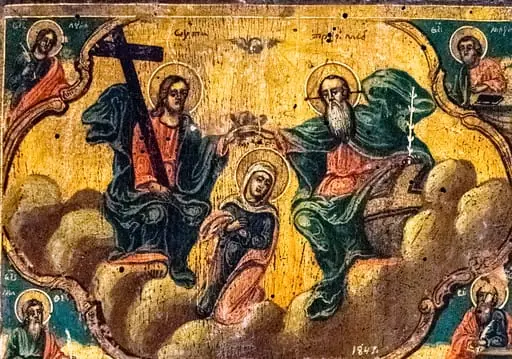 Icoaezeneapt
 Maica Domnului ține în brațe Pruncul Iisus Hristos care are în mâna stângă un hrisov înfășurat și Binecuvântează cu mâna dreaptă. Maica Domnului arată calea cu mâna dreaptă, deci este Hodighitria. Maica Domnului este înveșmântată în mantie cu maforion roșu vermillon cu interiorul verde și sacos galben, are aureolă. Pruncul Iisus Hristos este înveșmântat în galben-bronziu și alb crem-ivoriu, are aureolă. Întreaga icoană este încadrată de un chenar decorativ geometrizant vișiniu-acajou-sracojiu cu linia albă șerpuită, specifică centrului de la Nicula. Fondul icoanei este cerul albastru ultramarin bleumarin. Cromatica este armonioasă, luminoasă, bizantină și foarte picturală: roșu vermillon, verde spanac-avocado, kaki, galben chihlimbar, albastru ultramarin bleumarin, vișiniu, stacojiu-acajou, bronziu, alb, negru. Icoana este de Nicula. Inscripția din româno-chirilică se traduce MP IC XC Maica Domnului Iisus Hristos.
 Sfânta Mare Cuvioasă Parascheva de la Iași are crucea brun-neagră în mâna dreaptă, binecuvântând, și o ramură de finic verde, nuanța algelor în mâna stângă. Este îmbrăcată în veșmânt roșu vermillon-orange cu interiorul căptușit cu verde-mușchi de pădure și franjuri brun-bronzii. Sacosul este alb-crem cu danteluță, guleraș și dungi. Sfânta Cuvioasă are părul negru lung, lăsat pe umeri, coroană roșie cu verde-brad și aureolă brun-bronzie. Fondul icoanei este cerul albastru cobalt în registrul superior-mijloc și un câmp alb-crem, ancadrator întregii compoziții. Întreaga compoziție iconografică este încadrată de un chenar decorativ fitomorf, format dintr-o ghirlandă de 5 ruje mari orange-cărămizii cu frunze verzi. Cromatica este armonioasă: roșu vermillon-orange, albastru cobalt-ceruleum, verde alge, mușchi de pădure, bej-crem, bronziu, galben-solar, negru, alb zinc. Icoana este din Nordul Transilvaniei, Nicula.
Frequently asked questions
What is Cult Object?
Cult Object is a subject in art. A cult object is any material item venerated within a religious or ritual practice — ranging from ancient Egyptian amulets and Greek votive offerings to African ceremonial masks and South Asian divine images.
How many Cult Object works does Artifact World Gallery have?
Artifact World Gallery holds 200 public-domain Cult Object works, all free to view and download.
Who are the key Cult Object artists?
Key Cult Object artists in the collection include Hugo Kołłątaj, Leon Alexandru Biju and Robert Filliou George Brecht.
Where can I see Cult Object works?
Cult Object works in the collection are held by ASTRA National Museum Complex, "Dimitrie Gusti" National Village Museum and Ethnographical Museum of Transylvania.