Artwork
Adoration of the Trinity
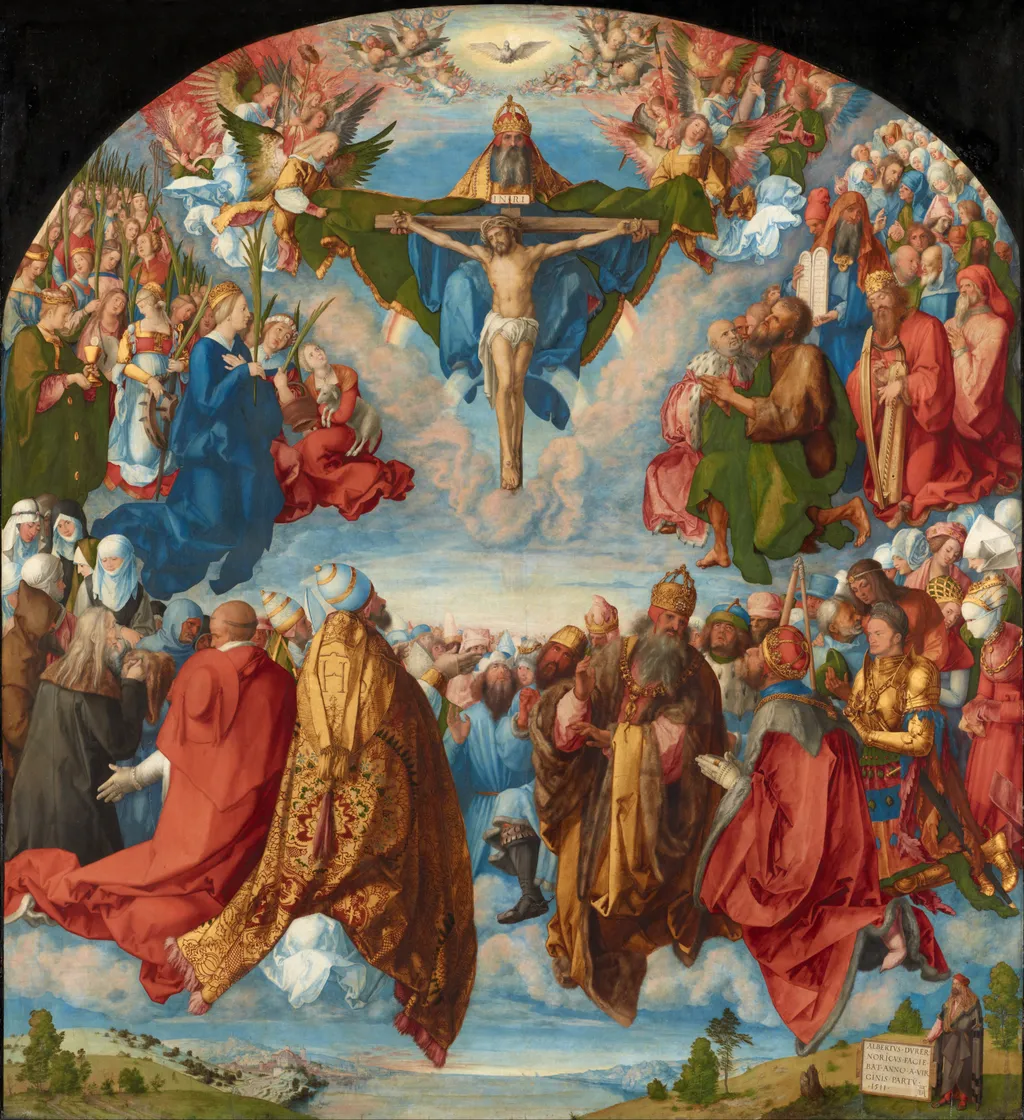
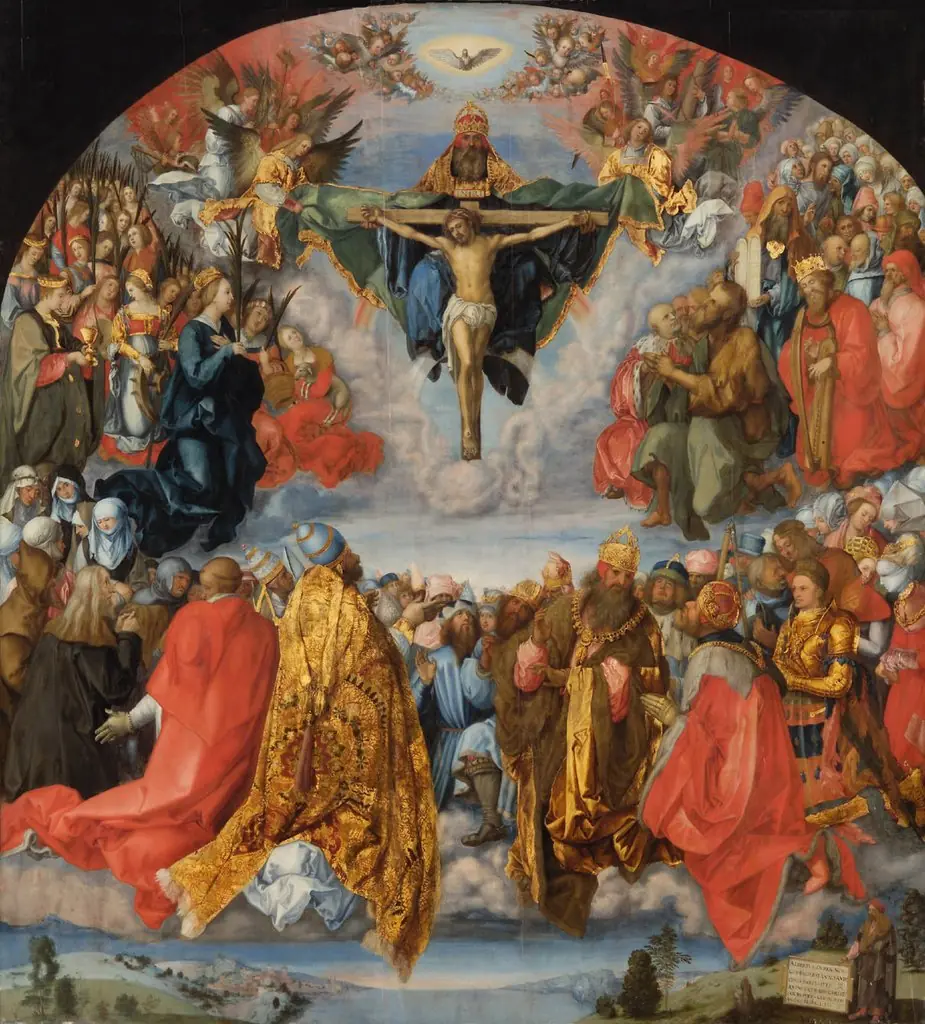
Adoration of the Trinity is an oil painting by the Northern Renaissance artist Albrecht Dürer. It dates from 1511 and is held in the collection of the Kunsthistorisches Museum.
About this work
Subject & Meaning
This composition synthesizes the entire Christian message, illustrating the adoration of the Trinity by all believers.
The painting depicts the Adoration of the Holy Trinity, presenting a vision of the Celestial City after the Last Judgment, inspired by the theological writings of Augustine. At the apex, God the Father, wearing an imperial crown and a gilt cloak, holds the crucified Christ, while the Holy Spirit appears as a dove within a luminous cloud surrounded by cherubim. Below this divine triad, the communion of saints is organized hierarchically: the Virgin Mary and John the Baptist lead the heavenly hosts, while the earthly multitudes are divided into the spiritual estate, led by the Pope, and the secular estate, led by the Holy Roman Emperor.
This composition synthesizes the entire Christian message, illustrating the adoration of the Trinity by all believers. The scene includes specific figures such as the donor Matthäus Landauer, a peasant representing the poor, and an enigmatic veiled queen, all gathered above a dawn landscape that bridges the earthly and the divine.
Technique & Style
The Adoration of the Trinity is executed in oil paint on a wooden panel, with some areas possibly tempera. The support is a lime panel according to Wikidata, while other descriptions note a poplar panel. Stylistically, the work exemplifies the German Renaissance, employing hierarchical scale to place the Trinity above a crowded assembly of saints, donors and a landscape.
The lower landscape draws on Albrecht Altdorfer and Joachim Patinir, and Dürer includes a self‑portrait holding a cartouche with his signature and date. The painting is set within an Italianate frame designed by the artist, and the composition balances sacred and secular figures in a monumental, visionary synthesis.
History & Provenance
The altarpiece was commissioned in 1508 by the wealthy Nuremberg merchant Matthäus Landauer for a chapel dedicated to the Holy Trinity and All Saints in the Zwölfbrüderhaus, a charitable institution he had co-founded with Erasmus Schiltkrot in 1501 to house elderly artisans. A preparatory drawing dated 1508, now in the Musée Condé at Chantilly, records the early conception of the composition and frame. Although the chapel was completed by 1508, Dürer, still occupied with the Heller Altarpiece and preferring the more lucrative print medium, delivered the painting only three years later, in 1511, when it was installed in the church.
The original carved frame, designed by Dürer and executed by Veit Stoss, remained in Nuremberg and is now in the Germanisches Nationalmuseum; a modern copy is displayed at the Kunsthistorisches Museum. The painting itself was sold to Emperor Rudolf II in 1584–1585 and transferred to Prague, before eventually entering the Kunsthistorisches Museum in Vienna, where it is displayed in the German paintings gallery (hall XI).
Albrecht Dürer's Adoration of the Trinity is permanently held by the Kunsthistorisches Museum in Vienna, Austria, where it is displayed in Hall XI of the German paintings collection. The work was commissioned by Matthäus Landauer in 1508 for a chapel in the Zwölfbrüderhaus in Nuremberg but was delivered and installed in 1511. In 1584–1585, the painting was sold to Emperor Rudolf II and transported to Prague before eventually entering the Vienna museum's holdings.
The original elaborate frame, designed by Dürer and carved by Veit Stoss, remained in Nuremberg and is now part of the collection at the Germanisches Nationalmuseum. A modern copy of this frame is currently exhibited alongside the painting in Vienna.
Context
The Adoration of the Trinity is regarded as one of the few altarpieces Dürer produced and among the first German pala-style altarpieces without movable wings, a format shaped by his second Venetian sojourn. The composition synthesizes heaven and earth in a vision of the City of God drawn from Augustine, and art-historical commentary has linked its spherical, Copernican spatial construction to the contemporary Martyrdom of the Ten Thousand (1508). Its division of the faithful into spiritual and lay ranks echoes Dürer's earlier Feast of the Rosary (1506), while the lower landscape reflects the panoramic vistas of Albrecht Altdorfer and Joachim Patinir.
The work has been described as visionary and as anticipating Altdorfer, Bruegel, Tintoretto, and the Baroque masters, though some critics judge it not a technical advance for Dürer. Its compositional affinities with Raphael's Disputation of the Holy Sacrament are noted, though the two were developed independently within a shared Renaissance tendency toward circular, geometric structures. Dürer's inclusion of his own self-portrait as a terrestrial witness to the vision has been read by the art historian Johann Konrad Eberlein as a means of objectifying the complex visionary content.
Legacy
The Adoration of the Trinity is recognized as a seminal work that synthesizes Christian doctrine just before the onset of the Reformation. Art historians regard its composition as visionary, anticipating the styles of Albrecht Altdorfer, Pieter Bruegel, Tintoretto, and later Baroque masters. The painting's arrangement of figures in a spherical, Copernican-like space has been compared to Raphael's Disputation of the Holy Sacrament, reflecting a shared Classical tendency in early 16th-century art despite the two artists having no direct contact.
The work's legacy also encompasses its original integrated design; while the original painted panel resides in the Kunsthistorisches Museum in Vienna, the elaborate frame designed by Dürer and carved by Veit Stoss remained in Nuremberg and is now held by the Germanisches Nationalmuseum. A modern copy of this frame is displayed alongside the panel in Vienna.
Overview
Albrecht Dürer’s Adoration of the Trinity, painted in oil on panel in 1511, is housed in Vienna’s Kunsthistorisches Museum. The composition presents a densely populated, vividly colored scene in which a crucified figure crowned with thorns occupies the central vertical axis, surrounded by a host of winged angels above and a multitude of richly dressed figures below.
Own this work as a print
Artist & collection
Artist
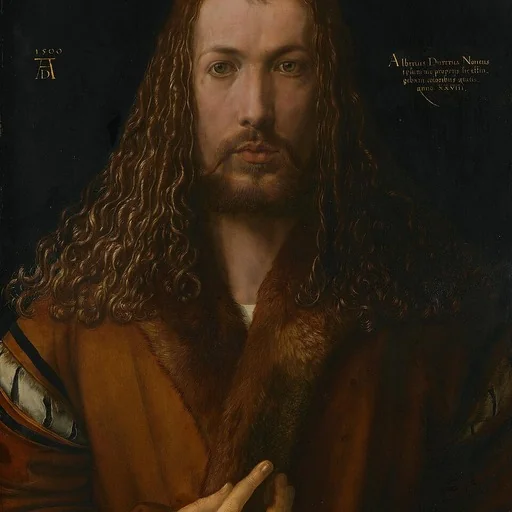
Albrecht Dürer spent his life in Nuremberg, a busy German city where artists traded prints like currency.

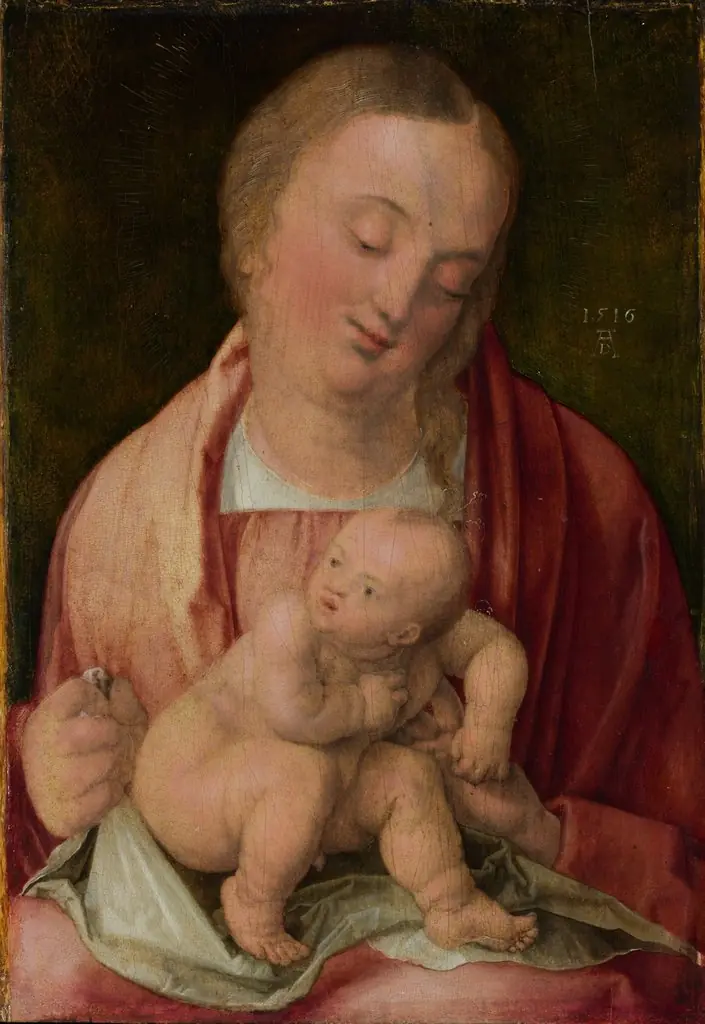
![Madonna and Child [obverse], by Albrecht Dürer](https://artifactworldgallery.com/img/albrecht-durer--madonna-and-child-obverse--d7b8ebf05d22ebe5-w320.webp)
![Lot and His Daughters [reverse], by Albrecht Dürer](https://artifactworldgallery.com/img/albrecht-durer--lot-and-his-daughters-reverse--b4ebf9b282faa17a-w320.webp)