Artwork
Saint Eustace
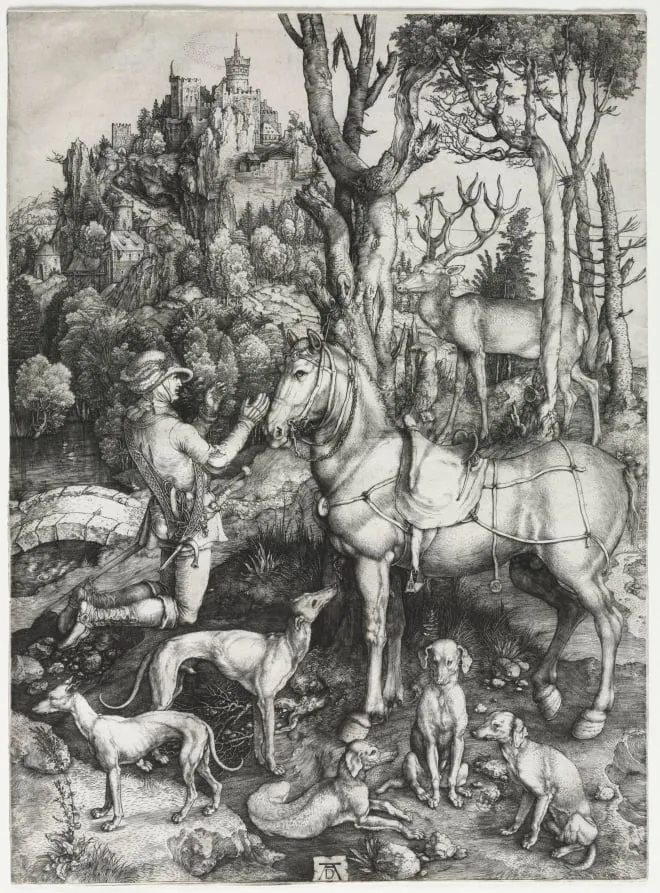
Saint Eustace is a print by the Renaissance artist Albrecht Dürer. It dates from 1501 and is held in the collection of the Cleveland Museum of Art.
- Accession no.
- 1958.109
- Credit line
- Bequest of Leonard C. Hanna Jr.
About this work
You see a knight on horseback in a dark forest, staring at a stag with a glowing cross between its antlers.
You see a knight on horseback in a dark forest, staring at a stag with a glowing cross between its antlers.
This engraving is Dürer’s largest. Every leaf and fur tuft feels real because he carved tiny lines into metal to hold ink. The stag’s miracle is easy to miss at first, like a hidden Easter egg in the trees.
Look up other prints by Albrecht Dürer (German, 1471–1528) to spot more of his quiet surprises.
Overview
This large engraving by Albrecht Dürer depicts a pivotal moment in the legend of Saint Eustace, a Roman general who converted to Christianity after a miraculous encounter with a stag.
Subject & Meaning
The scene shows the general, Placidas, on horseback in a dense forest, gazing at a stag with a radiant crucifix between its antlers, symbolizing his conversion.
Technique & Style
Dürer's mastery of tonal values and textures is evident in the detailed rendering of the natural surroundings, achieved through intricate linework on a metal plate.
Context
The engraving reflects Dürer's fascination with nature and its varied forms, as seen in the carefully posed hunting dogs and the dense foliage.
Artist & collection
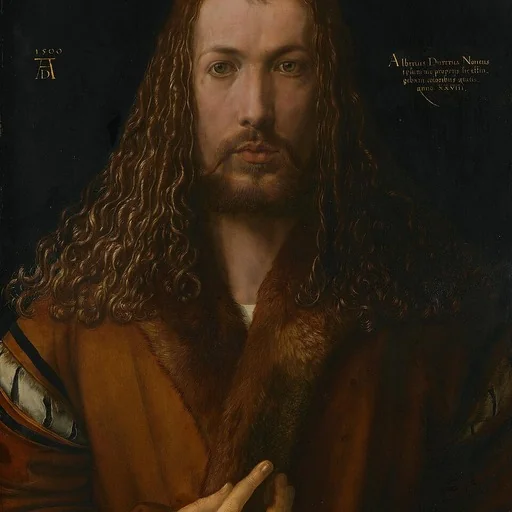
Artist
Albrecht Dürer spent his life in Nuremberg, a busy German city where artists traded prints like currency.

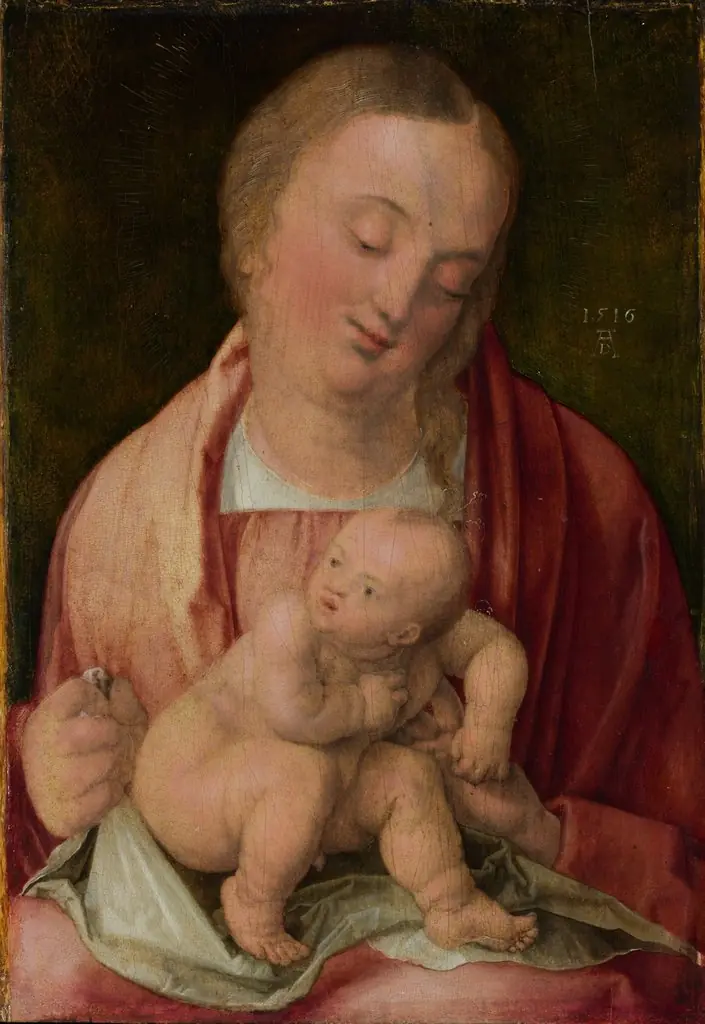
![Madonna and Child [obverse], by Albrecht Dürer](https://artifactworldgallery.com/img/albrecht-durer--madonna-and-child-obverse--d7b8ebf05d22ebe5-w320.webp)
![Lot and His Daughters [reverse], by Albrecht Dürer](https://artifactworldgallery.com/img/albrecht-durer--lot-and-his-daughters-reverse--b4ebf9b282faa17a-w320.webp)