Artwork
Venus and Adonis
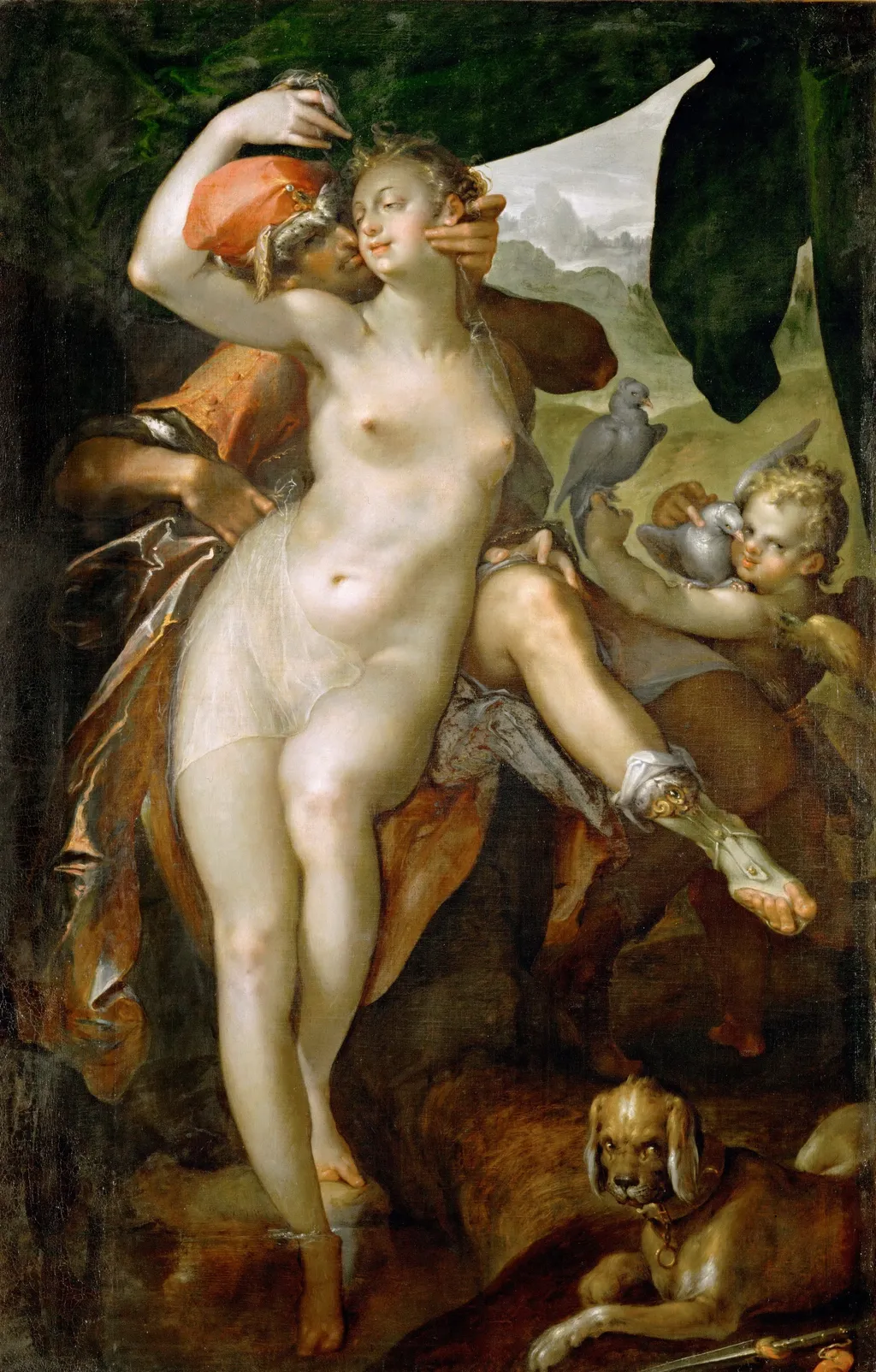
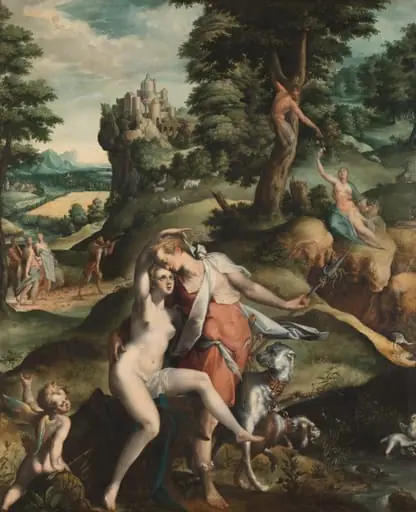
Venus and Adonis is an oil painting by the Mannerist artist Bartholomeus Spranger. It dates from 1599 and is held in the collection of the Kunsthistorisches Museum.
About this work
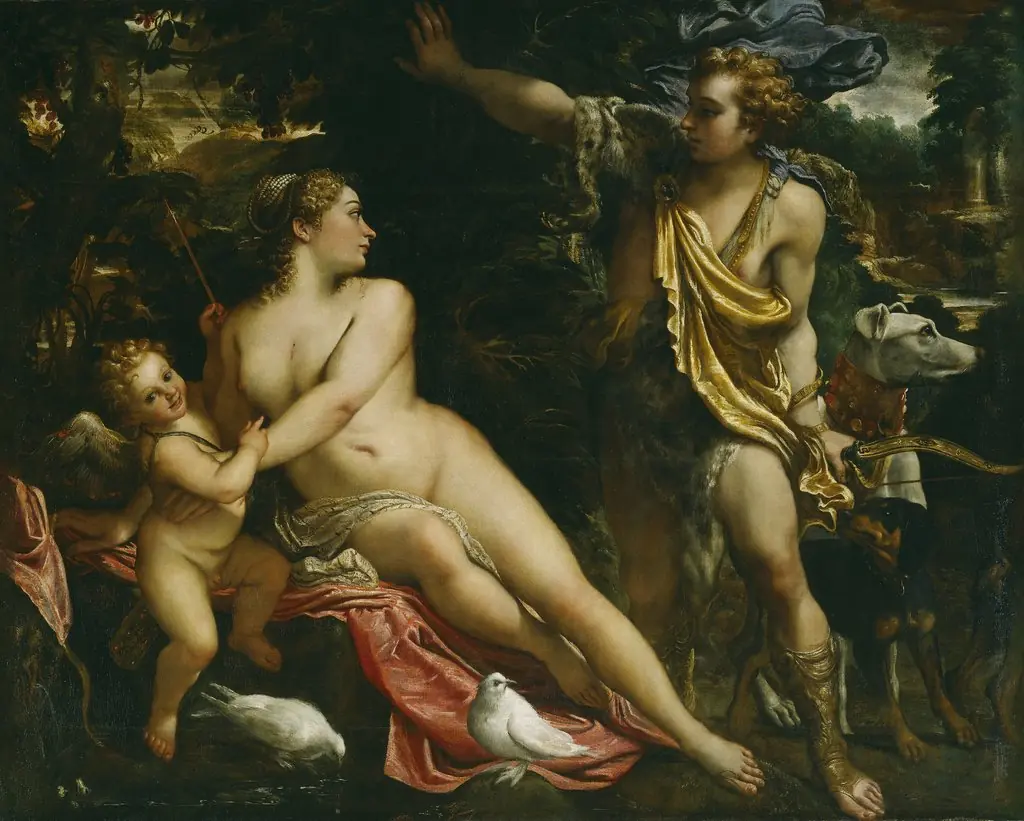
Venus clings to Adonis, trying in vain to keep him from the hunt, her dread already plain. Bartholomeus Spranger painted it around 1595-1597 for the Kunstkammer of Emperor Rudolf II in Prague, where it caught the erotic, intellectual Mannerism of the court. A hunting dog waits at Adonis's side while Cupid and two doves attend the goddess.
Subject & Meaning
The aerial perspective and landscape setting place the couple in a pastoral, idyllic scene that contrasts with the story's ominous outcome.
This mythological painting illustrates the tragic love story of Venus and Adonis as told in Ovid's Metamorphoses. Venus, the goddess of love, is depicted nude with transparent drapery, embracing a clothed Adonis. Surrounding iconography reinforces the narrative: hunting dogs and a bonnet allude to Adonis's fatal hunting expedition, while Cupid (Eros) with his quiver and arrows and a pigeon (sacred to Venus) underscore the theme of love.
The aerial perspective and landscape setting place the couple in a pastoral, idyllic scene that contrasts with the story's ominous outcome. Spranger's composition emphasizes sensuality and the fleeting nature of love, blending eroticism with mythological allegory.
Technique & Style
Executed in oil on canvas, the painting measures 163 × 104.3 cm. The composition employs a vertical format, emphasizing the embracing couple of Venus and Adonis set against a landscape with aerial perspective. Venus is depicted nude with diaphanous drapery, while Adonis remains clothed, creating a contrast in texture and finish. The handling displays the refined, courtly Mannerist style typical of Spranger, with smooth modeling, luminous flesh tones, and delicate brushwork.
The inclusion of a hunting dog, Cupid with his quiver, and pigeons adds narrative detail. The canvas support and oil medium are consistent with Northern Mannerist practice of the late 16th century.
Overview
Bartholomäus Spranger's painting, Venus and Adonis, dating from approximately 1595 to 1597, depicts a pivotal moment from Ovid's Metamorphoses. The goddess Venus attempts to dissuade her mortal lover, Adonis, from embarking on a hunt, foreseeing his tragic death by a wild boar. This oil on canvas work was created for Emperor Rudolf II's renowned Kunstkammer in Prague, serving as a prime example of the sophisticated and intellectual Mannerist style favored at the imperial court.
History & Provenance
This painting was commissioned by Emperor Rudolf II and became part of his celebrated Kunstkammer in Prague, a collection renowned for its breadth and intellectual depth. Created between 1595 and 1597, the work remained within imperial collections. Today, Venus and Adonis is held by the Kunsthistorisches Museum in Vienna, identified by the inventory number Gemäldegalerie 2526, though it is not presently exhibited to the public.
Context
Emperor Rudolf II's court in Prague was a vibrant center for art and culture during the late sixteenth century, becoming a nexus for Northern Mannerism. As court painter since 1581, Bartholomäus Spranger was a central figure in this environment, producing works that aligned with the emperor's refined tastes. The arrival of artists like Hans von Aachen in 1596 further enriched this intellectual atmosphere, fostering a distinctive artistic dialogue that shaped the visual language of the imperial court.
Own this work as a print
Artist & collection
Artist
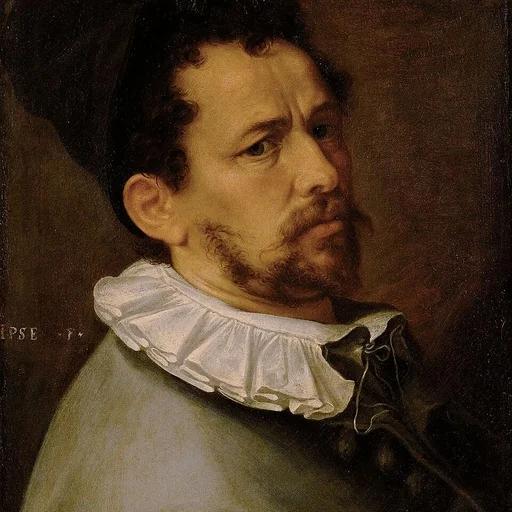
Bartholomeus Spranger or Bartholomaeus Spranger (21 March 1546 – 27 June 1611) was a Flemish painter, draughtsman, sculptor, and designer of prints.