Artwork
A mendicant bowing before a holy man, from the Prince Salim Album
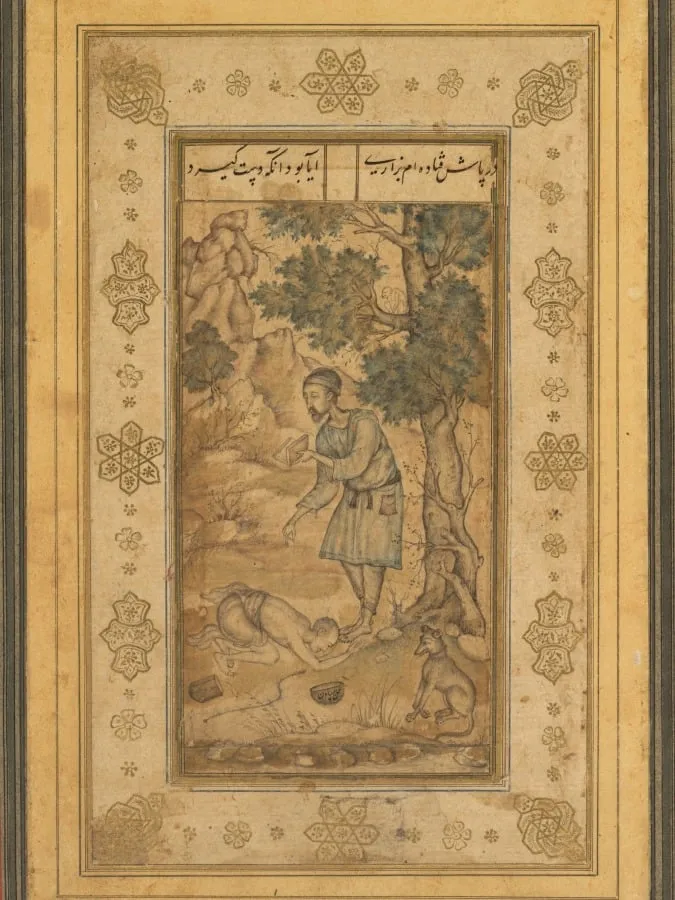
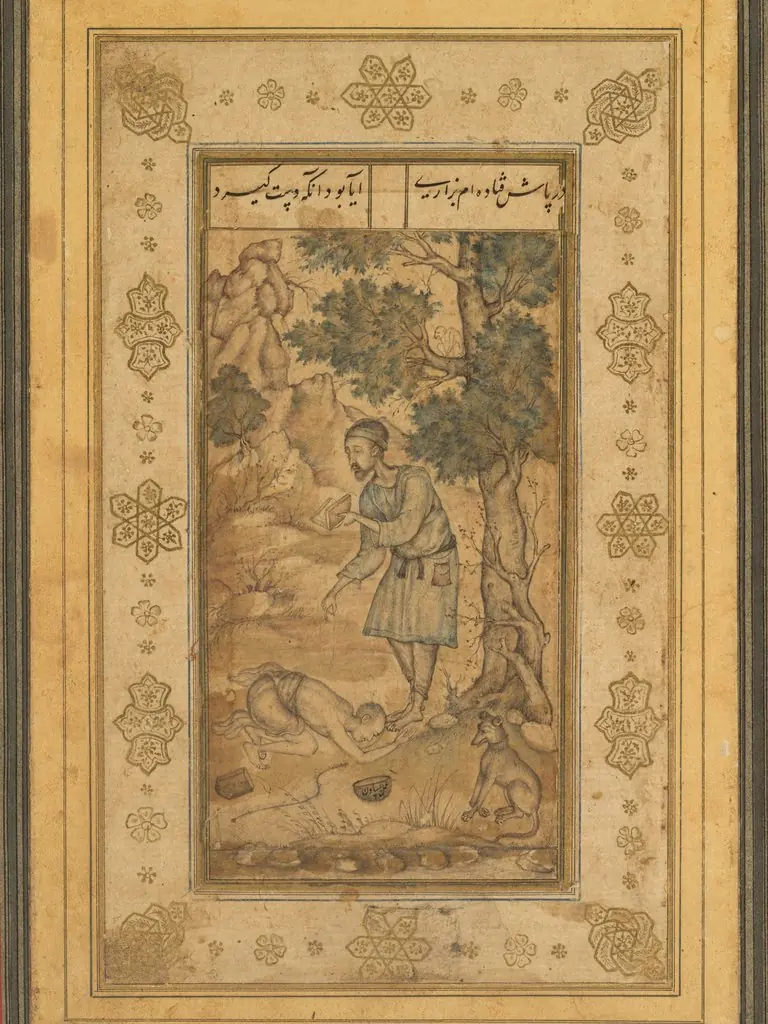
A mendicant bowing before a holy man, from the Prince Salim Album is an unspecified painting by the Patna School of Painting artist Basawan. It is held in the collection of the Cleveland Museum of Art. This miniature, part of the Prince Salim Album, depicts a pious figure seated beneath a solitary tree in a wilderness setting.
- Accession no.
- 2013.296
- Credit line
- Gift in honor of Madeline Neves Clapp; Gift of Mrs. Henry White Cannon by exchange; Bequest of Louise T. Cooper; Leonard C. Hanna Jr. Fund; From the Catherine and Ralph Benkaim Collection
About this work
Overview
This miniature, part of the Prince Salim Album, depicts a pious figure seated beneath a solitary tree in a wilderness setting. A jackal rests loyally at his side while a devotee bows, touching the saint’s head to his feet. The work is executed on a small scale, with the artist’s diminutive signature placed on the alms bowl, and is currently housed in the Cleveland Museum of Art.
Subject & Meaning
The central figure is a holy man, his robes tinted a subtle blue, embodying spiritual authority and humility. The presence of the jackal, an animal often associated with loyalty, reinforces the saint’s connection to the natural world. The devotee’s act of bowing emphasizes reverence and the transmission of sanctity from the enlightened to the lay follower.
Technique & Style
Created in the late 1580s, the painting reflects the Mughal workshop’s synthesis of Persian miniature conventions with emerging naturalistic approaches.
Created in the late 1580s, the painting reflects the Mughal workshop’s synthesis of Persian miniature conventions with emerging naturalistic approaches. Fine, microscopic brushwork renders delicate foliage and animal fur, while subtle modeling gives the figures a three‑dimensional presence. Such precision was admired by contemporary Persian connoisseurs for its virtuoso execution on a minute surface.
History & Provenance
The piece originates from the Prince Salim Album, a collection assembled under the patronage of the Mughal court. It entered the Cleveland Museum of Art’s collection through acquisition in the 20th century, where it remains a representative example of the period’s cross‑cultural artistic exchange.
Context
During Emperor Akbar’s reign, the imperial atelier encouraged the integration of diverse visual influences, including Persian models and, possibly, European prints. This openness fostered a new dimensionality and naturalism in Indian painting, evident in the work’s realistic treatment of space, light, and animal anatomy.
Artist & collection
Artist
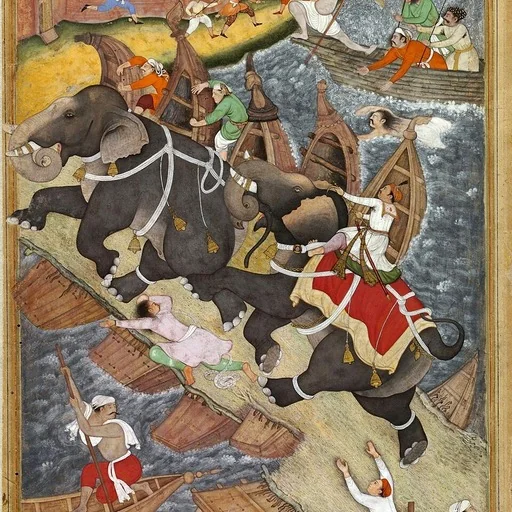
Basāwan, or Basāvan, was an Indian miniature painter in the Mughal style. He was known by his contemporaries as a skilled colorist and keen observer of human nature, and for his use of portraiture in the illustrations…

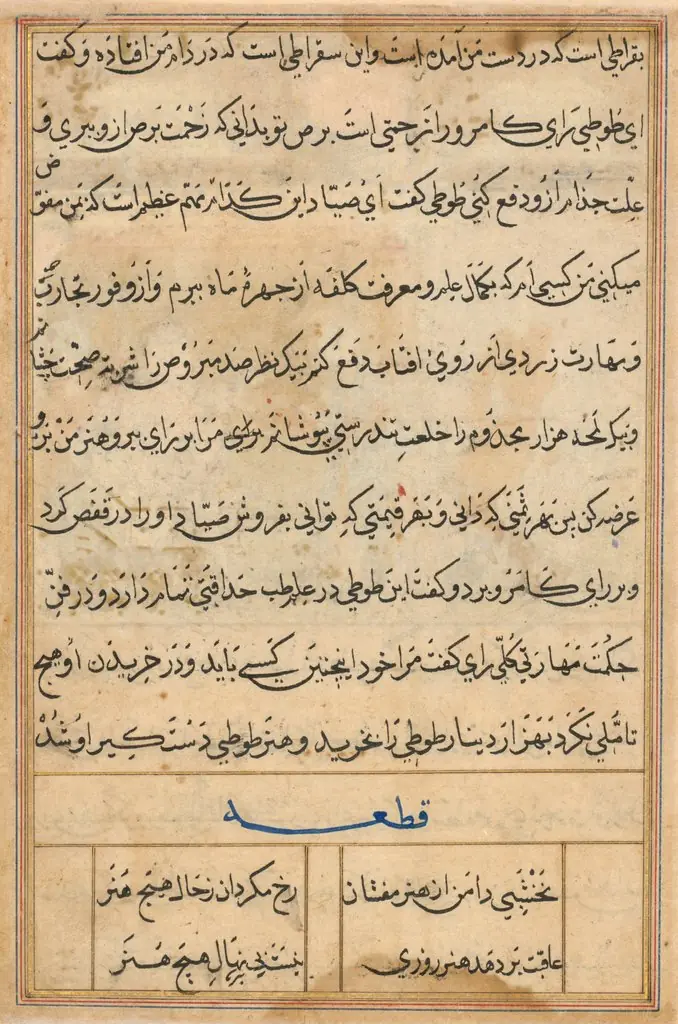 Page from Tales of a Parrot (Tuti-nama): text page
 Jain Ascetic Walking Along a Riverbank
 A mendicant bowing before a holy man, from the Prince Salim Album
 The siege of Arbela in the era of Hulagu Khan, from a Chingiz-nama (Book of Chingiz Khan) of the Jami al-tavarikh (Compendium of Chronicles) of Rashid al-Din (Persian, 1247–1318)
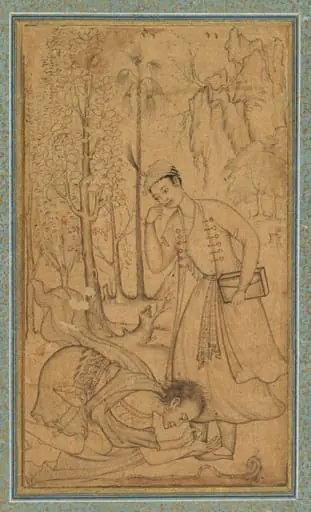
 A holy man prostrating himself before a learned prince
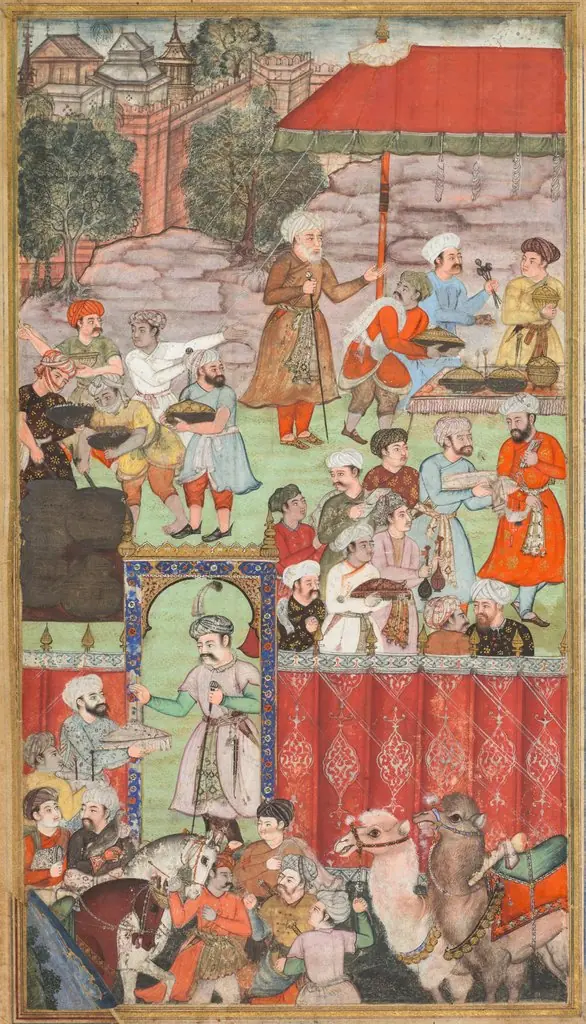 A feast for Babur hosted by his half-brother Jahangir Mirza in Ghazni in May 1505, from a Babur-nama (Memoirs of Babur)
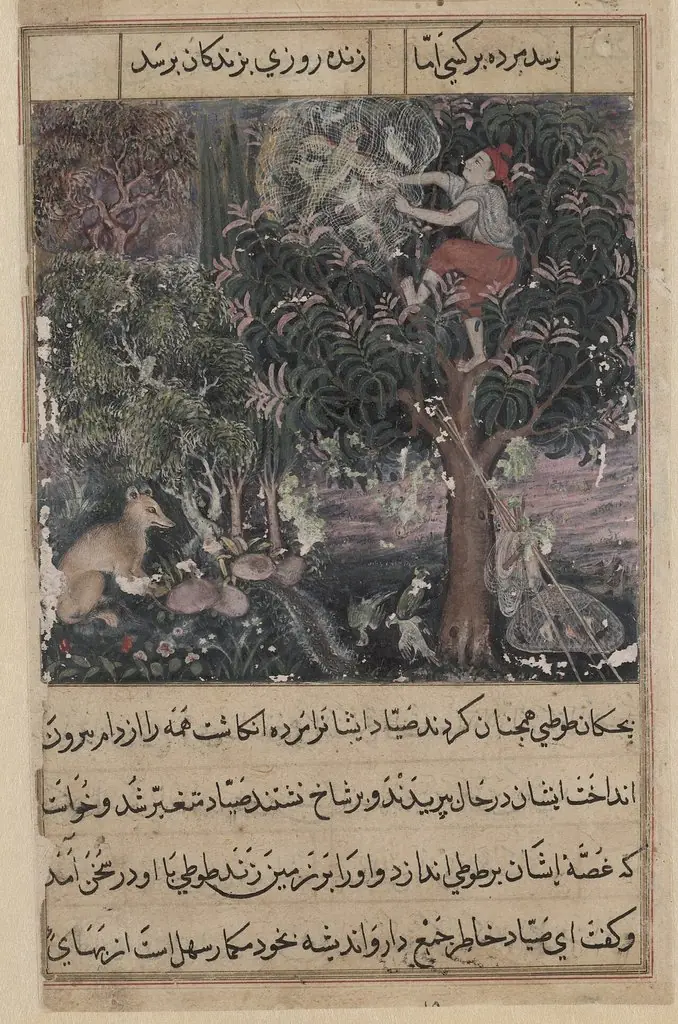 The hunter throws away the baby parrots, who pretend to be dead, and captures the mother, from a Tuti-nama (Tales of a Parrot): Fifth Night
 Page from Tales of a Parrot (Tuti-nama): text page
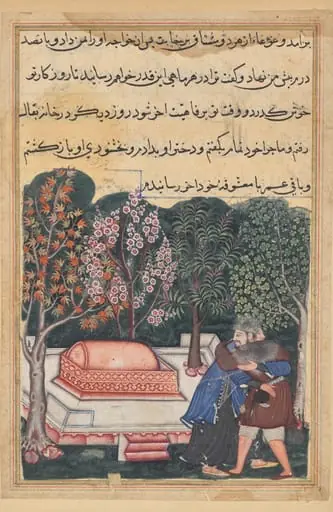 The young man of Baghdad reunited with his slave-girl, from a Tuti-nama (Tales of a Parrot): Forty-eighth Night
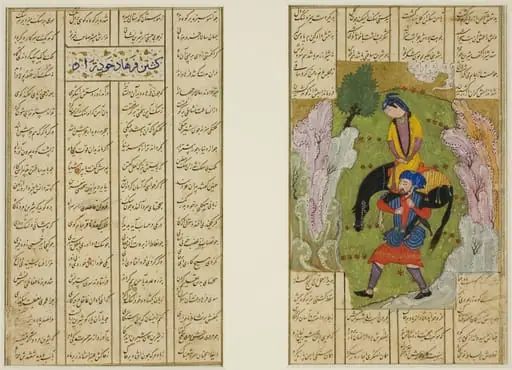 Farhad Carrying Shirin and Her Horse, from a copy of the Khamsa of Nizami
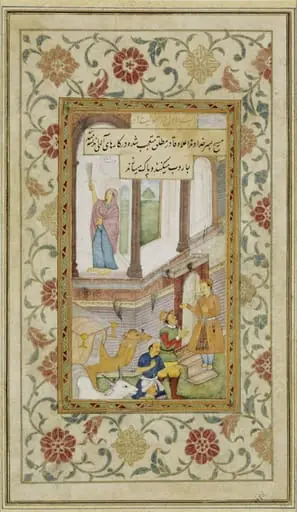 The Inn at Bethlehem
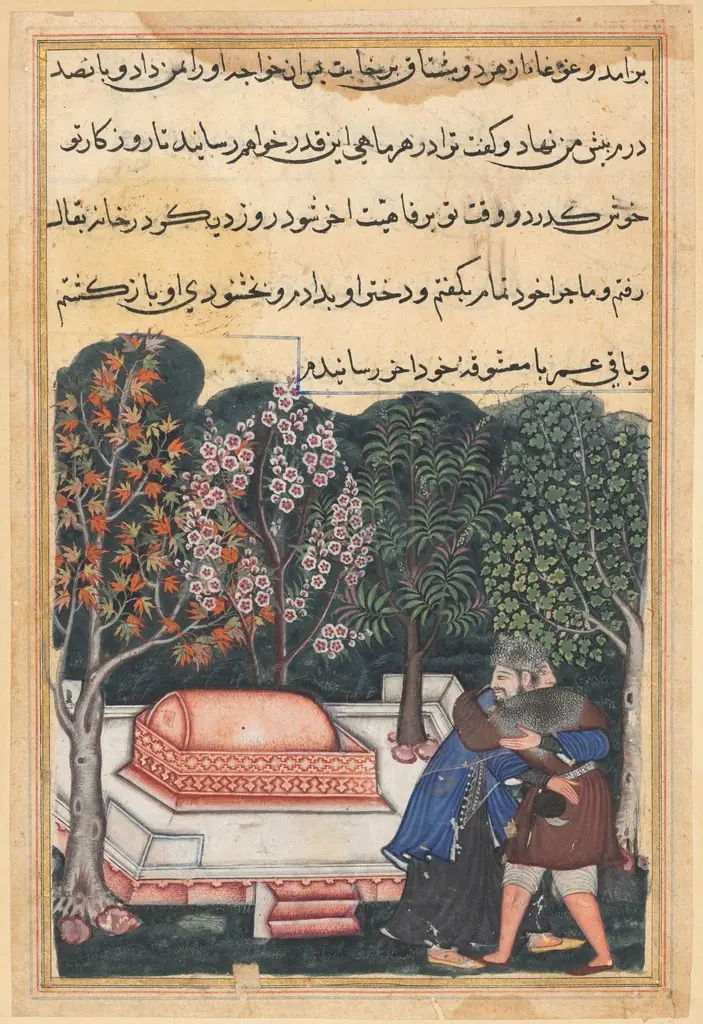 The young man of Baghdad reunited with his slave-girl, from a Tuti-nama (Tales of a Parrot): Forty-eighth Night
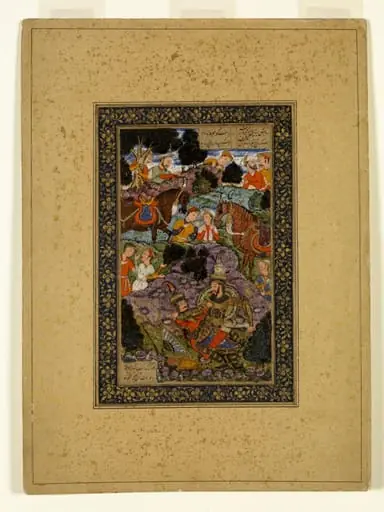 Rustam and Sohrab