Artwork
Allegory of Painting
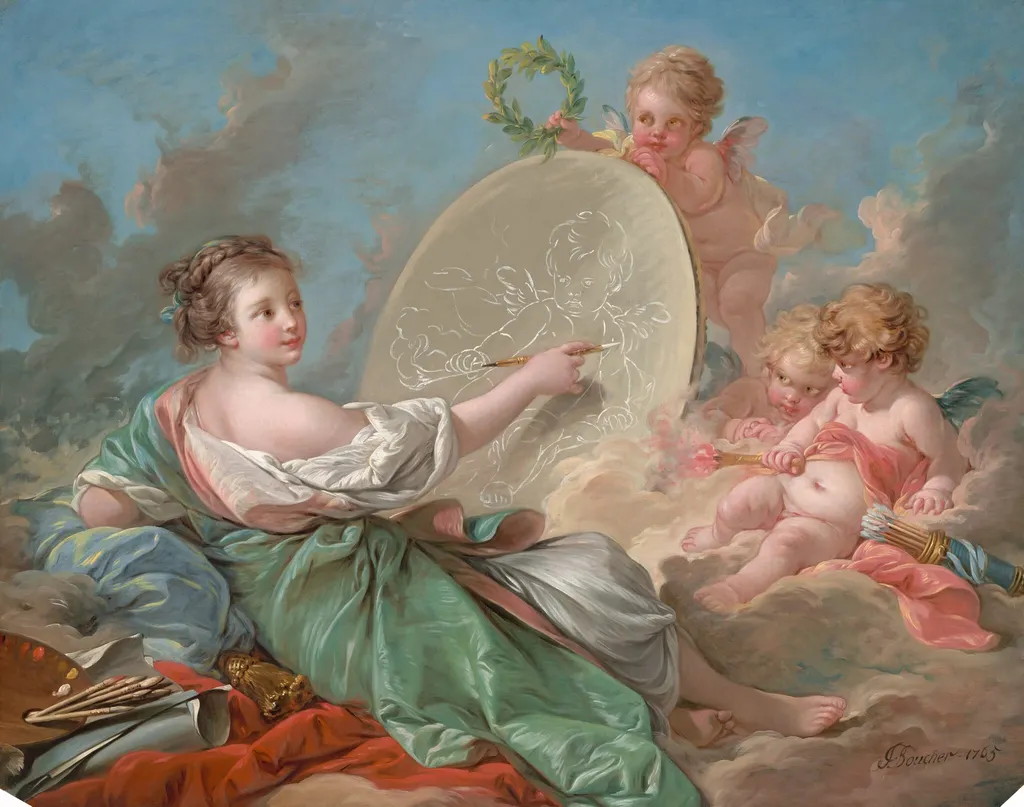
Allegory of Painting is an oil painting by the Rococo painting artist François Boucher. It dates from 1765 and is held in the collection of the National Gallery of Art.
- Inscription
- Inscribed:lower right in black paint, FB in monogram: FBoucher - 1765
About this work
Technique & Style
As an allegorical composition, the piece utilizes the fluidity of oil paint to render the soft, Rococo aesthetic characteristic of Boucher's mature style.
Executed in 1765, François Boucher's Allegory of Painting is an oil painting on canvas. The work measures 101.5 by 130 centimeters. As an allegorical composition, the piece utilizes the fluidity of oil paint to render the soft, Rococo aesthetic characteristic of Boucher's mature style.
The medium allows for the delicate modeling of forms and the luminous color palette typical of the artist's approach to mythological and allegorical subjects during this period.
History & Provenance
François Boucher executed this oil on canvas in 1765. Traditional accounts, originating with Paul Mantz in 1873, suggest the work was commissioned for Maximilian III Joseph, Elector of Bavaria, and later returned to France by Général de Saint-Maurice. However, modern scholarship notes that Saint-Maurice never served in Bavaria and died in 1796, rendering the early ownership narrative undocumented.
The first verified record appears in the collection of M. Maillet du Boullay, whose estate sold the painting at Hôtel Drouot in Paris on January 22, 1870. It subsequently passed to Gustave Rothan by 1874, then to the 4th duchesse de Dino by 1907, and likely to her daughter, Countess Mabel Stevens Orlowski. Wildenstein & Co. eventually sold the piece to the Samuel H. Kress Foundation in 1942, which gifted it to the National Gallery of Art in 1946.
The work is held by the National Gallery of Art in Washington, D.C., as part of the Samuel H. Kress Collection. Its accession number is 1946.7.2, reflecting its entry into the museum via a gift from the Samuel H. Kress Foundation in 1946. Prior to this transfer, the painting was sold to the foundation by Wildenstein & Co., Inc. in 1942.
The provenance traces back to the early 20th century through the collection of Adèle, 4th Duchess de Dino, and earlier owners including Gustave Rothan and M. Maillet du Boullay, though early attributions to the Elector of Bavaria remain based on tradition rather than documentary evidence. The provided sources do not list specific exhibition history for this work.
Legacy
The work, painted by François Boucher in 1765, was acquired by the National Gallery of Art in Washington, D.C., via the Samuel H. Kress bequest, a transfer that cemented its status as a key example of Rococo allegory within a major public collection.
Subsequent research into its provenance, spanning Bavarian patronage, French private owners, and a 1942 sale to Kress, has kept the painting at the center of scholarly discussion, reinforcing its enduring reputation as a benchmark for Boucher’s allegorical subjects.
Overview
François Boucher's 1765 oil on canvas, Allegory of Painting, exemplifies the Rococo style prevalent in 18th-century France. This work presents a personification of the artistic discipline, depicted as a female figure engaged in creation. As a prominent decorative artist of his era, Boucher frequently explored classical and allegorical themes, integrating them into the ornate and often idyllic visual language characteristic of Rococo art.
Subject & Meaning
The painting features a woman, draped in classical-inspired green and white garments, seated on a red cloth. She holds a brush, actively sketching a cherub onto a large oval canvas. Three additional cherubic figures observe her work, adding a playful and mythological dimension.
This scene symbolically represents the art of painting itself, with the classical attire and cherubs reinforcing the allegorical nature of artistic inspiration and creation.
Own this work as a print
Artist & collection

Artist
François Boucher was a French painter, draughtsman and etcher, who worked in the Rococo style.