Artwork
The Crystal Palace
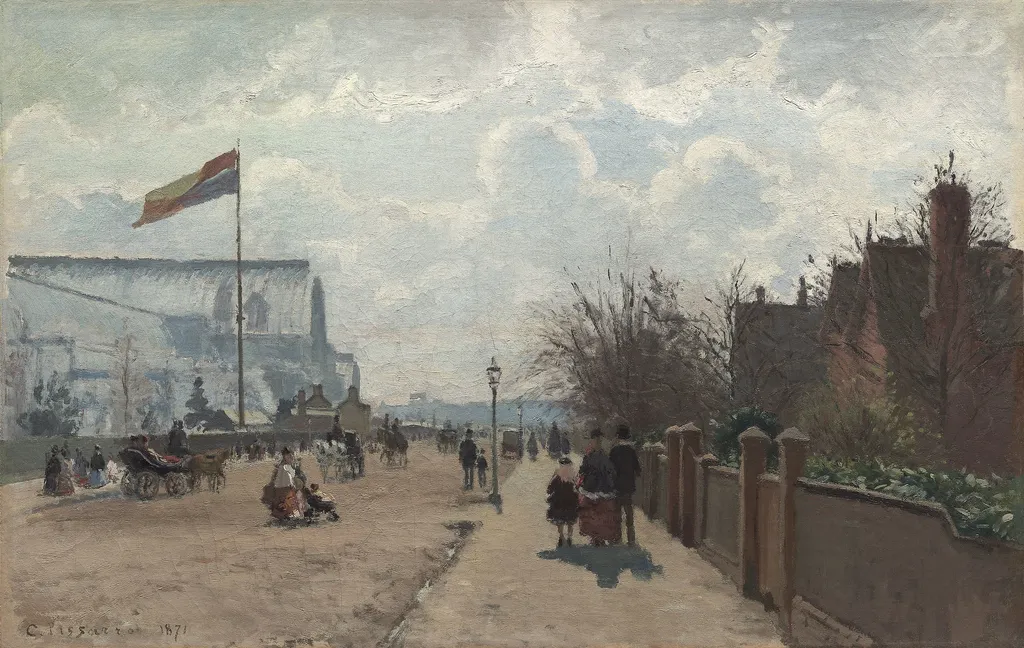
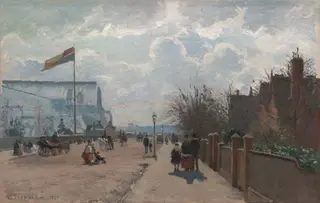
The Crystal Palace is an oil painting by the Impressionist artist Camille Pissarro. It dates from 1871 and is held in the collection of the Art Institute of Chicago.
About this work
Subject & Meaning
The surrounding houses are typical 19th-century English middle-class terraces, enclosed by dense fences and gardens with bare trees suggesting early spring.
The painting depicts a suburban street in Sydenham, London, showing the Crystal Palace from the 1851 World's Exhibition in the background. The composition uses diagonal perspective toward a vanishing point, with vertical elements such as a flagpole, gas lamps, and fence posts, and horizontal lines formed by rooftops and the palace's nave. Pissarro renders the Crystal Palace as a background structure, not the central focus, reflecting its role as a symbol of industrial modernity against a quiet domestic scene.
The surrounding houses are typical 19th-century English middle-class terraces, enclosed by dense fences and gardens with bare trees suggesting early spring. The atmosphere is calm and diffused, with light coming from a low sun, casting long shadows and creating a subtle interplay of gray, blue, and white tones in the sky. No individual faces are visible, emphasizing the stillness of suburban life over urban bustle.
The work thus juxtaposes the monumental glass-and-iron Crystal Palace with everyday domestic surroundings, symbolizing the coexistence of industrial grandeur and ordinary existence. Pissarro's technique captures transient light and weather effects, aligning with Impressionist concerns while referencing influences such as Hobbema's alley compositions and English landscape traditions.
Technique & Style
Camille Pissarro executed The Crystal Palace in 1871 using oil paint on canvas. The work measures 47.2 cm in height and 73.5 cm in width. Stylistically, the painting depicts a street scene in Sydenham with the Crystal Palace visible in the background, utilizing a composition where the road and sidewalks recede diagonally toward a central vanishing point.
Vertical elements, including a flagpole, gas lamps, and fence posts, contrast with the horizontal lines of house roofs and the palace's barrel-vaulted roof. The artist employed a moving brushstroke to render the sky, capturing varied cloud formations in shades of gray, blue, and white to create a dynamic atmosphere. The figures are rendered without visible facial features, contributing to a quiet suburban mood rather than a bustling city center. The scene is illuminated by low-angle sunlight, casting long shadows and enveloping the setting in diffuse backlight.
History & Provenance
Pissarro painted The Crystal Palace in 1871, signing and dating the canvas "C. Pissarro 1871" at the lower left. The work was produced during his exile in London, where he had fled with his partner Julie Vellay and their children after the outbreak of the Franco-Prussian War in 1870. Settling in the southern suburb of West Norwood, where his mother and brother had also taken refuge, Pissarro depicted the Crystal Palace Parade in Sydenham as it appeared in the spring of that year.
The painting entered the collection of Henry Johnson Fisher before being acquired by the Art Institute of Chicago in 1972, where it has since remained.
Camille Pissarro's 1871 oil painting The Crystal Palace is held in the permanent collection of the Art Institute of Chicago. The work, which depicts a street scene in Sydenham with the Crystal Palace in the background, has been part of the museum's holdings since 1972. Prior to its acquisition by the institution, the painting was owned by Henry Johnson Fisher.
The source material does not provide a specific inventory or accession number for the work, nor does it detail a broader exhibition history beyond its long-term residence in the Chicago collection.
Context
Painted during Pissarro's exile in London after fleeing the Franco-Prussian War, The Crystal Palace reflects a pivotal moment in the artist's development. While in the British capital, Pissarro reunited with Claude Monet and the dealer Paul Durand-Ruel, who purchased works from him and arranged exhibitions. The two painters also visited London museums together, studying the landscapes of John Constable and J. M. W. Turner, whose handling of light and atmosphere left a discernible mark on Pissarro's approach.
The composition of the street receding toward a vanishing point draws directly on Meindert Hobbema's Avenue at Middelharnis, which had entered the National Gallery's collection in March 1871 and which Pissarro is documented to have seen there. Replacing Hobbema's avenue trees with gas lamps and a flagpole, Pissarro transposed the seventeenth-century Dutch motif into a contemporary suburban London setting, situating the monumental iron-and-glass exhibition hall of 1851 as a backdrop to everyday middle-class life rather than as the painting's primary subject.
Overview
The Crystal Palace is a painting by Camille Pissarro, created in 1871 using oil paint. It is part of the Art Institute of Chicago's collection.
Own this work as a print
Artist & collection