Artwork
A Pawnee Warrior Sacrificing His Favorite Horse
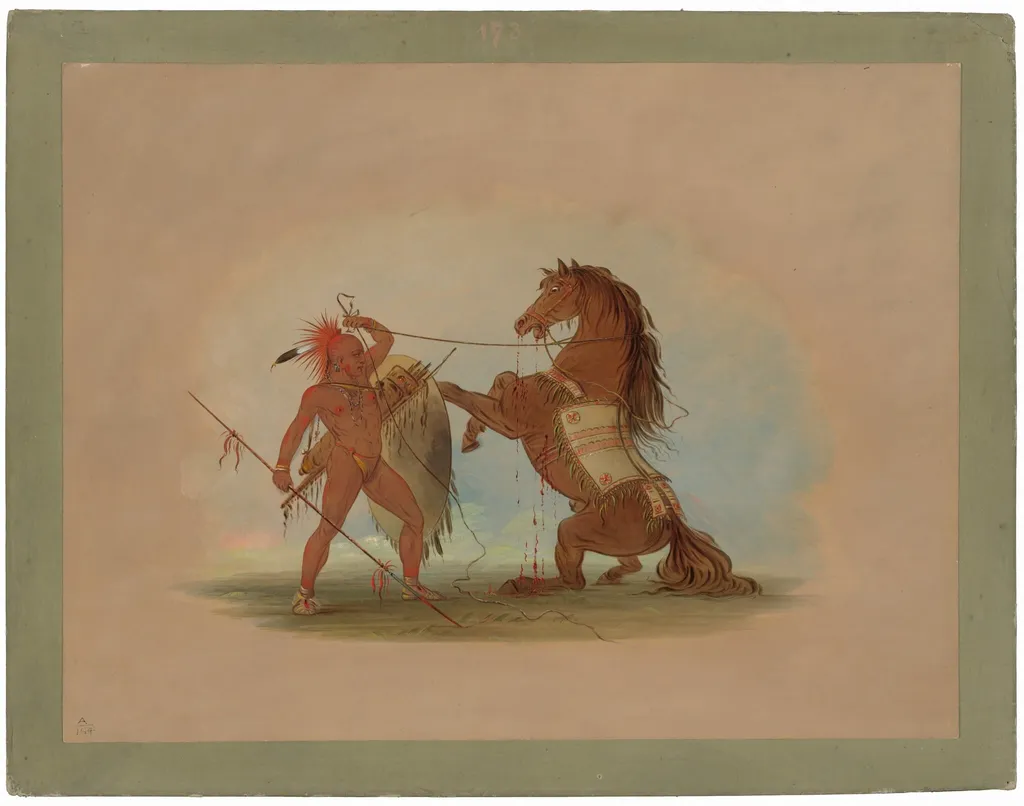
A Pawnee Warrior Sacrificing His Favorite Horse is an oil painting by the American Folk Art artist George Catlin. It dates from 1865 and is held in the collection of the National Gallery of Art.
About this work
Subject & Meaning
The composition focuses on the relationship between the warrior and the animal, highlighting the significance of the sacrifice within the tribe's belief system.
The painting depicts a religious ceremony in which a Pawnee warrior sacrifices his favorite horse. This act serves as the central ritual within the work's narrative, illustrating a moment of spiritual devotion and cultural practice. The genre is classified as religious, emphasizing the solemnity and sacred nature of the event portrayed.
The composition focuses on the relationship between the warrior and the animal, highlighting the significance of the sacrifice within the tribe's belief system.
Technique & Style
Painted in 1865 in oil on card mounted on paperboard, the work depicts a Pawnee warrior sacrificing his favorite horse. It measures 47.3 cm in height and 62 cm in width, reflecting George Catlin's characteristic approach to Native American subjects through a narrative-driven style. Rendered on a small, rigid support, the painting emphasizes dramatic gesture, aligning with nineteenth-century conventions of narrative genre painting.
Its composition centers the warrior's solemn act, using contrasts and detailed figure rendering to convey sacrifice and spiritual significance.
The work's materiality, oil on a mounted card support, suited Catlin's practical needs for field documentation. Handling and condition details are not specified in the available records, but the work's preservation is confirmed through its long-term care in a museum setting. Stylistically, it belongs to the broader category of nineteenth-century narrative painting that blends ethnographic interest with artistic interpretation.
History & Provenance
George Catlin painted A Pawnee Warrior Sacrificing His Favorite Horse in 1865, working in oil on card mounted on paperboard. The work descended from Catlin to his daughters Clara Gregory Catlin, Louise Catlin Kinney, and Elizabeth Wing Catlin. In 1912 the American Museum of Natural History purchased the painting from Elizabeth Wing Catlin.
The museum sold it in 1959 through Kennedy Galleries in New York to Paul Mellon of Upperville, Virginia, who gave it to the National Gallery of Art in Washington, D.C., in 1965, where it remains in the collection.
Context
Painted in 1865, George Catlin's A Pawnee Warrior Sacrificing His Favorite Horse entered the National Gallery of Art through a series of transactions beginning with the artist's descendants and culminating in a 1965 gift from Paul Mellon. The work has been interpreted as a depiction of a Pawnee ritual, reflecting both nineteenth-century ethnographic interest and Catlin's broader mission to document Native American life. As part of the NGA's collection since the mid-twentieth century, it remains a key piece for understanding the artist's engagement with religious and ceremonial subjects within the context of nineteenth-century American art and westward expansion.
Overview
Created in 1865, this oil painting on card, later mounted on paperboard, depicts a Pawnee warrior engaged in a ritual sacrifice of his prized horse. The work belongs to the American folk tradition and is catalogued as religious art, reflecting the artist’s interest in documenting Indigenous customs.
Own this work as a print
Artist & collection

Artist
George Catlin ( KAT-lin; July 26, 1796 – December 23, 1872) was an American lawyer, painter, author, and traveler, who specialized in portraits of Native Americans in the American frontier.

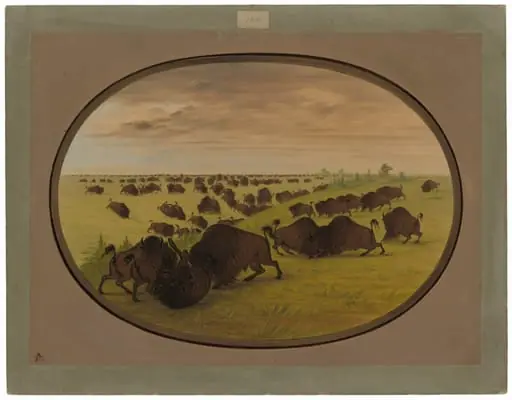 Bulls Fighting
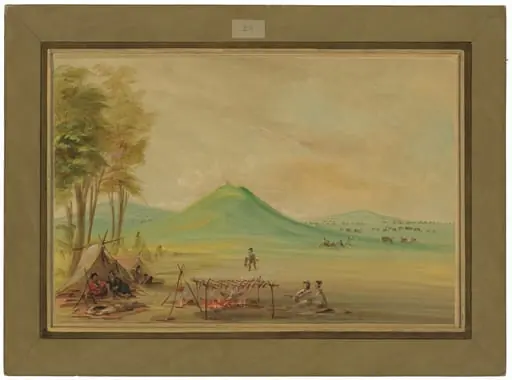 Expedition Encamped on a Texas Prairie. April 1686
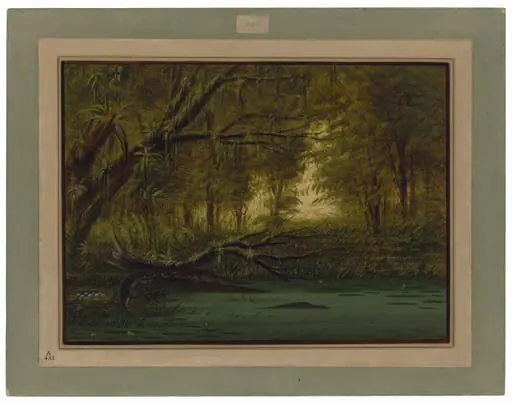 An Alligator's Nest
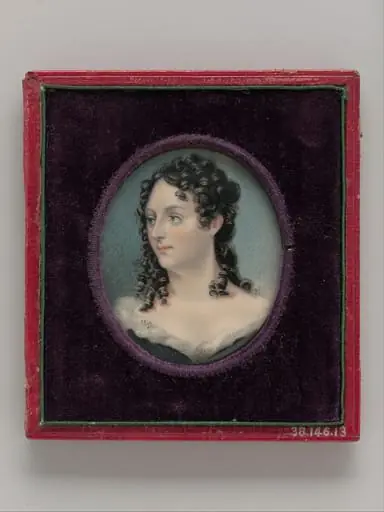 Mrs. George Catlin (Clara Bartlet Gregory)
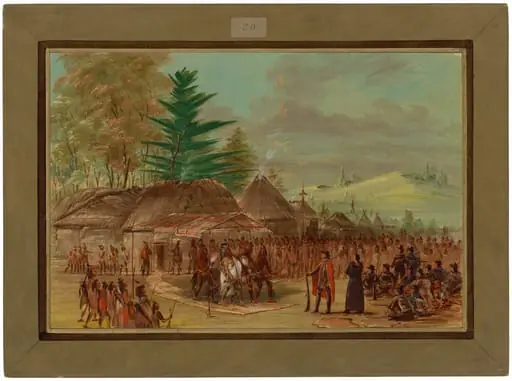 Chief of the Taensa Indians Receiving La Salle. March 20, 1682
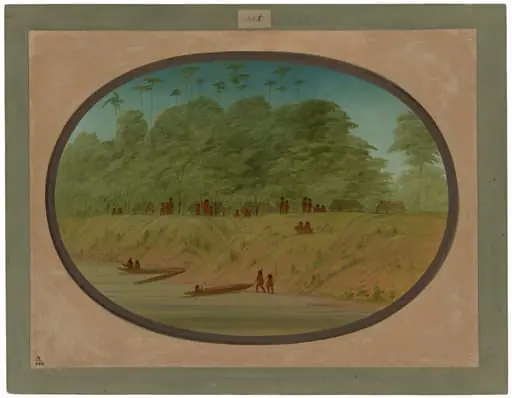 A Small Village - Payaguas Indians
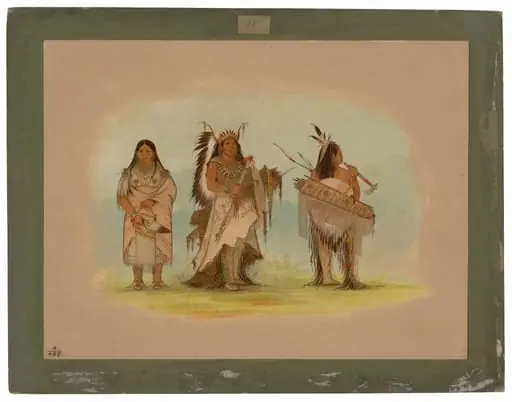 Omaha Chief, His Wife, and a Warrior
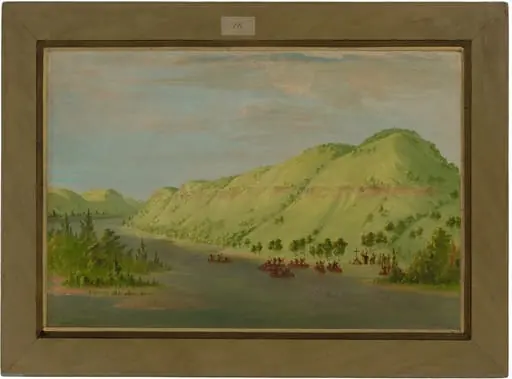 Father Hennepin Leaving the Mississippi to Join La Salle. May 8, 1680