Artwork
An Ojibbeway Village of Skin Tents
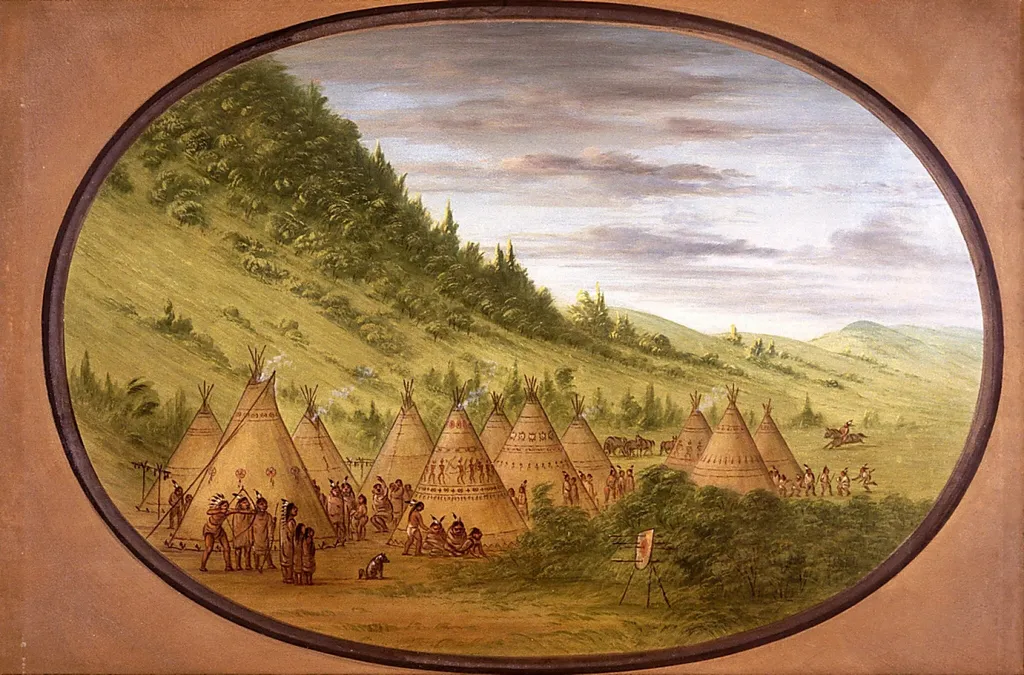
An Ojibbeway Village of Skin Tents is an oil painting by the Impressionist artist George Catlin. It dates from 1865 and is held in the collection of the National Gallery of Art.
About this work
Technique & Style
The modest dimensions and card support suggest a work conceived for reproduction or travel rather than as a large exhibition piece.
An Ojibbeway Village of Skin Tents is a small-scale oil painting executed on card that has been mounted on paperboard, a support combination typical of George Catlin's later, more portable studio practice. The work measures 47.5 by 63.9 centimeters in a horizontal landscape format, suited to its depiction of an encampment of skin tents set among trees. Catlin worked in oil, building the scene directly on the card surface, with the paperboard backing providing rigidity and stability for the thin primary support.
The composition is organized as a landscape, using the horizontal field to arrange the tents and surrounding woodland.
Stylistically, the painting reflects Catlin's documentary approach to Indigenous North American life, recording the structures and setting of an Ojibbeway village with attention to the arrangement of skin tents within their natural environment. The modest dimensions and card support suggest a work conceived for reproduction or travel rather than as a large exhibition piece.
History & Provenance
An Ojibbeway Village of Skin Tents is an 1861 oil on card painting by George Catlin. It entered the collection of George Catlin, then passed to his daughters Clara Gregory Catlin, Louise Catlin Kinney, and Elizabeth Wing Catlin. In 1912 it was purchased from Elizabeth Wing Catlin by the American Museum of Natural History.
The work was later sold in 1959 through Kennedy Galleries, New York, to Paul Mellon, and finally gifted to the National Gallery of Art in 1965.
An Ojibbeway Village of Skin Tents is held by the National Gallery of Art in Washington, D.C. Its accession or inventory number is not specified in the sources. The painting entered the collection through a gift in 1965 from Paul Mellon to the National Gallery of Art. It was previously owned by George Catlin, passed to his daughters, purchased in 1912 by the American Museum of Natural History, and sold in 1959 through Kennedy Galleries to Paul Mellon before its gift to the museum.
Context
Created in 1861, this landscape painting portrays an Ojibwe community using traditional skin tents, reflecting George Catlin's documented interest in Indigenous lifeways during his North American travels. Its depiction of Indigenous architecture aligns with Catlin's broader anthropological documentation efforts in the mid-19th century. The work entered the National Gallery of Art's collection in 1965 following its acquisition by Paul Mellon, establishing its institutional significance within American art history.
Scholarly attention to this painting highlights Catlin's role in shaping early visual records of Native American cultures, though critical reassessment has increasingly examined the colonial framing within his work. Its physical dimensions of 47.5 cm by 63.9 cm underscore its scale as a detailed narrative piece within the landscape genre.
The painting's provenance trajectory, from the Catlin family to the American Museum of Natural History and eventually to the National Gallery of Art, mirrors broader 20th-century patterns of Indigenous art collecting and institutional acquisition practices.
Overview
George Catlin’s 1865 oil painting, executed on card affixed to paperboard, presents a compact view of an Ojibwe settlement. A ring of conical hide tents surrounds modest fires, their smoke drifting upward, while a solitary tall tree rises behind the dwellings. The composition is rendered in muted, earthy tones that convey the natural light of the scene.
Subject & Meaning
The work records a genuine Ojibwe village as it existed in the early nineteenth century, emphasizing the communal arrangement of skin tents and the daily activities within. The central tree may symbolize permanence amid a mobile lifestyle, while the gentle plumes of smoke hint at domestic rituals and the intimate relationship between the inhabitants and their environment.
Own this work as a print
Artist & collection

Artist
George Catlin ( KAT-lin; July 26, 1796 – December 23, 1872) was an American lawyer, painter, author, and traveler, who specialized in portraits of Native Americans in the American frontier.

 Bulls Fighting
 Expedition Encamped on a Texas Prairie. April 1686
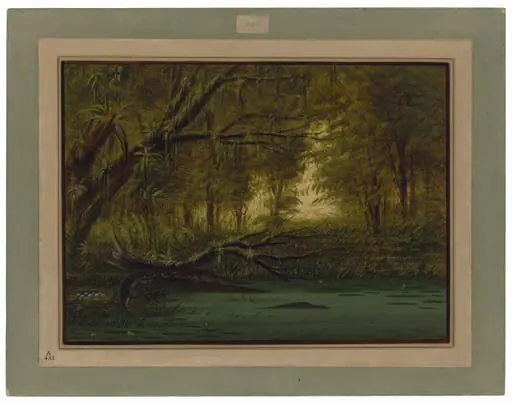 An Alligator's Nest
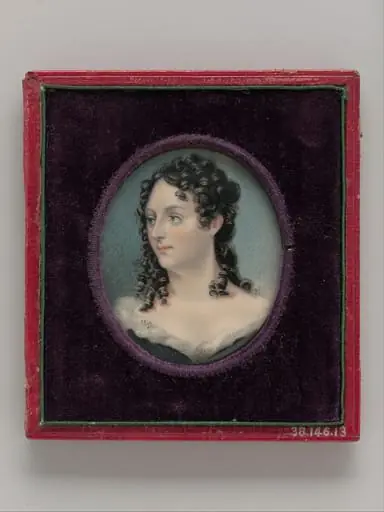 Mrs. George Catlin (Clara Bartlet Gregory)
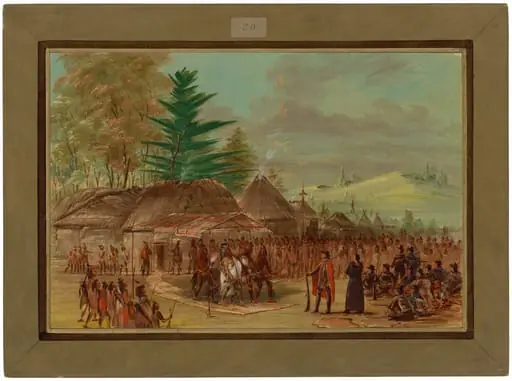 Chief of the Taensa Indians Receiving La Salle. March 20, 1682
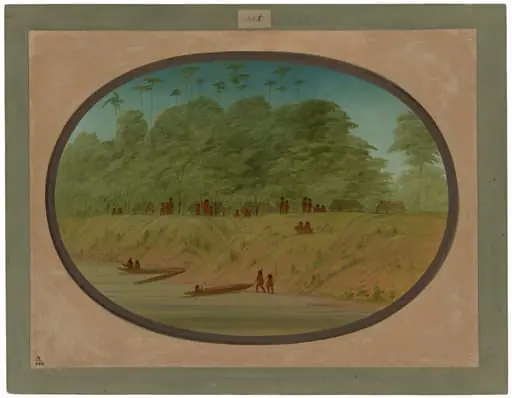 A Small Village - Payaguas Indians
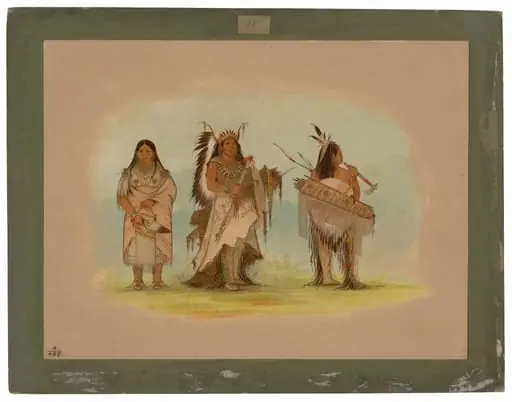 Omaha Chief, His Wife, and a Warrior
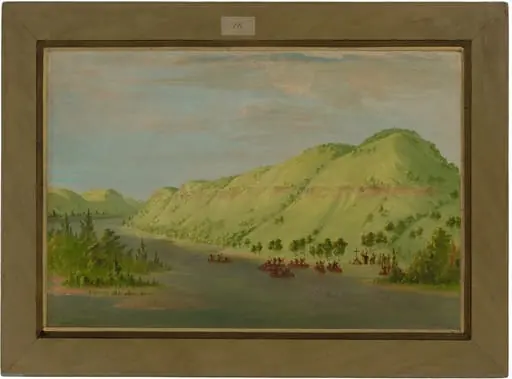 Father Hennepin Leaving the Mississippi to Join La Salle. May 8, 1680
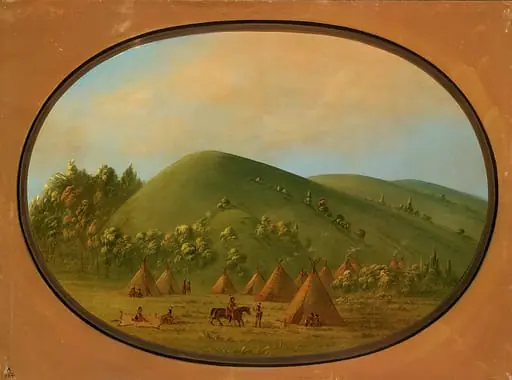 A Small Cheyenne Village
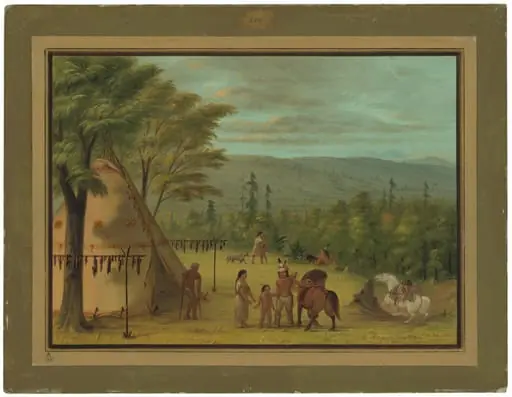 The Cheyenne Brothers Starting on Their Fall Hunt
 Vapor Bath - Minatarree
 A Little Sioux Village
 Assiniboin Encampment on the Upper Missouri
 Making Flint Arrowheads - Apachees
 La Salle Received in the Village of the Cenis Indians. May 6, 1686
 Pipe Dance - Assinneboine
 Prairie Indian Encampment
 Cheyenne Village
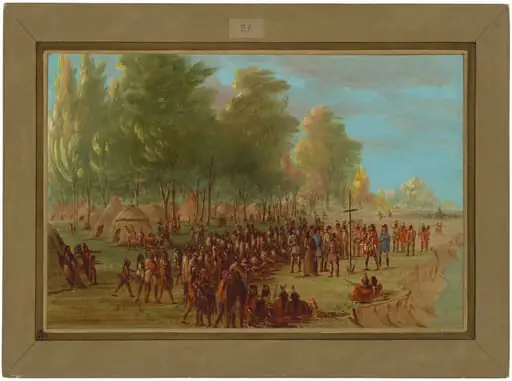 La Salle Erecting a Cross and Taking Possession of the Land. March 25, 1682
- A Crow Village of Skin Tents on the Salmon River