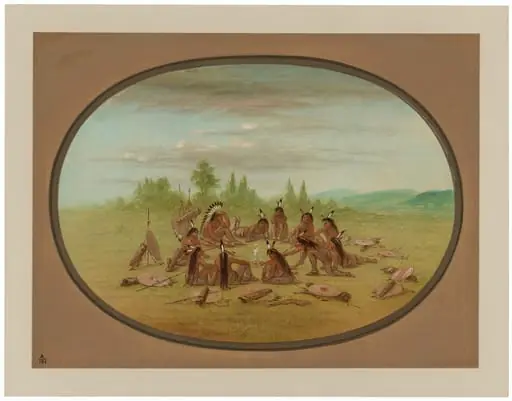
Artwork
Game of the Arrow - Mandan
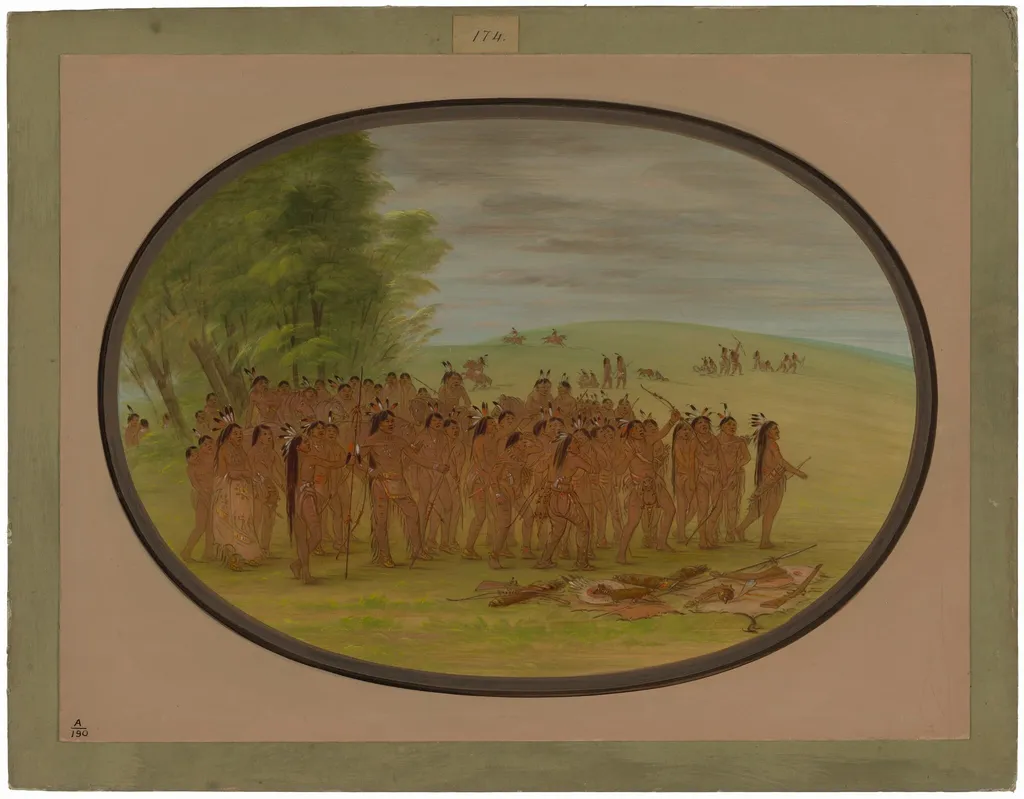
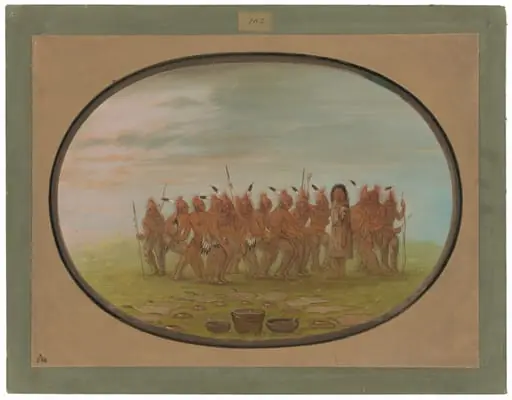
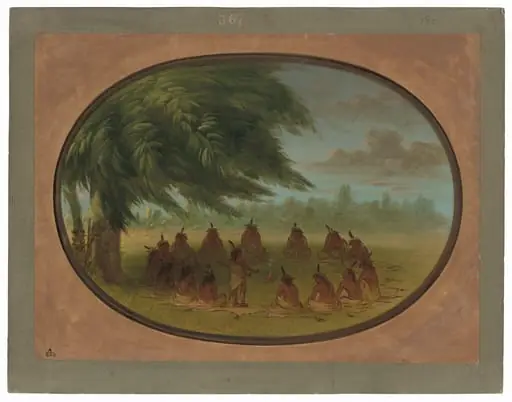
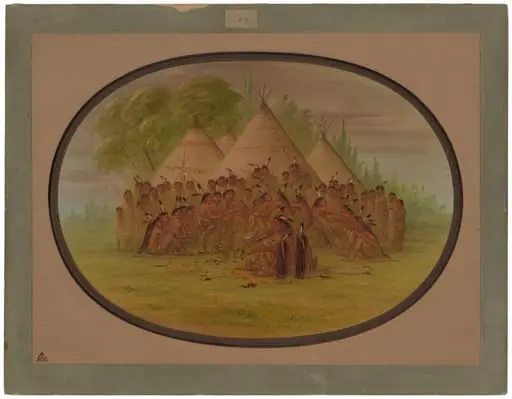
Game of the Arrow - Mandan is an oil painting by the American Folk Art artist George Catlin. It dates from 1865 and is held in the collection of the National Gallery of Art.
About this work
Technique & Style
The work is executed in oil on a card support, later mounted on paperboard, a format Catlin often used for portability during field campaigns.
The work is executed in oil on a card support, later mounted on paperboard, a format Catlin often used for portability during field campaigns. The paint is applied in smooth, even layers with careful attention to linear definition, especially in the figures’ silhouettes and decorative garments, while foliage and terrain are rendered with broader, blended strokes to suggest atmosphere.
The composition is organized along a shallow, stage-like plane that directs the viewer’s eye toward the central contest. Stylistically, it adheres to Catlin’s documentary manner: flattened perspective, crisp outlines, and a palette emphasizing earthy ochres and muted greens to evoke the Mandan landscape. The scene’s symmetry and staged arrangement underscore the ritual’s performative aspect rather than spontaneous action.
History & Provenance
George Catlin created the oil painting Game of the Arrow - Mandan in 1861. The work was originally owned by the artist until his death in 1872, after which it passed by descent to his daughters: Clara Gregory Catlin, Louise Catlin Kinney, and Elizabeth Wing Catlin. In 1912, the American Museum of Natural History purchased the piece directly from Elizabeth Wing Catlin.
The museum retained ownership until 1959, when it sold the painting through Kennedy Galleries in New York to collector Paul Mellon of Upperville, Virginia. Mellon subsequently gifted the work to the National Gallery of Art in 1965, where it remains part of the collection.
Legacy
The painting entered the National Gallery of Art's collection in 1965 after being acquired by Paul Mellon, a prominent American philanthropist, via the Kennedy Galleries in New York. This acquisition, documented in the artist's provenance, reflects the work's growing recognition within major American institutions. Its presence in the National Gallery of Art underscores its lasting reputation as an important example of 19th‑century genre painting and contributes to the broader understanding of George Catlin's body of work.
The documented chain of ownership from the artist's descendants to a national museum illustrates the painting's enduring legacy in the canon of American art.
Overview
George Catlin's 1865 painting, Game of the Arrow – Mandan, is an oil on card mounted on paperboard. This work, classified as American folk art, captures a genre scene featuring Mandan men engaged in a traditional stick-and-ball game. Catlin, an artist known for his extensive documentation of Native American cultures, created this piece later in his career, reflecting his ongoing interest in indigenous life on the American frontier.
Subject & Meaning
The painting portrays a group of Mandan men participating in a dynamic stick-and-ball game within an open field. Players wield long-handled implements to strike a small ball, with a solitary, bare-branched tree anchoring the background. Catlin intended this depiction to highlight the peaceful and recreational aspects of Mandan culture, emphasizing the game as a communal activity rather than a combative encounter.
Context
Before creating this 1865 work, George Catlin undertook five significant journeys across the American West during the 1830s. During these expeditions, he extensively documented the lives of Plains Indian communities through numerous portraits and genre scenes. Game of the Arrow – Mandan thus represents a distinct phase in Catlin's artistic trajectory, diverging from his earlier, more intensive fieldwork while maintaining his focus on Native American subjects.
Own this work as a print
Artist & collection

Artist
George Catlin ( KAT-lin; July 26, 1796 – December 23, 1872) was an American lawyer, painter, author, and traveler, who specialized in portraits of Native Americans in the American frontier.

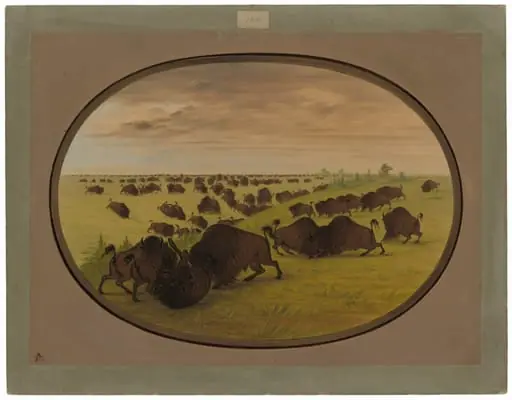 Bulls Fighting
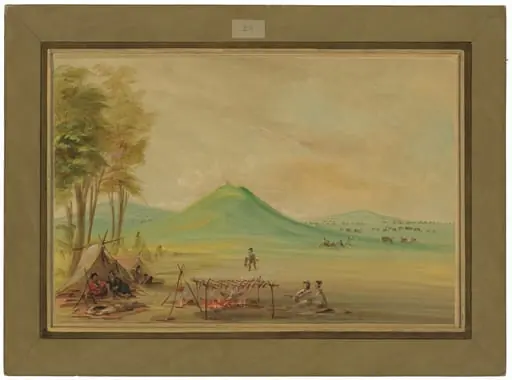 Expedition Encamped on a Texas Prairie. April 1686
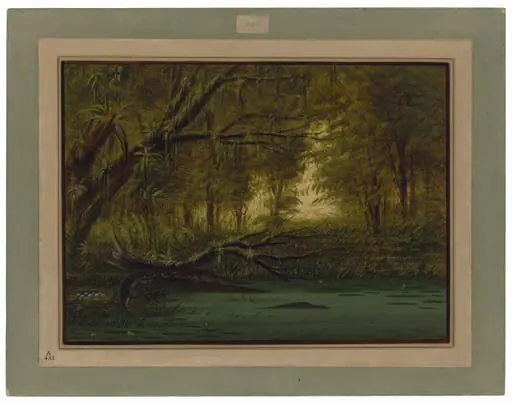 An Alligator's Nest
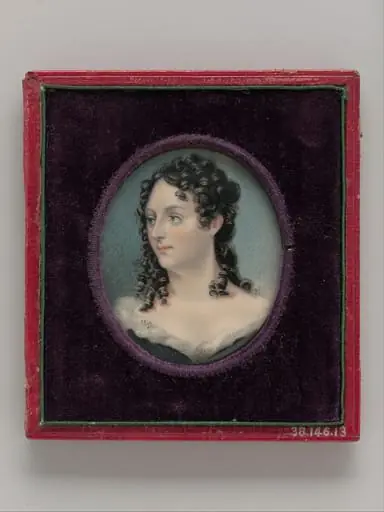 Mrs. George Catlin (Clara Bartlet Gregory)
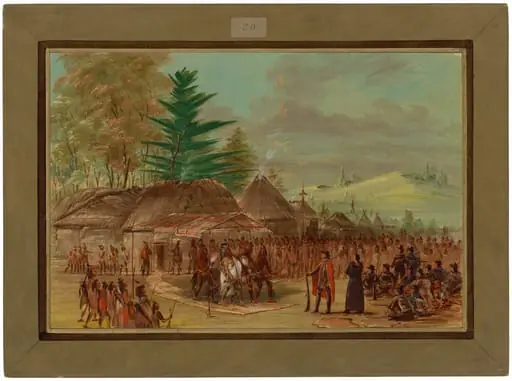 Chief of the Taensa Indians Receiving La Salle. March 20, 1682
 A Small Village - Payaguas Indians
 Omaha Chief, His Wife, and a Warrior
 Father Hennepin Leaving the Mississippi to Join La Salle. May 8, 1680