Artwork
Distinguished Crow Indians
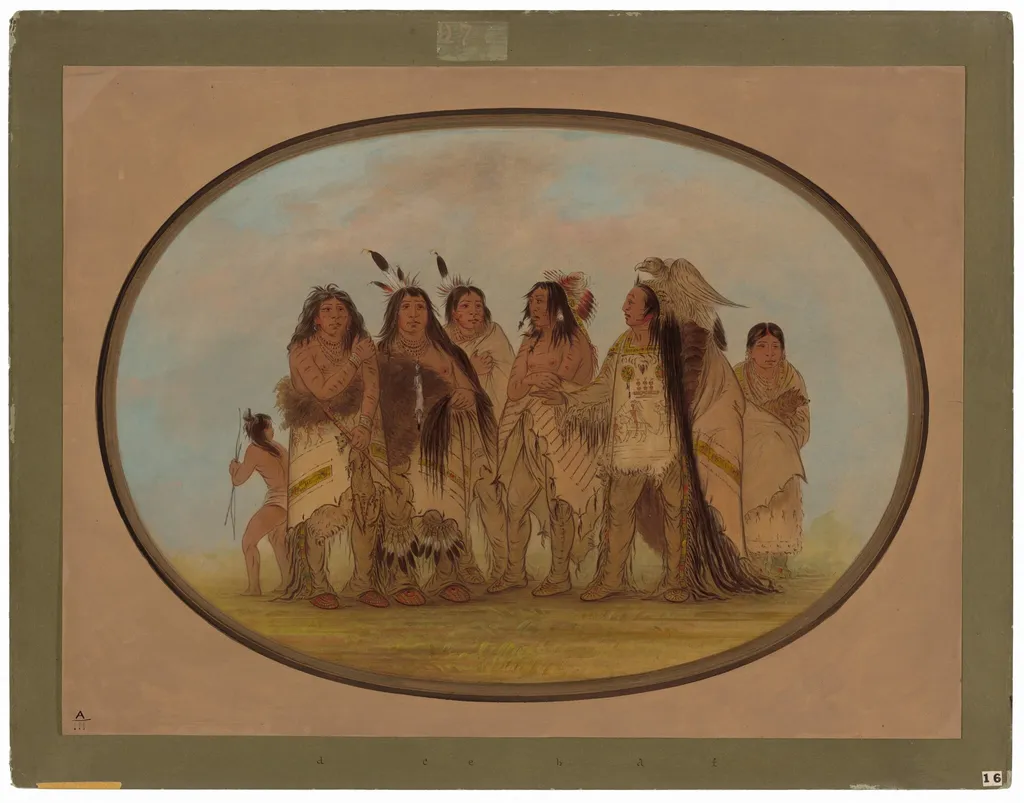
Distinguished Crow Indians is an oil painting by the American Folk Art artist George Catlin. It dates from 1865 and is held in the collection of the National Gallery of Art.
About this work
Technique & Style
The work is executed in oil on card mounted on paperboard, a support that suggests a portable, relatively lightweight format typical of Catlin's later practice.
The work is executed in oil on card mounted on paperboard, a support that suggests a portable, relatively lightweight format typical of Catlin's later practice. Measuring 47.1 × 63.5 cm, the painting falls within a modest scale suited to intimate portraiture. As a portrait genre piece from 1861, it belongs to Catlin's mature period, when he had spent decades documenting Native American subjects.
The oil medium allows for the detailed characterization and tonal modeling evident in his ethnographic portraiture, while the card-and-paperboard support reflects practical considerations for an artist who frequently traveled and shipped works.
History & Provenance
George Catlin painted Distinguished Crow Indians in 1861 in oil on card mounted on paperboard. The work remained in the artist's family after his death in 1872, descending to his daughters Clara Gregory Catlin, Louise Catlin Kinney, and Elizabeth Wing Catlin. In 1912, the American Museum of Natural History purchased the painting from Elizabeth Wing Catlin.
It was later sold in 1959 through Kennedy Galleries in New York to collector Paul Mellon of Upperville, Virginia. Mellon gifted the work to the National Gallery of Art in 1965, where it remains today.
The painting is held by the National Gallery of Art in Washington, D.C.
Its provenance traces from George Catlin through his daughters Clara Gregory Catlin, Louise Catlin Kinney, and Elizabeth Wing Catlin. The American Museum of Natural History purchased it from Elizabeth Wing Catlin in 1912. In 1959, Kennedy Galleries in New York sold the work to Paul Mellon of Upperville, Virginia, who gifted it to the National Gallery of Art in 1965.
Legacy
Distinguished Crow Indians exerted lasting influence on American portraiture through its nuanced portrayal of Indigenous dignity. The work's technical mastery and cultural significance established a precedent for later Native American representation in fine art. Its inclusion in major collections cemented Catlin's legacy as a chronicler of 19th-century frontier life. The painting remains a cornerstone in the National Gallery of Art's collection reflecting early cross-cultural engagement.
Overview
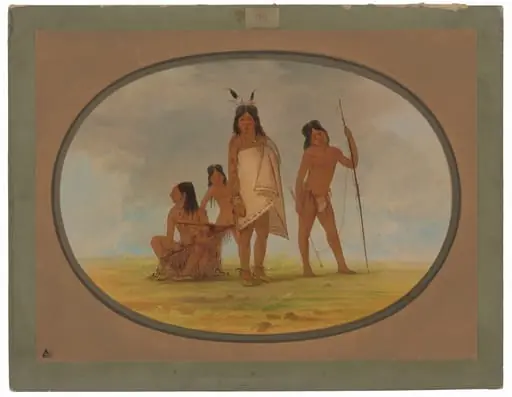
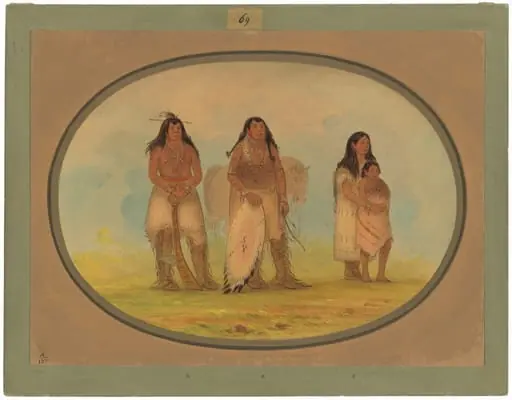
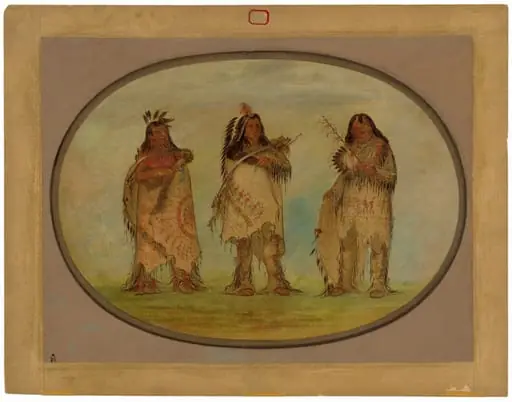
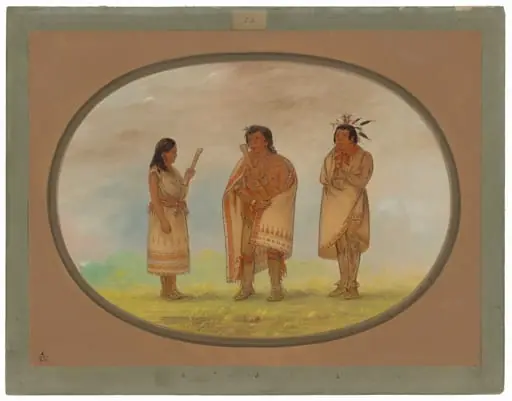
Created in 1865, Distinguished Crow Indians is an oil painting executed on a card that has been mounted onto a paperboard backing. The work presents a small group of Crow individuals arranged in a linear pose, each dressed in traditional regalia that includes feathered headdresses and elaborately patterned robes. The central figure is distinguished by a robe featuring a bird motif, while a figure on the left holds a bow and arrow.
Subject & Meaning
The composition records a moment of cultural presentation, emphasizing the distinctive attire and weaponry of the Crow people. By foregrounding the ceremonial dress and the bow, the artist highlights both the aesthetic qualities of the tribe’s material culture and the martial skills traditionally associated with Plains societies.
Context
Distinguished Crow Indians belongs to a larger body of work in which Catlin sought to preserve the appearance and customs of Plains peoples before the encroachment of Euro‑American settlement. The painting reflects the broader nineteenth‑century American interest in documenting indigenous cultures, while its folk‑art sensibility aligns it with contemporaneous efforts to produce accessible, factual visual reports.
Own this work as a print
Artist & collection

Artist
George Catlin ( KAT-lin; July 26, 1796 – December 23, 1872) was an American lawyer, painter, author, and traveler, who specialized in portraits of Native Americans in the American frontier.

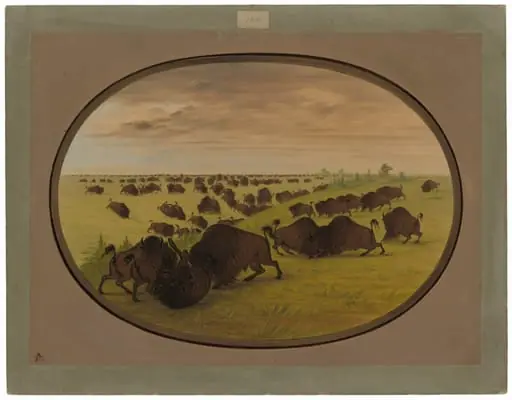 Bulls Fighting
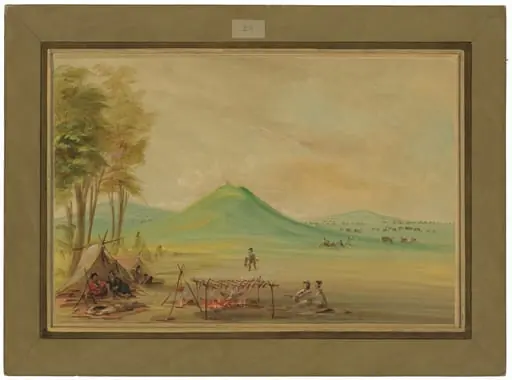 Expedition Encamped on a Texas Prairie. April 1686
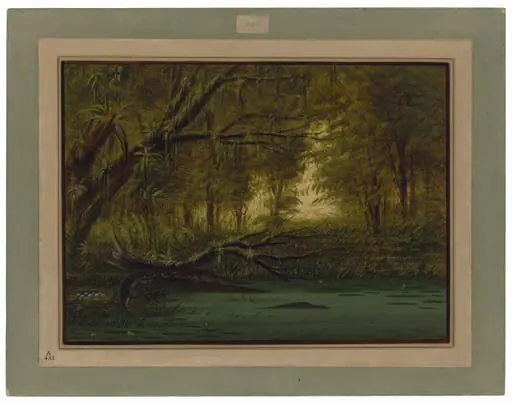 An Alligator's Nest
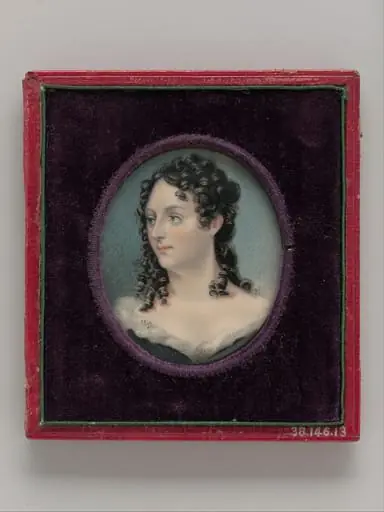 Mrs. George Catlin (Clara Bartlet Gregory)
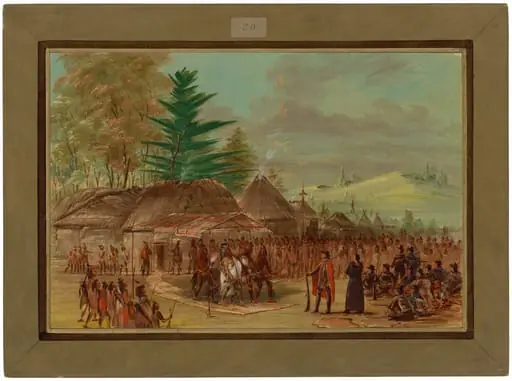 Chief of the Taensa Indians Receiving La Salle. March 20, 1682
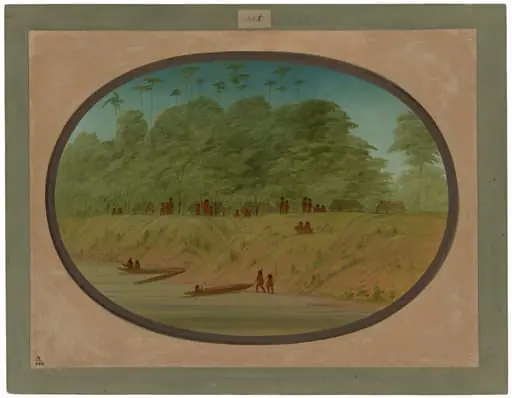 A Small Village - Payaguas Indians
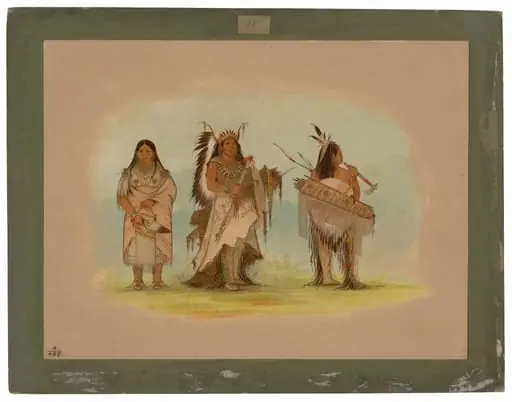 Omaha Chief, His Wife, and a Warrior
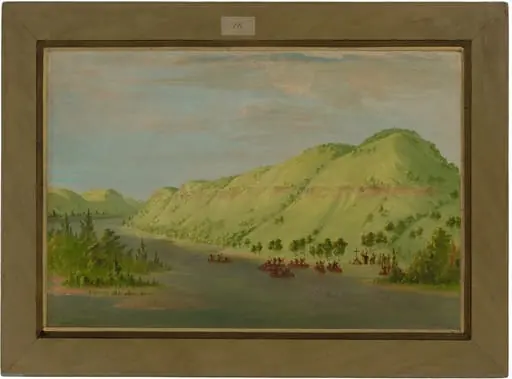 Father Hennepin Leaving the Mississippi to Join La Salle. May 8, 1680