Artwork
Pawnee Indians
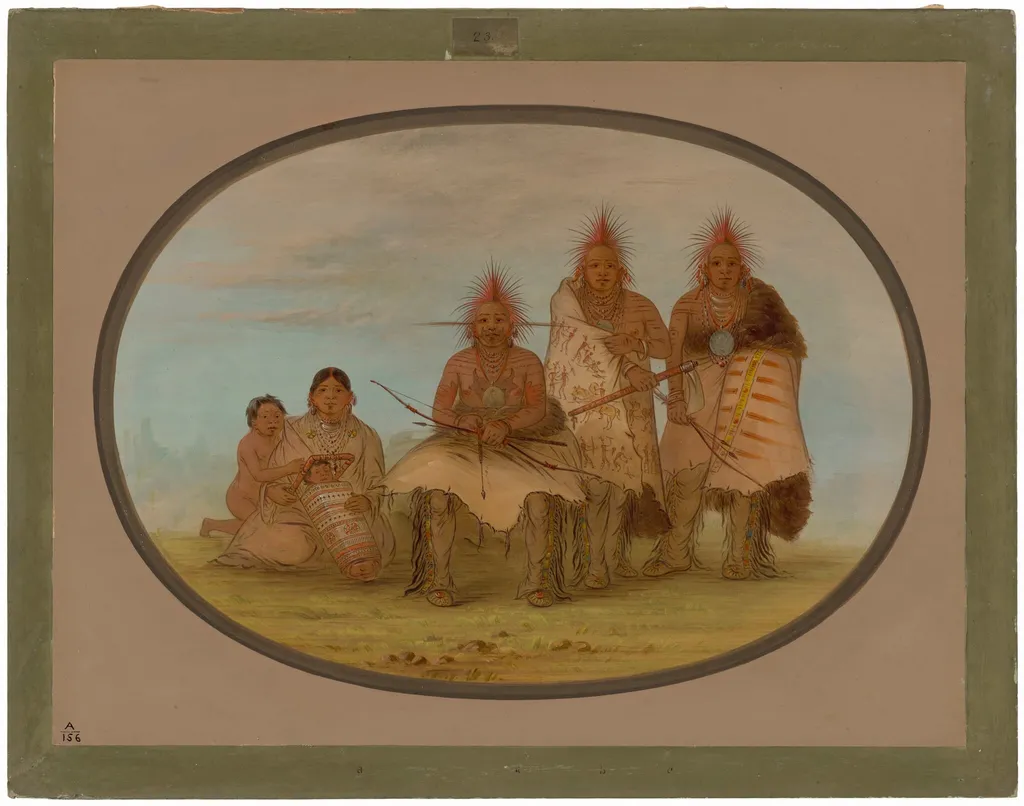
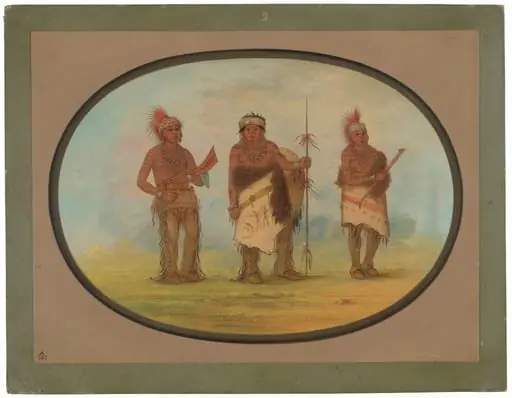
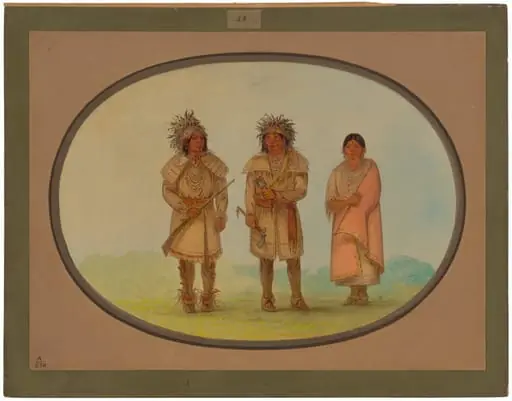
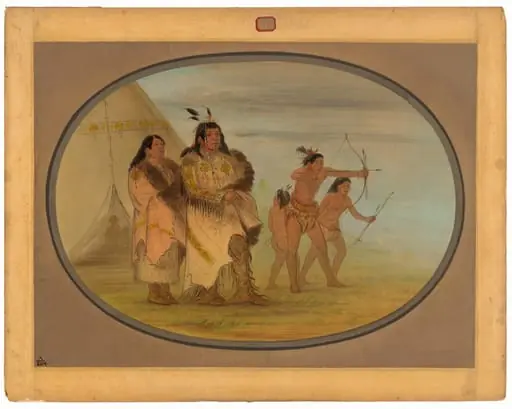
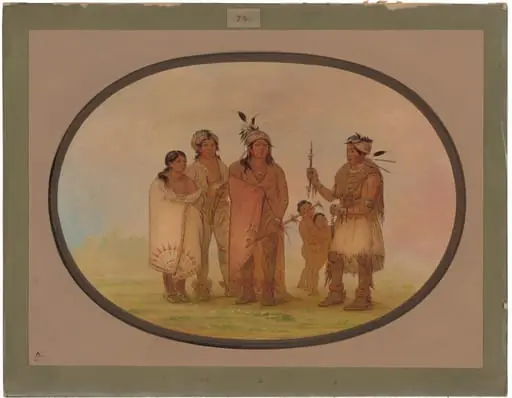
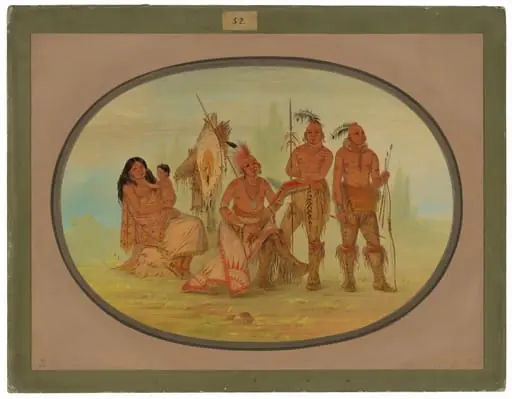
Pawnee Indians is an oil painting by the American Folk Art artist George Catlin. It dates from 1865 and is held in the collection of the National Gallery of Art. Created in 1865, this oil painting depicts a small group of Pawnee individuals gathered outdoors.
About this work
Technique & Style
Handling is crisp and linear, with carefully delineated contours and flat, evenly applied color that emphasizes clarity over textural modulation.
The work is executed in oil paint applied to a card support that was subsequently mounted onto a paperboard, a construction typical of Catlin’s portable field practice for ethnographic portraiture. Handling is crisp and linear, with carefully delineated contours and flat, evenly applied color that emphasizes clarity over textural modulation. Stylistically, the composition adheres to Catlin’s established formula for Plains Indian portraits: frontal or three-quarter views set against minimal, unmodeled grounds, and a descriptive rather than atmospheric approach to light and shadow.
The palette relies on muted earth tones and restrained accents, avoiding the dramatic chiaroscuro favored by academic portraitists of the period. Formal qualities foreground individual regalia and physiognomic detail, aligning with Catlin’s documentary aims rather than idealized figuration.
History & Provenance
The painting Pawnee Indians was created by George Catlin in 1861 as an oil-on-card work mounted on paperboard.
Its provenance begins with the artist, who retained the painting until his death in 1872. It then descended through his daughters, Clara Gregory Catlin, Louise Catlin Kinney, and Elizabeth Wing Catlin, before being purchased in 1912 by the American Museum of Natural History from Elizabeth Wing Catlin. The painting was later sold in 1959 via Kennedy Galleries in New York to Paul Mellon, who gifted it to the National Gallery of Art, Washington, D.C., in 1965.
Pawnee Indians by George Catlin is held by the National Gallery of Art in Washington, D.C., where it entered the collection in 1965 as a gift from Mr. Paul Mellon of Upperville, Virginia. Mellon had acquired the work in 1959 through Kennedy Galleries in New York. The painting had previously been owned by the American Museum of Natural History, which purchased it in 1912 from Elizabeth Wing Catlin, one of George Catlin's three daughters, Clara Gregory Catlin, Louise Catlin Kinney, and Elizabeth Wing Catlin, through whom the work had passed by descent from the artist.
No exhibition history beyond this provenance chain is documented in the available sources.
Legacy
Pawnee Indians exerted lasting influence through its role in shaping portrayals of Indigenous peoples in American art and its presence in major institutional collections. The painting remained in prominent holdings, including the National Gallery of Art in Washington, D.C., where it was accessioned as part of the museum's distinguished collection of 19th-century American works. Its legacy is underscored by continued scholarly attention to Catlin's documentation of Native cultures, with the artwork frequently cited in studies of representation and ethnographic art.
The work's provenance reflects its significance, moving from the artist's family to major cultural institutions and private collectors before its final donation to the National Gallery of Art in 1965.
Overview
Created in 1865, this oil painting depicts a small group of Pawnee individuals gathered outdoors. Five figures, two men, two women, and a child, are arranged with the men standing frontally, spears in hand, while the women and child sit nearby. A muted sky and distant hills form a simple backdrop, emphasizing the figures and their attire.
Subject & Meaning
The work records a moment of everyday life among the Pawnee, highlighting communal interaction and cultural markers such as feathered headpieces and a ceremonial drum. The inclusion of weaponry and traditional dress suggests a blend of domestic and martial identity, offering viewers insight into the tribe’s social structure and customs during the mid‑19th century.
Context
Created during a period of rapid expansion and displacement of Native peoples, the painting serves as a visual record of a community that was undergoing profound change. It aligns with contemporary efforts to document frontier life, offering a counterpoint to the romanticized portrayals common in the era’s popular imagination.
Own this work as a print
Artist & collection

Artist
George Catlin ( KAT-lin; July 26, 1796 – December 23, 1872) was an American lawyer, painter, author, and traveler, who specialized in portraits of Native Americans in the American frontier.

 Bulls Fighting
 Expedition Encamped on a Texas Prairie. April 1686
 An Alligator's Nest
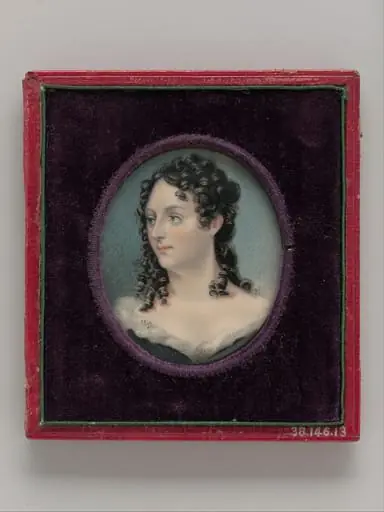 Mrs. George Catlin (Clara Bartlet Gregory)
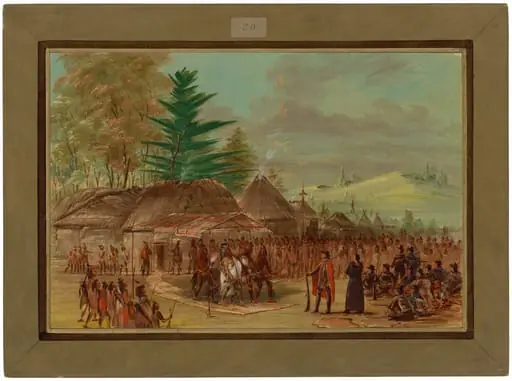 Chief of the Taensa Indians Receiving La Salle. March 20, 1682
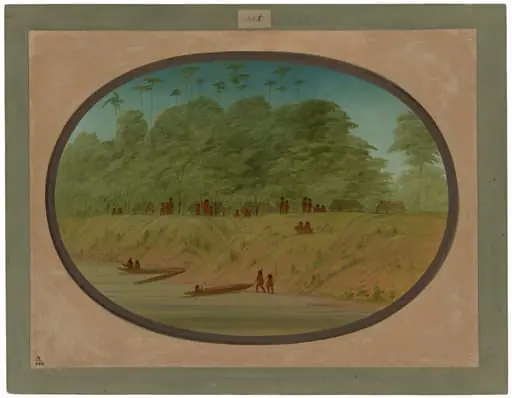 A Small Village - Payaguas Indians
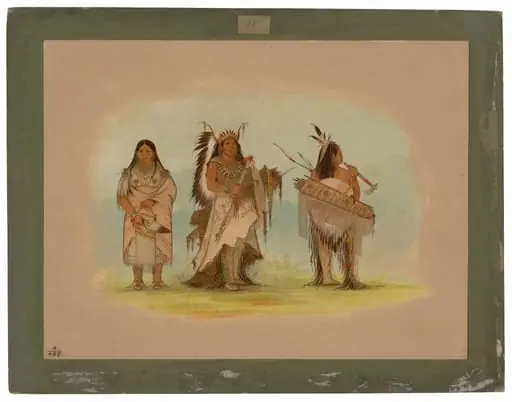 Omaha Chief, His Wife, and a Warrior
 Father Hennepin Leaving the Mississippi to Join La Salle. May 8, 1680