Artwork
Shore of the Trombetas
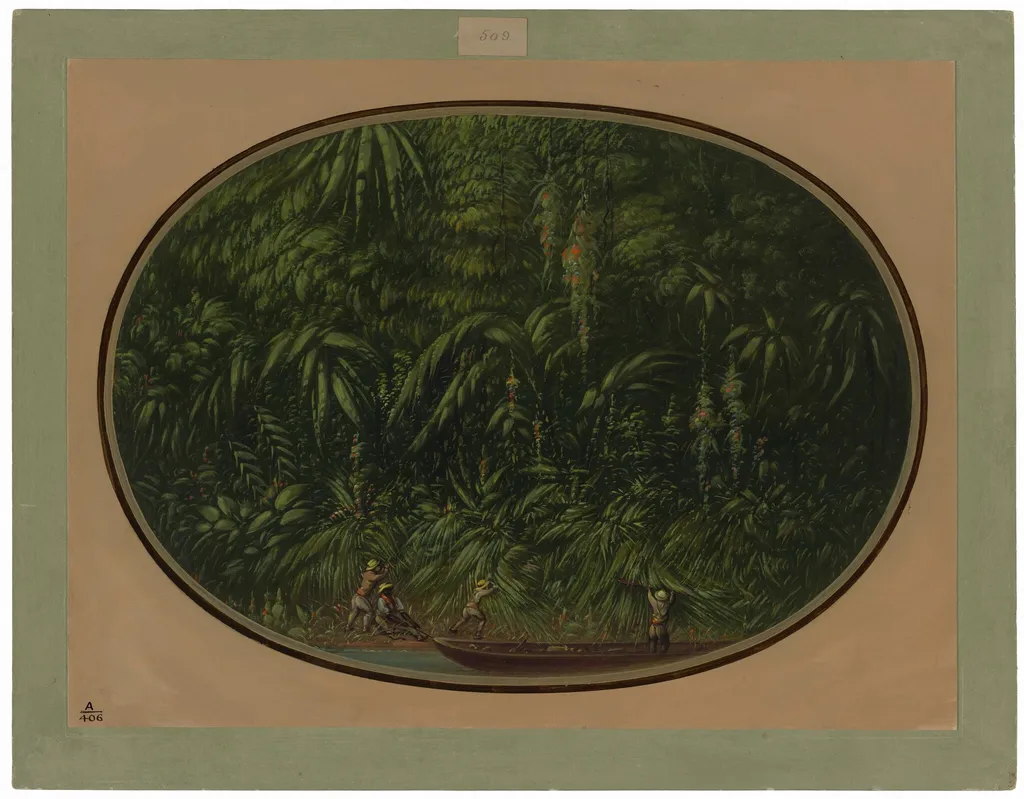
Shore of the Trombetas is an oil painting by the Impressionist artist George Catlin. It dates from 1862 and is held in the collection of the National Gallery of Art.
About this work
Overview
5 cm, the work depicts a dense tropical riverside scene in Brazil and is now held in the collection of the National Gallery of Art in Washington, D.
Shore of the Trombetas is an oil painting on card mounted on paperboard by the American artist George Catlin, dated 1864, though the National Gallery of Art also lists a broader range of 1854/1869. Measuring 47.1 by 62.5 cm, the work depicts a dense tropical riverside scene in Brazil and is now held in the collection of the National Gallery of Art in Washington, D.C., as part of the Paul Mellon Collection. The painting belongs to Catlin's so-called "Cartoon Collection," a second major body of work numbering more than 600 pieces that he produced during the 1850s and 1860s, following his earlier celebrated "Indian Gallery" of Native American portraits from the 1830s. While Catlin remains best known for his documentation of Indigenous North American life, Shore of the Trombetas represents his significant engagement with South American subjects during his travels in the hemisphere, expanding scholarly understanding of his later career beyond the western United States.
Subject & Meaning
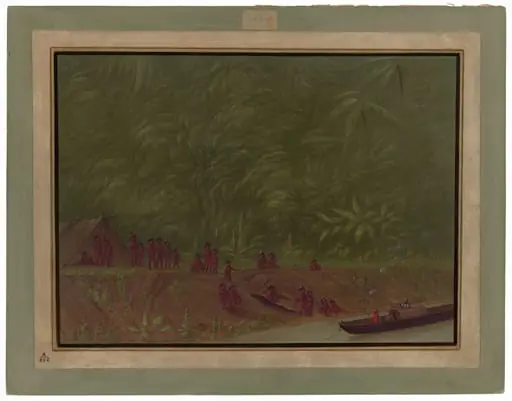
The painting presents an oval composition depicting the shore of the Trombetas River, a tributary of the Amazon located above the great rapids, as Catlin himself noted in his 1871 catalog entry: "SHORE OF THE TROMBUTAS, above the great rapids." A dense tropical forest dominates the scene, rendered in deep greens with touches of red and orange flowers scattered throughout the foliage. At the bottom edge, four small figures wearing hats work near a dark canoe at the waterline. One figure stands in shallow water holding a long pole or oar, another leans from the canoe, and two others work at the forest edge with raised arms. The composition emphasizes the overwhelming scale and density of the jungle environment, with the human figures dwarfed by the surrounding vegetation. This visual hierarchy suggests themes of human encounter with an immense and potentially impenetrable natural world. The oval format itself functions as a framing device, creating a lens-like or porthole effect that mediates the viewer's access to this remote riverside environment.
Technique & Style
Catlin executed Shore of the Trombetas in oil on card mounted on paperboard, a support characteristic of his Cartoon Collection works. The brushwork shows careful detail in layered leaves and plants, with smoother handling in the water and figures. Light appears diffused, filtering through the canopy without strong shadows, creating an atmospheric effect rather than dramatic chiaroscuro. The composition is set within an oval format, presented in the original with a rectangular tan mat and green outer border. A small paper label reading "509" appears at top center, corresponding to its catalog number in Catlin's 1871 exhibition, and "A 406" is stamped at lower left. The handling of paint varies across the surface: dense, textured application in the foliage contrasts with the more smoothly rendered water and diminutive human figures. This technical variation reinforces the spatial depth and the overwhelming presence of the tropical vegetation. The color palette relies primarily on deep greens modulated by touches of warmer hues in the flowers, with the dark canoe and figures providing tonal anchors at the lower edge.
History & Provenance
The painting remained in Catlin's possession until his death in 1872, then descended to his daughters: Clara Gregory Catlin, Louise Catlin Kinney, and Elizabeth Wing Catlin. In 1912, the American Museum of Natural History purchased the work from Elizabeth Wing Catlin, acquiring it as part of a larger group of Cartoon Collection paintings. The museum deaccessioned the work in 1959, selling it through Kennedy Galleries in New York to Paul Mellon of Upperville, Virginia. Mellon, a major collector of American art, accumulated more than 300 paintings from the deaccessioned Cartoon Collection. In 1965, he gave 351 works from this collection to the National Gallery of Art, including Shore of the Trombetas, which entered the museum with accession number 1965.16.269. The painting has been exhibited subsequently, including in "Sudamerica: Pinturas de George Catlin" at the Museo Franz Meyer, Mexico City; the Museo Nacional de Bellas Artes, Buenos Aires; and the Museo Chileno de Arte Precolombino, Santiago, Chile, in 1989-1990, where it appeared as number 31 with a color reproduction. It was also shown in 1992 at The Museums at Hartwick College, Oneonta, New York, and in 1994-1995 at The Lowe Art Museum, University of Miami, Coral Gables, Florida, both under the title "South American Indian Paintings by George Catlin" as National Lending Service exhibitions.
Context
George Catlin (1796-1872) was largely self-taught as an artist, having studied law at Litchfield, Connecticut, before turning to painting in Philadelphia. He spent eight years during the 1830s among Indigenous peoples of the Yellowstone River region, Indian Territory, Arkansas, and Florida, producing the 470 full-length portraits and scenes that formed his first "Indian Gallery." After 1852-1857 travels in South and Central America, he lived in Europe until 1871. The Shore of the Trombetas belongs to this later period of South American engagement, when Catlin expanded his documentary project beyond North American subjects. Critical and scholarly attention to Catlin has traditionally centered on his Indian Gallery, but the Cartoon Collection, including this Brazilian scene, has gained recognition as a significant body of work in its own right. The National Gallery of Art's acquisition of 351 Cartoon Collection works in 1965 fundamentally reshaped the institutional preservation and study of this later phase of Catlin's career. The painting's inclusion in traveling exhibitions across Latin America in 1989-1990 signaled growing scholarly interest in Catlin's South American subjects within hemispheric art historical frameworks.
Legacy
Shore of the Trombetas occupies an important position in the reassessment of George Catlin's artistic legacy beyond his iconic Native American portraits. As part of the Cartoon Collection, the work helped preserve knowledge of Catlin's South American travels and his documentary impulse applied to tropical environments and their inhabitants. The painting's afterlife has been shaped by its inclusion in major institutional collections, first the American Museum of Natural History and then the National Gallery of Art, ensuring its accessibility for scholarly research and public viewing. Its reproduction in successive National Gallery of Art catalogues, beginning in 1970 and continuing through 1992, has maintained its visibility in the literature on American painting. The work also circulates in commercial reproduction contexts, reflecting continued public interest in Catlin's exotic subject matter. More broadly, Shore of the Trombetas contributes to ongoing critical discussions about the visual culture of exploration, the representation of tropical environments in nineteenth-century American art, and the complex dynamics of the colonial gaze in landscape painting. The diminutive, laboring figures within the overwhelming jungle setting invite consideration of how Catlin positioned human presence within the vastness of the Amazonian environmentCBR environment, a theme that resonates with contemporary concerns about human relationships with threatened ecosystems.
Own this work as a print
Artist & collection

Artist
George Catlin ( KAT-lin; July 26, 1796 – December 23, 1872) was an American lawyer, painter, author, and traveler, who specialized in portraits of Native Americans in the American frontier.

 Bulls Fighting
 Expedition Encamped on a Texas Prairie. April 1686
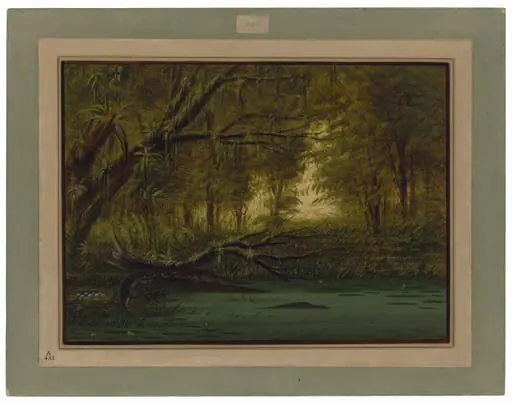 An Alligator's Nest
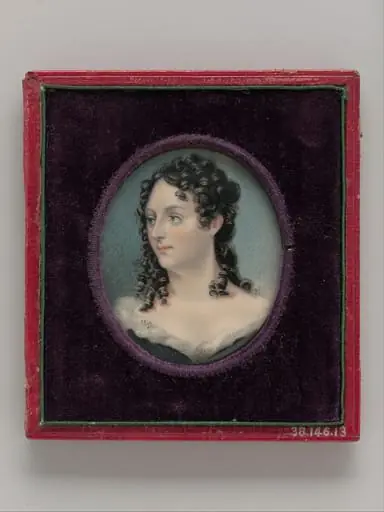 Mrs. George Catlin (Clara Bartlet Gregory)
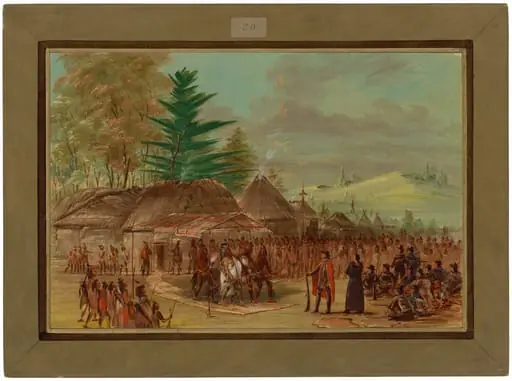 Chief of the Taensa Indians Receiving La Salle. March 20, 1682
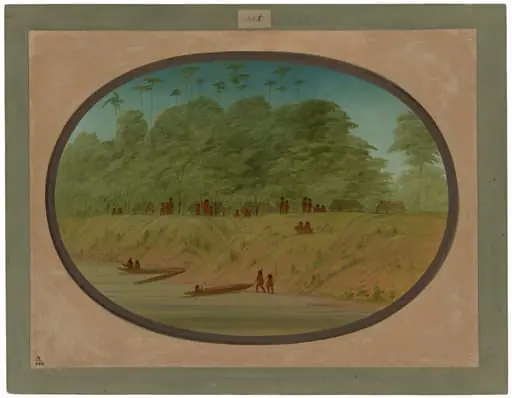 A Small Village - Payaguas Indians
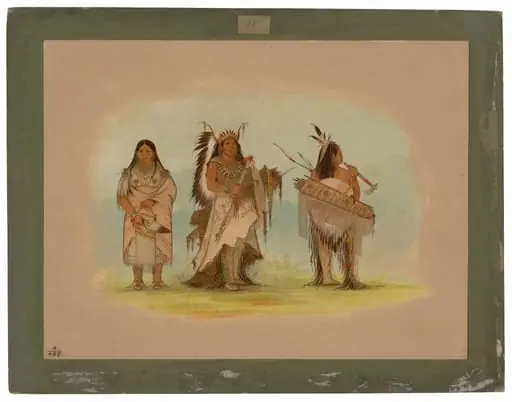 Omaha Chief, His Wife, and a Warrior
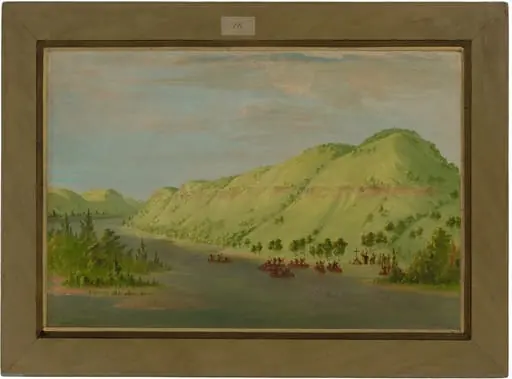 Father Hennepin Leaving the Mississippi to Join La Salle. May 8, 1680
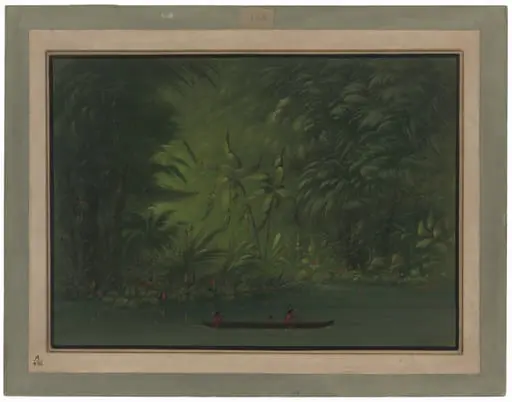 Entrance to a Lagoon, Shore of the Amazon
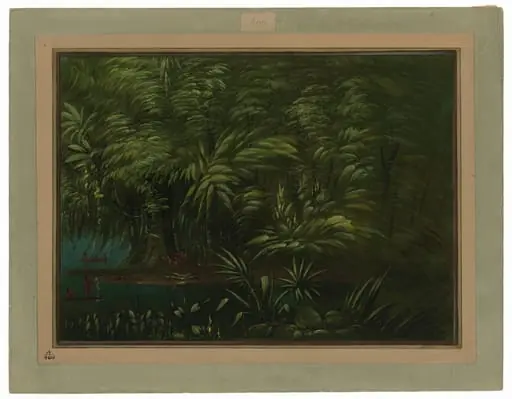 Luxuriant Forest on the Bank of the Amazon
 Shore of the Uruguay - Making a Sketch
 Lengua Indians Ascending the Rapids of the Rio Uruguay
 Interior of an Amazon Forest - Zurumati
 A Small Lengua Village, Uruguay
 A Small Lengua Village
 A Mura Encampment - Boat Sketch
 A Caribbe Village in Dutch Guiana
- Shore of the Essequibo