Artwork
The House of Cards
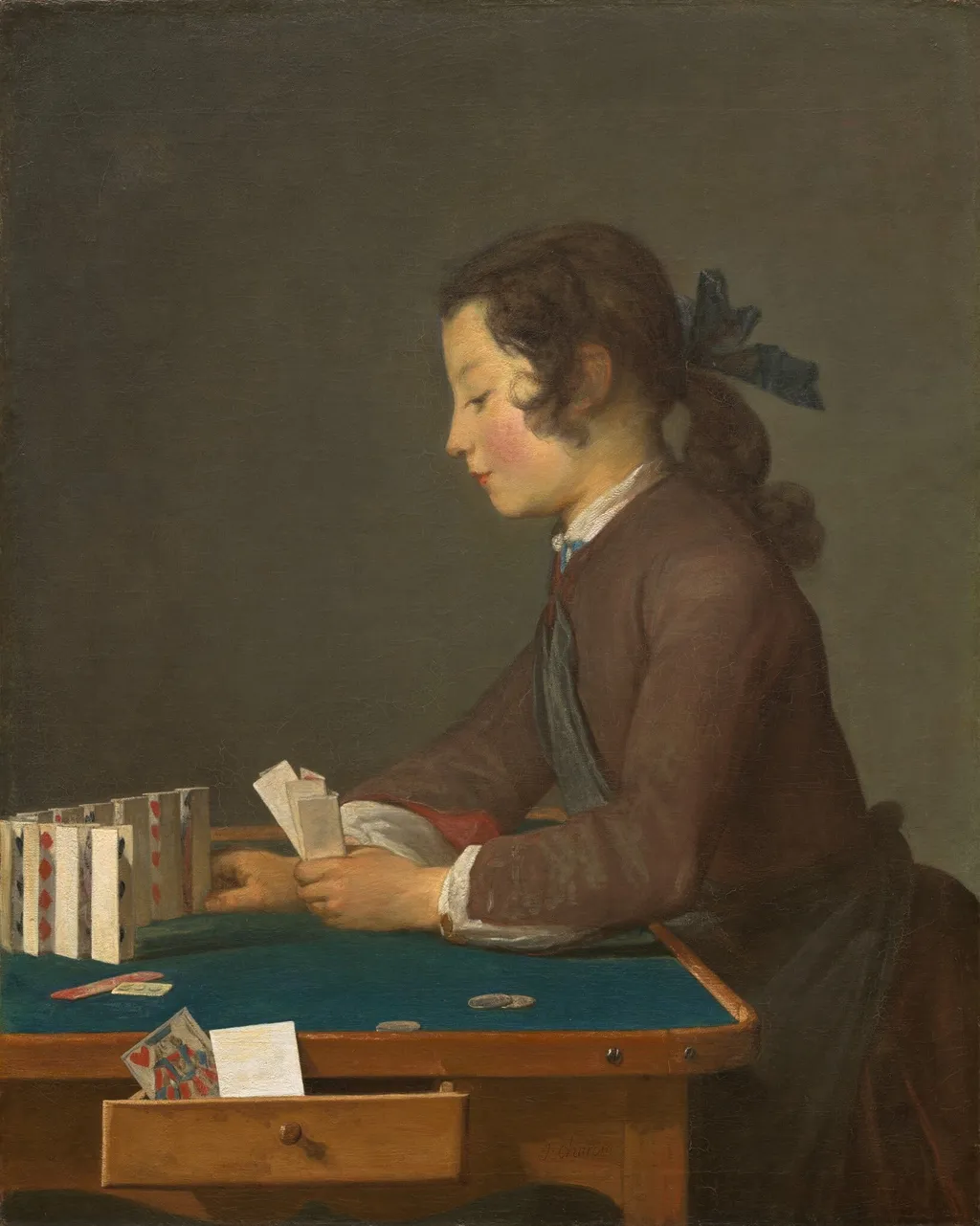
The House of Cards is an oil painting by the Baroque artist Jean-Baptiste-Siméon Chardin. It dates from 1737 and is held in the collection of the National Gallery of Art.
- Inscription
- Inscribed:lower center on table frame in dark brown paint: J. Chardin
About this work
Technique & Style
2 by 66 centimeters, depicting a boy in profile as he constructs the ground floor of a card house on a table.
The House of Cards is an oil on canvas painting executed by Jean Siméon Chardin in 1737. The work is a vertical-format composition measuring 82.2 by 66 centimeters, depicting a boy in profile as he constructs the ground floor of a card house on a table. The genre is classified as a portrait, and the painting is held in the Andrew W. Mellon collection at the National Gallery of Art in Washington, D.C. A vertical format and the focus on a single absorbed child figure align with the painting's noted role as an example of the "théorie de l'absorbement" in discussions of eighteenth-century pictorial aesthetics.
History & Provenance
The House of Cards is an oil on canvas portrait painted by Jean‑Siméon Chardin in 1737, depicting a boy constructing the first floor of a card house on a table. It was commissioned by Empress Catherine II of Russia for the Imperial Hermitage Gallery, where it appeared in the 1774 catalogue.
The painting remained in the Hermitage collection until the early 20th century, when it was purchased in March 1931 through Matthiesen Gallery, P. & D. Colnaghi & Co., and M. Knoedler & Co. by Andrew W. Mellon. It was deeded to the A.W. Mellon Educational and Charitable Trust on 1 May 1937 and gifted to the National Gallery of Art later that year.
The House of Cards has been held by the National Gallery of Art in Washington, D.C., since 1937, as part of the Andrew W. Mellon Collection. It entered the Imperial Hermitage Gallery in Saint Petersburg by 1774, where it was recorded as catalogue entry no. 408, described as "Un jeune garcon faisant des maisons de cartes". In March 1931, the painting was purchased through Matthiesen Gallery in Berlin, P. & D. Colnaghi & Co. in London, and M. Knoedler & Co. in New York by Andrew W. Mellon.
It was deeded on 1 May 1937 to The A.W. Mellon Educational and Charitable Trust in Pittsburgh before being gifted later that year to the NGA. The work's documented exhibition history is anchored in its 1774 appearance in the Hermitage manuscript catalogue compiled by Ernst Milich between 1777 and 1785, and in its later inclusion in Pierre Rosenberg's 1979 Chardin exhibition catalogue (Galeries nationales du Grand Palais, Paris; Cleveland Museum of Art; Museum of Fine Arts, Boston) under no. 72.
Context
Jean‑Siméon Chardin’s 1737 oil on canvas, The House of Cards, depicts a boy constructing a card house and exemplifies the artist’s focus on everyday childhood activities. The work was first recorded in the 1774 Hermitage catalogue (no. 408) and later entered the collection of Andrew W. Mellon, who gifted it to the National Gallery of Art in 1937. Scholars such as Pierre Rosenberg have highlighted its place within Chardin’s genre oeuvre and its moralizing tone.
The painting’s provenance and display history illustrate its significance in the transmission of 18th‑century French art to American institutions. Its formal qualities have been invoked in discussions of absorption in modernist criticism, linking Chardin to later aesthetic debates.
Legacy
The painting's legacy is significantly defined by its role in Michael Fried's influential aesthetic theory. It serves as a primary example of the "theory of absorption" in his work Absorption and Theatricality: Painting and Beholder in the Age of Diderot, where the subject's intense focus is analyzed as a rejection of the viewer's presence. Beyond its theoretical importance, the work is recognized for its relationship to a broader group of related paintings.
A version of the composition is held in the Uffizi Gallery in Florence, and another painting, Little Girl with a Shuttlecock, is frequently considered its pendant. These variants, dispersed across major institutions like the Uffizi and the National Gallery of Art, underscore the composition's enduring resonance and its status as a key subject in the study of 18th-century French genre painting.
Overview
Jean Siméon Chardin's oil on canvas, The House of Cards, painted around 1737, captures a solitary moment of childhood concentration. The work portrays a young boy engrossed in the delicate act of building a card structure, a common theme in Chardin's oeuvre that highlights everyday activities and quiet domesticity. This painting exemplifies the artist's skill in rendering simple subjects with profound observation and subtle emotional depth.
Subject & Meaning
The central figure is a young boy, his dark hair pulled back, dressed in a brown jacket over a white shirt, seated at a table. His intense focus on carefully stacking playing cards reveals a moment of deep absorption. The scattered coins on the table, alongside the inherently unstable card house, may subtly suggest themes of fleeting fortune, the ephemeral nature of childhood pastimes, or the precariousness of human endeavors.
Own this work as a print
Artist & collection
Artist
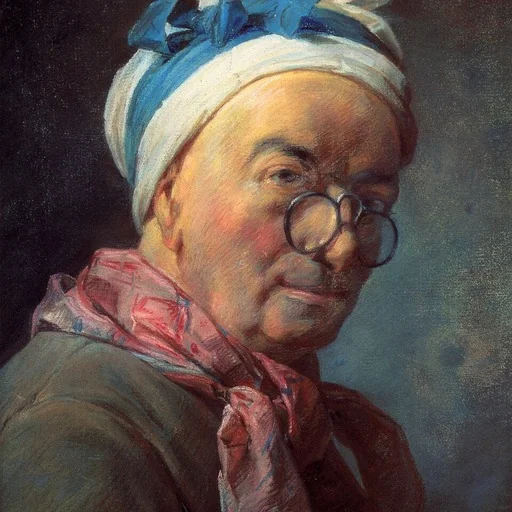
Jean Siméon Chardin (French:; November 2, 1699 – December 6, 1779) was an 18th-century French painter.