Artwork
Madame Monet wearing a kimono
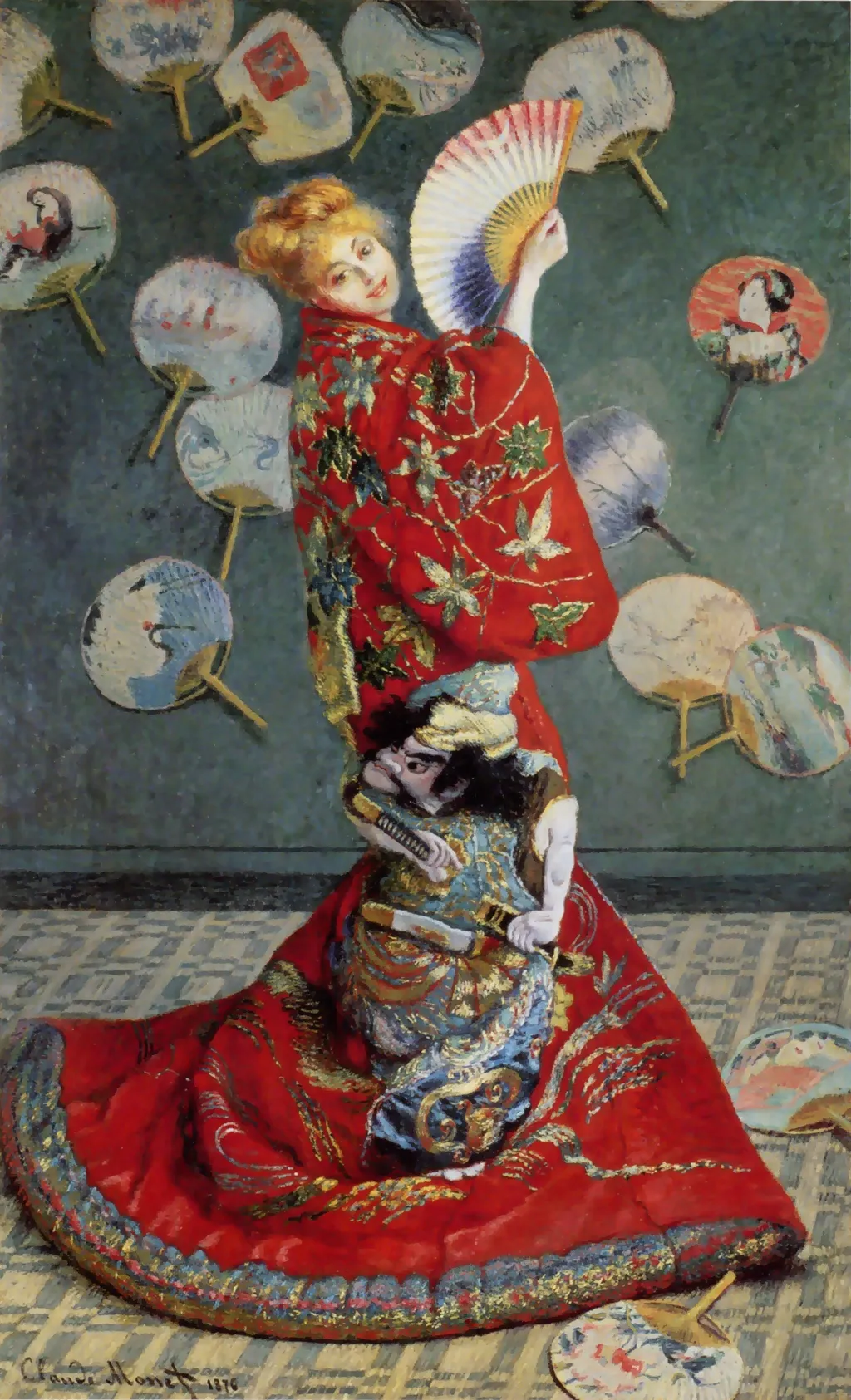
Madame Monet wearing a kimono is an oil painting by the Impressionist artist Claude Monet. It dates from 1888 and is held in the collection of the Museum of Fine Arts Boston.
About this work
Technique & Style
The background fans display hazy Impressionist landscapes alongside specific motifs, such as a red-crowned crane, rendered with varying degrees of definition.
Executed in 1876, this work is an oil painting on canvas measuring 231.8 by 142.3 centimeters. The composition features a full-length portrait of a woman standing on a tatami mat before a wall adorned with Japanese uchiwa fans. Monet applied significant attention to the intricate embroidery of the red uchikake kimono, specifically positioning a detailed samurai figure near the canvas center to create a stark visual contrast with the model's delicate features and blonde wig.
The artist employed a pose where the body is turned in profile while the face engages the viewer directly, a gesture likely derived from illustrations of traditional Japanese dance. The handling of color emphasizes the distinction between the European subject and the appropriated setting, further highlighted by a folding fan held in the French national colors. The background fans display hazy Impressionist landscapes alongside specific motifs, such as a red-crowned crane, rendered with varying degrees of definition.
History & Provenance
Madame Monet wearing a kimono, also called La Japonaise, is an oil on canvas portrait that Monet completed in 1876. He painted the work to alleviate pressing financial pressures, borrowing a richly decorated red kimono from a friend and arranging for its sale through dealer Paul Durand‑Ruel for the second Impressionist exhibition that year. After its debut, the painting entered the collection of Paul Rosenberg and Philip Lehman, who later transferred ownership to the Museum of Fine Arts, Boston, where it has been conserved since 1956.
Madame Monet wearing a kimono, also known as La Japonaise, is held by the Museum of Fine Arts, Boston, where it has been conserved since 1956. The painting's provenance traces through the collections of Paul Rosenberg and Philip Lehman before entering the museum. Its recorded exhibition history begins with the second Impressionist exhibition of 1876 in Paris, where it was shown by the dealer Paul Durand-Ruel alongside eighteen other works by Monet.
The canvas measures 231.8 × 142.3 cm and is catalogued among the museum's holdings. Earlier owners documented in the provenance include the dealers and collectors through whom the work passed before its 1956 accession by the Boston institution.
Context
Critics at the 1876 Impressionist exhibition responded to Madame Monet wearing a kimono with divided opinions. Émile Zola and Alexandre Pothey praised its bold color and innovation, while others condemned the work as bizarre and sexually suggestive. Simon Boubée’s review described a “Chinese” figure in red robes with “two heads,” one belonging to a demimondaine and the other to a monster, mocking the painting’s hybrid cultural imagery. The samurai embroidery and Camille’s coquettish expression were read as provocative, prompting Monet to withdraw the work before the show closed.
Decades later, Monet himself dismissed it as a market-driven “piece of filth,” though some scholars argue this remark reflected embarrassment rather than disavowal, noting his contemporaneous letter to critic Philippe Burty calling the kimono’s rendering “magnificent.” The painting’s Japonisme reflects Monet’s engagement with a broader vogue for Japanese aesthetics in 1870s Paris, yet its staged, performative quality underscores the era’s appropriative tendencies rather than authentic intercultural exchange.
Overview
Madame Monet wearing a kimono, an oil painting from 1876, is a notable work by French Impressionist Claude Monet. This large-scale canvas features a full-length portrait of a woman, identified as Monet's first wife, Camille Doncieux. The artwork measures 231.8 cm by 142.3 cm and is recognized for its engagement with contemporary trends in art and culture. It currently resides in the collection of the Museum of Fine Arts, Boston.
Subject & Meaning
The painting portrays Camille Doncieux adorned in a vibrant red uchikake kimono, a traditional Japanese garment, and a wig. She holds a fan in her right hand, while the background is decorated with an array of Japanese fans against a green wall. This depiction reflects the widespread fascination with Japanese art and culture, known as Japonisme, prevalent in Europe during the late 19th century. The pose and attire evoke a sense of exoticism.
Artist & collection

Artist
Oscar-Claude Monet was a French painter and founder of Impressionism who is seen as a key precursor to modernism, especially in his attempts to paint nature as he perceived it.