Artwork
On the Banks of the Seine, Bennecourt
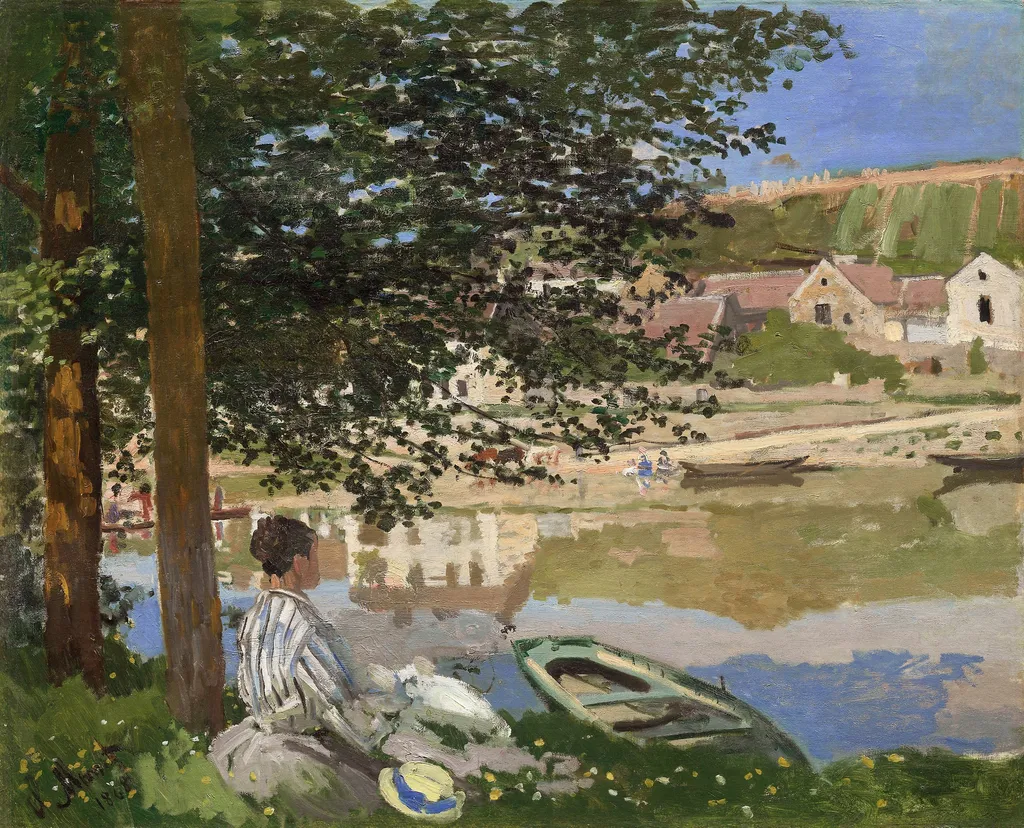
On the Banks of the Seine, Bennecourt is an oil painting by the Realist artist Claude Monet. It dates from 1868 and is held in the collection of the Art Institute of Chicago.
About this work
Subject & Meaning
Iconographically, the work represents a moment of domestic precariousness during the couple's temporary residence at the Gloton inn in 1868.
The painting depicts Camille Doncieux, Monet's partner and future wife, seated on an island in the Seine while looking back toward the village of Gloton in Bennecourt. Although the composition currently features a small dog on her lap, technical analysis reveals pentimenti indicating Monet originally painted their young son, Jean, in that position before altering the figure. The setting includes the calm river, a rowing boat, and distant hills where Émile Zola and Paul Cézanne had previously stayed, with barely visible figures on the opposite bank establishing the vanishing point.
Iconographically, the work represents a moment of domestic precariousness during the couple's temporary residence at the Gloton inn in 1868. Created shortly after Monet faced eviction and financial despair, the scene's tranquility and the light application of color on the foreground grass contrast with the artist's personal turmoil at the time. The composition emphasizes the reflection on the water and integrates the human figure into the landscape without specific glorification.
Technique & Style
Monet painted On the Banks of the Seine, Bennecourt in 1868 using oil on canvas, a portable support suited to plein air work. The canvas measures 81.5 cm in height and 100.7 cm in width, typical dimensions for a landscape of the period. The paint is applied in thin, broken layers that capture the shimmering surface of the water and the lightness of the sky, while the figures are rendered with minimal detail, emphasizing atmospheric effect over precise form.
The composition places the viewer on a riverbank, with a rowing boat and distant village rendered in muted tones, and the brushwork varies from delicate highlights on foliage to broader strokes in the background, creating a sense of immediacy and tranquility. The work was created during a financially strained time for Monet and his partner Camille, who served as the model for the figure on the island, and it reflects his early experimentation with color and light that would later define Impressionist practice.
History & Provenance
On the Banks of the Seine, Bennecourt was painted by Claude Monet in 1868 during a brief stay at the inn at Gloton, a hamlet of Bennecourt, where he and his partner Camille Doncieux had taken rooms with their young son Jean. It is the only surviving work from that sojourn, painted at a moment of acute financial distress that forced Monet to abandon the lodgings.
The painting's documented ownership begins with Louis Aimé Léon Clapisson of Neuilly-sur-Seine, who acquired it for 500 francs. He lent it to the Galerie Georges Petit for the 1889 exhibition "Claude Monet; A. Rodin." Clapisson sold the canvas on 21 April 1892 to the dealer Paul Durand-Ruel for 1,500 francs, and Durand-Ruel resold it just over three weeks later, on 18 May 1892, to the Chicago collector Potter Palmer for 7,500 francs.
The work then descended through the Palmer family, who donated it to the Art Institute of Chicago in 1922.
The painting is held by the Art Institute of Chicago, where it is accessioned as a gift of the Palmer family in 1922.
It has appeared in multiple exhibitions, including a loan to the Galerie Georges Petit for the 1889 exhibition Claude Monet; A. Rodin. More recently, it traveled in a group of Impressionist works to venues in the United States, Europe, and Japan, though specific later exhibition titles and dates are not listed in the cited sources.
Context
Painted in 1868 during a financially strained stay at Gloton near Bennecourt, the work reflects Monet’s early plein‑air practice and his precarious domestic circumstances with Camille Doncieux and their infant son. It is the sole surviving canvas from that sojourn and shows pentimenti indicating an initial figure of the child before the seated model was established.
The picture entered Durand‑Ruel’s stock in 1892 and crossed the Atlantic to Potter Palmer’s Chicago collection, later forming part of the Palmer bequest to the Art Institute of Chicago in 1922. Its critical fortunes paralleled the growing recognition of Monet’s role in Impressionism, though contemporary reviews of the 1868 Salon submissions did not single out this canvas. Later twentieth‑century retrospectives placed it within the narrative of Monet’s development, underscoring the period’s shift toward light‑inflected landscape and the normalization of the female figure within natural settings.
Legacy
The painting's legacy is anchored in its early provenance and subsequent public visibility. After being purchased by Louis Aimé Léon Clapisson in 1868 for 500 francs, it entered the Parisian art market and was lent to the 1889 Galerie Georges Petit exhibition, which helped raise Monet's profile. Durand-Ruel acquired it later that year, and Potter Palmer bought it in 1892, bringing the work to Chicago where it entered the Art Institute of Chicago's collection in 1922.
This chain of ownership reflects the painting's role in the commercial circulation of Impressionist works. Its inclusion in numerous exhibitions across the United States, Europe, and Japan further cemented Monet's international reputation. The work is frequently cited in studies of Monet's personal life and Impressionist technique, particularly for its depiction of Camille Doncieux and its innovative handling of light and atmosphere.
Overview
Claude Monet’s 1868 oil on canvas titled On the Bank of the Seine, Bennecourt depicts a quiet riverside tableau. A woman in a striped dress and hat sits on a grassy bank, turned away from the viewer, while trees frame the scene and a small rowing boat peeks from the foreground. The Seine stretches behind, mirroring a clear blue sky.
Own this work as a print
Artist & collection
Artist
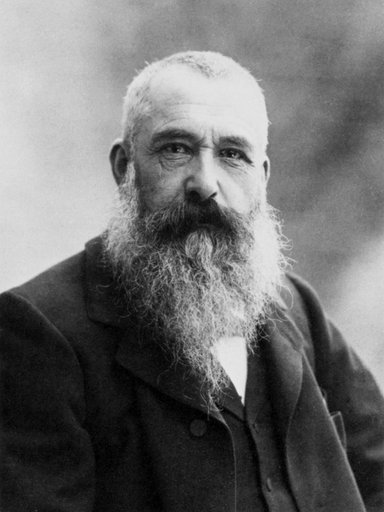
Oscar-Claude Monet was a French painter and founder of Impressionism who is seen as a key precursor to modernism, especially in his attempts to paint nature as he perceived it.