Artwork
The Bodmer Oak, Fontainebleau Forest
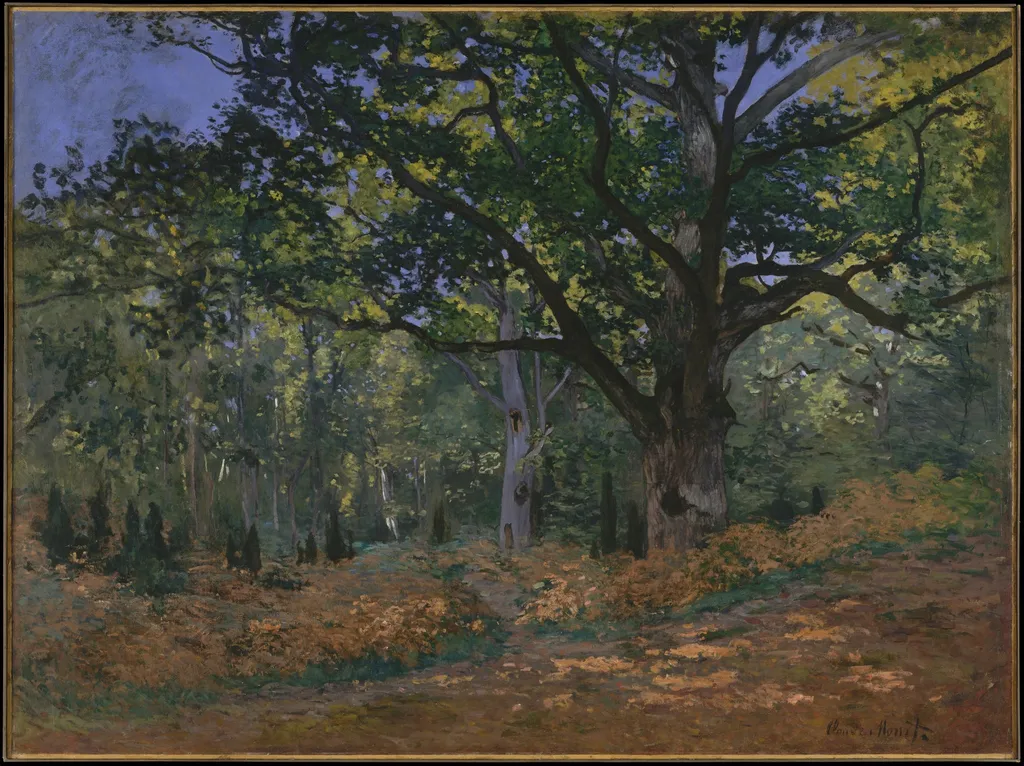
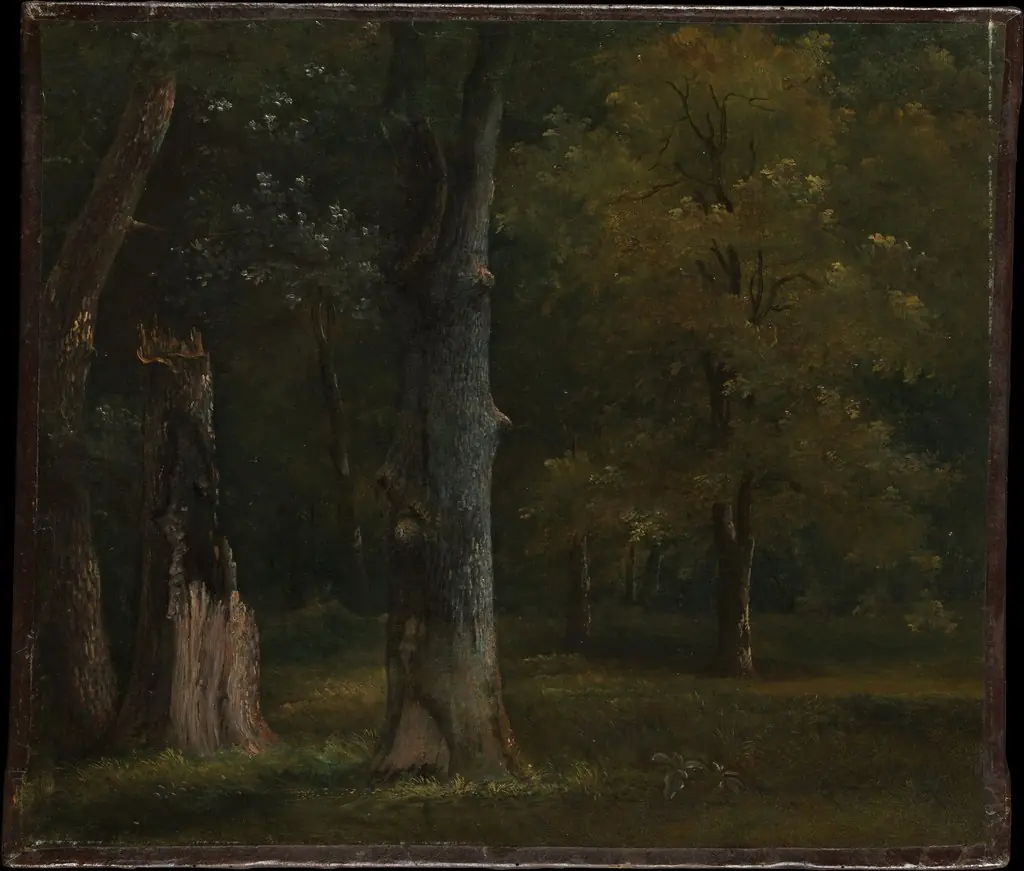
The Bodmer Oak, Fontainebleau Forest is an oil painting by the Impressionist artist Claude Monet. It dates from 1865 and is held in the collection of the Metropolitan Museum of Art.
About this work
Technique & Style
Monet employs a chiaroscuro-like contrast to focus attention on the tree, while subtly using distant trunks to articulate spatial recession.
The Bodmer Oak, Fontainebleau Forest is an oil painting on canvas executed by Monet in 1865. Its composition is organized in three distinct planes: a relatively lightly described foreground and background frame the centrally placed oak, which is rendered in darker hues and greater detail. Monet employs a chiaroscuro-like contrast to focus attention on the tree, while subtly using distant trunks to articulate spatial recession.
The handling emphasizes coloristic shadow and a low, backlit vantage that heightens the oak's monumentality. The palette, deep sky blue harmonizing with the reddish-brown forest floor, further accentuates the subject's majesty.
History & Provenance
The Bodmer Oak, Fontainebleau Forest was painted by Claude Monet in 1865 during his stays near Chailly-en-Bière at the edge of the Fontainebleau Forest, a site associated with the Barbizon School and protected by imperial decree since 1853. Monet chose the oak, named after the illustrator Karl Bodmer, as a subject linked to the area's artistic heritage. The work was completed amid Monet's early experiments in plein air painting after departing from academic instruction under Gleyre.
Monet initially brought the painting to Paris and later to Ville d'Avray to evade creditors, but it was seized in late 1866 or early 1867. Recovered, he sold it to dealer Paul Durand-Ruel in 1872, who subsequently sent it to New York. The painting entered private collections before being acquired by the Metropolitan Museum of Art in 1964.
The painting is currently held by the Metropolitan Museum of Art in New York. It entered the Met's holdings in 1964 after a series of private sales that began with its 1872 purchase from Paul Durand-Ruel.
Context
Painted in 1865, The Bodmer Oak represents Claude Monet's strategic engagement with the Barbizon School while developing his own approach to nature. Working in the protected Bas-Bréau zone of the Fontainebleau Forest, Monet sought to emulate the market success of predecessors like Corot, working near a tree whose name honored the illustrator Karl Bodmer. The work is noted for its innovative composition, utilizing a three-plane structure with focused depth of field and colored shadows to accentuate the oak's majesty.
This painting marks a pivotal moment where Monet moved beyond academic training to apply his theories on natural representation. Its subsequent journey, from seizure due to debt to sale by Durand-Ruel and eventual acquisition by the Metropolitan Museum of Art in 1964, underscores its enduring significance in the canon of Impressionist landscape painting.
Legacy
The Bodmer Oak, Fontainebleau Forest has remained visible in major museum circuits since its acquisition by the Metropolitan Museum of Art in 1964, a fact that has reinforced its standing in the history of French landscape painting. The work's distinctive treatment of light and its symbolic link to the 19th-century Barbizon figure Karl Bodmer have been cited as influences on later naturalistic approaches in Impressionist and Post-Impressionist art. Its continued presence in the Met's collection underscores a lasting reputation as a pivotal early piece in Monet's oeuvre.
Overview
The Bodmer Oak, Fontainebleau Forest (1865) is an oil painting by Claude Monet depicting a massive, ancient oak tree standing centrally within the dense woodland of the Fontainebleau Forest. Executed during Monet's formative period before his full commitment to Impressionism, the work demonstrates his early engagement with the Barbizon School's tradition of plein air landscape painting. The composition is dominated by the vertical thrust of the oak's trunk and the sprawling, intricate network of its branches, which fill the upper canvas and create a complex interplay of light and shadow.
Monet employs a palette of muted greens, browns, and grays to render the atmospheric depth of the forest, contrasting the textured bark of the central subject with the softer, more indistinct forms of the surrounding undergrowth and distant trees. Painted in 1865, this work reflects Monet's study of nature's structural integrity and his developing technique in capturing natural light, serving as a significant precursor to his later, more radical Impressionist landscapes. The painting highlights the artist's dedication to observing specific natural phenomena rather than idealizing the scene, marking a crucial step in his artistic evolution.
Subject & Meaning
The artwork centers on the venerable Bodmer Oak, its expansive branches reaching across the canvas, dominating the forest scene. Surrounding trees recede into the background, hinting at the depth of the woods. The foreground depicts a natural forest floor, strewn with fallen leaves and twigs.
This detailed rendering evokes a sense of quiet immersion, inviting contemplation of the ancient tree and its secluded environment.
Own this work as a print
Artist & collection
Artist
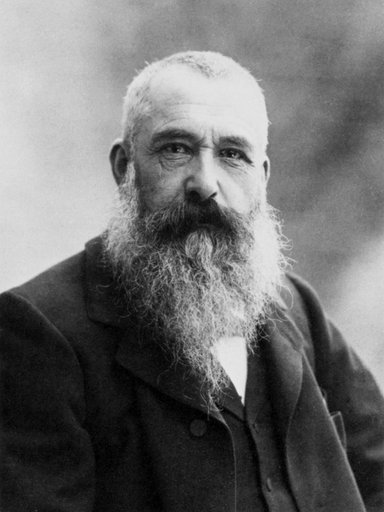
Oscar-Claude Monet was a French painter and founder of Impressionism who is seen as a key precursor to modernism, especially in his attempts to paint nature as he perceived it.