Artwork
An Eastern Ruler Seated on His Throne
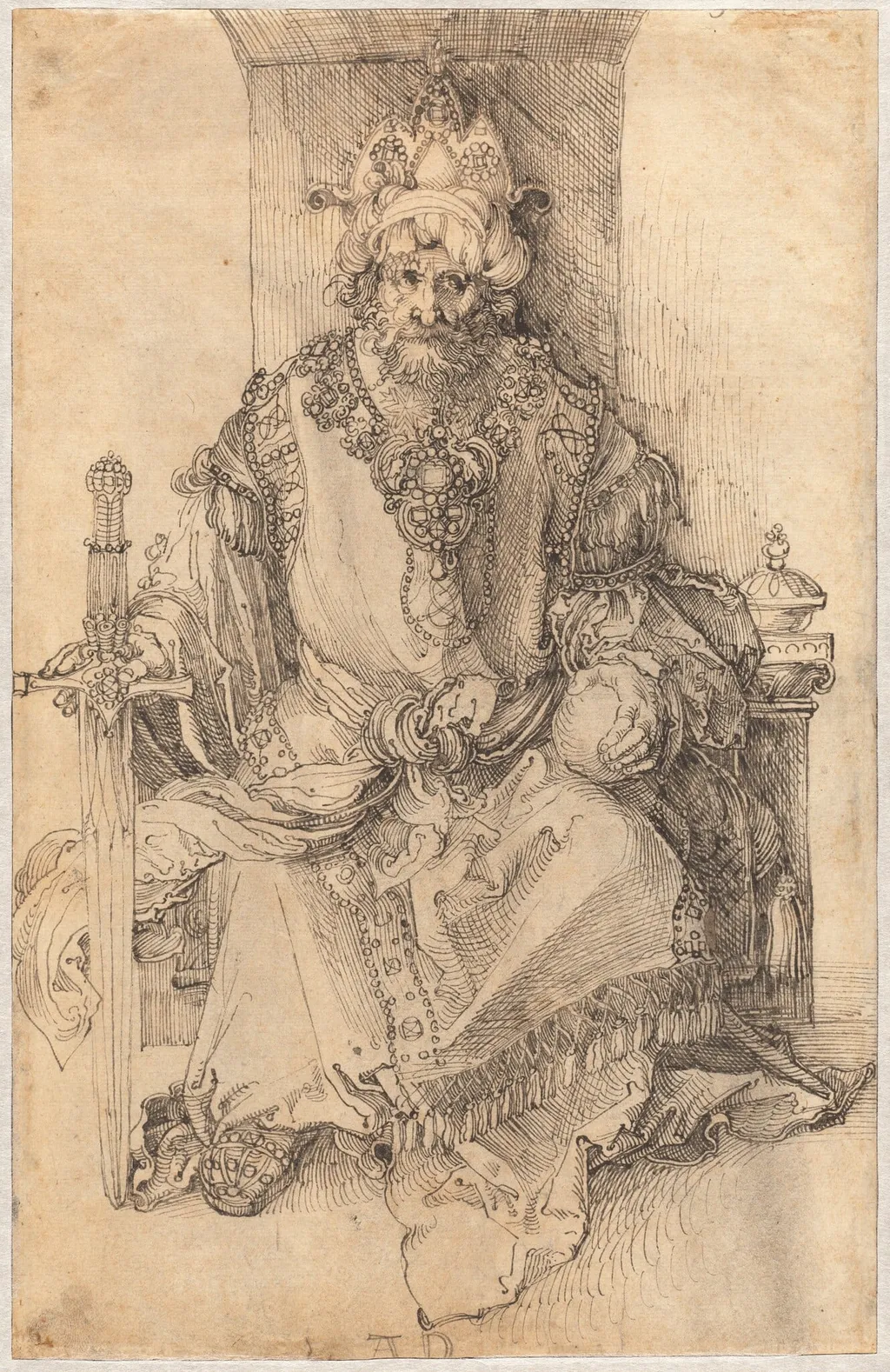
An Eastern Ruler Seated on His Throne is an ink drawing by the Northern Renaissance artist Albrecht Dürer. It dates from 1495 and is held in the collection of the National Gallery of Art.
- Inscription
- Inscribed:inscribed (by another early hand?) in pen and black ink with Durer's monogram, partially cut; verso inscribed in graphite "Collection/du Comte Thibaudiau/Cat. No. 268).
About this work
Overview
An Eastern Ruler Seated on His Throne is a pen and black ink drawing on laid paper by the German artist Albrecht Dürer, executed circa 1495 in Nuremberg.
An Eastern Ruler Seated on His Throne is a pen and black ink drawing on laid paper by the German artist Albrecht Dürer, executed circa 1495 in Nuremberg. Measuring 30.6 by 19.7 centimeters, the work depicts a sultan in elaborate ceremonial regalia seated upon an ornate throne. The drawing is held in the collection of the National Gallery of Art in Washington, D.C., where it was acquired in 1972 through the Ailsa Mellon Bruce Fund, with the accession number 1972.22.1.a. The sheet bears a partially cut monogram at lower center, inscribed in pen and black ink, and a related version with the accession number 1972.22.1.b also exists in the same collection. This drawing represents an important early example of Dürer's engagement with Orientalist subject matter and demonstrates his precocious mastery of linear technique at the outset of his career.
Subject & Meaning
The drawing depicts a sultan, as identified in the work's Wikidata classification, presented as an powerful Eastern ruler in a formal, hieratic pose. The figure occupies the central vertical axis of the composition, seated upon an elaborately carved throne with architectural elements behind him. His ceremonial attire includes a tall jeweled crown, a fur-trimmed and embroidered robe with decorative patterned edges, and a large jeweled pendant at his chest. His full, curly beard and voluminous curled hair frame a face of commanding authority. In his right hand he holds a long sword vertically, its pommel resting near his shoulder with the blade touching the ground, while his left hand rests upon his thigh. To his right sits a covered vessel or orb upon a small pedestal, an attribute that reinforces his sovereign status. The iconography draws upon contemporary European fascination with Ottoman and Eastern Mediterranean rulers, reflecting the expanding horizons of European knowledge during the period of exploration and the persistent threat and allure of the Ottoman Empire. The subject has been discussed in scholarship on Dürer's depictions of Ottoman Turks as an early case of what scholars have analyzed as proto-Orientalist representation.
Technique & Style
The drawing is executed in pen and black ink on laid paper, with a limited palette of black or dark brown ink on cream-toned paper that has yellowed with age and developed some discoloration and age spots. The medium allows for precise, detailed linework that is particularly evident in the rendering of jewelry, embroidery, and facial hair. Modeling is achieved through dense cross-hatching and parallel lines, with darker ink concentrations strategically placed behind the figure's head and beneath the throne to create spatial depth and to set off the luminous figure against a darker ground. The handling demonstrates Dürer's characteristic control of the pen, with variations in line weight and density that suggest both volume and texture. The architectural throne features carved armrests with decorative finials and draped fabric, all rendered with the same meticulous attention. A monogram appears at the bottom center of the composition, though it is partially cut. The overall effect is one of monumental dignity achieved through economical means, the vertical format emphasizing the ruler's elevated status and the drawing's function as an independent work of art rather than merely a preparatory study.
History & Provenance
The provenance of the drawing is well documented through a distinguished chain of ownership. It passed from William Young Ottley (1771-1836) of London to Sir Thomas Lawrence (1769-1830), also of London, whose collection mark (Lugt 2445) it bears. Subsequent owners included S.G. Liesching of Stuttgart and Count Adolphe-Narcisse Thibeaudeau (1795-1856) of Paris, from whose collection it was sold in Paris on 20-25 April 1857 as lot 268. After entering a private collection in the United States, it was purchased privately through the dealer Robert Light by the National Gallery of Art in 1972. The verso of the sheet bears a graphite inscription reading Collection/du Comte Thibaudiau/Cat. No. 268, confirming its passage through the Thibeaudeau collection. The work has been exhibited extensively, beginning with NGA Recent Acquisitions in 1974, followed by Master Drawings from the Collection of the National Gallery of Art and Promised Gifts in 1978, Early German Drawings and Prints: Two Recent Acquisitions and Related Works in 1979, and German Drawings from a Private Collection at the British Museum in 1984. It was featured in the major exhibition Circa 1492: Art in the Age of Exploration in 1991-1992, Six Centuries/Six Artists in 1997, and Albrecht Dürer at the Albertina in Vienna in 2003. More recently it appeared in Albrecht Dürer: Master Drawings, Watercolors, and Prints from the Albertina in 2013, The Poetry of Light at the Museo Correr in Venice in 2014-2015, and again at the Albertina in 2019-2020.
Context
This drawing belongs to the early phase of Dürer's career, when the artist was establishing his reputation in Nuremberg and beginning to explore subjects beyond the traditional Northern European repertoire. The work has attracted significant scholarly attention since its acquisition by the National Gallery of Art. Christopher White published it in 1973 in Master Drawings as one of two new drawings by Dürer, and it was subsequently catalogued by Walter L. Strauss in The Complete Drawings of Albrecht Dürer. The drawing has been discussed in the context of Dürer's developing interest in foreign cultures and his engagement with the visual representation of power and authority. Heather Madar's 2011 study examined Dürer's depictions of Ottoman Turks within the framework of early modern Orientalism. The work also appears in general studies of Dürer's drawings by Andrew Robison and in design theory publications by Benjamin Martinez, Jacqueline Block, Gene A. Mittler, and James D. Howze, indicating its use as an exemplary instance of compositional force and linear technique. The related sheet, accessioned as 1972.22.1.b, suggests that the National Gallery of Art acquired multiple works from this provenance at the same time.
Legacy
An Eastern Ruler Seated on His Throne has become a significant work in the study of early Dürer and in broader discussions of European visual culture's engagement with the Ottoman world. Its acquisition by the National Gallery of Art in 1972 brought it into one of the most important public collections of European art in the United States, ensuring its continued accessibility to scholars and the general public. The drawing's inclusion in major loan exhibitions, particularly the 1991-1992 Circa 1492: Art in the Age of Exploration and the 2003 and 2019-2020 Dürer exhibitions at the Albertina, has secured its place in the canon of the artist's early works. Its reproduction in scholarly literature ranging from specialized drawing catalogues to general design textbooks testifies to its pedagogical value as an exemplar of controlled pen technique and monumental composition. The work remains an important touchstone for understanding how a young Dürer synthesized Northern European draftsmanship with subjects drawn from the expanding world of Mediterranean and Near Eastern diplomacy and conflict, pointing toward the cosmopolitan breadth that would characterize his entire career.
Own this work as a print
Artist & collection
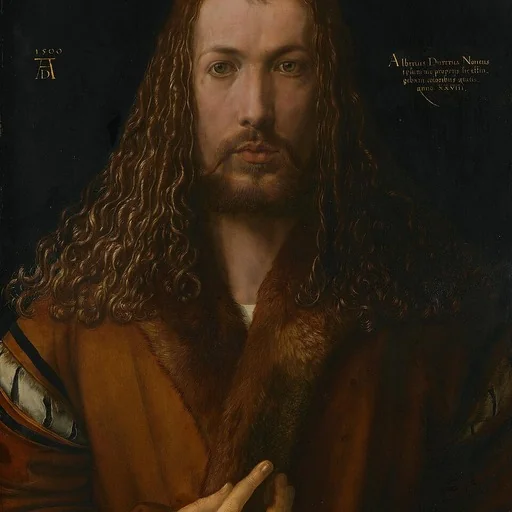
Artist
Albrecht Dürer spent his life in Nuremberg, a busy German city where artists traded prints like currency.

![Madonna and Child [obverse], by Albrecht Dürer](https://artifactworldgallery.com/img/albrecht-durer--madonna-and-child-obverse--d7b8ebf05d22ebe5-w320.webp)
![Lot and His Daughters [reverse], by Albrecht Dürer](https://artifactworldgallery.com/img/albrecht-durer--lot-and-his-daughters-reverse--b4ebf9b282faa17a-w320.webp)