Artwork
Apollo and Diana
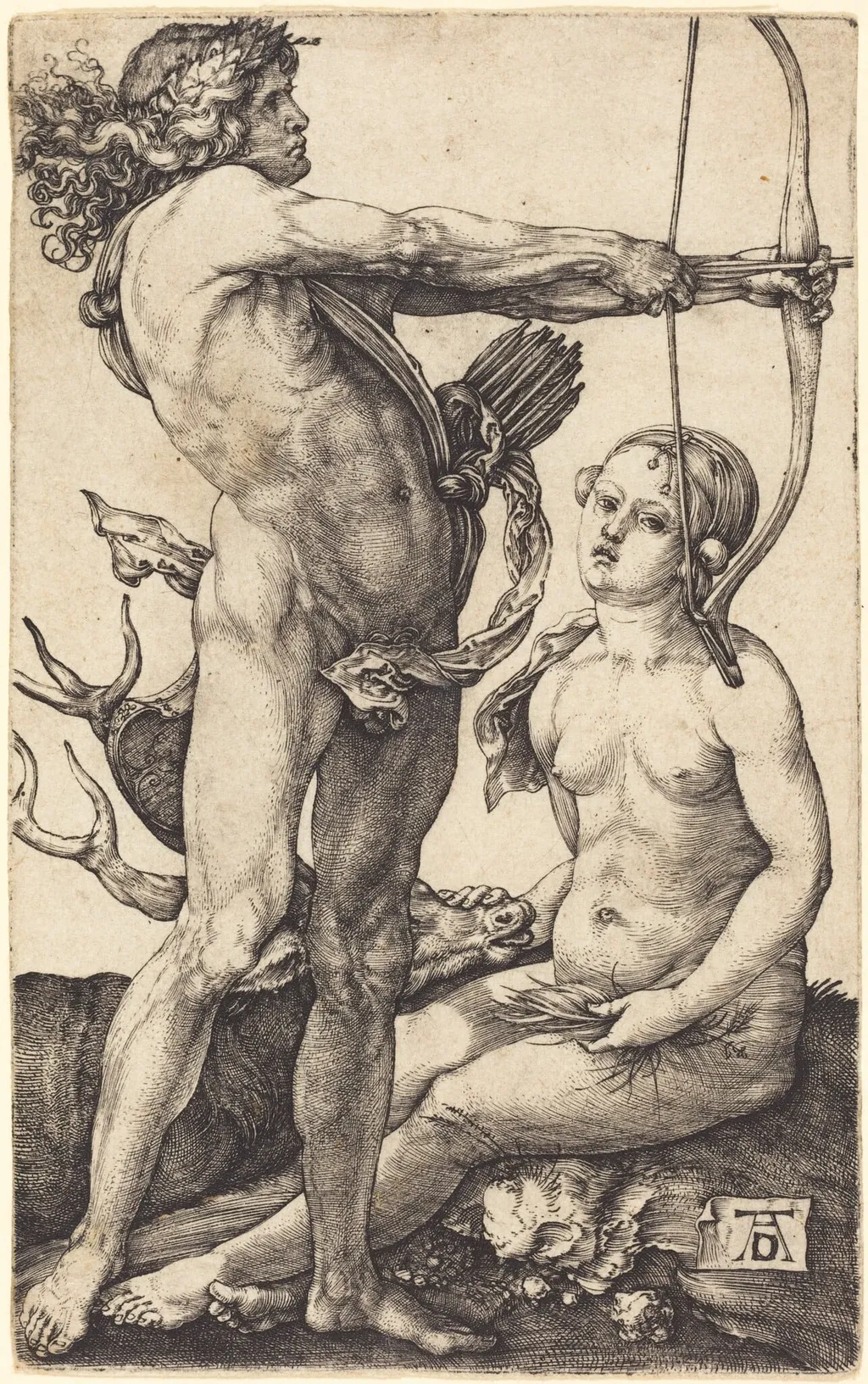
Apollo and Diana is an ink print by the Northern Renaissance artist Albrecht Dürer. It dates from 1504 and is held in the collection of the Metropolitan Museum of Art.
- Inscription
- Inscribed:in plate, lower left, on sheet on ground: AD [D corrected] [artist's monogram]; verso, bottom center, in graphite by a later hand: 1668 [?]/NR [?]; verso, bottom left, in graphite by a later hand: B3
- Markings
- Marked:none
About this work
Subject & Meaning
This approach demonstrates a clear artistic dialogue with Antonio Pollaiuolo, positioning Dürer's figure between Pollaiuolo's famous depictions of Hercules.
This engraving depicts the mythological siblings Apollo and Diana within a scene grounded in everyday reality. Diana is shown seated and facing the viewer, appearing weary during a hunting rest as she strokes a deer resting its head on her thigh and prepares to feed it grass. Standing before her, Apollo has just finished adjusting his bow.
The composition highlights Dürer's study of human anatomy, particularly in the meticulously rendered, tensed muscles of Apollo. The god's arched back creates a curve that visually echoes the shape of the bow he draws, a formal device reflecting Italian Renaissance influences. This approach demonstrates a clear artistic dialogue with Antonio Pollaiuolo, positioning Dürer's figure between Pollaiuolo's famous depictions of Hercules.
Technique & Style
The engraving employs copperplate intaglio technique, executed entirely with the burin on a copper support, printed in black ink on laid paper. Dürer renders Apollo with taut musculature and exaggerated contrapposto, his flexed torso and curved back mirrored by the arc of his drawn bow; Diana sits frontally, her relaxed posture and gesture of feeding the resting stag evoking quotidian stillness rather than heroic grandeur. The composition integrates Italian Renaissance anatomical precision with Northern graphic clarity, aligning Apollo’s anatomy with Pollaiuolo’s studies of strained bodies, while the surrounding space remains flattened, typical of Dürer’s early prints. Handling shows fine cross-hatching and controlled line modulation to articulate form and texture, without signs of abrasion or significant wear in standard impressions.
History & Provenance
Albrecht Dürer’s engraving *Apollo and Diana* is dated circa 1503-1504 and was produced in Nuremberg during the artist’s early engagement with Italian Renaissance ideals of human anatomy. The work entered the modern market through Albert W. Scholle in New York, then passed to Clendenin J. Ryan Sr. before being sold at Parke-Bernet Galleries, New York, on 17 January 1940 (lot 78). It was purchased that year by Lessing J. Rosenwald, who donated it to the National Gallery of Art, Washington, in 1943. The engraving *Apollo and Diana* is held in the Prints and Drawings department of the National Gallery of Art in Washington, D.C., specifically within the Rosenwald Collection. The work entered the museum's holdings in 1943 as a gift from collector Lessing J. Rosenwald, who had acquired it in 1940 following the sale of the Clendenin J. Ryan Sr. collection at Parke-Bernet Galleries in New York. Prior to Ryan's ownership, the print was in the collection of Albert W. Scholle of New York. The accession record links the piece to the Lugt collection numbers 1760b and 1932d associated with Rosenwald. While the work is part of the National Gallery of Art's permanent collection, no specific past exhibition history is detailed in the provided sources.
Context
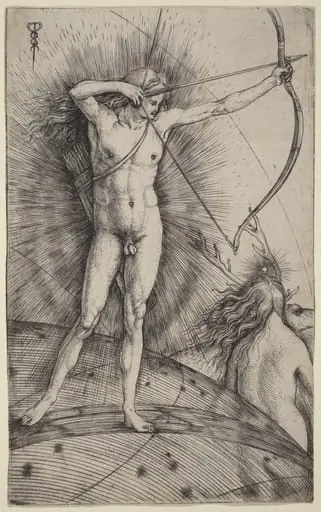
The engraving titled Apollo and Diana, created by Albrecht Dürer in 1504, exemplifies his early engagement with Italian Renaissance aesthetics and the technical innovations of Northern printmaking. It reflects a competitive dialogue between Dürer and the German artist Jacopo de' Barbari, each producing prints depicting the mythological siblings Apollo and Diana, with Apollo poised to draw his bow and Diana seated in quiet repose, attended by a deer. Art historical analysis emphasizes the work’s naturalistic detail and emotional nuance, particularly in its rendering of musculature and spatial interaction, marking a departure from late medieval conventions toward a more anatomically precise and psychologically resonant style. Dürer’s composition draws clear inspiration from the works of Antonio Pollaiuolo, situating his interpretation between the heroic vigor of classical statuary and contemporary Northern approaches to narrative figuration. The print is housed in the National Gallery of Art as part of the Rosenwald Collection, ensuring its accessibility for scholarly study.
Legacy
The engraving stands as a central composition within Dürer's body of work, documenting his early engagement with Italian Renaissance art and the representation of the human body. It is emblematic of the emulation between Dürer and Jacopo de' Barbari, each of whom produced a plate devoted to the mythological sibling pair, with Apollo standing and drawing his bow while Diana is accompanied by a stag. Dürer's meticulously rendered musculature of Apollo, with an exaggerated curvature of the back responding to the arc being drawn, situates the figure midway between Antonio Pollaiuolo's Hercules and Antaeus in the Uffizi and his Hercules and Nessus at Yale University. The work is discussed in the 2022 publication "Albrecht Dürer. Gravure et Renaissance" by Mathieu Deldicque and Caroline Vrand.
A related print by Jacopo de' Barbari on the same subject is catalogued as a companion work, reinforcing the print's place in a broader Renaissance dialogue on classical mythology.
Own this work as a print
Artist & collection
Artist
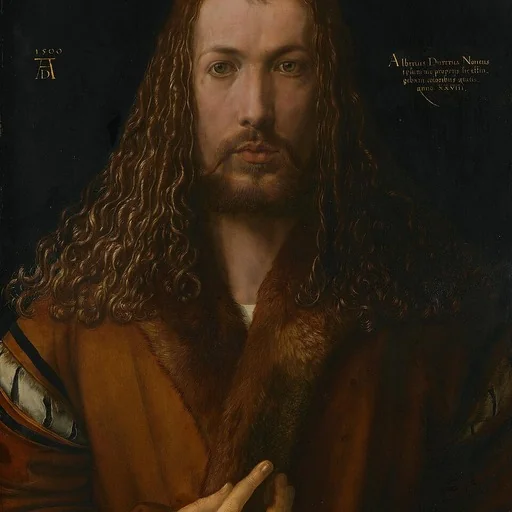
Albrecht Dürer spent his life in Nuremberg, a busy German city where artists traded prints like currency.

![Madonna and Child [obverse], by Albrecht Dürer](https://artifactworldgallery.com/img/albrecht-durer--madonna-and-child-obverse--d7b8ebf05d22ebe5-w320.webp)
![Lot and His Daughters [reverse], by Albrecht Dürer](https://artifactworldgallery.com/img/albrecht-durer--lot-and-his-daughters-reverse--b4ebf9b282faa17a-w320.webp)