Artwork
Mais puisque j'vous dis que c'est son ballon...
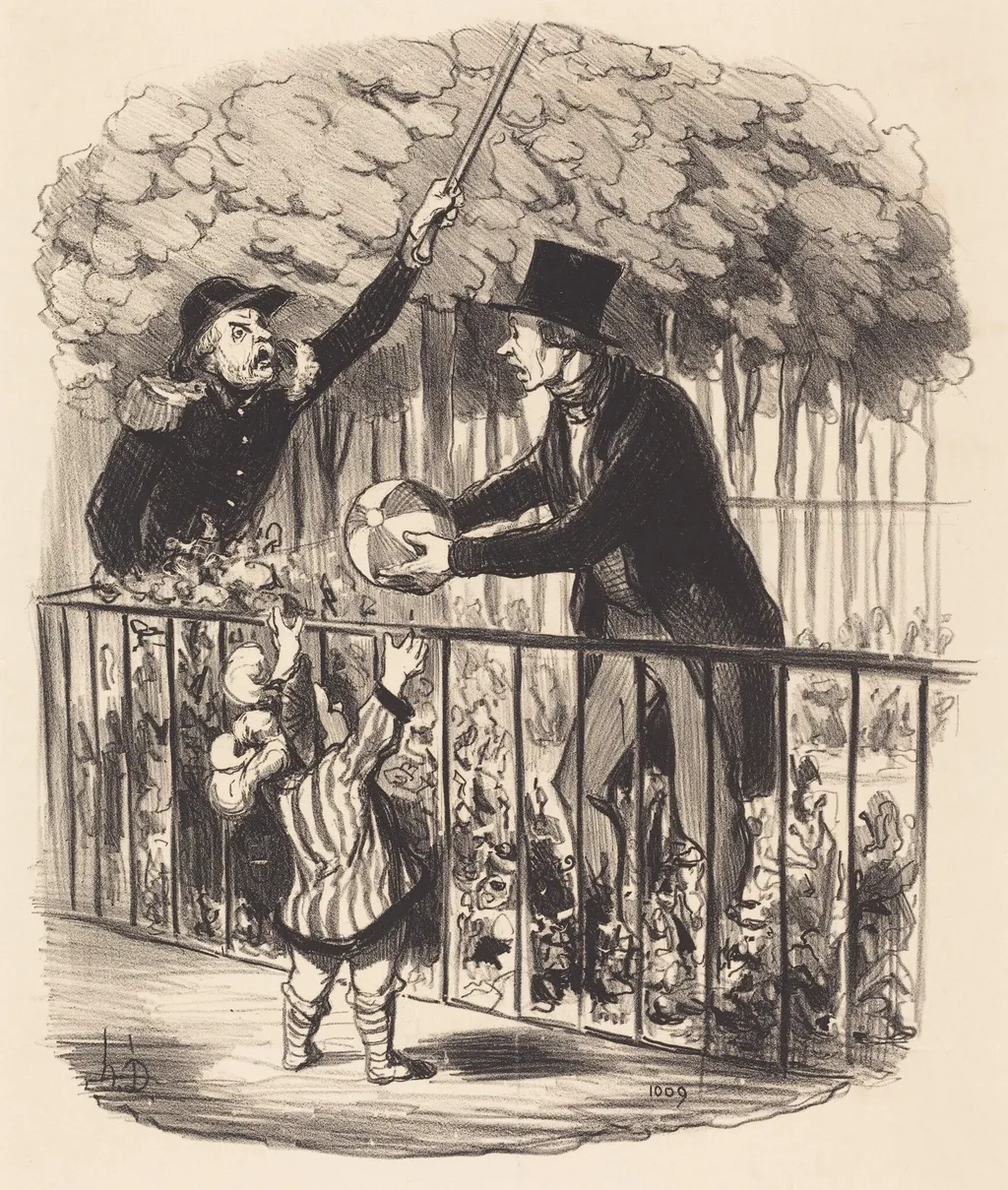
Mais puisque j'vous dis que c'est son ballon... is an ink print by the Romanticist artist Honoré Daumier. It dates from 1847 and is held in the collection of the National Gallery of Art.
About this work
Overview
Created in 1847, this lithograph by Honoré Daumier captures a moment of public dispute over a seemingly trivial object. Executed in the medium of stone lithography, it reflects Daumier’s role as a visual commentator in Parisian newspapers. The image’s immediacy and informal composition align with his practice of translating everyday social friction into accessible imagery for a broad readership.
Subject & Meaning
Their clash mirrors broader societal tensions: class conflict, ownership, and the absurdity of public disputes.
Two men argue over a round object, one insists it belongs to him, the other clutches it like a balloon. Their clash mirrors broader societal tensions: class conflict, ownership, and the absurdity of public disputes. The crowd below, blurred yet attentive, suggests the public’s fascination with such spectacles. Daumier uses the mundane to expose how trivial conflicts can escalate into communal drama under social strain.
Technique & Style
Daumier employed rapid, expressive lines typical of lithographic sketching, allowing for dynamic movement and emotional intensity. The figures are rendered with minimal detail, emphasizing gesture over realism. The crowd is suggested through smudged forms, enhancing the sense of chaos and anonymity.
The contrast between the sharply defined protagonists and the indistinct onlookers directs focus to the absurdity of their confrontation.
History & Provenance
Produced during the final years of the July Monarchy, the print likely appeared in Le Charivari, where Daumier regularly published satirical works. Though the original publication context is unrecorded, its survival in museum collections reflects its recognition as a representative example of 19th-century French political satire. It was not commissioned but emerged from Daumier’s independent critique of public life.
Context
France in 1847 was marked by economic hardship and rising dissent against King Louis-Philippe’s regime. Daumier’s prints, often censored, used humor to circumvent direct political attack. This image, devoid of overt symbols, relies on recognizable social types, the pompous bourgeois and the blustering commoner, to evoke systemic tensions without naming specific figures or events.
Legacy
Daumier’s lithographs influenced later generations of illustrators and cartoonists by demonstrating how everyday scenes could carry social critique. This work, like others in his oeuvre, helped establish lithography as a legitimate medium for commentary beyond fine art. Its enduring presence in collections underscores its role in documenting the visual language of 19th-century public discourse.
Own this work as a print
Artist & collection
Artist
Honoré-Victorin Daumier (French: ; 26 February 1808 – 10 or 11 February 1879) was a French painter, sculptor, and printmaker, whose many works offer commentary on the social and political life in France, from the…