Artwork
Equestrian Portrait of Elisabeth of France
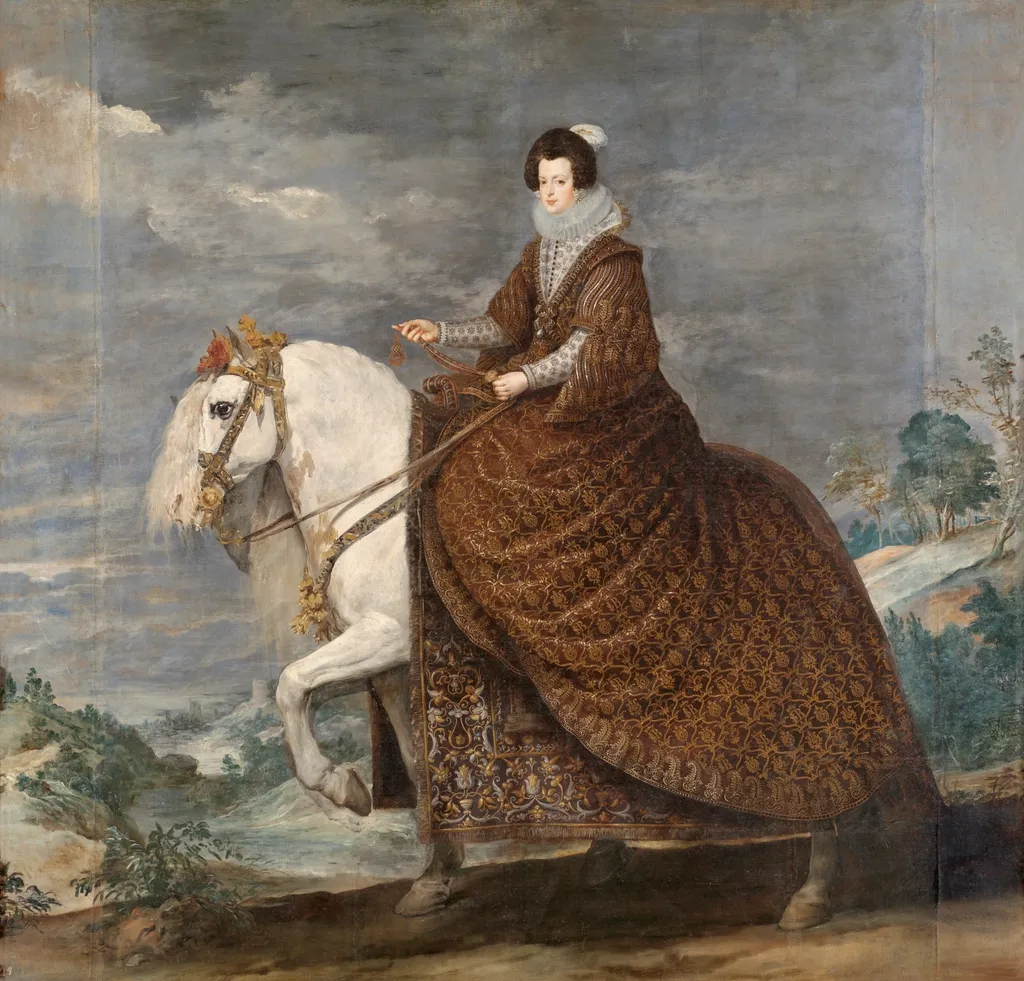
Equestrian Portrait of Elisabeth of France is an oil painting by the Early Baroque Italian artist Diego Velázquez. It dates from 1631 and is held in the collection of the Museo del Prado.
About this work
Subject & Meaning
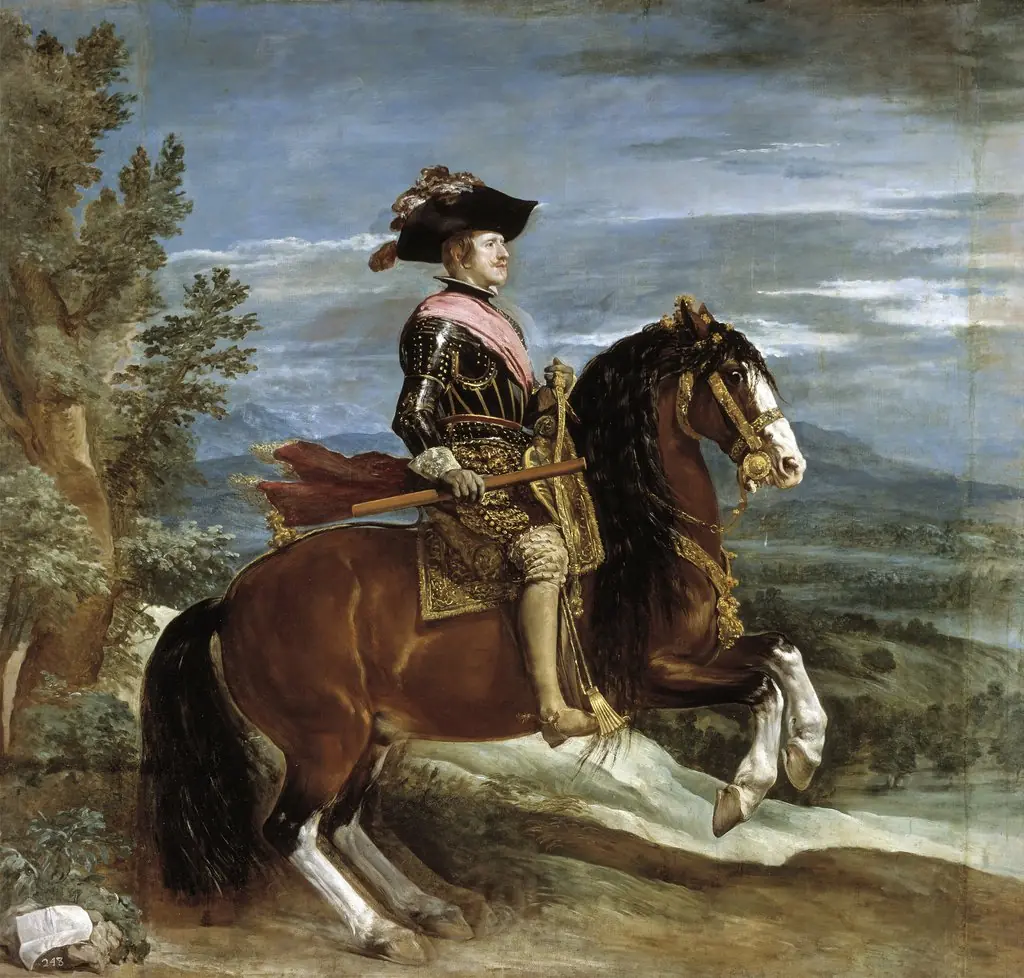
The painting is an equestrian portrait of Elisabeth of France, queen consort of Philip IV of Spain, depicted in profile riding sidesaddle on an overo horse with a long mane and forelock that falls over its face. The horse performs the passage gait and is turned to the left so that the composition mirrors her husband's equestrian portrait, in which he faces right, creating symmetry within the royal series. Elisabeth wears a jacket embroidered with stars and a gold-embroidered skirt bearing her coat of arms and initials, and the Golden Fleece insignia signals her membership in that prestigious dynastic order.
The work was conceived as part of a five-painting series of the royal family for the Hall of Realms at the Buen Retiro Palace, asserting Habsburg royal authority through the traditional iconography of the sovereign on horseback. The combination of the queen's regalia, the controlled passage of the horse, and the mirrored pairing with Philip IV presents Elisabeth as a dignified consort sharing in the majesty of the Spanish monarchy.
Technique & Style
X-ray examinations reveal an underlying composition where the horse's girth and the queen's simpler attire were initially visible before being obscured.
Executed in oil paint on canvas, the work measures 301 cm by 314 cm. Technical analysis by Carmen Garrido at the Museo del Prado indicates the canvas support consists of three sections: a central panel flanked by two vertical strips added during Velázquez's time. X-ray examinations reveal an underlying composition where the horse's girth and the queen's simpler attire were initially visible before being obscured. While Velázquez handled the queen's head and the horse's legs, a more meticulous workshop painter likely filled in the intricate gold embroidery on the skirt and saddle cloth, a process that covered parts of the horse previously painted.
The horse is depicted in a passage gait as an overo with a flowing mane, combining Frisian vigor with heavy forms. A 2024–2025 restoration addressed uneven color aging on the added canvas strips.
History & Provenance
The Equestrian Portrait of Elisabeth of France was commissioned by the Spanish court as part of a series of five equestrian portraits of the royal family, intended for the Hall of Realms in the Buen Retiro Palace in Madrid. Velázquez executed the work in 1631, employing his workshop to complete details after initial underpainting; technical analysis shows the horse’s girth and simpler queen’s dress beneath later embellishments. The painting remained in the royal collection, passing to Ferdinand VII of Spain, and entered the Museo del Prado after the museum’s foundation in 1819, where it is displayed in Prado Hall 012.
The Equestrian Portrait of Elisabeth of France is housed in the Museo del Prado, Madrid, where it is displayed in Hall 012 of the Royal Palace of Madrid. The work was originally intended for the Hall of Realms in the Buen Retiro Palace and has remained in the Prado since the museum's establishment in 1819. The sources do not record an inventory or accession number for the painting.
Context
Commissioned for the Hall of Realms in Madrid's Buen Retiro Palace, this work forms part of a coordinated series of five royal equestrian portraits. Technical analysis led by Carmen Garrido at the Museo del Prado reveals that the canvas was executed simultaneously with its counterparts using identical preparation methods. Scholarship indicates significant workshop participation; while Velázquez likely handled the queen's head and the horse's legs, another artist meticulously rendered the complex embroidery of the gown and trappings.
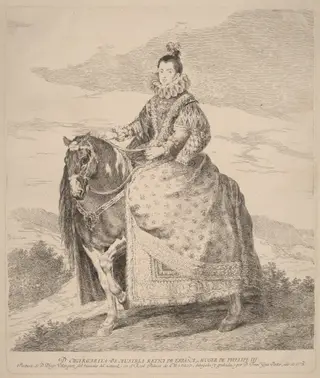
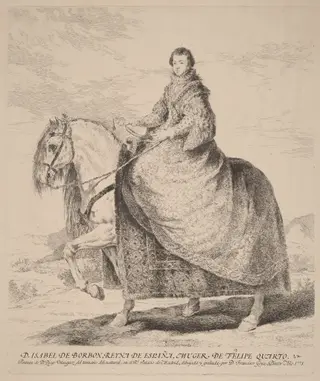
X-ray evidence contradicts earlier theories that Velázquez merely retouched an archaic painting, instead showing a simpler underpainting that was later elaborated upon. The composition was designed with specific architectural constraints in mind, including a cut corner to accommodate a door, and was positioned to face left, creating symmetry with the portrait of her husband, Philip IV. Francisco de Goya later acknowledged the work's significance by producing an etching based on the image in 1778.
Legacy
The painting's legacy is closely tied to its place within the Hall of Realms equestrian series, where it was displayed alongside companion portraits of the wider royal family. A 2024–2025 restoration addressed uneven tonal aging visible on the lateral canvas additions, helping to preserve the work's appearance for continued display at the Museo del Prado.
Beyond its institutional history, the portrait exerted influence on later Spanish artists: in his print series after Velázquez, Francisco de Goya produced an etching titled Isabelle de Bourbon. Reine d'Espagne, épouse de Philippe IV (1778), directly copying the composition. The work thus served as a reference point for subsequent generations engaging with the Spanish royal equestrian tradition.
Overview
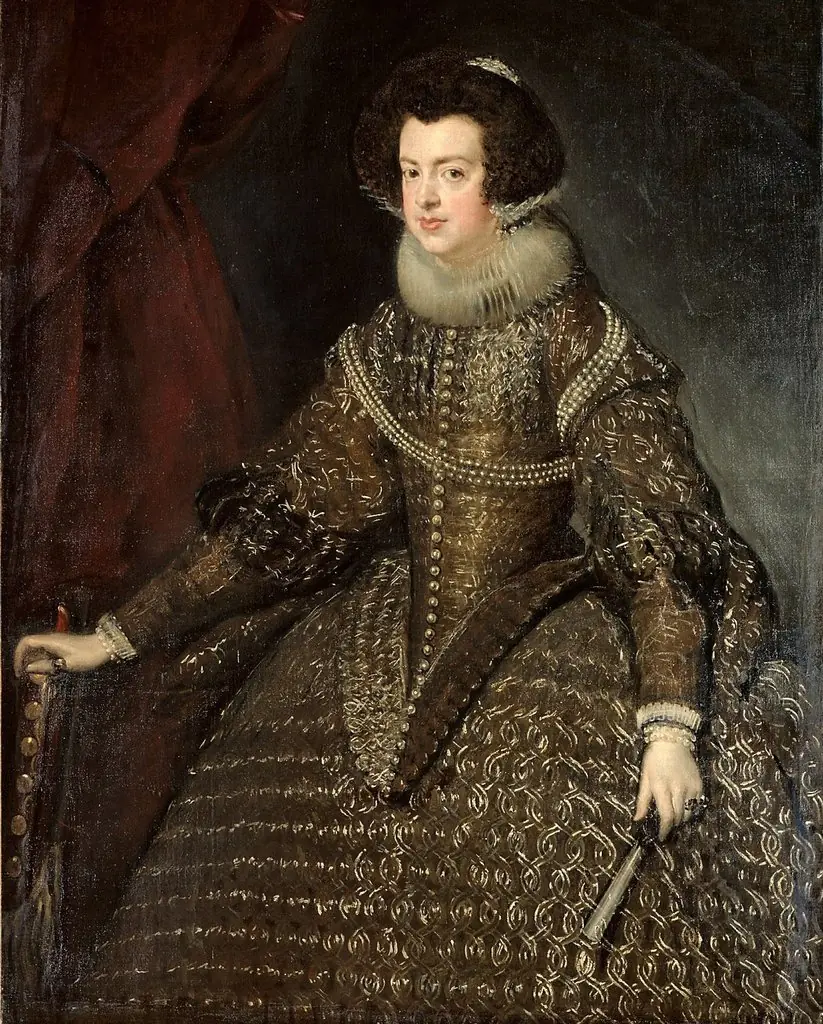
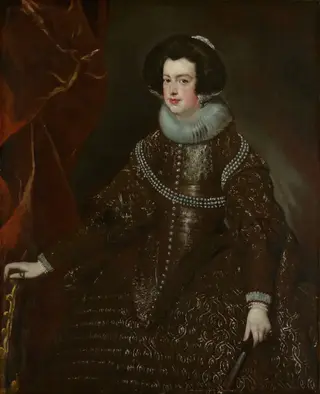
Diego Velázquez painted this equestrian portrait of Elisabeth of France around 1635, utilizing oil on canvas. The work depicts the queen seated upon a white horse, dressed in a dark, richly patterned cloak and a stiff collar. Her composed posture, combined with her powerful attire, conveys a sense of regal authority.
Originally commissioned for the Hall of Realms in Madrid, the painting now resides in the collection of the Museo del Prado.
Own this work as a print
Artist & collection
Artist
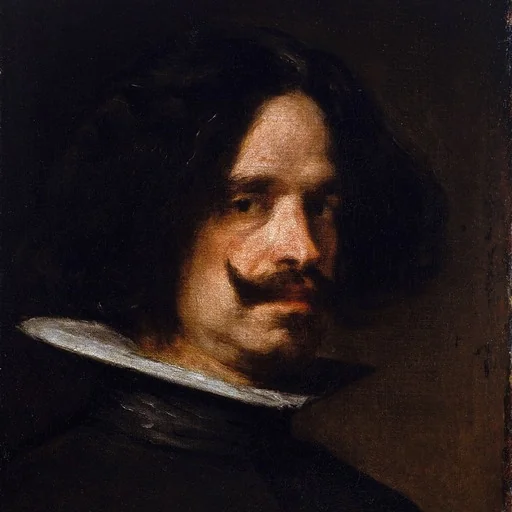
Diego Rodríguez de Silva y Velázquez was a Spanish Baroque painter, the leading artist in the court of King Philip IV of Spain and Portugal, and of the Spanish Golden Age.