Artwork
Baby at Play
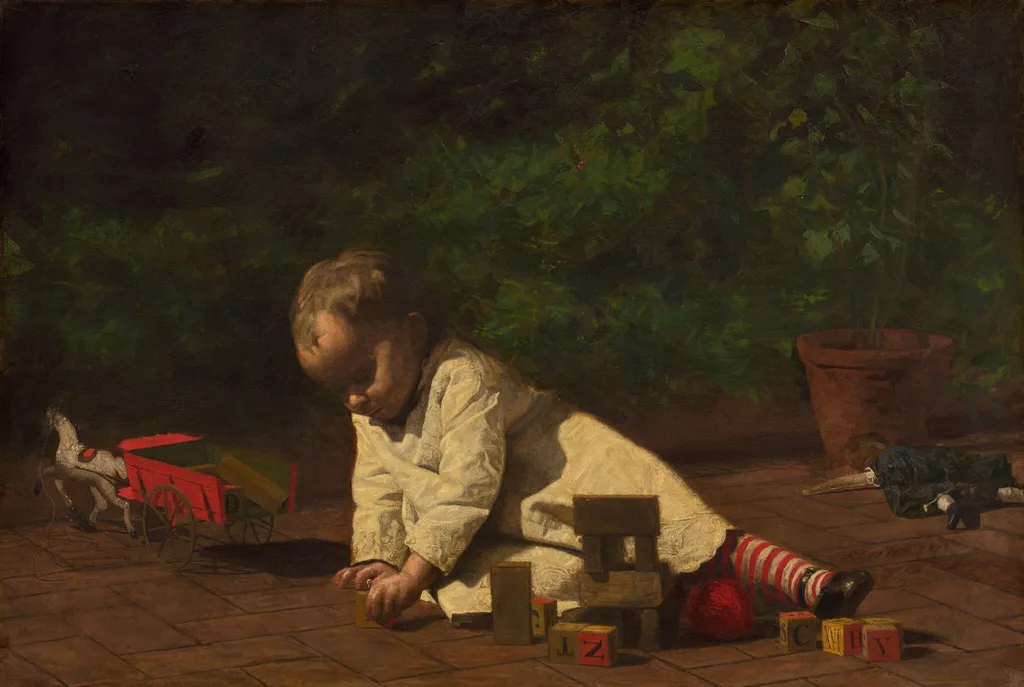
Baby at Play is an oil painting by the Impressionist artist Thomas Eakins. It dates from 1876 and is held in the collection of the National Gallery of Art.
- Inscription
- Inscribed:lower right on brick pavement: Eakins / 76
About this work
Overview
Baby at Play is an oil on canvas painting by American artist Thomas Eakins, completed in 1876.
Baby at Play is an oil on canvas painting by American artist Thomas Eakins, completed in 1876. Measuring 81.9 by 122.8 centimeters (32 1/4 by 48 3/8 inches), the work depicts the artist's two-and-a-half-year-old niece, Ella Crowell, absorbed in play with wooden alphabet blocks. The painting is held in the collection of the National Gallery of Art in Washington, D.C., where it entered in 1982 as a gift from the John Hay Whitney Charitable Trust. The work represents the culminating achievement of a series of intimate portraits of family and friends that Eakins produced between 1870 and 1876, and it exemplifies his commitment to psychological realism and unidealized observation of American life.
Subject & Meaning
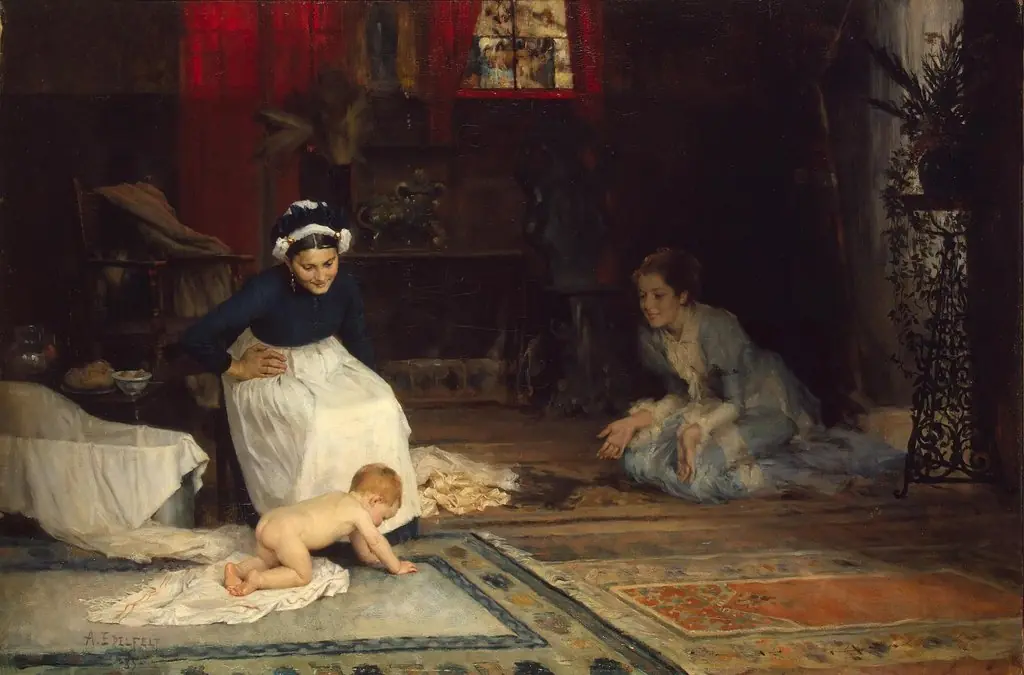
The painting shows Ella Crowell seated on a tiled floor, leaning forward to arrange wooden alphabet blocks that display visible letters including Z, L, C, W, U, and V. She wears an intricately embroidered white frock and red-and-white striped stockings. Surrounding her are elements of childhood: a small red toy cart pulled by a white horse stands to the left, a red ball rests beside her leg, and a dark cloth or toy lies near a large terracotta pot that holds leafy green foliage filling the upper background. One scholarly interpretation suggests Eakins was depicting Ella's initial foray into the adult world of education and learning, having temporarily cast aside more infantile toys in favor of alphabet blocks, the tools of language. This reading positions the child as ready to enter the next critical stage in her intellectual development. The lowered vantage point encourages the spectator to adopt a child's point of view, while the penetrating psychological focus elevates the image from sentimental genre scene to a serious portrayal of an earnest, intelligent child.
Technique & Style
Eakins employed oil on canvas with smooth and controlled brushwork, giving careful attention to the texture of lace and the geometric pattern of floor tiles. Light falls from the upper left, illuminating the child's head, hands, and the white fabric, while the background recedes into shadow. The palette is dominated by earthy browns, deep greens, and bright accents of red and white. The figure is arranged in a stable pyramidal block at the composition's center, and the deft handling of light and shadow emphasizes spatial volume. Despite the diminutive stature of the model, her painted form achieves a striking monumentality through this compositional structure. The work exemplifies Eakins' Realist approach, with meticulous attention to detail and dedication to portraying life with authenticity rather than idealization.
History & Provenance
The painting remained in the artist's family after its completion, passing first to Mrs. William J. Crowell, Eakins's sister, in Avondale, Pennsylvania, and subsequently to her son, James W. Crowell (1888-1954), in Claremont, California. It entered the commercial market through Babock Galleries in New York, was sold in May 1944 to M. Knoedler & Co., and then in April 1946 to Charles G. Lang (1890-1956) of Baltimore. After being consigned again to Knoedler in 1950, it was sold in May 1954 to John Hay Whitney (1904-1982) of Manhasset, New York. Whitney deeded the work to the John Hay Whitney Charitable Trust in 1982, which then gave it to the National Gallery of Art the same year. The accession number is 1982.76.5. The painting has been exhibited extensively, including at the M. H. de Young Memorial Museum in San Francisco (1935), The Baltimore Museum of Art (1936-1937, as Child Playing), the Tate Gallery in London (1960-1961), and in major Eakins retrospectives at the National Gallery of Art, the Art Institute of Chicago, and the Philadelphia Museum of Art (1961-1962), as well as at the Whitney Museum of American Art (1970) and a 2001-2002 traveling exhibition that included the Musée d'Orsay in Paris and The Metropolitan Museum of Art in New York.
Context
Baby at Play emerges from a period in which Eakins concentrated on intimate portraits of those closest to him, a practice that allowed him to explore psychological depth without the conventions of formal commissioned portraiture. The work has attracted sustained scholarly attention, with references in major publications including Lloyd Goodrich's foundational 1933 study Thomas Eakins: His Life and Work, Gordon Hendricks's 1974 monograph The Life and Work of Thomas Eakins, and Franklin Kelly's 1996 catalogue American Paintings of the Nineteenth Century, Part I. The painting's critical reception has emphasized how Eakins transformed a potentially sentimental subject into something intellectually rigorous through his formal choices and empathetic observation. The lowered viewpoint and pyramidal composition in particular have been noted as devices that lend gravity and monumentality to a scene of everyday childhood activity.
Legacy
As the final work in Eakins's 1870-1876 series of intimate portraits, Baby at Play holds a significant position in understanding the development of American Realism and the artist's own trajectory. Its residence in the National Gallery of Art, following its place in the celebrated John Hay Whitney Collection, has ensured its visibility to broad audiences. The painting's inclusion in major retrospectives and its reproduction in scholarly literature have cemented its status as a key example of Eakins's ability to invest ordinary American subjects with psychological complexity and formal sophistication. The work continues to serve as an important case study for discussions of childhood in nineteenth-century American art, the representation of interior consciousness in Realist painting, and Eakins's particular methods of engaging viewers through manipulated perspective and unflinching observation.
Own this work as a print
Artist & collection
Artist
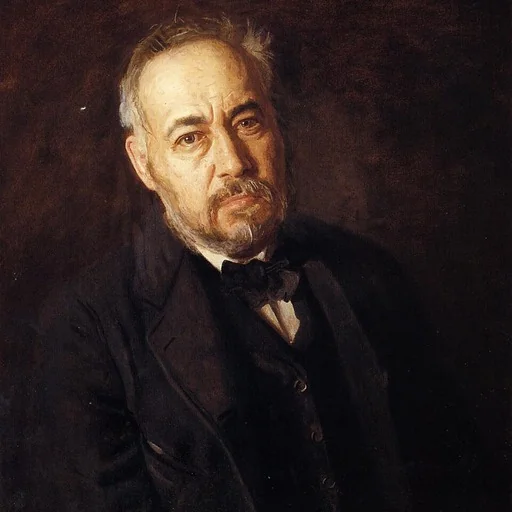
Thomas Cowperthwait Eakins (; July 25, 1844 – June 25, 1916) was an American realist painter, photographer, sculptor, and fine arts educator.