Artwork
Flight into Egypt
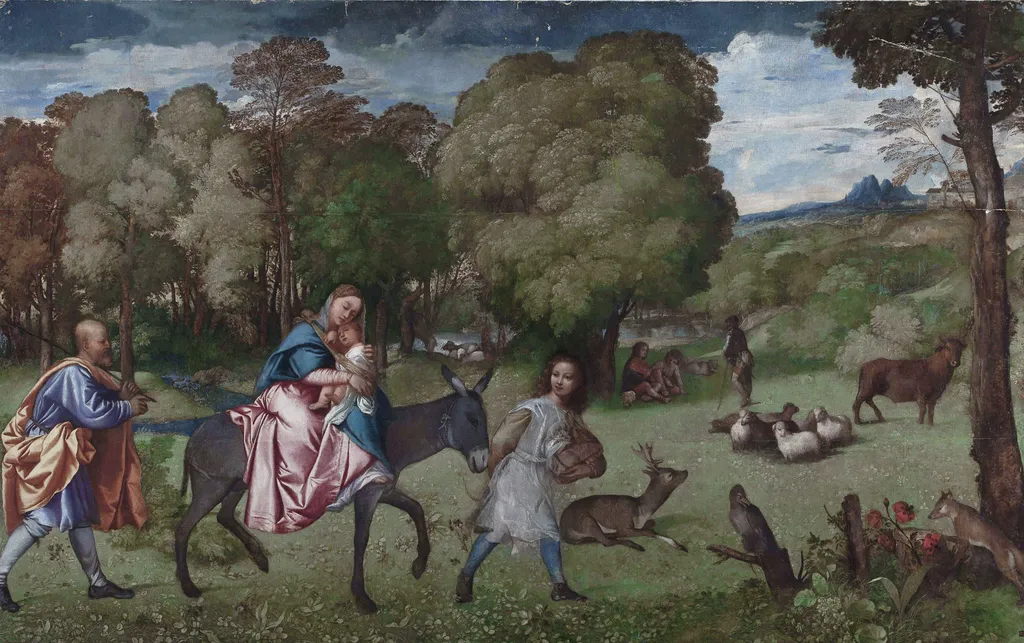
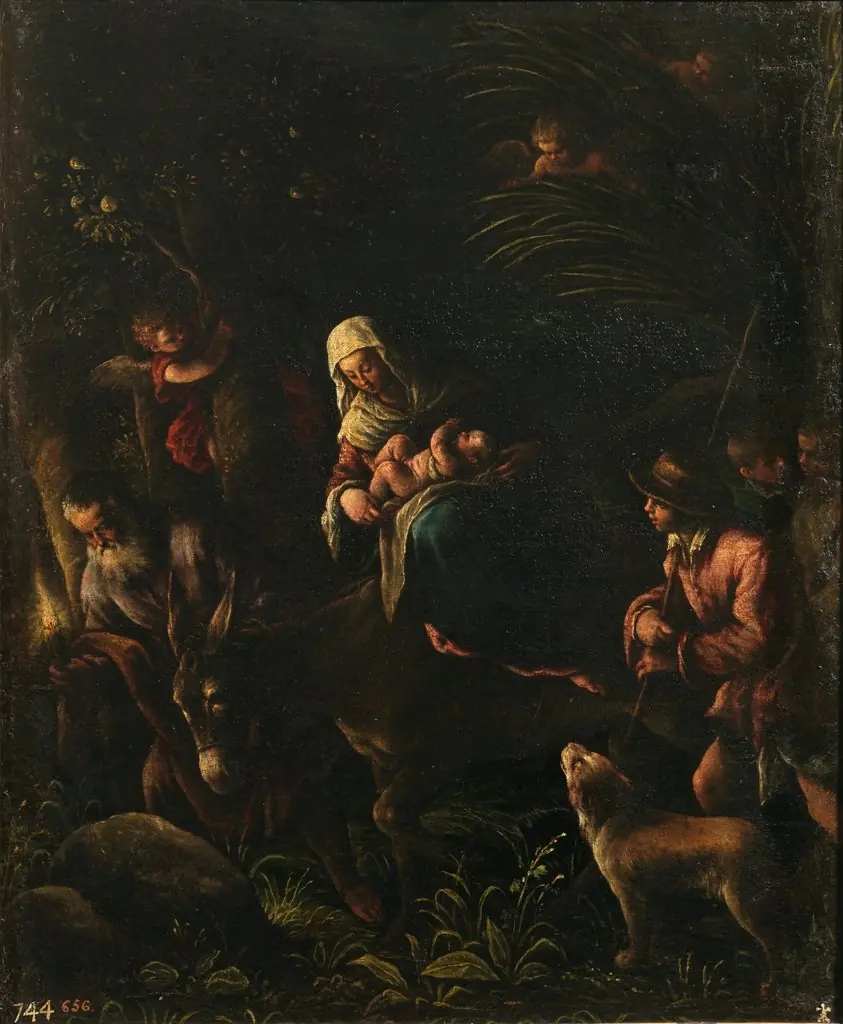
Flight into Egypt is an oil painting by the High Renaissance artist Titian. It dates from 1508 and is held in the collection of the Hermitage Museum.
About this work
Subject & Meaning
A boy leading the mule ahead is identified as the young John the Baptist, whose encounter with Jesus in the wilderness derives from apocryphal gospel tradition.
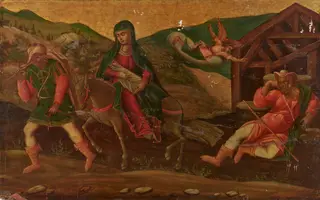
The painting depicts the biblical Flight into Egypt, in which the Holy Family, Mary, Joseph, and the Christ Child, flee to Egypt to escape King Herod's order to kill the newborn Jesus, as recounted in the Gospel of Matthew. The scene is rendered as a pastoral landscape, with the Holy Family's journey serving as the narrative anchor for an idealized rural setting. Mary, shown weary with her head bowed, cradles the infant Jesus against her in the manner of contemporary peasant mothers, while an elderly, fatigued Joseph struggles to keep pace behind the donkey.
A boy leading the mule ahead is identified as the young John the Baptist, whose encounter with Jesus in the wilderness derives from apocryphal gospel tradition. Wild animals running before the family evoke the dangers of the journey, and a shepherd tending his flock in the background reinforces the pastoral character while also alluding to the traditional Christian image of Jesus as the "good shepherd."
Technique & Style
Flight into Egypt is an oil painting executed on canvas, measuring roughly 206 × 336 cm. The work employs Titian’s characteristic oil‑on‑canvas technique, with a layered application of pigment that produces a luminous surface and a palette dominated by muted greens and earth tones. Brushwork is vigorous, creating bold, expressive strokes that define both figures and landscape, while the composition places the Holy Family slightly off‑center amid a expansive pastoral setting populated by deer, an ox and a shepherd with his flock. The painting’s handling reflects a Renaissance blend of religious narrative and idealized scenery, and a later restoration revived scholarly consensus attributing it to Titian.
History & Provenance
Titian’s Flight into Egypt is dated to approximately 1508–1509, marking it as one of the artist’s earliest works. The painting’s creation is firmly attributed to Titian, though some scholars have occasionally proposed alternative attributions, such as Paris Bordone. Following restoration, however, the consensus reaffirmed its origins in Titian’s hand, reflecting his early engagement with pastoral and religious themes under the influence of Giorgione.
The work entered the collection of the Hermitage Museum in Saint Petersburg, where it remains. Its provenance traces back to the imperial Gatchina Palace near Saint Petersburg, where it was already recognized as a Titian. No specific commissioning patron or early ownership history outside this context is documented in the available sources.
Titian's Flight into Egypt is held in the collection of the State Hermitage Museum in Saint Petersburg, Russia. The work originated from the Imperial Gatchina Palace near Saint Petersburg, where it was previously attributed to the artist. Although some scholarship has suggested alternative attributions to Paris Bordone, the painting is currently accepted as an autograph work by Titian following its restoration.
The provided sources do not list a specific inventory or accession number for the painting. Furthermore, the available documentation mentions a 2012 exhibition of the work at the National Gallery in London and related publications, but it does not contain a comprehensive record of the painting's full exhibition history or specific dates of display at other institutions.
Context
Flight into Egypt occupies an important place in the literature on Titian as one of his earliest documented works, produced around 1508–1509 during the Venetian High Renaissance. Its provenance from the imperial castle of Gatchina, where it was already attributed to Titian, is complicated by the fact that several monographic studies omitted it altogether, while others reattributed it to artists such as Paris Bordone. Following a subsequent restoration, the attribution to Titian regained broad acceptance.
The painting is frequently described as Titian's first masterpiece, noted for its bold brushwork and exhilarating use of color within a pastoral landscape that still reflects the strong influence of Giorgione. Its large scale and ambitious conception mark it as a significant statement in early sixteenth-century Venetian religious painting, and it has generated dedicated scholarly attention, including studies published in The Burlington Magazine in 2012 and a feature in the London Review of Books.
Titian revisited the Flight into Egypt theme in his Rest on the Flight into Egypt of around 1512, reusing the same models and costumes, which has reinforced the painting's importance as a foundational work in his career.
Legacy
Later scholarship has emphasized the painting’s role in shaping Titian’s reputation as a master of early Venetian color and narrative composition. Art historians note that its innovative blend of sacred narrative with an idealized pastoral landscape contributed to its status as one of Titian’s earliest masterpieces, influencing subsequent assessments of his development. The attribution, long contested, gained renewed confidence after 21st‑century restoration revealed consistent brushstroke patterns with other early Titian pieces.
Its inclusion in the Hermitage collection has made it a focal point for studies of Renaissance religious painting and its legacy in museum display.
Overview
This oil painting, titled Flight into Egypt, is generally considered an early creation by the Venetian Renaissance artist Titian. Executed around 1508 or 1509, it represents a significant piece from the initial phase of his career. The work is currently housed in the collection of the Hermitage Museum in Saint Petersburg, Russia.
Own this work as a print
Artist & collection
Artist
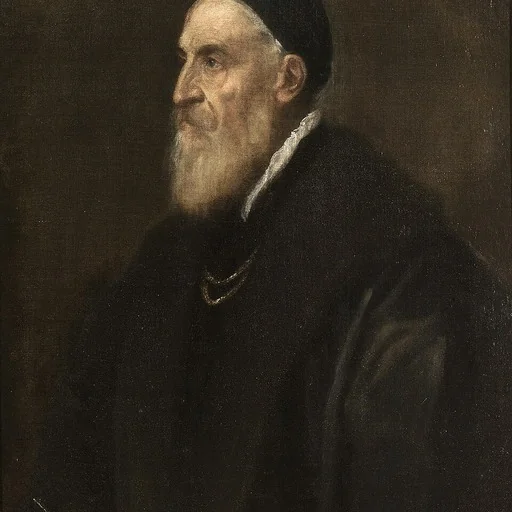
Tiziano Vecellio (Italian:; c. 1488/1490 – 27 August 1576), Latinized as Titianus, hence known in English as Titian ( TISH-ən), was an Italian Renaissance painter. The most important artist of Renaissance Venetian…