Artwork
Laocoön
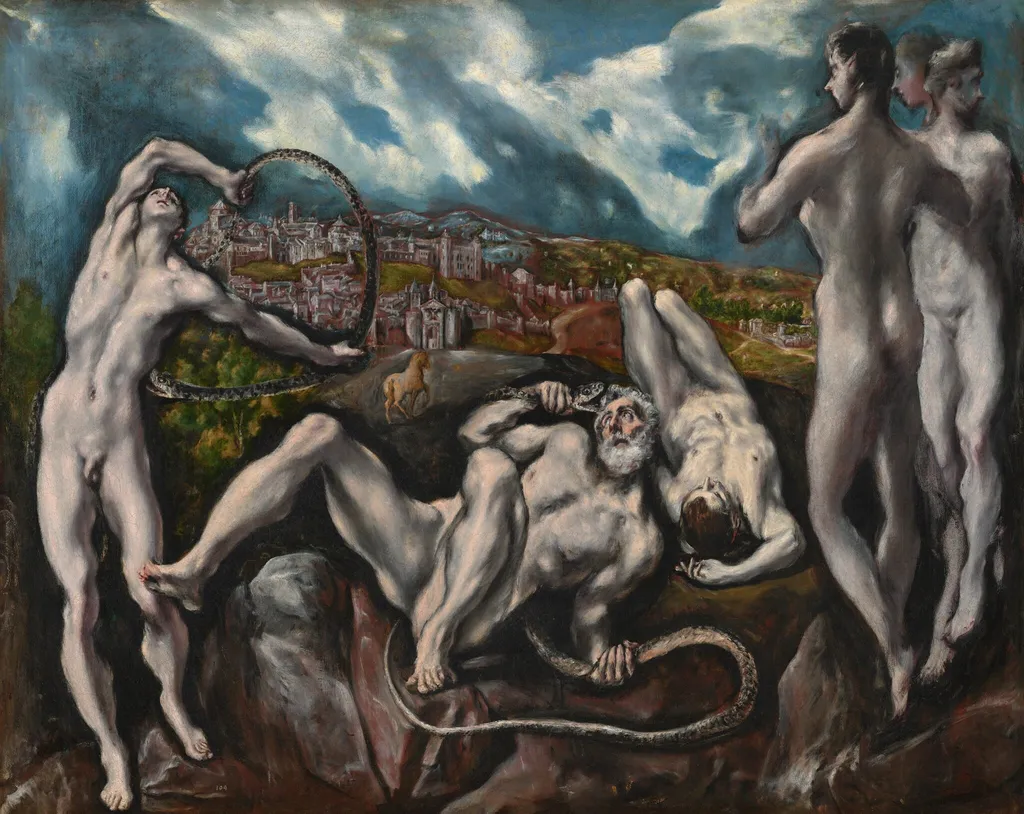
Laocoön is an oil painting by the Baroque artist El Greco. It dates from 1612 and is held in the collection of the National Gallery of Art.
- Inscription
- Inscribed:unidentified inventory number at lower left: 104
About this work
Subject & Meaning
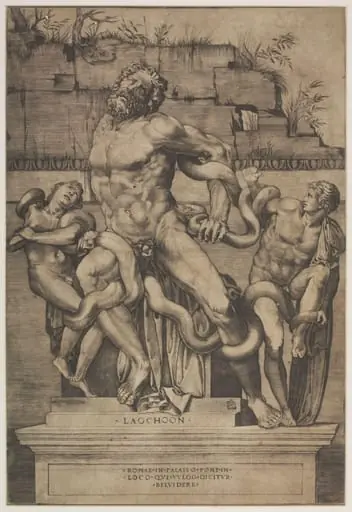
Unlike the ancient sculpture that inspired it, the work portrays the sons as adults rather than children.
El Greco's painting depicts the mythological death of Laocoön, a Trojan priest of Poseidon or Apollo, and his two sons, strangled by sea serpents as divine punishment for warning against the Trojan Horse. Unlike the ancient sculpture that inspired it, the work portrays the sons as adults rather than children. The composition includes watching deities, possibly Apollo and Artemis, and an unfinished figure, set against a backdrop of Toledo rather than Troy, linked by folklore claiming Toledans descended from Trojans.
The Trojan Horse is visible approaching the city gates. Stylistically, the work rejects Renaissance harmony for Mannerist distortion, using elongated, contorted figures and murky colors to evoke suffering and turmoil. Interpretations of its meaning vary: it may symbolize humanity's struggle against evil, serve as a metaphor for the Inquisition's condemnation of Archbishop Bartolomé de Carranza, or represent a painterly attempt to surpass sculpture (paragone).
Technique & Style
Executed in oil on canvas, the work measures approximately 142 by 193 centimeters. Created between 1610 and 1614, it represents El Greco's sole surviving mythological painting and is considered one of his final works, potentially left unfinished at his death. The composition exhibits distinct Mannerist qualities, deliberately rejecting Renaissance balance through elongated, contorted figures with unnaturally stretched limbs.
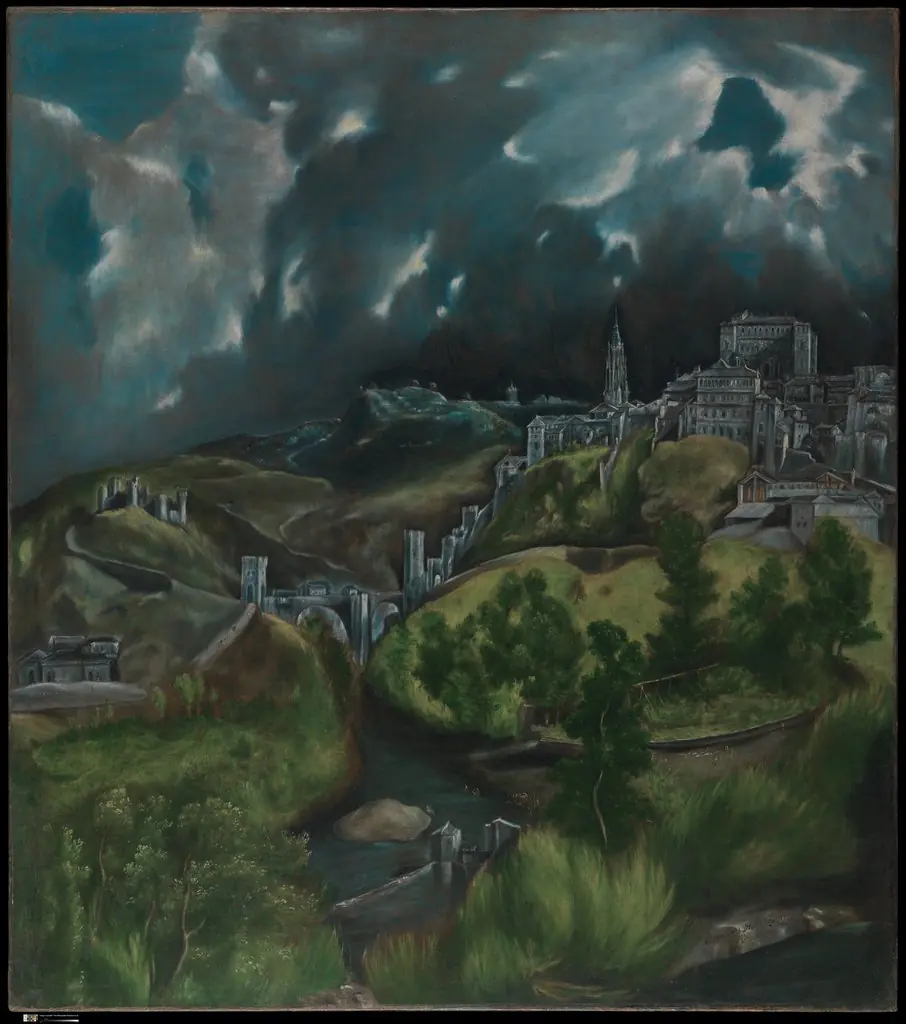
The figures display a murky yellow and green coloration that enhances the atmosphere of suffering, contrasting with the dark, undulating rocks of the foreground. The background features a gloomy, turbulent sky over Toledo, rendered in shades of grey. An unfinished figure, consisting only of a head and leg, appears on the right side, suggesting the artist may have abandoned the work or altered the composition late in the process.
History & Provenance
The work titled Laocoön, painted by El Greco circa 1610–1614, is documented in the artist’s 1614 estate inventory as one of two small versions of the subject, a record that aligns with the dimensions of the surviving canvas. After El Greco’s death the painting entered the possession of his son Jorge Manuel and later passed by inheritance to Infante Antonio de Orléans, Duke of Galliera, before moving through several European dealers, Durand‑Ruel in Paris, Paul Cassirer in Berlin, collector Edwin Fischer, and Prince Paul of Yugoslavia, until it was consigned to Knoedler in 1946 and sold to the Samuel H. Kress Foundation, which gifted it to the National Gallery of Art in Washington the same year. No specific commission is recorded; the work appears to have been produced for the artist’s own workshop or market.
The Laocoön is held by the National Gallery of Art in Washington, D.C., where it resides within the Samuel H. Kress Collection. Its official accession number is 1946.18.1. The work entered the museum's holdings in 1946 after being sold by Prince Paul of Yugoslavia to the Samuel H. Kress Foundation in February of that year; the foundation subsequently gifted the painting to the gallery.
Prior to this acquisition, the canvas passed through a notable European provenance, including ownership by the Infante Antonio de Orleáns, dealers Durand-Ruel and Paul Cassirer, and the pianist Edwin Fischer. While the provided sources detail this extensive chain of custody, they do not record specific exhibition histories or dates of public display for the artwork.
Context
Created between 1610 and 1614, Laocoön stands as El Greco's sole surviving mythological painting, a rarity in Spanish art of the period. The work exemplifies the Mannerist movement, deliberately rejecting Renaissance balance through elongated, contorted figures and a turbulent emotional atmosphere. While inspired by the famous Hellenistic sculpture unearthed in Rome in 1506, El Greco diverges from classical ideals by depicting the sons as adults rather than children and placing the scene against a gloomy view of Toledo instead of Troy.
This substitution likely references local folklore claiming Toledan descent from Trojan survivors. Scholars debate the painting's specific intent, with interpretations ranging from a metaphor for the Inquisition's condemnation of Archbishop Carranza to a symbolic struggle against evil or an attempt to surpass sculpture through painting. The composition remains unfinished, possibly due to the artist's death, with evidence suggesting collaboration by his son, Jorge Manuel.
Legacy
The painting Laocoön (c.1610–14) is recognized as the only large-scale mythological canvas by El Greco, a status that has shaped its scholarly reputation as a pivotal example of Mannerist reinterpretation of classical narrative. Its dramatic composition, elongated figures, and the integration of Toledo’s landscape have been cited as influential for later artists seeking expressive distortion. The work’s provenance, from the artist’s estate through several private collections to its acquisition by the Samuel H. Kress Foundation and donation to the National Gallery of Art, underscores its enduring cultural value and has made it a focal point for studies of El Greco’s late period and the legacy of the Hellenistic Laocoön sculpture.
Overview
El Greco's Laocoön, an oil on canvas painting created between 1610 and 1614, is housed at the National Gallery of Art in Washington, D.C. This work reinterprets a dramatic ancient Greek myth, depicting the priest Laocoön and his sons in their final moments. The artist's distinctive Mannerist style is evident in the painting's emotional intensity and departure from classical ideals of harmony and proportion.
Own this work as a print
Artist & collection
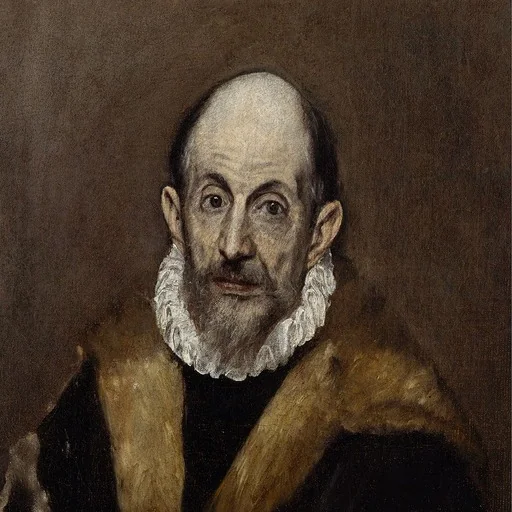
Artist
Doménikos Theotokópoulos was born in 1541 in Candia (modern Heraklion), the capital of Venetian-ruled Crete, where he was trained in the post-Byzantine tradition of icon painting.