Artwork
Untitled
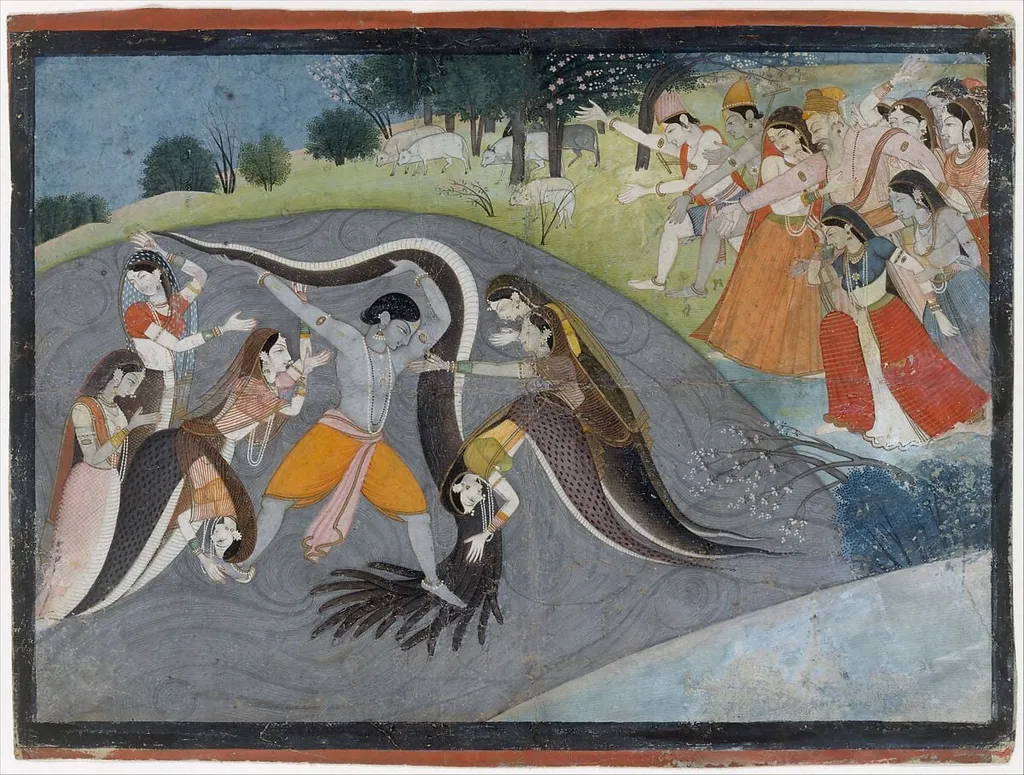
Untitled is a watercolor painting by the Romanticist artist First generation after Manaku and Nainsukh. It dates from 1785 and is held in the collection of the Metropolitan Museum of Art.
About this work
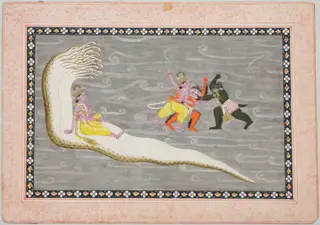
A blue-skinned god stands on a snake, ringed by men, women, and demons in swirling poses: Krishna lifting Mount Govardhan to shield villagers from a storm. No larger than a postcard, every leaf and jewel is picked out in tiny brushstrokes. The painter is unknown, the style matching Punjab hill workshops around 1785.
Subject & Meaning
The presence of the demon and snake suggests a conflict between cosmic forces, with Krishna serving as the central protagonist.
Created in 1785 by an artist from the first generation following Manaku and Nainsukh, this religious work depicts a dramatic narrative involving the deity Krishna. The iconography centers on a confrontation featuring Krishna alongside a demon, a snake, a man, and a woman. As a piece of opaque watercolor and ink on paper, the composition uses these specific figures to represent a scene from Hindu mythology, likely illustrating a moment of divine intervention or struggle.
The presence of the demon and snake suggests a conflict between cosmic forces, with Krishna serving as the central protagonist. While the specific mythological episode is not explicitly named in the available records, the grouping of these characters establishes the painting's function as a visual retelling of sacred stories involving the god's exploits against evil entities.
Technique & Style
Executed in opaque watercolor and ink on paper, this 1785 painting reflects the refined handling characteristic of the first generation of artists working after Manaku and Nainsukh. The modest support measures 20.3 by 26.7 centimeters, a scale suited to intimate viewing. The medium allowed for precise linear definition combined with layered color washes, consistent with the religious genre tradition to which the work belongs.
History & Provenance
This opaque watercolor and ink on paper painting was created in 1785 by an artist of the first generation working after Manaku and Nainsukh, the renowned Pahari court painters. The work entered the collection of the Metropolitan Museum of Art, where it is currently held within the museum's Indian painting holdings. No further details regarding its commission, prior ownership, or chain of custody prior to the museum's acquisition are documented in the available sources, and no specific accession number or exhibition history is disclosed.
Overview
This untitled painting, rendered in opaque watercolor and ink, depicts a vibrant scene from Hindu mythology. Though small in scale, it presents the deity Krishna protecting villagers from a storm by lifting Mount Govardhan. The artwork's precise creator remains unknown, yet its distinctive style aligns with artistic practices prevalent in the Punjab hills region during the late 18th century.
Artist & collection
Artist
First generation after Manaku and Nainsukh
First generation after Manaku and Nainsukh is the conventional name for a group of Pahari painters active in the Punjab Hills of northern India, chiefly the Guler and Kangra region, from about 1740 to 1830.

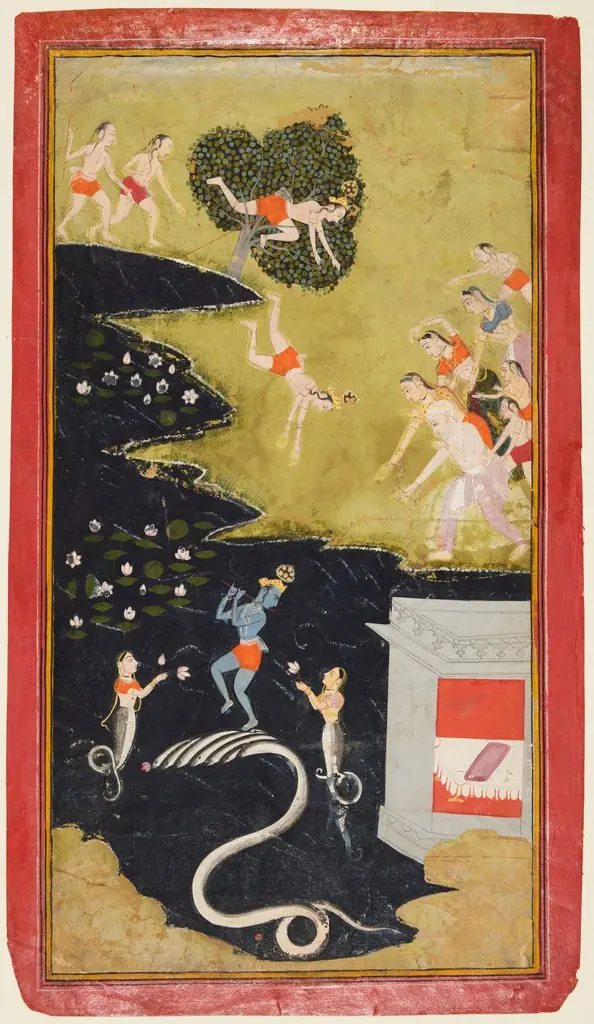
- Krishna Quells the Serpent Kaliya, from a Bhagavata Purana
 Radha and Krishna
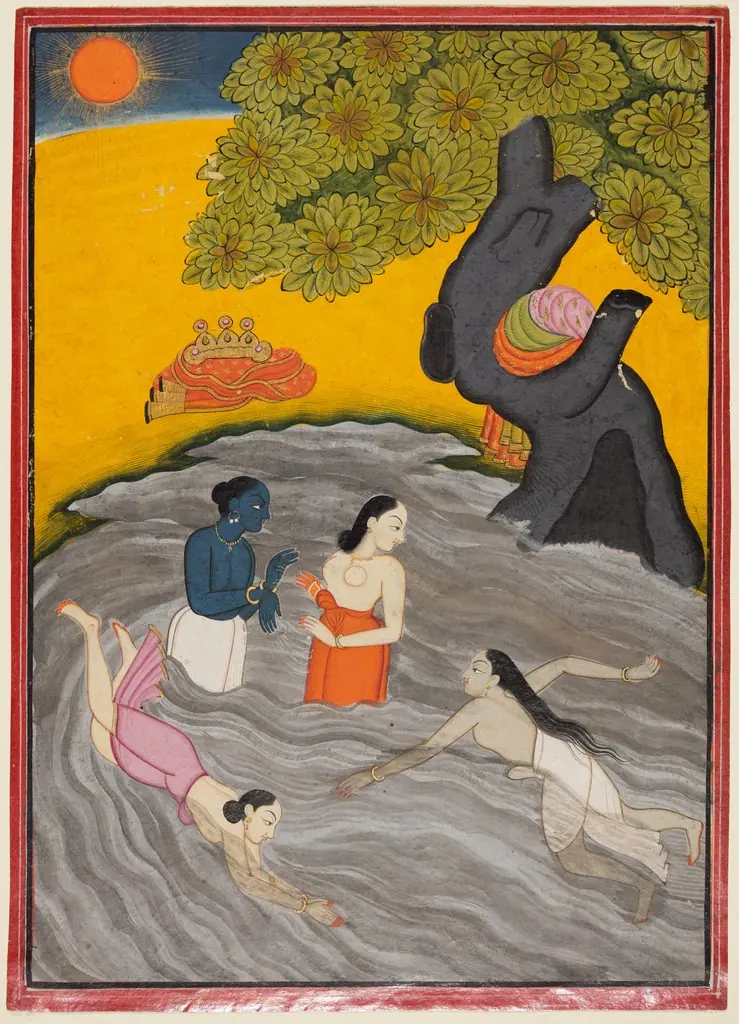 Krishna Playing with the Gopis in the Yamuna
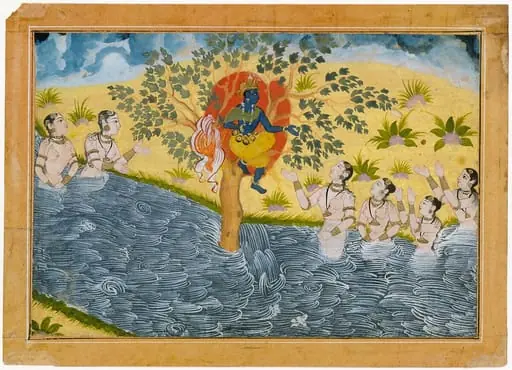 Untitled
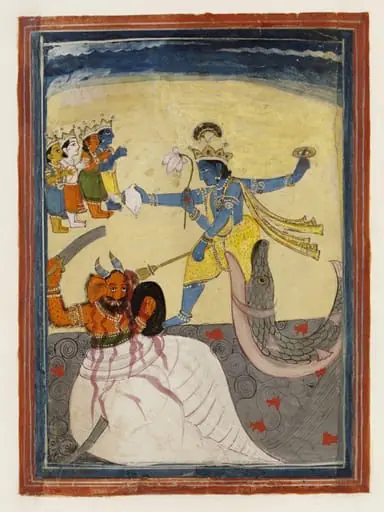 Vishnu as Matsya
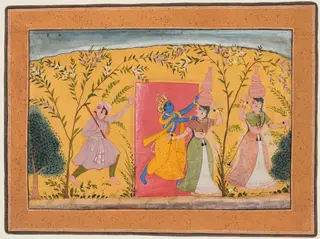 Krishna Exacts a Toll from the Milkmaids: Dana-Lila, from a Bhagavata Purana
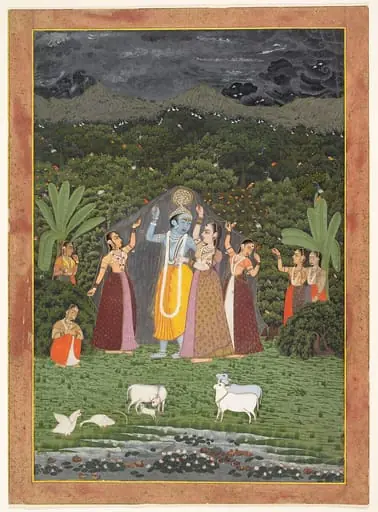 Untitled
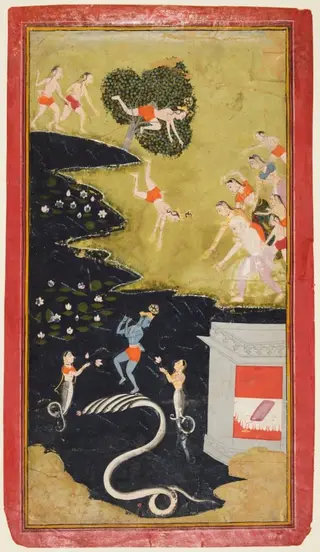 Krishna Quells the Serpent Kaliya, from a Bhagavata Purana
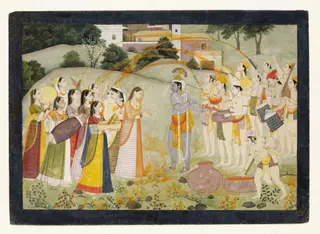 Krishna and Radha
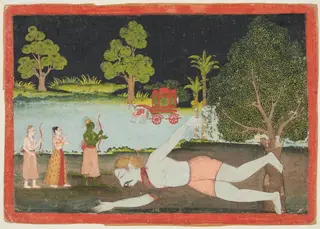 Rama and Lakshmana slay the demon giant Viradha, from Chapters 2 through 4 of the Aranya Kanda (Book of the Forest) of a Ramayana (Rama’s Journey)
 Untitled
 Vishnu on Serpent Shesha and Vishnu Battling Demons Madhu and Kaitabha