Artwork
Might Not the Pupil Know More?, Plate 37
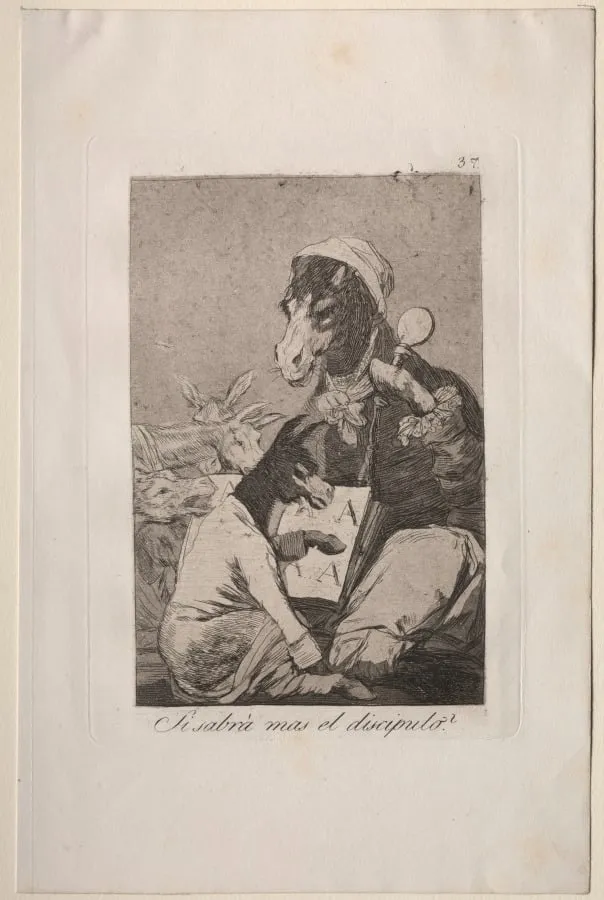
Might Not the Pupil Know More?, Plate 37 is a print by the Romanticist artist Francisco de Goya. It dates from 1799 and is held in the collection of the Cleveland Museum of Art. Might Not the Pupil Know More?
- Accession no.
- 1922.632
- Credit line
- Dudley P. Allen Fund
About this work
Overview
This plate exemplifies Goya's shift from court portraiture to social commentary, using allegory to expose the vices and follies of late 18th-century Spain.
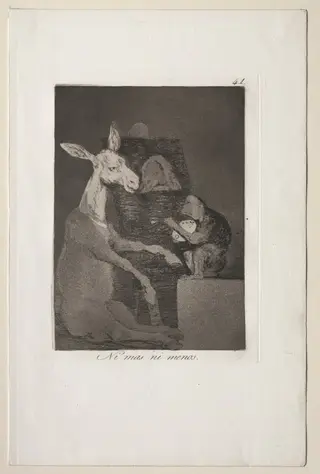
Might Not the Pupil Know More? (¿No habrá quien nos enseñe?), Plate 37, is a capricho etching and aquatint created by Francisco de Goya in 1799 as part of the series Los Caprichos. The work depicts a sleeping man, dressed in a loose jacket and hat, seated on the ground against a wall while cradling an infant. A donkey stands directly behind him, its head lowered near the man's ear.
The composition utilizes the contrast between the human figure and the animal to visualize the series' satirical critique of ignorance and the failure of education. The title poses a rhetorical question suggesting that the donkey, often a symbol of stupidity, might ironically possess more wisdom than the sleeping adult or the society that produced him. Goya employed aquatint to create deep, atmospheric shadows that isolate the figures, enhancing the somber and critical tone characteristic of his mature printmaking.
This plate exemplifies Goya's shift from court portraiture to social commentary, using allegory to expose the vices and follies of late 18th-century Spain. The image remains a pivotal example of his exploration of reason versus superstition.
Subject & Meaning
The image presents a solitary figure seated on the ground, his back against a wall, cradling a sleeping infant. A donkey stands nearby, its head close to the man’s, suggesting a quiet, perhaps intimate exchange between human and animal. The composition conveys a sense of domestic fatigue and the ordinary hardships of rural life, inviting contemplation of care and responsibility.
Technique & Style
Rendered in monochrome, the print relies on chiaroscuro to model form, using stark contrasts of light and shadow to define the figures and the surrounding space. Goya employs fine hatching and cross‑hatching to suggest texture in the man’s loose jacket and the donkey’s fur, while the overall tonal range remains restrained, emphasizing the scene’s subdued atmosphere.
History & Provenance
After its creation in the late eighteenth century, the print entered various private collections before being acquired by the Cleveland Museum of Art, where it remains on display. Its presence in the museum’s holdings reflects the institution’s commitment to representing Goya’s early graphic work alongside his later, more widely known paintings.
Artist & collection
Artist
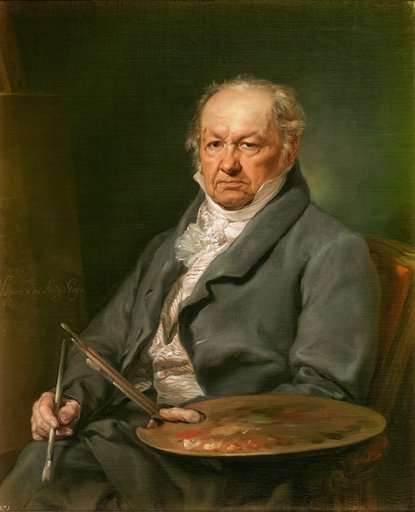
Francisco José de Goya y Lucientes was a Spanish romantic painter and printmaker.