Artwork
Manao Tupapau (She is Haunted by a Spirit)
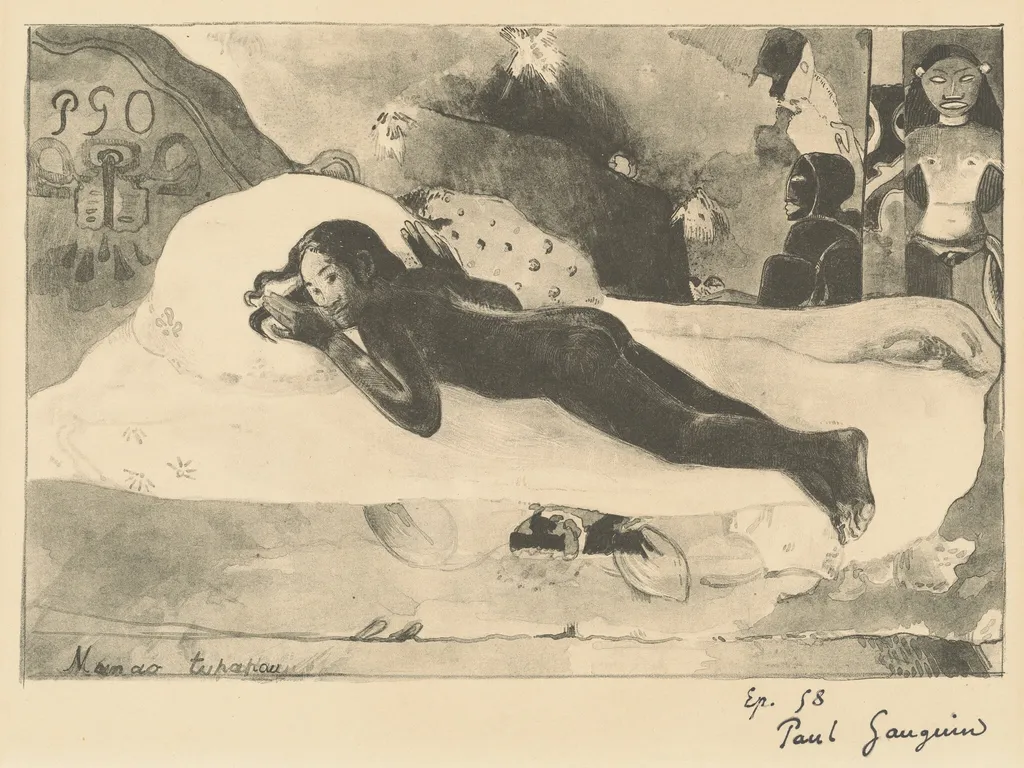
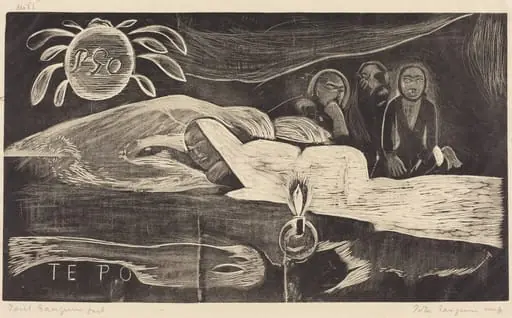
Manao Tupapau (She is Haunted by a Spirit) is an ink print by the Impressionist artist Paul Gauguin. It dates from 1894 and is held in the collection of the National Gallery of Art.
About this work
Overview
The composition merges observed reality with imagined otherworldliness, using minimal color and expressive line work to evoke mood over literal description.
Created in 1894, Manao Tupapau is a lithograph by Paul Gauguin that captures a moment of psychological tension within a Tahitian setting. Executed in black ink on stone, the print reflects Gauguin’s interest in spiritual and symbolic narratives during his time in French Polynesia. The composition merges observed reality with imagined otherworldliness, using minimal color and expressive line work to evoke mood over literal description.
Subject & Meaning
The central figure, a reclining Tahitian woman, appears calm yet surrounded by spectral forms that suggest haunting presence. Her stillness contrasts with the looming, distorted shapes around her, possibly ancestral spirits or manifestations of inner dread. Objects like a mask and guitar float ambiguously above, hinting at cultural hybridity and the intrusion of memory or myth into daily life.
The title, meaning 'She is Haunted by a Spirit,' frames the scene as a psychological encounter rather than a literal vision.
Technique & Style
Gauguin employed lithography to achieve bold, fluid lines and tonal contrasts, exploiting the medium’s capacity for expressive sketchiness. The background is rendered with loose, shadowy strokes, while the figure’s form is defined by cleaner contours. The absence of color heightens the eerie atmosphere, and the inclusion of symbolic elements, such as the curled dog and floating objects, adds layers of ambiguity. The technique supports a Synthetist approach, simplifying forms to convey emotional and spiritual resonance.
History & Provenance
This print was produced during Gauguin’s second stay in Tahiti, a period marked by his increasing isolation and fascination with indigenous beliefs. It was likely made in 1894 at his studio in Papeete, possibly as part of a small series exploring spiritual themes. Few impressions were pulled, and surviving examples are held in major museum collections, including the Museum of Modern Art and the British Museum, reflecting its early recognition within avant-garde print circles.
Context
Gauguin’s work in Tahiti emerged amid European fascination with the 'exotic' and the decline of colonial idealism. He drew from local myths, Christian iconography, and Symbolist literature to construct visions that challenged Western rationalism. Manao Tupapau reflects this synthesis, positioning the Tahitian woman not as an object of ethnographic study but as a vessel for universal themes of fear, memory, and the unseen.
Legacy
The print influenced later artists interested in psychological depth and non-Western symbolism, particularly within Expressionist and Surrealist circles. Its stripped-down aesthetic and emotional ambiguity helped redefine printmaking as a vehicle for introspective narrative rather than mere reproduction. While Gauguin’s colonial perspective remains contested, the work endures as a quiet, unsettling meditation on the boundaries between the real and the imagined.
Own this work as a print
Artist & collection
Artist
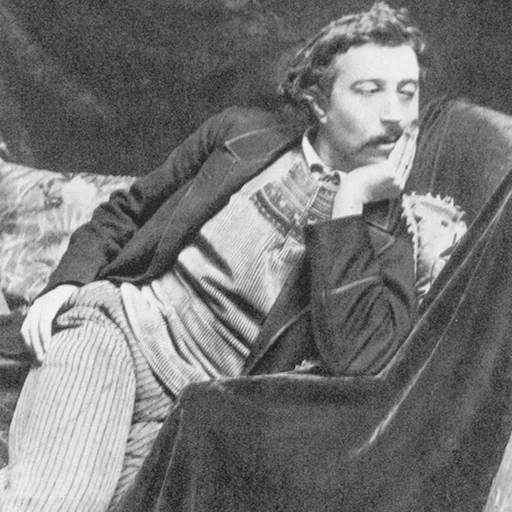
Eugène Henri Paul Gauguin (; French:; 7 June 1848 – 8 May 1903) was a French painter, sculptor, printmaker, ceramist, and writer, whose work has been primarily associated with the Post-Impressionist and Symbolist movements.