Artwork
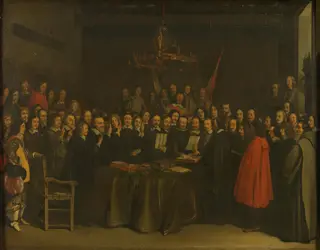
The Ratification of the Treaty of Münster
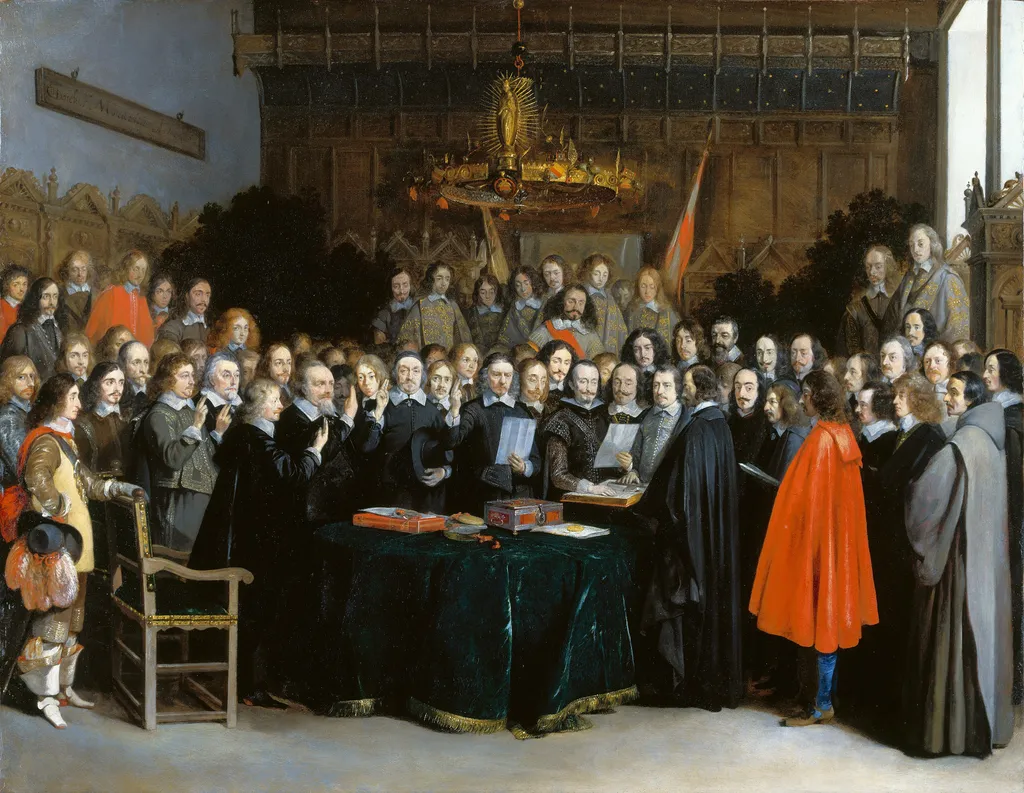
The Ratification of the Treaty of Münster is an oil painting by the Dutch Golden Age artist Gerard ter Borch. It dates from 1648 and is held in the collection of the Rijksmuseum.
About this work
Subject & Meaning
A golden chandelier featuring a crowned Madonna holding the Christ child hangs above the assembly, emblematically invoking divine blessing upon the peace.
Gerard ter Borch's 1648 oil on copper depicts the precise moment of the oath-swearing for the Treaty of Münster, which ended the Eighty Years' War by recognizing the sovereignty of the Dutch Republic. The scene captures the Dutch and Spanish plenipotentiaries gathered around a table in the Münster town hall; the Dutch raise their right hands while the Spanish place theirs upon an open Bible topped with a metal cross. A heavy green velvet cloth covers the table, which also holds the sealed treaties and a casket.
The composition functions as a factual historical document rather than a glorified fantasy, featuring lifelike portraits of the diplomats and the artist himself on the far left, serving as a witness. A golden chandelier featuring a crowned Madonna holding the Christ child hangs above the assembly, emblematically invoking divine blessing upon the peace.
Technique & Style
Executed in 1648, this history painting is an oil work applied to a copper support, measuring 45.4 by 58.5 centimeters. The artist signed the piece in the upper left corner. Stylistically, the composition avoids monotony through a slightly asymmetrical arrangement of figures across the room's width, utilizing alternating foreground and background positioning.
Ter Borch employed bright daylight entering from the right to illuminate individual faces against dark wooden paneling. The work is distinguished by its factual approach, depicting over fifty plenipotentiaries with portrait-like accuracy and rendering architectural details, such as carved magistrate benches and a heavy green velvet tablecloth with gold trim, with documentary precision. Rather than idealizing the subjects as classical heroes, the painter captured lifelike likenesses and specific furnishings, establishing the image as a historical record while including himself as an eyewitness on the far left.
History & Provenance
Gerard ter Borch painted The Ratification of the Treaty of Münster in 1648, signing and dating the copper panel. Having accompanied the Dutch envoy Adriaan Pauw to Münster from 1645, the artist witnessed the ratification of 15 May 1648 firsthand and included a self-portrait at the left edge to document his presence. Ter Borch set an asking price of 6,000 florins but failed to sell the work, and it remained in his estate at his death, passing by inheritance before entering the commercial market in the early nineteenth century.
It was acquired from the Van Leyen collection in Amsterdam and purchased by Talleyrand in 1804, later passing through the collections of the Duchess of Berry (1837) and Prince Anatole Demidoff (1868) before the Marquess of Hertford bought it in London. Sir Richard Wallace donated it to the National Gallery, London, in 1871 (accession NG896), and since 2000 it has been on long-term loan to the Rijksmuseum in Amsterdam.
Context
Scholars regard the work as a rare Dutch historical painting that records the 1648 ratification of the Treaty of Münster with unusual factual precision, among the first oil-on-copper works to portray a contemporary political event realistically. Analysis notes the artist's eyewitness presence, his self-portrait as a witness, and the meticulous rendering of architecture, furnishings, and individual portraits that reflect rigorous observation. The painting's symbolic program, including the crowned Madonna and the green velvet tablecloth, conveys the diplomatic triumph.
Its provenance, from the artist's estate through the Demidoff and Wallace collections to the National Gallery and later loan to the Rijksmuseum, underscores its enduring scholarly and curatorial significance.
Legacy
Gerard ter Borch's painting established a significant legacy as one of the first works to depict a major political event with factual precision rather than allegorical glorification. Instead of casting figures as classical heroes, the artist used lifelike portraiture and accurate architectural detail to create a work functioning as a historical document. To amplify its reach, he commissioned the engraver Jonas Suyderhoef to produce a print, completed in 1650 and inscribed with the Latin phrase "PAX OPTIMA RERUM" to emphasize the value of peace.
The painting's reputation as a rare example of Dutch history painting has been sustained through its provenance, which included ownership by Talleyrand and the Demidoff family. Since 1871 it has been held by the National Gallery in London and, from 2000, has been on long-term loan to the Rijksmuseum in Amsterdam.
Overview
Gerard ter Borch's 1648 painting, The Ratification of the Treaty of Münster, is a significant history piece rendered on copper. This work captures a pivotal moment in European diplomacy: the formal signing of the peace agreement between the Dutch Republic and Spain. It serves as a visual record of the conclusion of the Eighty Years' War, depicting the solemn assembly of key delegates in a richly appointed interior.
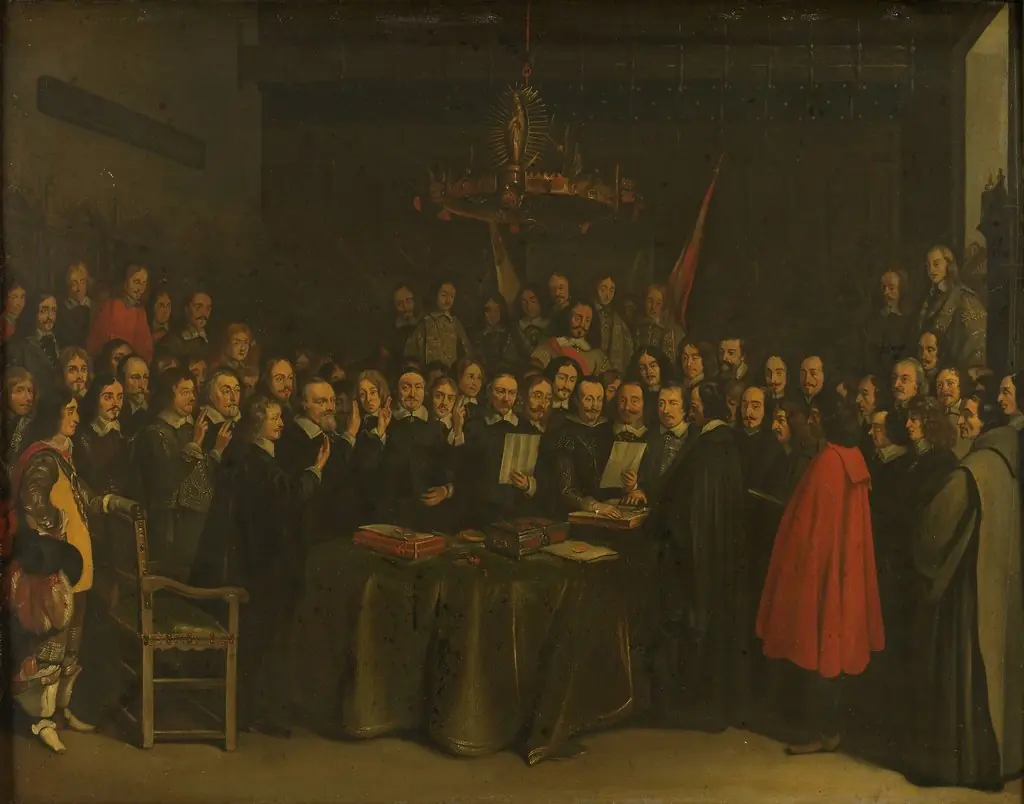
Own this work as a print
Artist & collection
Artist
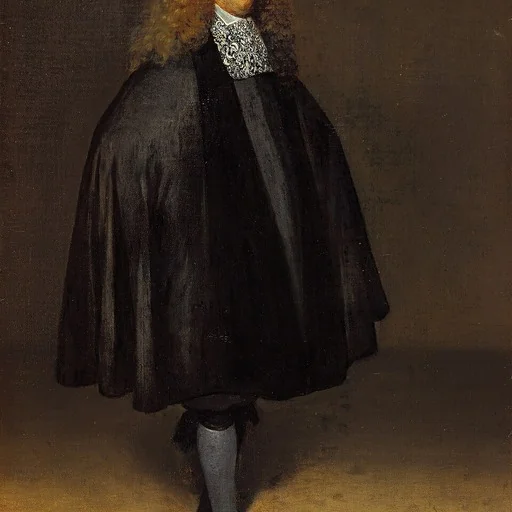
Gerard ter Borch (Dutch:; December 1617 – 8 December 1681), also known as Gerard Terburg (Dutch: ), was a Dutch Golden Age painter mainly of genre subjects.

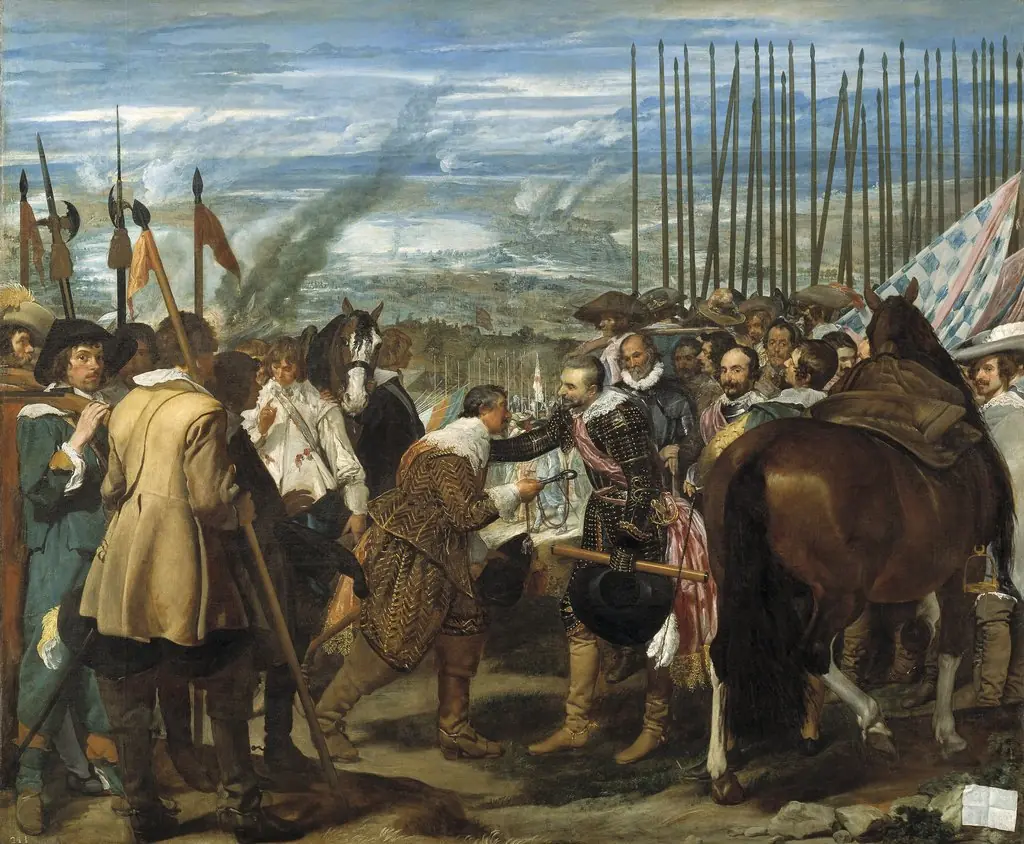 The Surrender of Brea
 Untitled
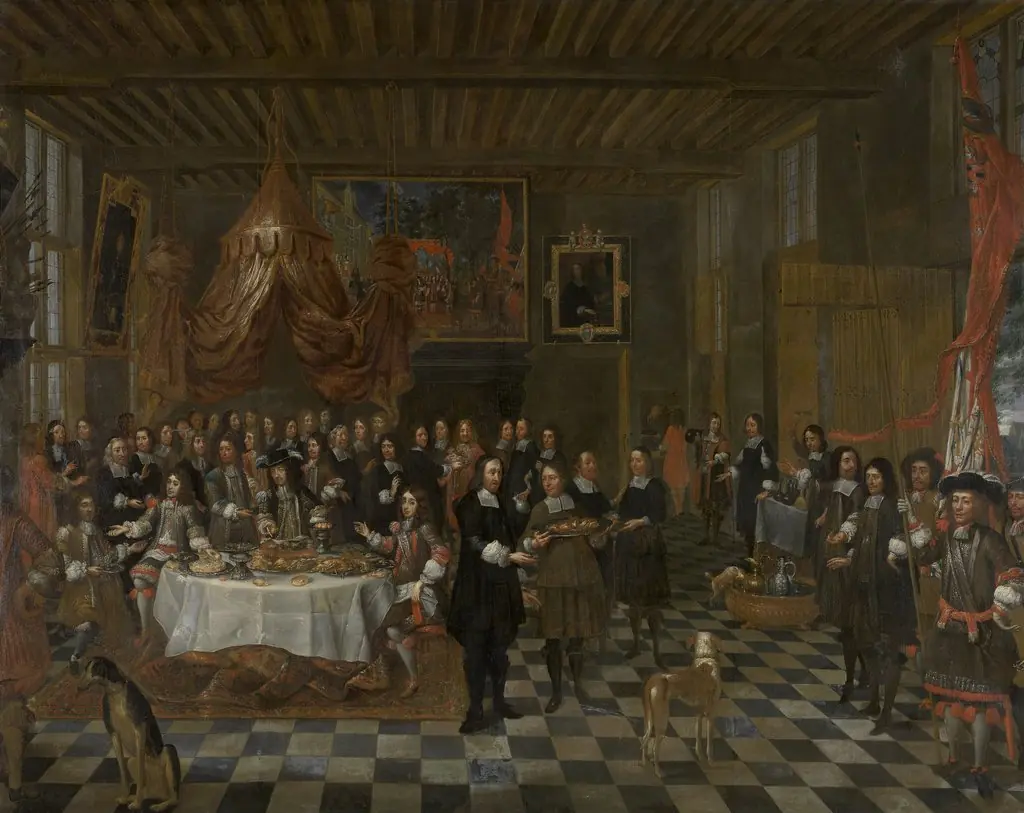 The Reception of Charles II and his Brothers in the Guild of Saint Barbara in Bruges
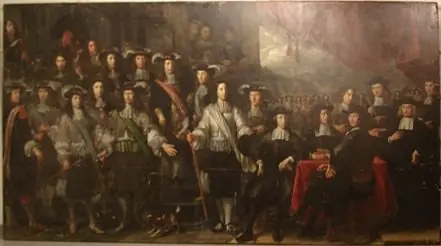 Council of war of eleven companies of the Dordrecht militia, ca 1675
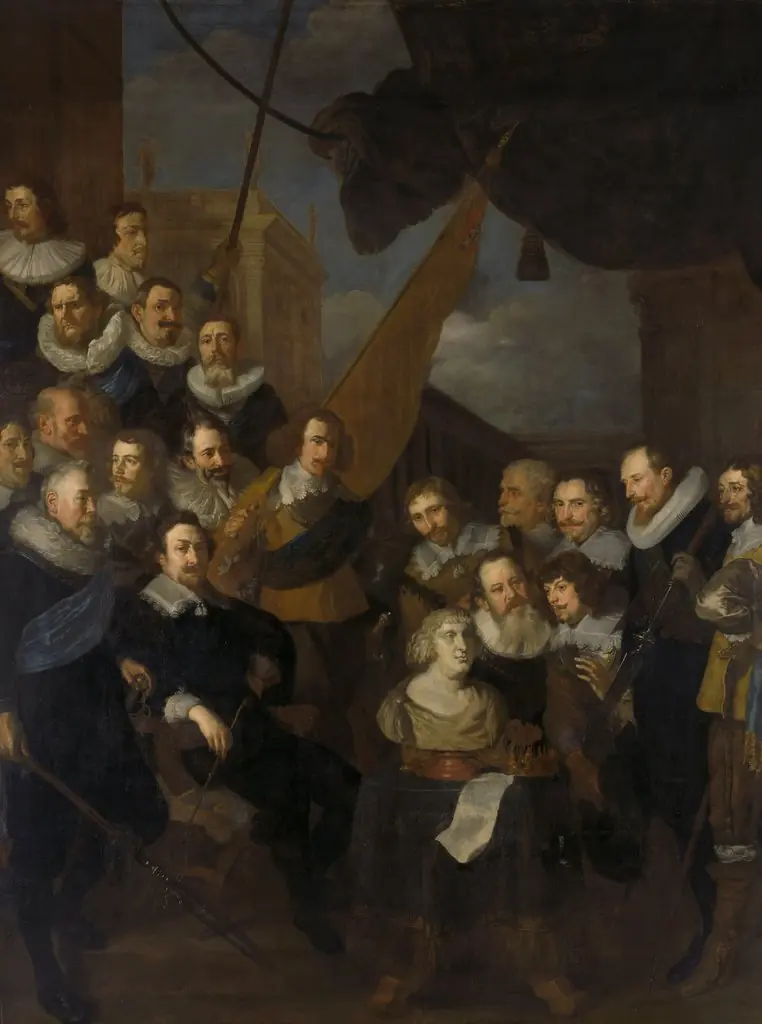 Officers of the militia of departmetn XIX in Amsterdam under the command of Cornelis Bicker and Frederick van Banchem, ready to receive Maria de' Medici in 1638
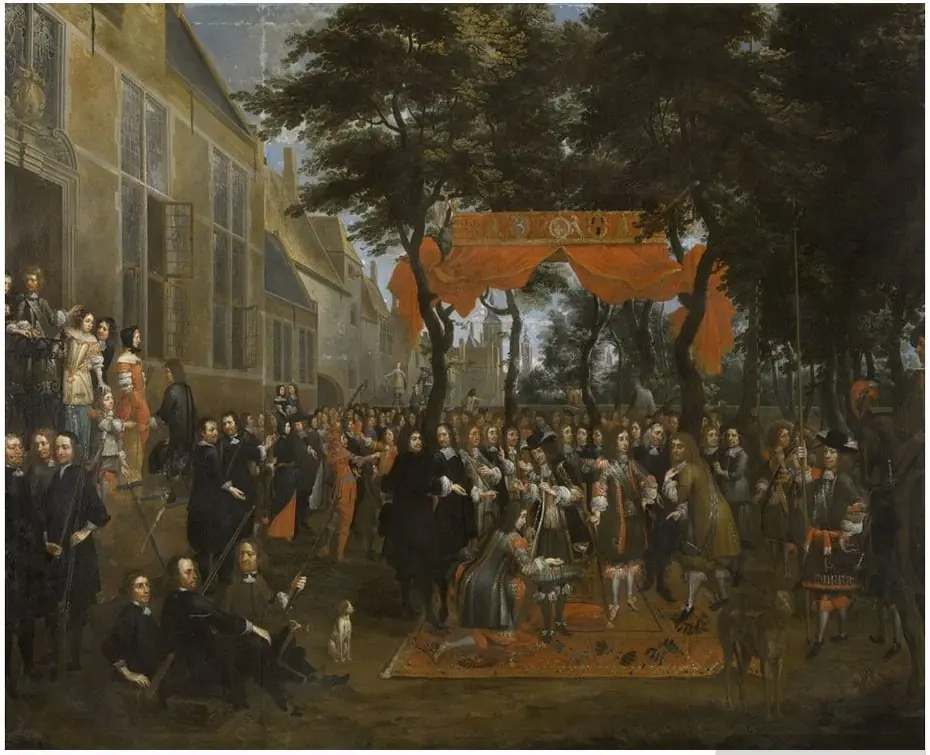 The Reception of Charles II and his Brothers
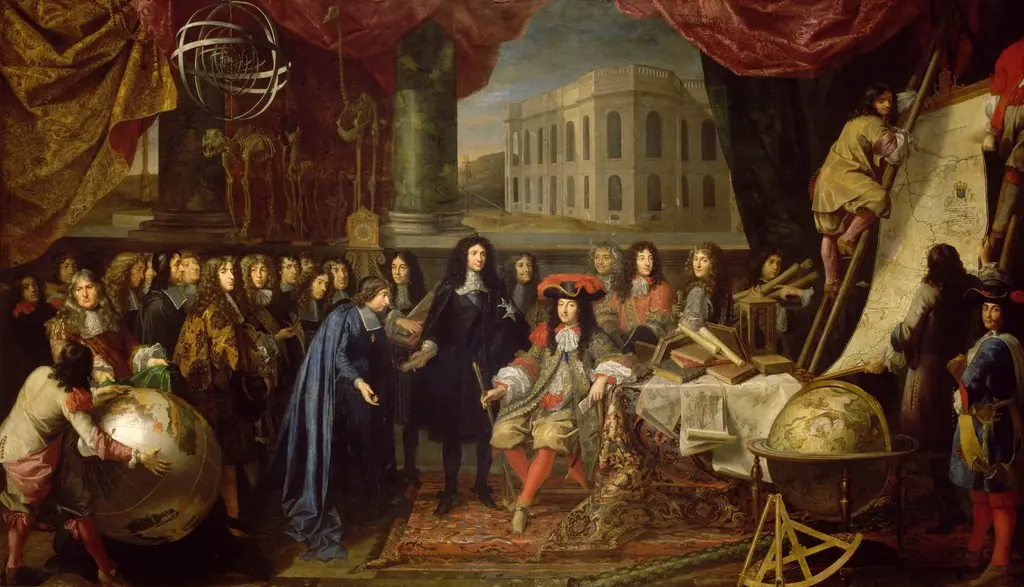 Establishment of the French Academy of Sciences and of Paris Observatory
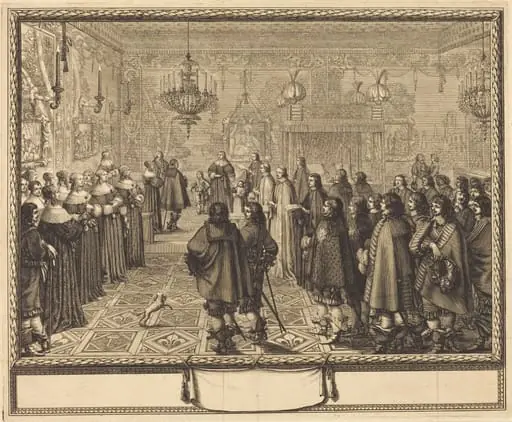 Ceremony of the Contract of Marriage between Vladislas IV, King of Poland, and LouiseMarie of Gonzaga, Princess of Mantua, at Fontainbleau
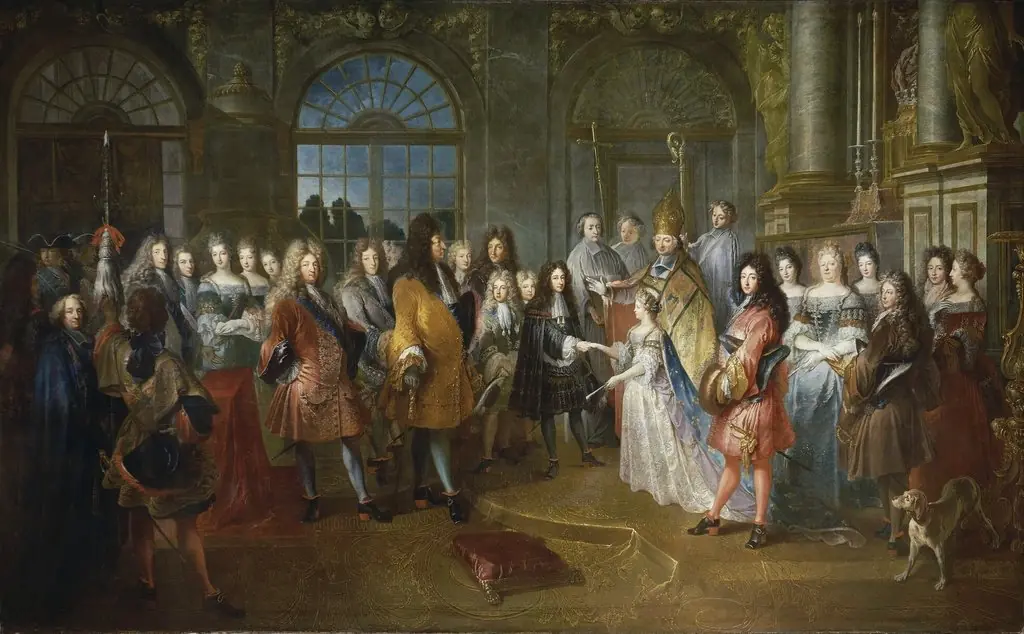 Mariage de Louis de France, duc de Bourgogne et de Marie-Adélaïde de Savoie, 7 décembre 1697
 The Superintendents of the Collegium Medicum in Amsterdam, 1683