Artwork
Portrait of Francesco Maria della Rovere
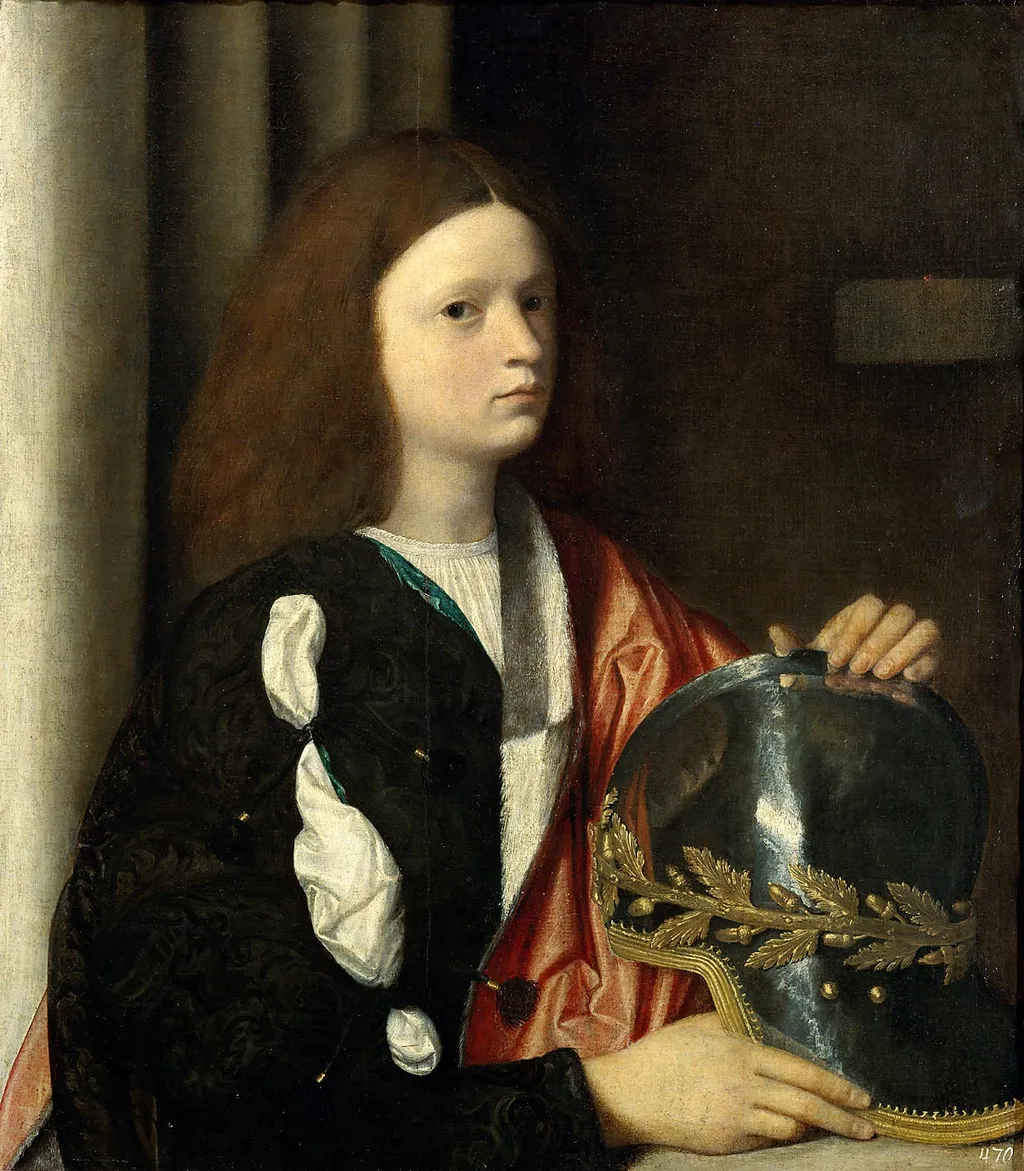
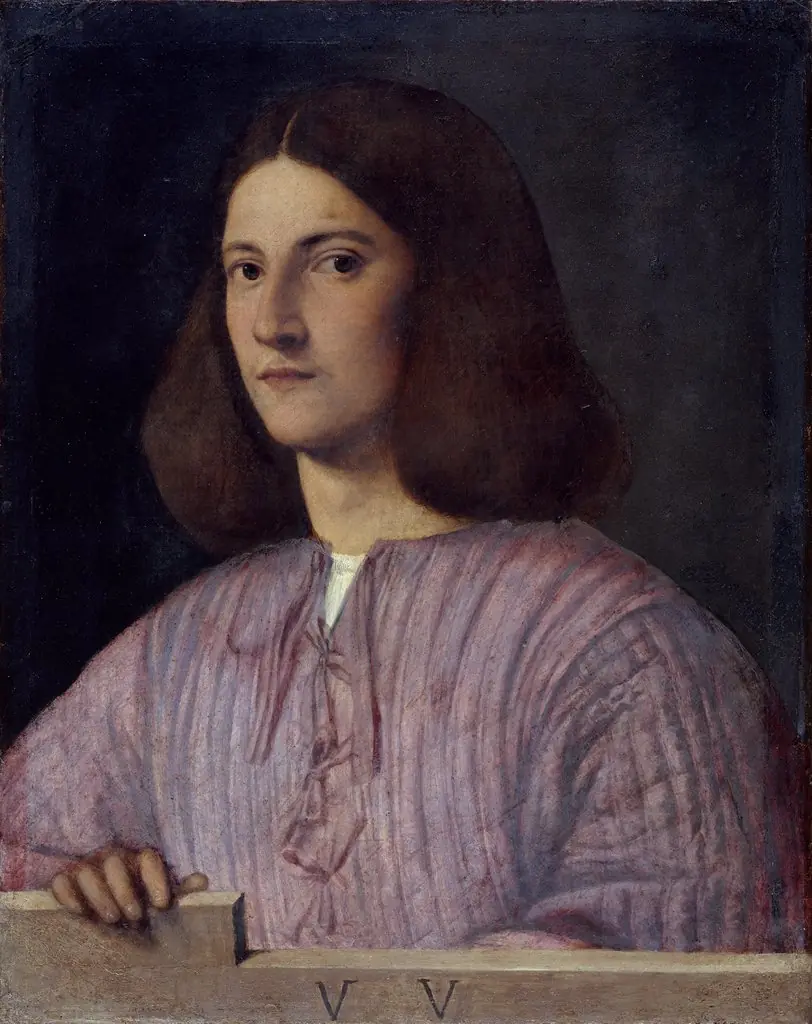
Portrait of Francesco Maria della Rovere is an unspecified painting by the High Renaissance artist Giorgione. It dates from 1502 and is held in the collection of the Kunsthistorisches Museum.
About this work
Subject & Meaning
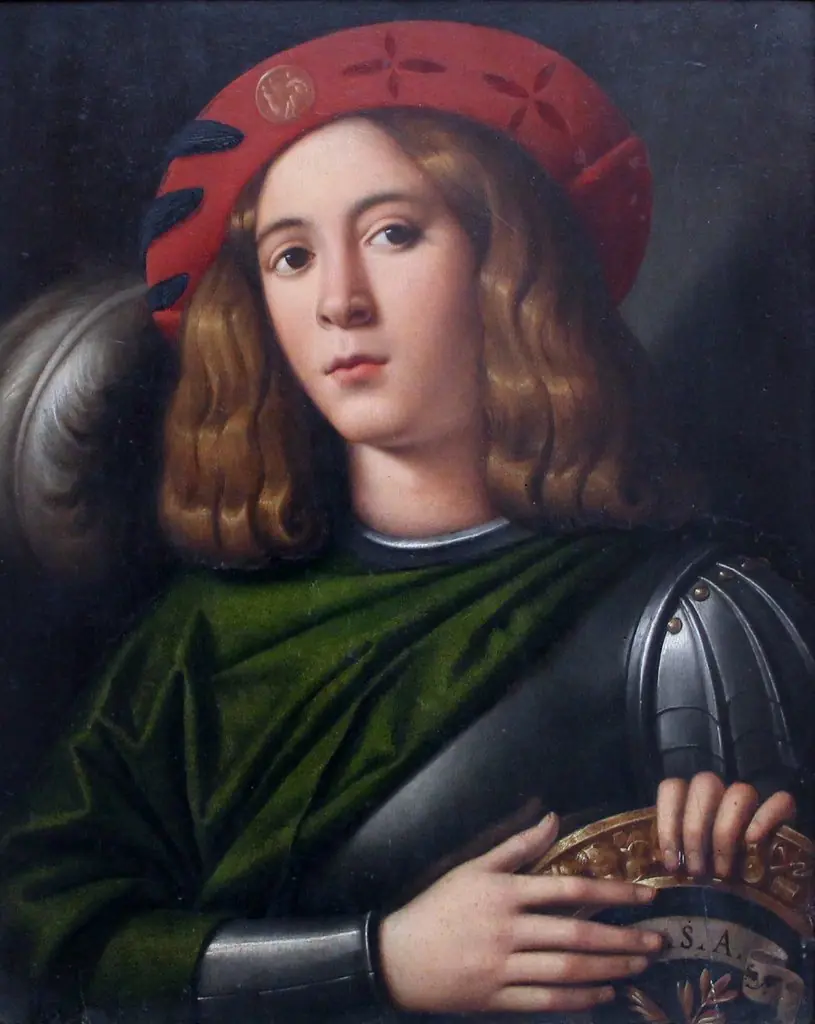
The painting portrays Francesco Maria della Rovere, identified as the young Duke of Urbino, aged about thirteen.
The painting portrays Francesco Maria della Rovere, identified as the young Duke of Urbino, aged about thirteen. He is shown in a three‑quarter view to the right, his hands resting on a shelf that bears a gleaming helmet. The helmet, decorated with a stylized crown, symbolizes his anticipated military career. Its highly reflective surface mirrors a tiny portrait of a young woman and a fragment of his red cloak, a detail that highlights the artist’s interest in light refraction and the study of surface effects inspired by Flemish painters and Leonardo da Vinci. The subject’s soft hair falls over his shoulders, reinforcing the youthful, idealized presentation.
Technique & Style
Executed circa 1502, this work is an oil painting originally created on a wood panel before being transferred to canvas. Measuring 73 by 64 cm, the composition features a half-length figure turned in three-quarter profile, resting his hands on a ledge that supports a gleaming helmet. The artist renders the subject's soft hair falling onto his shoulders as a diffuse patch of color with blurred contours, a technique characteristic of tonalism.
The helmet, decorated with a stylized crown and crafted in gilded bronze, displays sophisticated effects of luminosity and reflection. Its polished surface acts as a convex mirror, capturing a miniature inverted reflection of the youth and a fragment of his red cloak. These optical complexities demonstrate a Venetian engagement with Flemish and Leonardesque studies regarding light refraction and surface brilliance.
History & Provenance
Attributed to Giorgione and dated to circa 1502, this oil painting was originally executed on panel before being transferred to canvas. The work first appears in historical records within the ducal collections of Urbino around 1623-1624. By 1636, it belonged to the Venetian collector Bartolomeo della Nave, who subsequently sold it to the Hamilton collection. After 1646, the painting entered the holdings of Archduke Leopold Wilhelm of Austria in Brussels, where it was reproduced in David Teniers the Younger's 1660 catalog, the Theatrum Pictorium. Following the Archduke's death, ownership passed by inheritance to Emperor Leopold I, eventually becoming part of the imperial Habsburg collections now housed in Vienna's Kunsthistorisches Museum. The work is held in the Kunsthistorisches Museum in Vienna. Its inventory number is not specified in the sources. The painting was owned by Archduke Leopold Wilhelm of Austria before entering the Habsburg collection, and was later recorded in the collections of Bartolomeo della Nave in Venice and the Hamilton family before that. It was exhibited in the 1660 publication Theatrum Pictorium by David Teniers the Younger for Archduke Leopold Wilhelm. The work has been displayed in exhibitions related to the Venetian school and High Renaissance portraiture, including a 1660 engraving reproduction for the archduke's collection. The painting is described as an oil-on-panel work transferred to canvas, dated c. 1502, and is part of the museum's permanent holdings. The provenance traces the work from Urbino ducal collections in 1623-1624, through Bartolomeo della Nave in Venice, to the Hamilton collection, then to Archduke Leopold Wilhelm in 1659, and finally to the Kunsthistorisches Museum. The subject is traditionally identified as young Francesco Maria della Rovere, Duke of Urbino, depicted with a symbolic helmet representing his future military career.
Context
The Portrait of Francesco Maria della Rovere, painted c. 1502 by Giorgione, is housed in the Kunsthistorisches Museum in Vienna and exemplifies the High Renaissance Venetian school's exploration of light and reflection. The work depicts the young Duke of Urbino in three-quarter view, his hand resting on a richly detailed golden helmet adorned with oak leaves and acorns, which functions as a mirror-like surface reflecting a miniature portrait and a fragment of his red cloak. This treatment of metallic surfaces reflects contemporary Venetian interest in the optical studies of Flemish painters and Leonardo da Vinci. The painting's provenance traces a complex path from Urbino and Bartolomeo della Nave's Venetian collection to the Hamilton family, then to Archduke Leopold Wilhelm of Austria, and finally to the Habsburg imperial collection. Scholarship on the attribution and significance of the work is anchored in the writings of Alessandra Fregolent, whose 2001 monograph on Giorgione remains a key reference.
Artist & collection