Artwork
The Three Philosophers
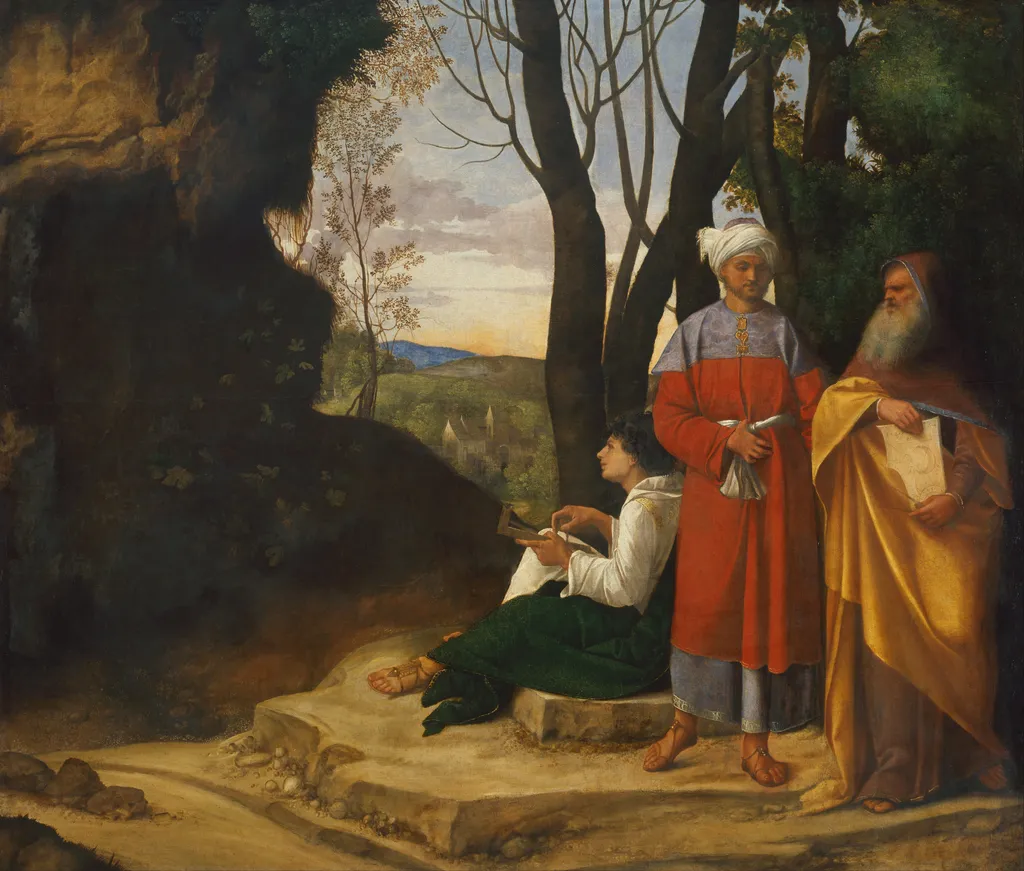
The Three Philosophers is an oil painting by the High Renaissance artist Giorgione. It dates from 1500 and is held in the collection of the Kunsthistorisches Museum.
About this work
Subject & Meaning
The old bearded man holds a compass and a parchment with astronomical calculations, while the seated young man studies a cave with measuring instruments.
The painting depicts three male figures of different ages, old, middle-aged, and young, set within a natural landscape. The old bearded man holds a compass and a parchment with astronomical calculations, while the seated young man studies a cave with measuring instruments. Behind them appear a village, mountains, and a mysterious blue area of unknown meaning. The work's iconography has been interpreted in multiple ways. A widely accepted reading sees the figures as representing the transmission of knowledge from Greek antiquity through Arab scholarship to Renaissance science: the old man as a Greek philosopher (Plato or Aristotle), the turbaned middle figure as an Arab scholar such as Avicenna or Averroes, and the youth as emergent Renaissance empirical inquiry. The cave the young man measures may allude to Plato's allegory of the cave, symbolizing yet-undiscovered knowledge. Alternative identifications have been proposed, including Pythagoras with his teachers Pherecydes and Thales, or even King Solomon with Hiram of Tyre and Hiram Abiff. Some scholars interpret the three figures as allegories for the three ages of man, three epochs of civilization, or the three Abrahamic religions. Augusto Gentili suggested an astrological reading related to the anticipated coming of the Antichrist, based on an eclipse diagram visible on the old man's parchment. The painting's deliberate ambiguity has led art historians to conclude that Giorgione intended multiple, open-ended interpretations.
Technique & Style
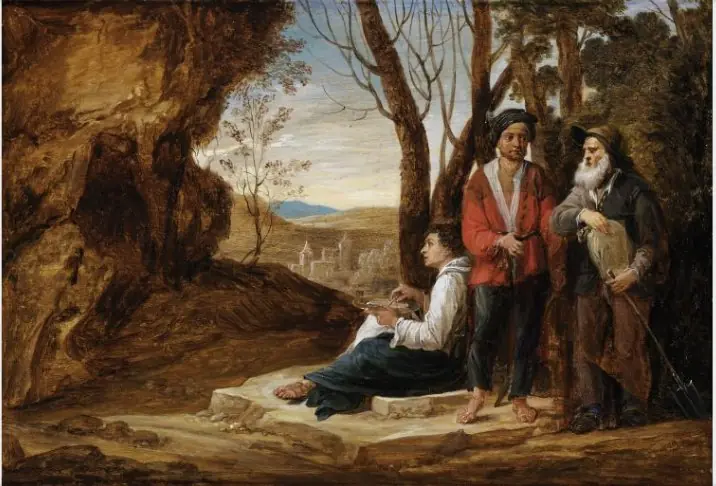
The Three Philosophers is an oil painting on canvas, measuring 125.5 × 146.2 cm. Attributed to Giorgione, it is classified as a landscape painting and is held by the Kunsthistorisches Museum in Vienna. Stylistically, the work is rooted in the Venetian High Renaissance and is noted for its atmospheric handling of light and landscape. The composition sets three allegorical figures, an old bearded man, a turbaned Oriental philosopher, and a seated youth, within a natural setting that includes a village, mountains, and a distant blue form of uncertain meaning. The young man observes a cave at the left edge, apparently measuring it with an instrument, while the oldest figure holds a sheet bearing the word "eclipsis" and an astronomical diagram. Technical examination has reinforced Giorgione's sole authorship: an infrared reflectogram lends no support to the earlier theory that Sebastiano del Piombo finished the work. The painting was later cropped on the left side, a truncation visible in David Teniers the Younger's copies from the Theatrum Pictorium; the original dark rock formation once occupied more than half the canvas, sharpening the interplay of light and shadow that scholars link to its philosophical themes.
History & Provenance
Commissioned by the Venetian noble Taddeo Contarini, a merchant with interests in alchemy and the occult, this oil painting was executed by Giorgione between approximately 1505 and 1509. While early accounts by Marcantonio Michiel, who viewed the work in Contarini's collection in 1525, suggested completion by Sebastiano del Piombo, modern technical analysis attributes the entire execution to Giorgione. Following Contarini's ownership, the painting passed to Dario Contarini by 1545 and later to Bartolomeo della Nave in 1636. It subsequently entered the collection of Archduke Leopold Wilhelm of Austria, where it was documented in David Teniers the Younger's 1659 catalog, Theatrum Pictorium. The work eventually became part of the Habsburg imperial holdings and has been housed in the Kunsthistorisches Museum in Vienna since 1891. The Three Philosophers is held at the Kunsthistorisches Museum in Vienna under inventory number 2675. It entered the imperial collection via Archduke Leopold Wilhelm of Austria, passing through Bartolomeo della Nave and Hamilton before accession. The work was documented in David Teniers the Younger's Theatrum Pictorium catalog in 1659 and 1673, noting its later cropping in copies. The painting was commissioned by Taddeo Contarini, a Venetian noble with interests in occultism and alchemy, and was completed circa 1508-1509. It was recorded in Marcantonio Michiel's 1525 inventory as being in Contarini's villa. Contemporary scholarship rejects earlier attributions to Sebastiano del Piombo, confirming Giorgione as sole author. The work has been featured in exhibitions including Bellini and Giorgione in the House of Taddeo Contarini at the Frick Collection (November 9, 2023, February 4, 2024).
Context
The painting The Three Philosophers was created by Giorgione around 1509 and commissioned by the Venetian noble Taddeo Contarini, a merchant with interests in occultism and alchemy. It is housed in the Kunsthistorisches Museum in Vienna and was documented in David Teniers the Younger's Theatrum Pictorium catalog as part of Archduke Leopold Wilhelm's collection. Contemporary descriptions by Marcantonio Michiel identify the work as depicting allegorical figures: an old bearded philosopher possibly representing Greek thought, a Persian or Arab scholar possibly referencing Avicenna or Averroes, and a young man engaged in measurement or observation, symbolizing emerging Renaissance science. Interpretations of the composition vary, including associations with Plato's Allegory of the Cave, stages of human development, or transmission of philosophical knowledge through Arabic translations. Some scholars link the figures to Pythagorean traditions or alchemical symbolism, while others connect them to broader cultural or religious narratives. The work's complex iconography and layered symbolism have made it a focal point for discussions on Renaissance intellectual currents, with recent scholarship emphasizing its ambiguity and the deliberate openness of its meaning.
Legacy
The painting's reputation as a subject of scholarly debate has endured for centuries. Marcantonio Michiel's early 16th-century description established its canonical identification, though later viewers frequently reinterpreted its meaning, from the Magi in the 18th century to diverse philosophical, religious, and allegorical readings in modern scholarship. The work entered the Habsburg imperial collection through Archduke Leopold Wilhelm of Austria, becoming part of one of Europe's most prestigious assemblages. David Teniers the Younger documented it in his 1659 and 1673 Theatrum Pictorium catalogues, and his small study copies (21.5 × 30.9 cm) remain valuable historical records of the collection. In contemporary reception, the French historian Paul Veyne included the painting in his "musée imaginaire," reflecting its continued cultural prestige. The work was also featured in a 2023-2024 exhibition at the Frick Collection, paired with Giovanni Bellini's St. Francis in the Desert, underscoring its sustained importance in Renaissance art history.
Own this work as a print
Artist & collection


 Predigt Johannes des Täufers
 The Feast of the Gods
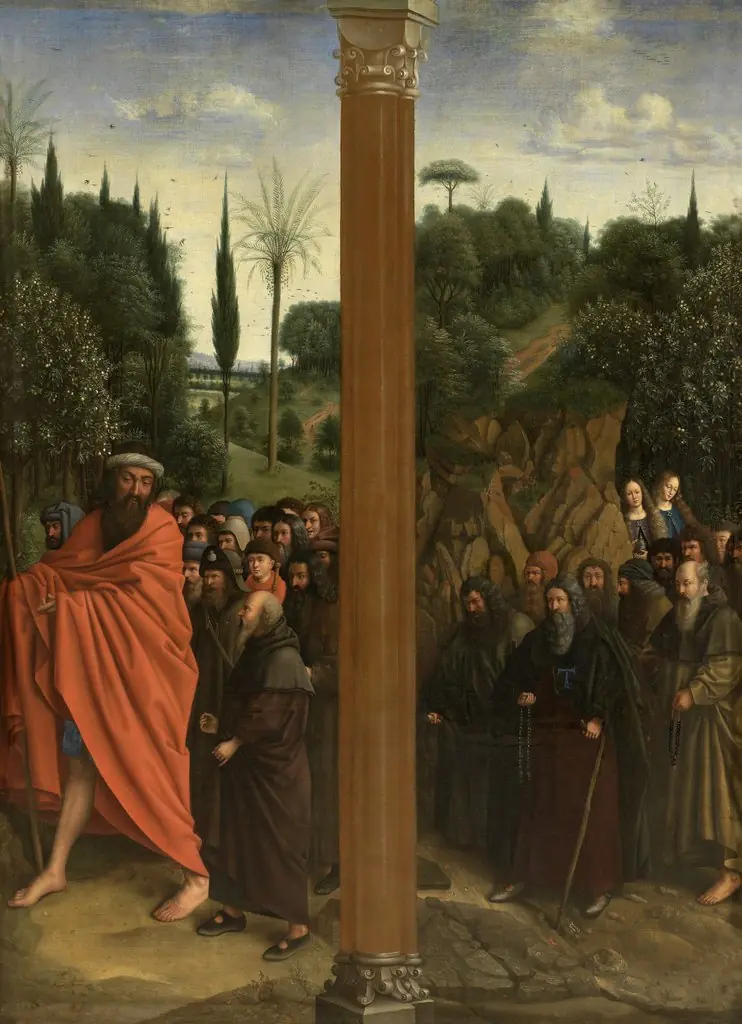 Holy Hermits and Holy Pilgrims
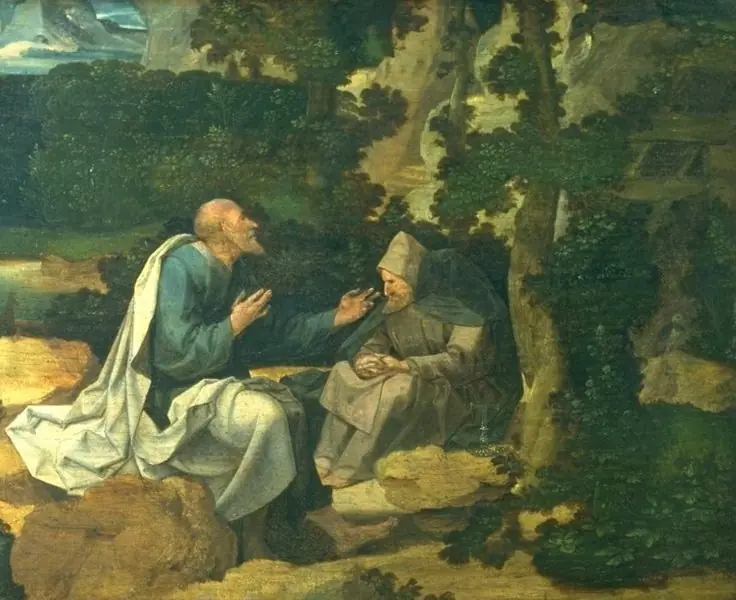 Landscape with the hermits Paul and Anthony
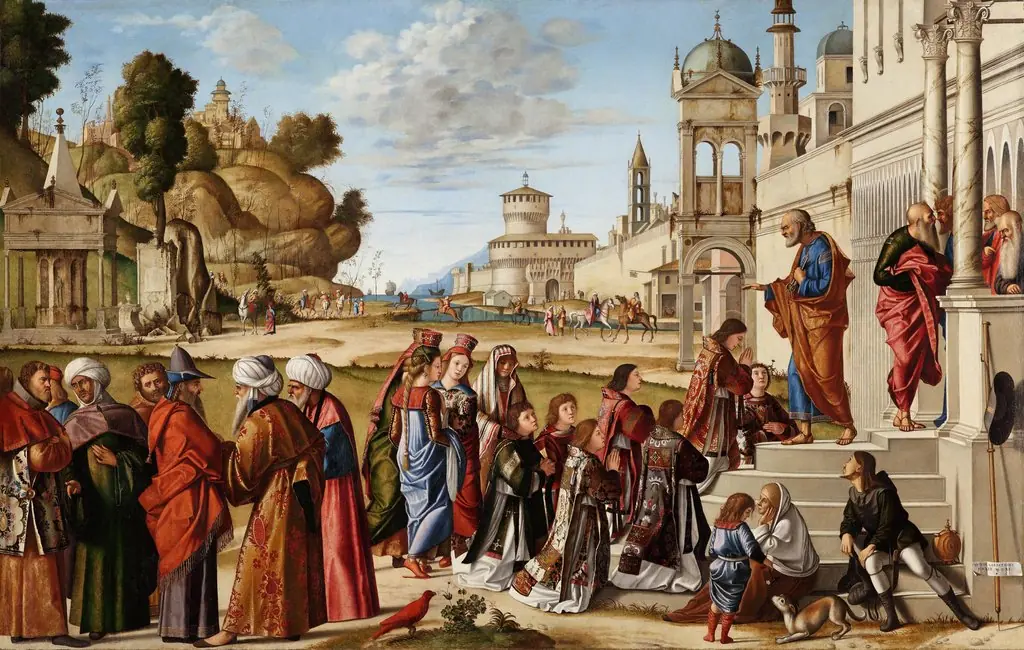 The Ordination of St. Stephen
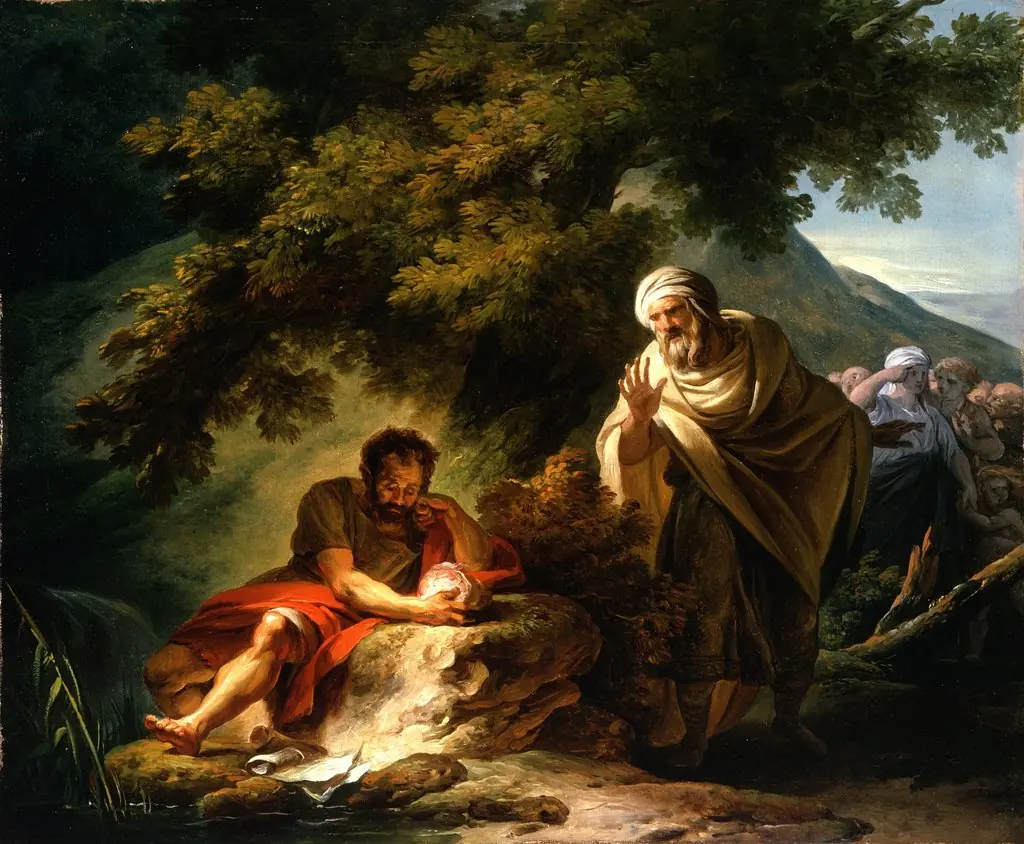 Democritus among the Abderitans
 Saint John the Baptist says goodbye to his Parents
 Ruth and Boas
 Ham Mocking Noah
 Mary's Passage Across the Mountains
 Sacred conversation
- The Three Philosophers