Artwork
The Return of the Prodigal Son
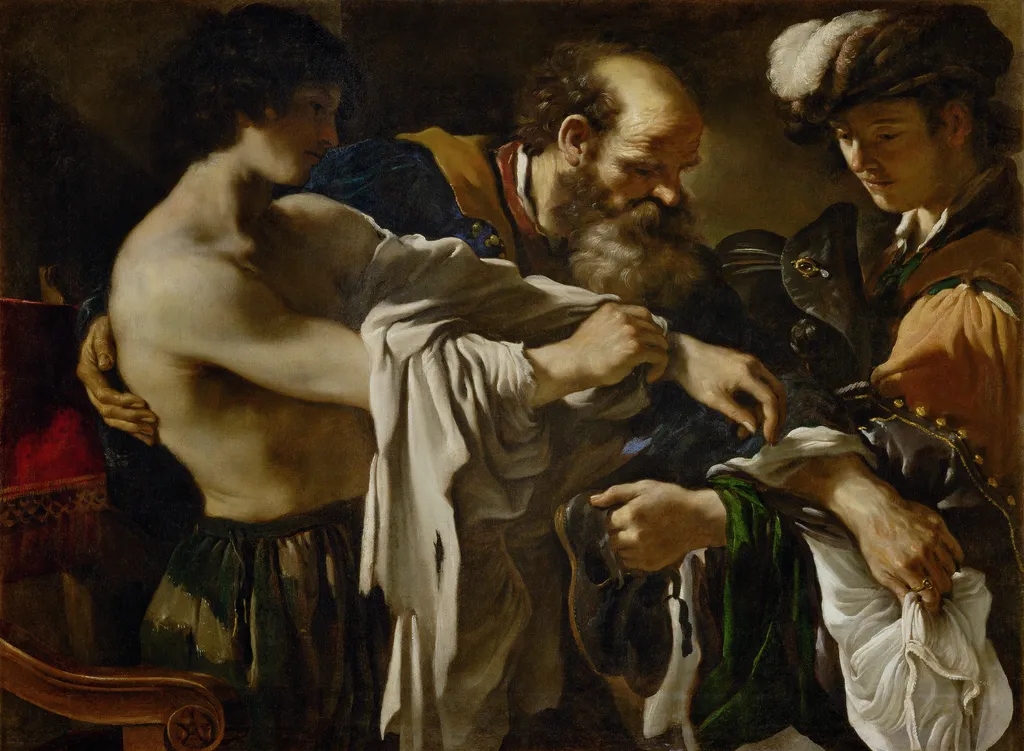
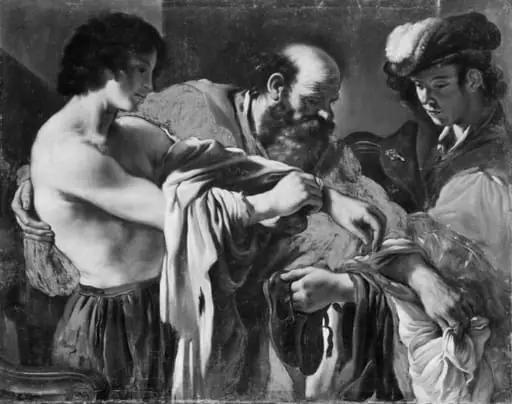
The Return of the Prodigal Son is an oil painting by the Early Baroque Italian artist Guercino. It dates from 1619 and is held in the collection of the Kunsthistorisches Museum.
About this work
Subject & Meaning
Symbolically, the scene focuses on the act of clothing the prodigal, representing his transition from shame to renewal.
The painting illustrates the biblical parable from Luke 15:11–32, specifically depicting the moment immediately following the prodigal son's acceptance by his father. The composition features three half-length figures: the returning son, his father, and the faithful elder brother. Symbolically, the scene focuses on the act of clothing the prodigal, representing his transition from shame to renewal.
The father and elder brother work together to replace the son's torn shirt with a white tunic and new shoes. The father's central position unites the two brothers both physically and metaphorically. Visual contrasts deepen the meaning: the prodigal's face remains in shadow, and his gesture of undressing suggests submission and rebirth, while the illuminated elder brother stands in a posture of detachment. The soft lighting creates a suspended, silent atmosphere that emphasizes the narrative tension.
Technique & Style
The Return of the Prodigal Son is an oil on canvas painting measuring 107 × 143.5 cm. The composition presents three half-length figures arranged horizontally from left to right: the prodigal son, the father, and the elder brother. Guercino animates the scene through an interlacing of gestures, the father and brother work to reclothe the youth, with a torn shirt being replaced by a white tunic while new shoes are offered. The father stands at the center, physically and symbolically uniting the two sons.
The prodigal's face remains in shadow, his undressing gesture suggesting submission and renewal; the fully illuminated elder brother appears detached. Narrative tension emerges through restrained postures and eloquent silences, while diffused light creates a suspended atmosphere. The work exemplifies Guercino's atmospheric chiaroscuro and is considered his most Caravaggesque painting.
History & Provenance
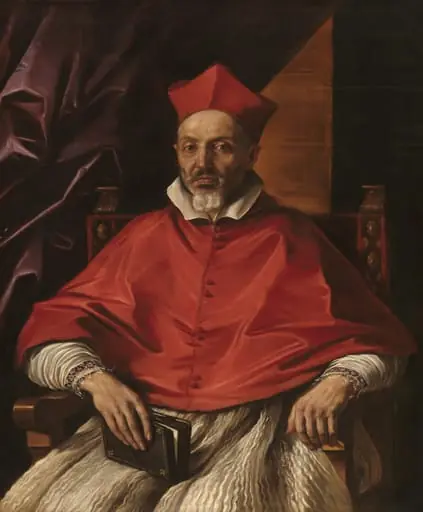
The Return of the Prodigal Son was commissioned by Cardinal Giacomo Serra, the Genoese papal legate of Ferrara from 1616 to 1623. Their artistic relationship began in 1617, when Guercino presented the cardinal with a painting during a visit to Cento. Impressed by the young artist's talent, Serra summoned Guercino to Ferrara in 1619, initiating an exclusive and productive patronage. The painting is dated to 1619 and executed in oil on canvas, measuring 107 × 143.5 cm.
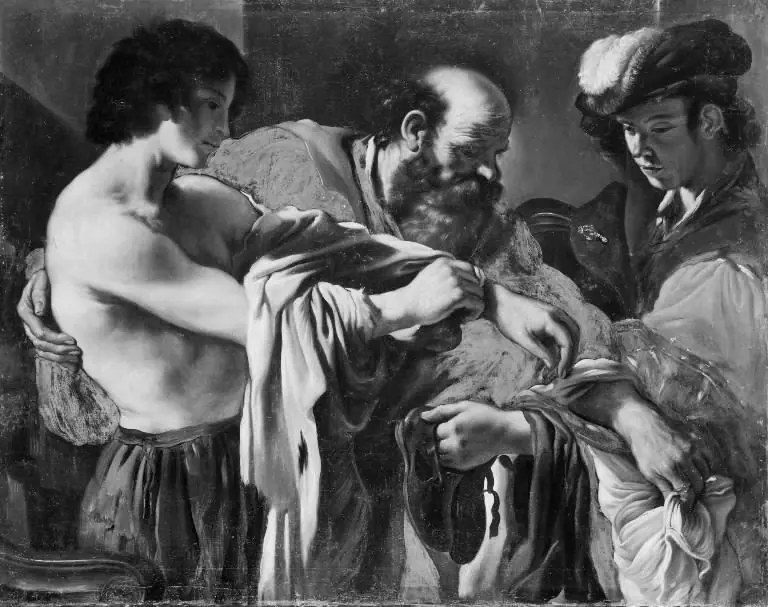
The provenance between its creation and 1720 remains undocumented. In 1720, the painting appears as no. 247 in the first volume of Ferdinand Storffer's manuscript Gemaltes Inventarium der Aufstellung der Gemäldegalerie in der Stallburg, which records the holdings of the Vienna gallery. The manuscript is preserved at the Kunsthistorisches Museum, where the painting remains today. A copy of the work is held at the Statens Museum for Kunst in Copenhagen.
The painting is held in the Kunsthistorisches Museum, Vienna.
Its accession in the museum’s holdings is documented in Ferdinand Storffer’s manuscript Gemaltes Inventarium der Aufstellung der Gemäldegalerie in der Stallburg (1720), where it appears as entry no. 247. The work remains part of the museum’s permanent collection.
No exhibition history beyond its presence in the museum’s holdings is provided by the cited sources.
Context
Guercino’s Return of the Prodigal Son (1619) is widely regarded as a paradigm of his early maturity and a touchstone for assessing his relationship to Caravaggism. Scholars highlight its atmospheric chiaroscuro and the concentrated emotional charge of the three half-length figures as quintessential of Guercino’s idiom, even as they note its exceptional proximity to Caravaggio’s tenebrism in the handling of light and the moral intensity of the scene. The painting was commissioned by Cardinal Giacomo Serra, a Genoese prelate in Ferrara, and entered the imperial collection in Vienna by 1720, where it remained a touchstone for later Habsburg taste.
Italian art-historical literature treats the work as a summation of Guercino’s early religious narrative style, emphasizing the interplay of gesture and silence that structures the composition and the symbolic economy of the father’s embrace and the elder brother’s detachment.
Legacy
The painting is regarded as one of Guercino’s most representative works, described as an absolute synthesis of his style, his atmospheric chiaroscuro, and his iconographic inventions. It is also considered the most Caravaggesque painting by Barbieri.
The work was commissioned by Cardinal Jacopo Serra, with whom Guercino established an exclusive and intense artistic relationship. By 1720, it was recorded in the imperial collections in Vienna, appearing in the manuscript inventory of Ferdinand Storffer. A copy is held at the Statens Museum for Kunst in Copenhagen.
Overview
Created in 1619, The Return of the Prodigal Son is an oil on canvas by the Italian Baroque artist Giovanni Francesco Barbieri, known as Guernino. Executed in the early Baroque idiom, the work portrays the biblical episode of reconciliation between a wayward son and his father. It is part of the religious painting tradition and is presently housed in Vienna’s Kunsthistorisches Museum.
Own this work as a print
Artist & collection
Artist
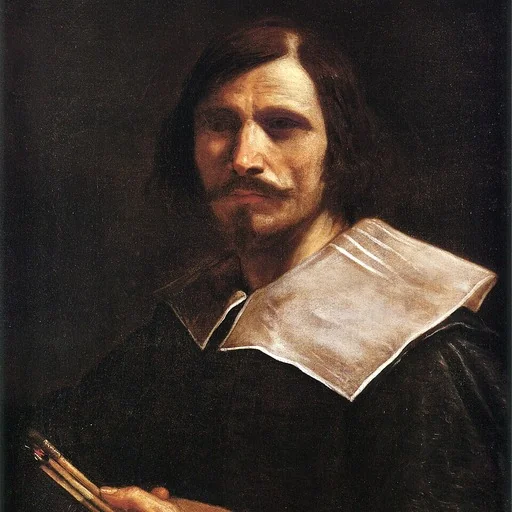
Giovanni Francesco Barbieri (8 February 1591 – 22 December 1666), better known as (il) Guercino (Italian pronunciation: ), was an Italian Baroque painter and draftsman from Cento in the Emilia region, who was active in Rome and Bologna.