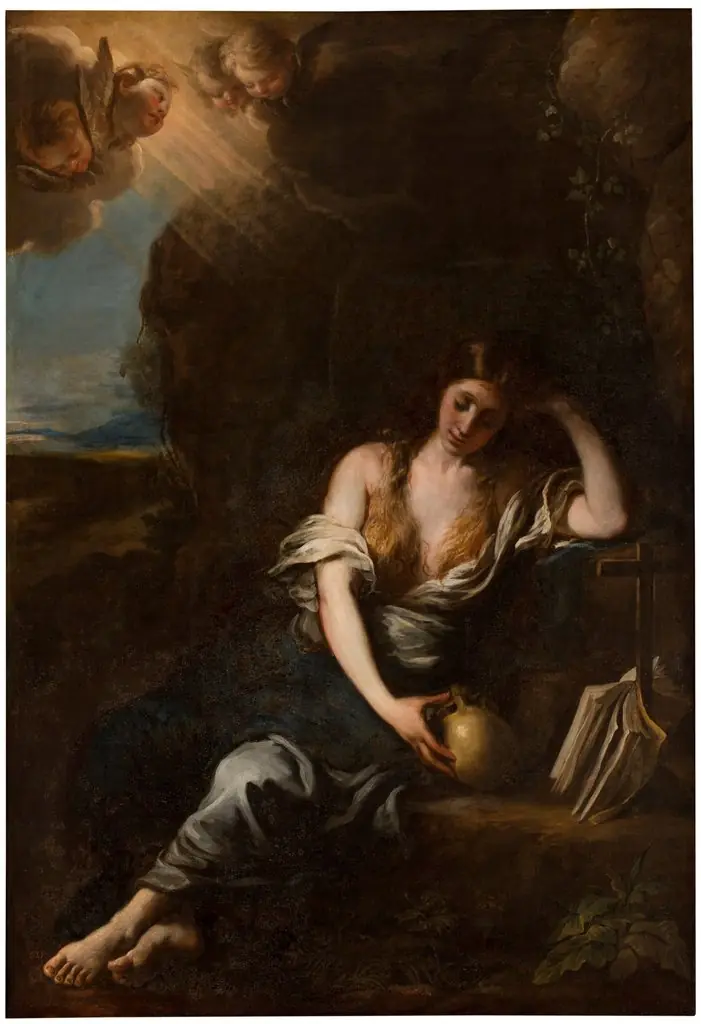
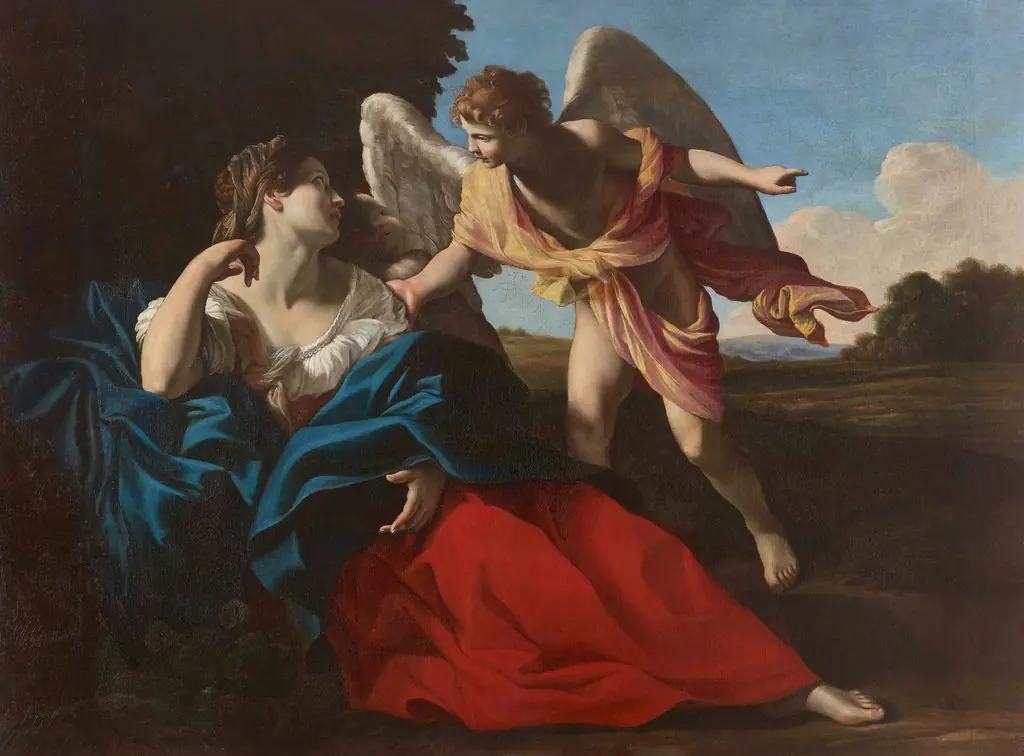
Artwork
Penitent Magdalene
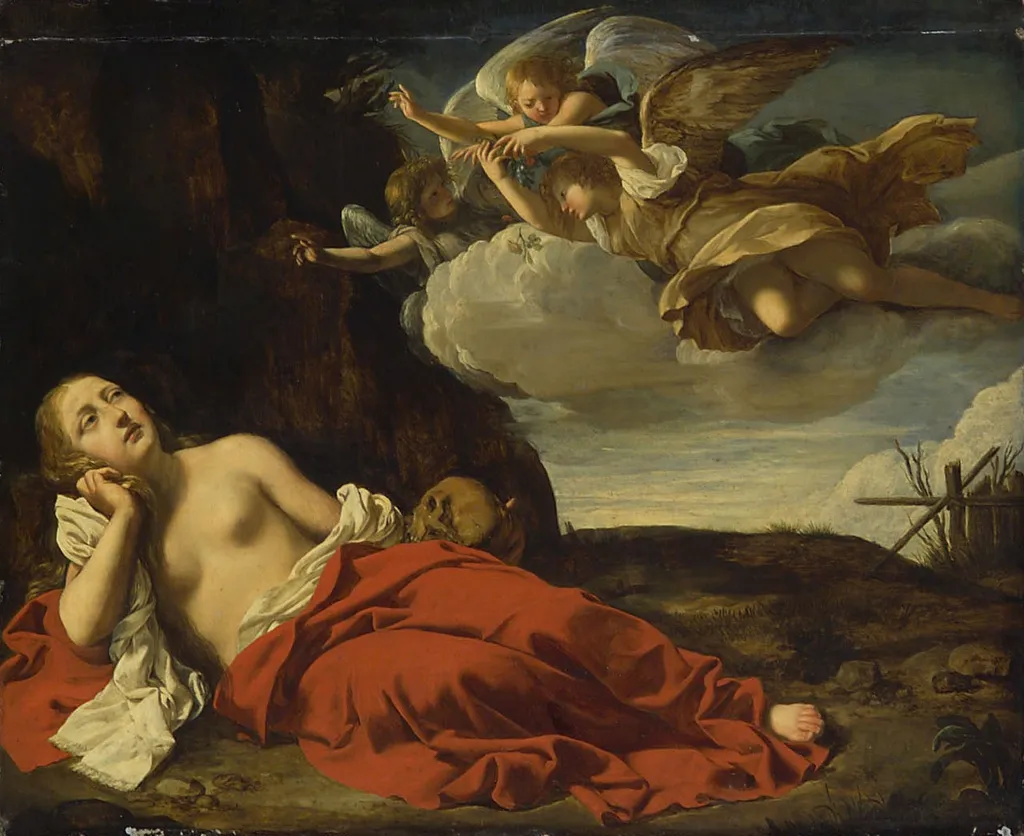
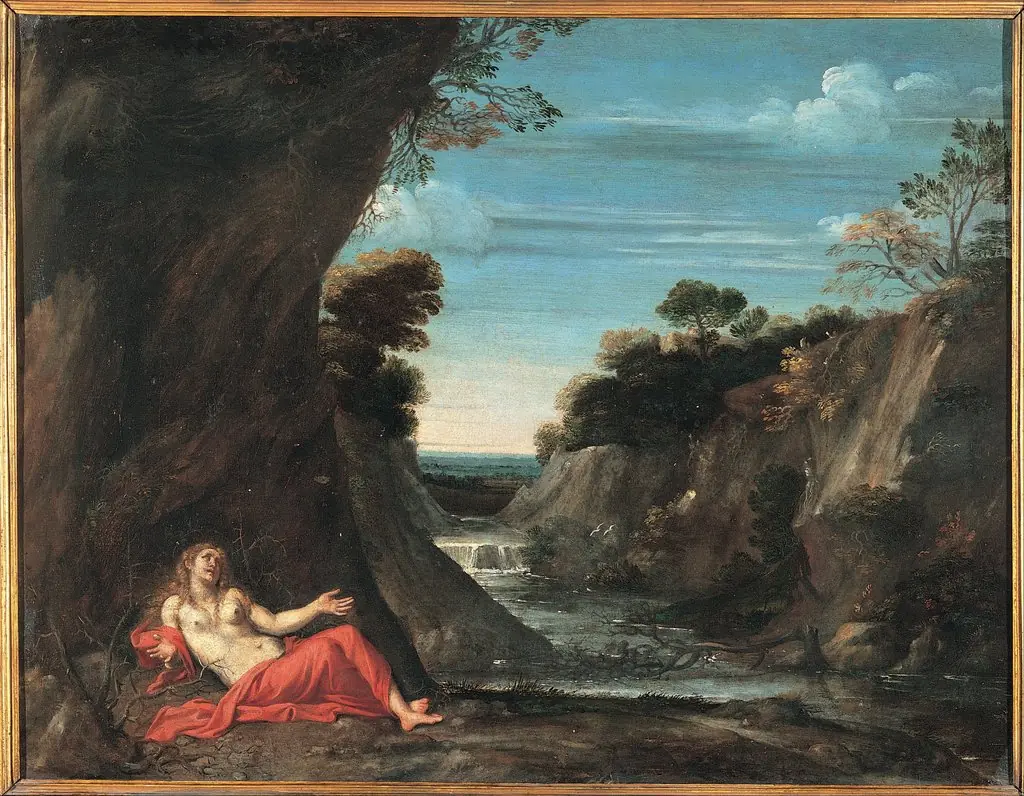
Penitent Magdalene is an unspecified painting by the Early Baroque Italian artist Guido Cagnacci. It dates from 1642 and is held in the collection of the Kunsthistorisches Museum.
About this work
Subject & Meaning
A coarse olive-green cloth covers her lower body, and on the floor to her right lie a wooden crucifix and a silver vessel used for anointing.
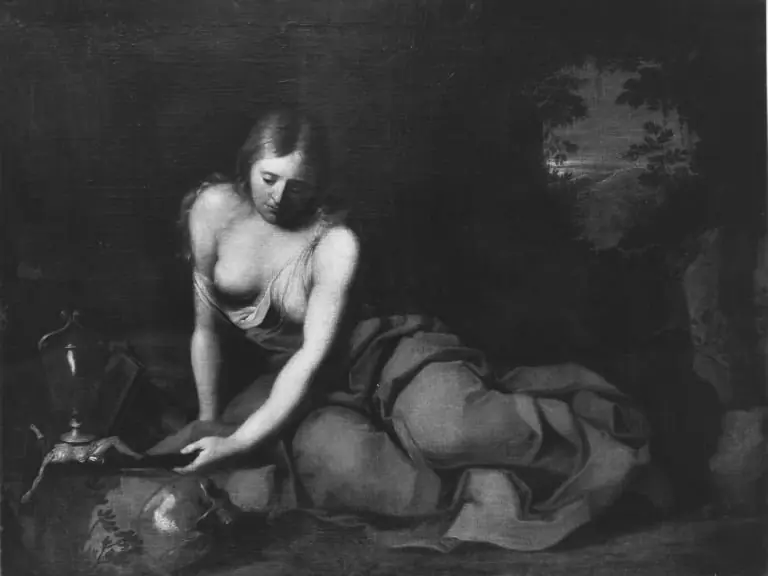
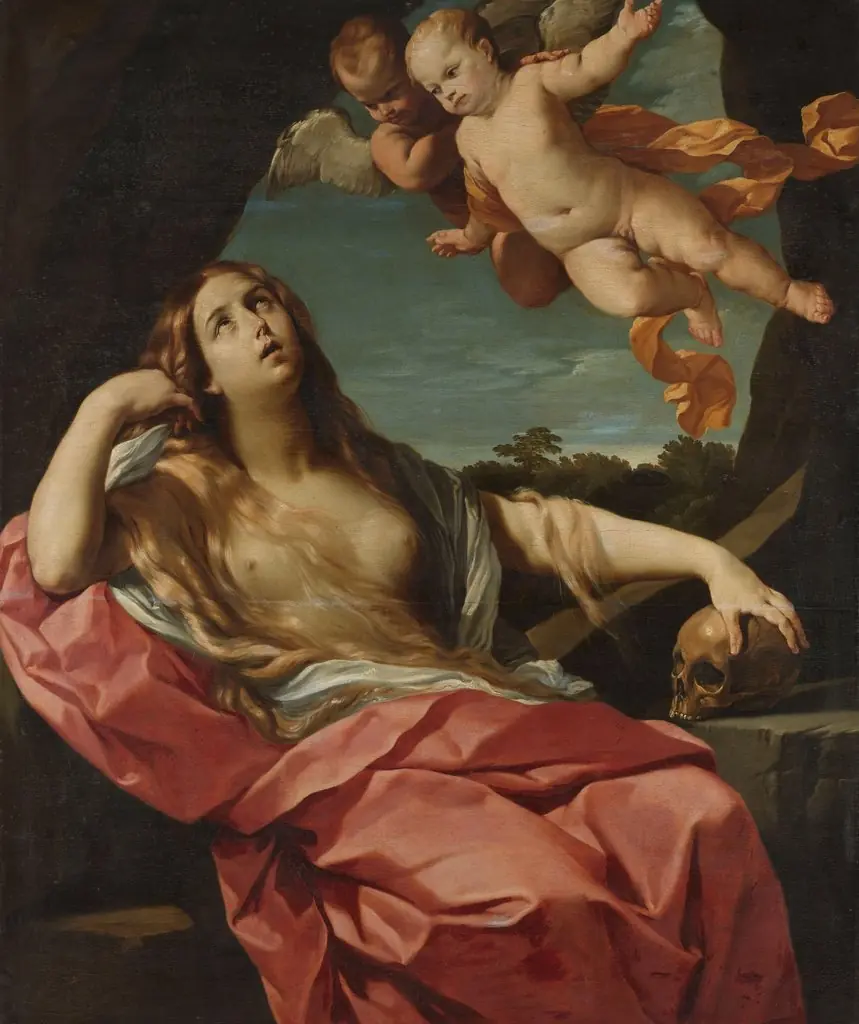
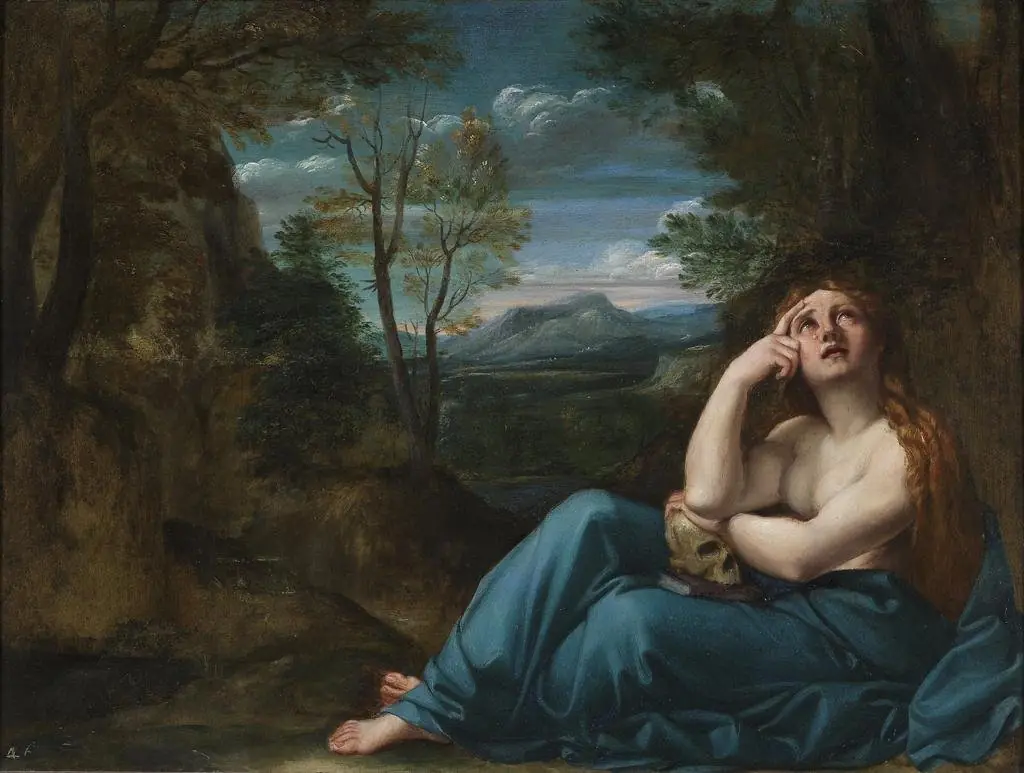
The painting shows Mary Magdalene in a moment of penitential contemplation, her partially exposed torso illuminated against a dark interior of a cave or ruined space. She leans against the rock, her head tilted back and face turned upward, with long reddish-brown hair falling over her shoulders. In her right hand she holds a metal scourge loosely, while her left hand rests on a skull that rests in her lap, serving as a memento mori.
A coarse olive-green cloth covers her lower body, and on the floor to her right lie a wooden crucifix and a silver vessel used for anointing. The composition emphasizes a striking contrast of light and shadow, with strong illumination from the upper left highlighting her exposed chest and the curve of her neck.
The work belongs to the tradition of Magdalene imagery in which the saint withdrew into solitude after the death of Christ, dedicating herself to prayer and penance. Cagnacci incorporates standard iconographic attributes: the skull as a symbol of mortality, the scourge as an instrument of self‑discipline, the crucifix as a sign of devotion, and the silver vessel recalling the biblical scene of Mary Magdalene anointing Jesus. These elements together convey themes of repentance, mortality, and spiritual devotion.
The figure’s nakedness and sensual pose introduce an erotic dimension that blurs the line between religious ecstasy and physical desire, reflecting Cagnacci’s characteristic blend of sensual realism with devotional subject matter.
Technique & Style
Cagnacci's Penitent Magdalene is a painting on a relatively small support measuring 43.5 by 53 cm, executed between 1626 and 1627. It is classified as a religious painting and counts among the artist's early works. The composition is set inside a cave or ruined structure against a dark background, with a narrow strip of night sky visible at the left.
A strong light falls from the upper left onto the figure's bare upper body, sharply separating it from the surrounding shadow while the lower zones remain in darkness. The Magdalene is shown seated, leaning against the rock wall with her head thrown far back and her face turned upward, her long reddish-brown hair falling behind her shoulders. She holds a metal scourge loosely in her right hand and a skull in her lap, while a rough olive-green cloth covers her lower body. A wooden cross and a silver ointment jar rest on the ground to her right.
Stylistically, the work is regarded as characteristic of Cagnacci's fusion of religious subject matter with sensual bodily depiction, combining influences from the Roman-Bolognese environment with his own pictorial language. The treatment of the figure deliberately blurs the boundary between spiritual ecstasy and physical abandon, exploiting the shared bodily vocabulary of both states.
History & Provenance
The painting was first recorded in the Roman collection of the Torlonia family before entering the Gallerie Nazionali d’Arte Antica in 1892. It has remained in the Palazzo Barberini in Rome ever since, where it is catalogued under inventory number 898. Early attribution to the Venetian painter Francesco Trevisani was later superseded by a reattribution to Guido Cagnacci, a proposal first advanced by Gianni Papi in 1988 and accepted in subsequent scholarship.
The work is dated to the period between 1626 and 1627, placing it among Cagnacci’s early output and reflecting his synthesis of Bolognese classicism with a sensual visual language. The provenance chain therefore moves from the Torlonia collection to the Gallerie Nazionali d’Arte Antica and finally to its present location within the Palazzo Barberini.
The artwork depicts the Penitent Magdalene in a moment of contemplative isolation, seated within a rocky grotto with a partially exposed torso. Light from the upper left illuminates her figure against a dark backdrop, emphasizing the stark contrast between flesh and shadow. Her head is thrown back, hair cascading over her shoulders, while she holds a skull in her lap as a memento mori and a metal whip in her right hand, symbolizing self‑flagellation.
A modest olive‑green cloth covers her lower body, and on the floor lie a wooden crucifix and a silver salting dish, both serving as iconographic attributes of Mary Magdalene.
The composition draws on traditional iconography of the Magdalene’s penitential hermitage, yet subverts expectations through an explicit erotic charge. Cagnacci renders the saint’s naked torso bathed in dramatic illumination, allowing the viewer to confront both spiritual renunciation and sensual allure simultaneously. The skull, the whip, and the silver basin function as conventional symbols of repentance, mortality, and devotion, while the exposed anatomy introduces a tension between sacred mortification and earthly desire.
This duality reflects Cagnacci’s broader artistic interest in the interplay of flesh and faith, a theme that has been interpreted as both a devotional gesture and a provocative exploration of the body’s capacity for transcendence.
The painting Penitent Magdalene by Guido Cagnacci is held in the Gallerie Nazionali d’Arte Antica within the Palazzo Barberini in Rome. Its current inventory number is 898. The work entered the collection in 1892 after previously being part of the Roman Torlonia collection.
Earlier attributions mistakenly assigned the piece to Francesco Trevisani, but scholarly reattribution to Cagnatti was established by Gianni Papi in 1988 and widely accepted thereafter. Exhibition history is limited to its ongoing display in the Palazzo Barberini following its transfer to the Gallerie Nazionali d’Arte Antica.
Context
Guido Cagnacci’s Penitent Magdalene (c. 1626–27) occupies a contested yet pivotal place in early modern religious imagery due to its synthesis of Counter-Reformation devotional conventions with a distinctly sensual figuration. Initially misattributed to Francesco Trevisani and briefly linked to Artemisia Gentileschi, the work was definitively assigned to Cagnacci by Gianni Papi in the late 1980s, a reattribution now widely accepted in scholarship. Its provenance traces from the Torlonia collection in Rome to the Gallerie Nazionali d’Arte Antica’s Palazzo Barberini, where it remains inventoried as a key example of the artist’s early output.
The painting’s critical reception pivots on its paradoxical treatment of sanctity and corporeality. While the Magdalene’s attributes, the skull, scourge, and unguent vessel, conform to established iconography, her exposed torso, dramatically arched back, and ambiguous facial expression blur the boundaries between spiritual transport and erotic suggestion. This tension reflects Cagnacci’s engagement with the Roman–Bolognese milieu, where Caravaggisti and classical idealists alike explored the interplay of flesh and faith.
The work’s unsettling sensuality, though atypical for Counter-Reformation imagery, underscores the period’s broader fascination with the Magdalene as both penitent and seductress, a duality that continues to shape its interpretation.
Overview
Penitent Magdalene is a painting by Italian Baroque artist Guido Cagnacci, created circa 1642. It is characteristic of the early Italian Baroque style and is part of the Kunsthistorisches Museum's collection.
Legacy
While specific details on the painting's direct influence are not provided, it contributes to the broader legacy of Italian Baroque art, showcasing the period's characteristic use of chiaroscuro and emotionally charged religious themes.
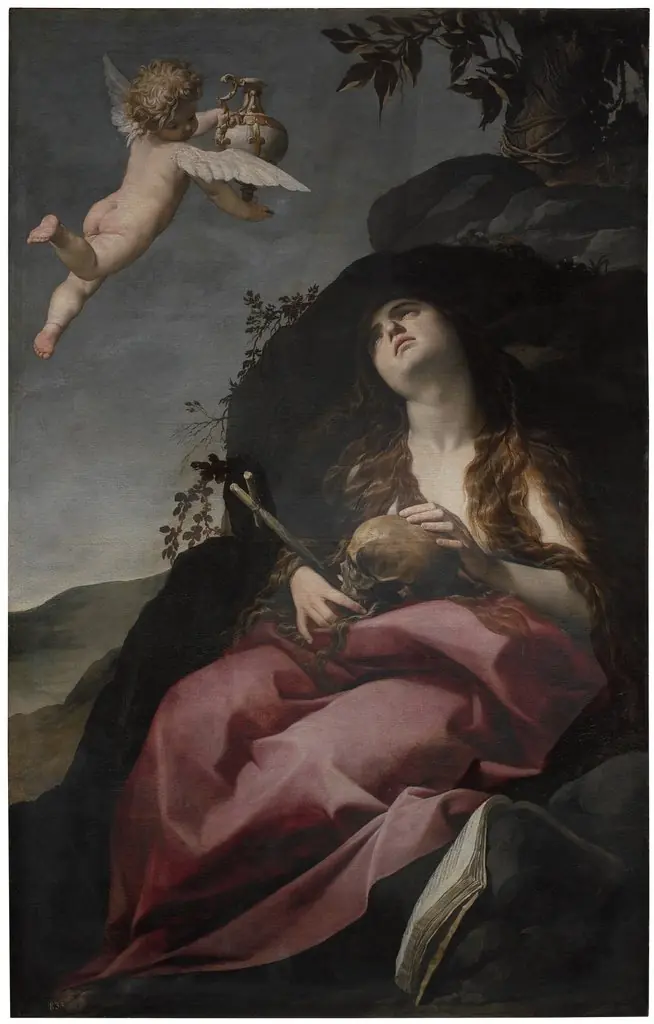
Artist & collection
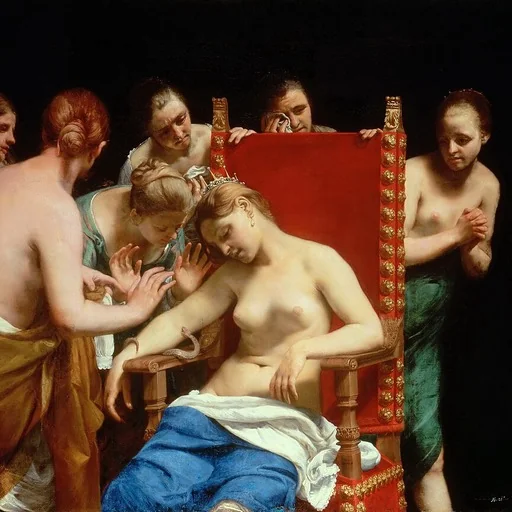
Artist
Guido Cagnacci (Italian:; 13 January 1601 – 1663) was an Italian Baroque painter originally from Santarcangelo di Romagna.