Artwork
Liberation of Andromeda, release of the winds by Aeolus and Aeneas
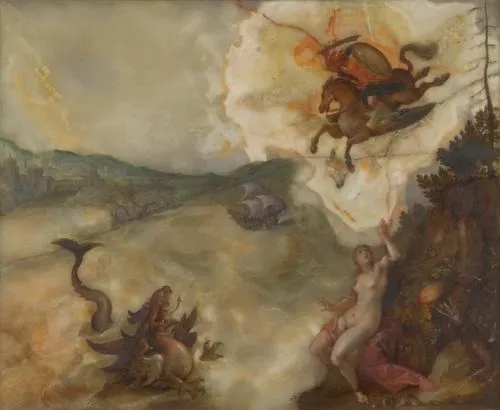
Liberation of Andromeda, release of the winds by Aeolus and Aeneas is an oil painting by the Mannerist artist Hans von Aachen. It dates from 1600 and is held in the collection of the Kunsthistorisches Museum.
About this work
Overview
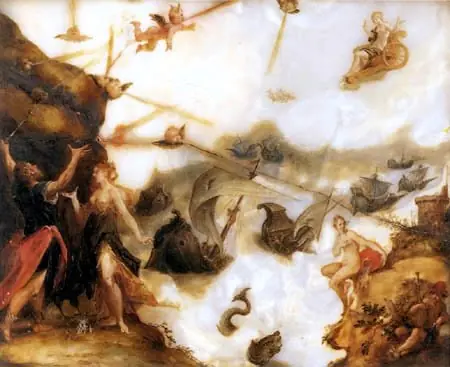
Liberation of Andromeda, release of the winds by Aeolus and Aeneas is a double-sided mythological painting on alabaster by the German artist Hans von Aachen, dated to approximately 1600. Measuring 38 by 45 centimetres, the work is executed in oil on a translucent alabaster panel and is held in the collection of the Kunsthistorisches Museum at Ambras Castle in Innsbruck, Austria, under inventory number PA 941. The piece is significant as a prime example of the stone painting (Steinmalerei) highly prized at the court of Emperor Rudolf II in Prague, where Von Aachen ranked among the leading painters. Its unusual double-sided format juxtaposes two distinct mythological narratives drawn from classical antiquity, demonstrating the sophisticated erudition and technical virtuosity that characterised court art of the period.
Subject & Meaning
The composition captures the moment of maximum drama: Perseus and the monster face each other diagonally while Andromeda awaits her fate.
The work presents two mythological scenes on opposite sides of a single alabaster panel. The recto depicts the Liberation of Andromeda, drawn from Ovid's Metamorphoses (4.663-722). Andromeda, daughter of King Cepheus and Queen Cassiopeia, was chained to a sea rock as punishment for her mother's boast that she surpassed the Nereids in beauty. Perseus arrives on his winged horse Pegasus to rescue her, confronting a sea monster that emerges from the turbulent waters. The composition captures the moment of maximum drama: Perseus and the monster face each other diagonally while Andromeda awaits her fate. The verso illustrates the Release of the Winds by Aeolus, based on Virgil's Aeneid (1.49-129). Juno, seated in her peacock-drawn chariot in the sky, incites Aeolus to unleash the winds imprisoned in his mountain to endanger the ships of her enemy Aeneas as they approach Sicily. Aeolus is shown with his sceptre freeing the winds, while Juno promises him a beautiful spring nymph as reward. The pairing of these subjects reflects the Renaissance and Baroque fascination with classical mythology, themes of divine intervention, and the struggle between mortal heroes and cosmic forces.
Technique & Style
The painting is executed in oil on a translucent alabaster panel, a technique that exploited the natural veining and colour of the stone to enhance atmospheric effects. Hans von Aachen utilised the inherent structure and hue of the alabaster to render the stormy sea and gloomy, cloud-covered sky, setting strong painterly contrasts against the stone's natural patterns. The surface exhibits a smooth, enamel-like finish with fine detail in the figures and atmospheric haze in the landscape. The palette consists of muted browns, grays, and creamy whites with touches of red and orange, unified by soft, diffused light that permeates the scene. Visual observation reveals careful attention to the rearing horse amid swirling orange-tinged clouds, the nude Andromeda with raised right arm and outward-extended left arm, and the sea creature with coiled tail and open jaws in the turbulent water. A dark tree trunk frames the right edge, while a sailing vessel appears in the middle distance, demonstrating Von Aachen's skill in integrating figure, landscape, and narrative drama within a compact format.
History & Provenance
The work was created around 1600 during Hans von Aachen's service as one of the most important painters at the court of Emperor Rudolf II in Prague. The painting is now held at Schloss Ambras Innsbruck, part of the Kunsthistorisches Museum, and bears the inventory number PA 941. The Ambras Castle collection, originally assembled by Archduke Ferdinand II of Tyrol in the sixteenth century, became one of the earliest museum collections in Europe and was later incorporated into the Kunsthistorisches Museum. The specific commission history and earlier ownership chain before its entry into the Ambras collection are not documented in the available sources. The work remains on permanent display at its present location.
Context
Hans von Aachen's activity at the court of Rudolf II in Prague placed him at the centre of one of the most sophisticated artistic environments of early seventeenth-century Europe. The Rudolfine court prized painting on stone as a demonstration of technical mastery and intellectual refinement; finely veined stones such as marble and alabaster, as well as semi-precious stones, were favoured supports for religious and antique subjects. Von Aachen's intensive engagement with this medium aligned with court taste and contributed to the prestige of Steinmalerei. The choice of Ovidian and Virgilian subjects reflects the humanist education and classical erudition expected of court artists, while the double-sided format suggests a work designed for intimate, contemplative viewing rather than public display. The painting exemplifies the period's characteristic synthesis of Northern European technical precision with Italianate compositional drama.
Legacy
The Liberation of Andromeda, release of the winds by Aeolus and Aeneas stands as a significant document of Rudolfine court culture and the practice of painting on stone in early Baroque Europe. Its survival at Schloss Ambras Innsbruck ensures its accessibility within one of Austria's most important historical collections. In the twenty-first century, the work has entered broader public awareness through commercial reproductions, including prints marketed by Les Classics from 2021 onward, though these derivative products bear no artistic connection to the original. The painting continues to attract scholarly attention for its technical sophistication, its exemplification of courtly mythological subject matter, and its value as a work by Hans von Aachen, whose role in the development of Northern Mannerism and early Baroque painting remains an active subject of art historical research.
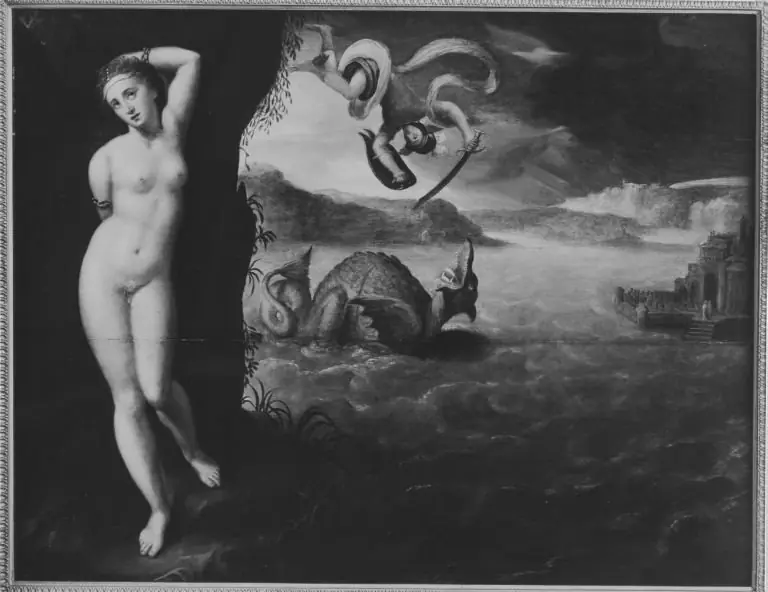
Artist & collection
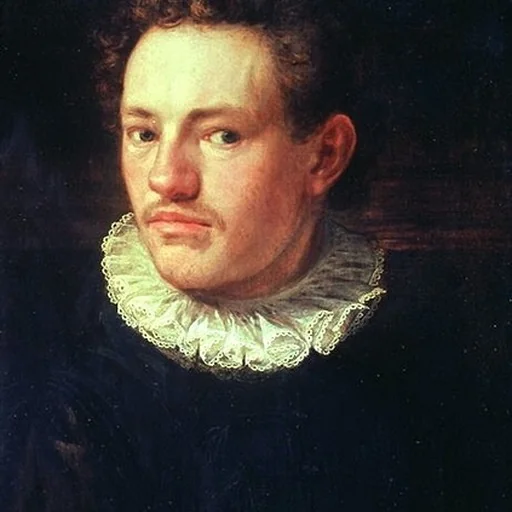
Artist
Hans von Aachen (1552 – 4 March 1615) was a German painter who was one of the leading representatives of Northern Mannerism.