Artwork
The Denial of Saint Peter
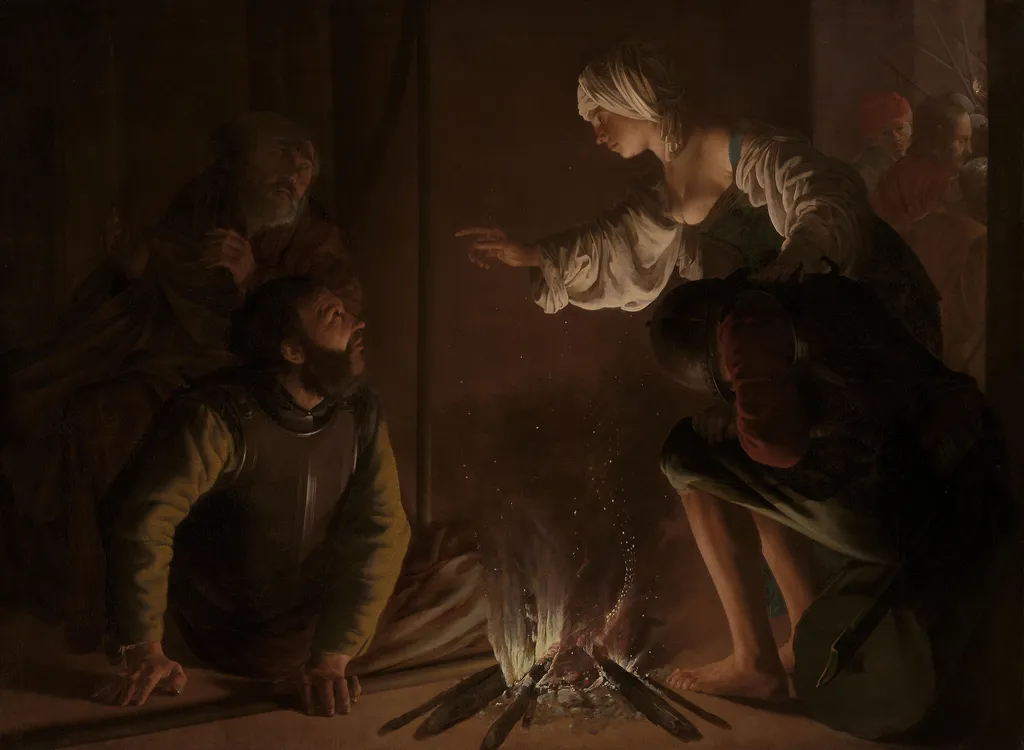
The Denial of Saint Peter is an oil painting by the Caravaggisti artist Hendrick ter Brugghen. It dates from 1628 and is held in the collection of the Art Institute of Chicago.
About this work
Overview
The Denial of Saint Peter is an oil painting on canvas by the Dutch Caravaggist Hendrick ter Brugghen, dated 1628, now in the collection of the Art Institute of Chicago. Measuring 132.3 by 178 centimeters, this religious work depicts the biblical episode in which Saint Peter denies his association with Christ three times before the rooster crows. Painted in the final years of ter Brugghen's life, it represents a significant development in his artistic approach, marked by heightened dramatic lighting and a more resolved, baroque sensibility than his earlier compositions. The painting is notable for its sophisticated synthesis of Italianate chiaroscuro with Northern European iconographic traditions, and for its complex spatial construction that links the viewer directly to the scene of Peter's moral failure.
Subject & Meaning
The palette of browns, blacks, and warm yellows, dominated by the fire's glow, reinforces the nocturnal setting and the moral darkness of Peter's betrayal.
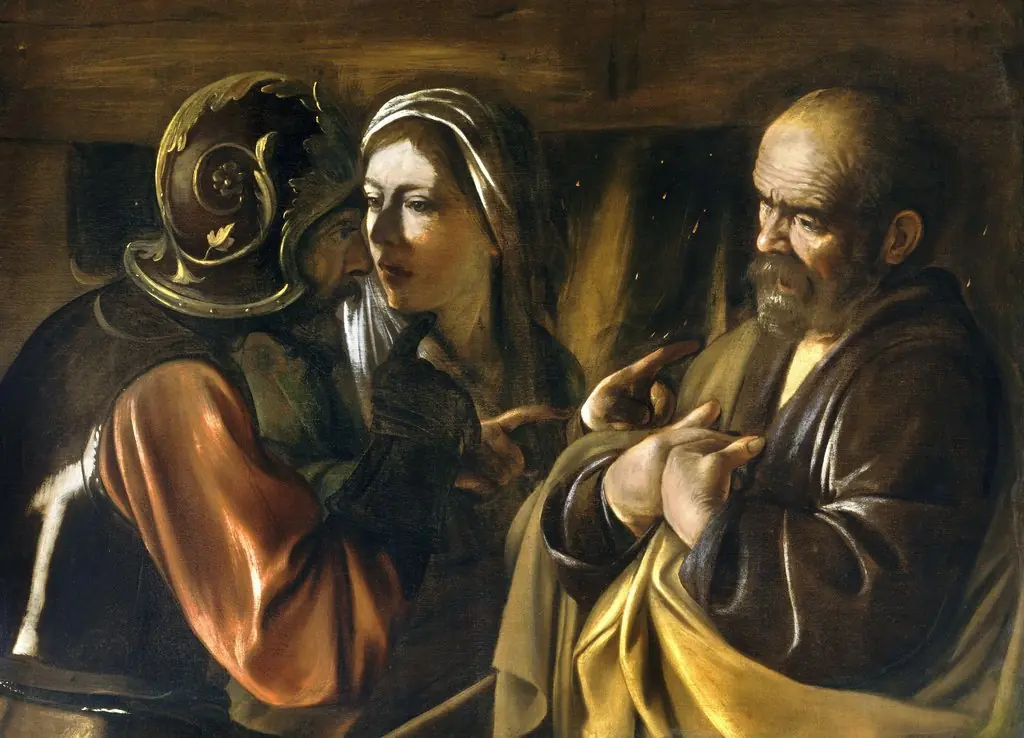
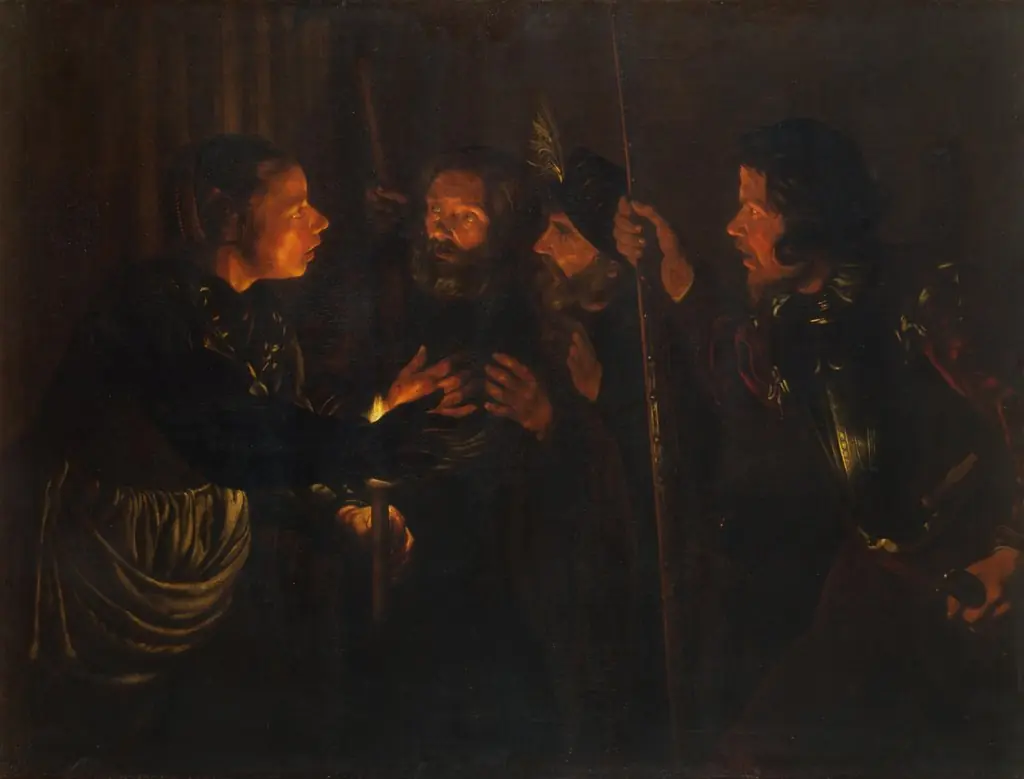
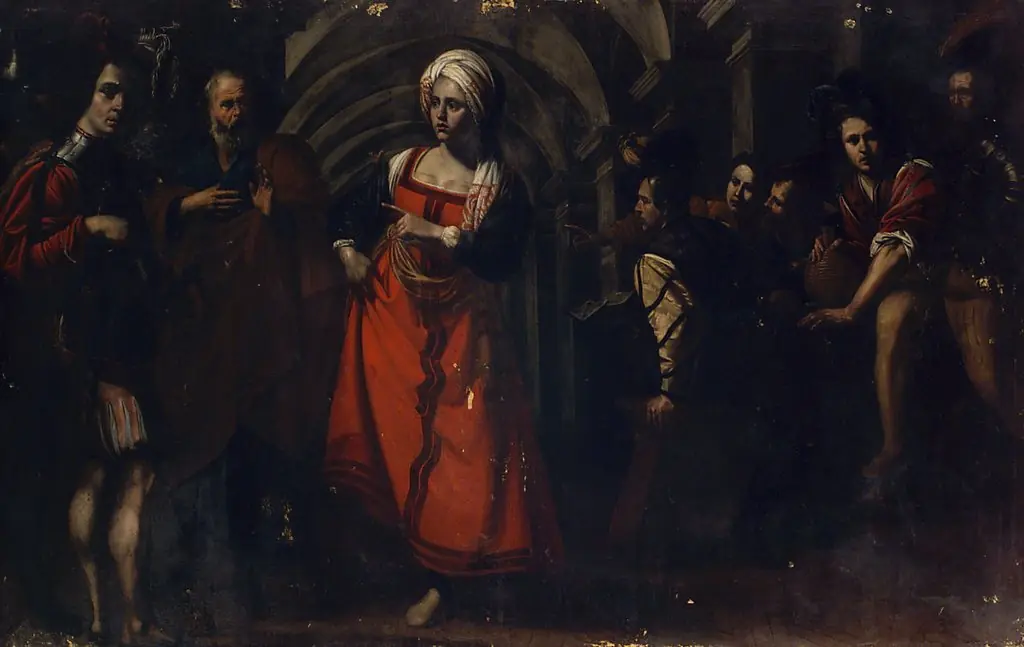
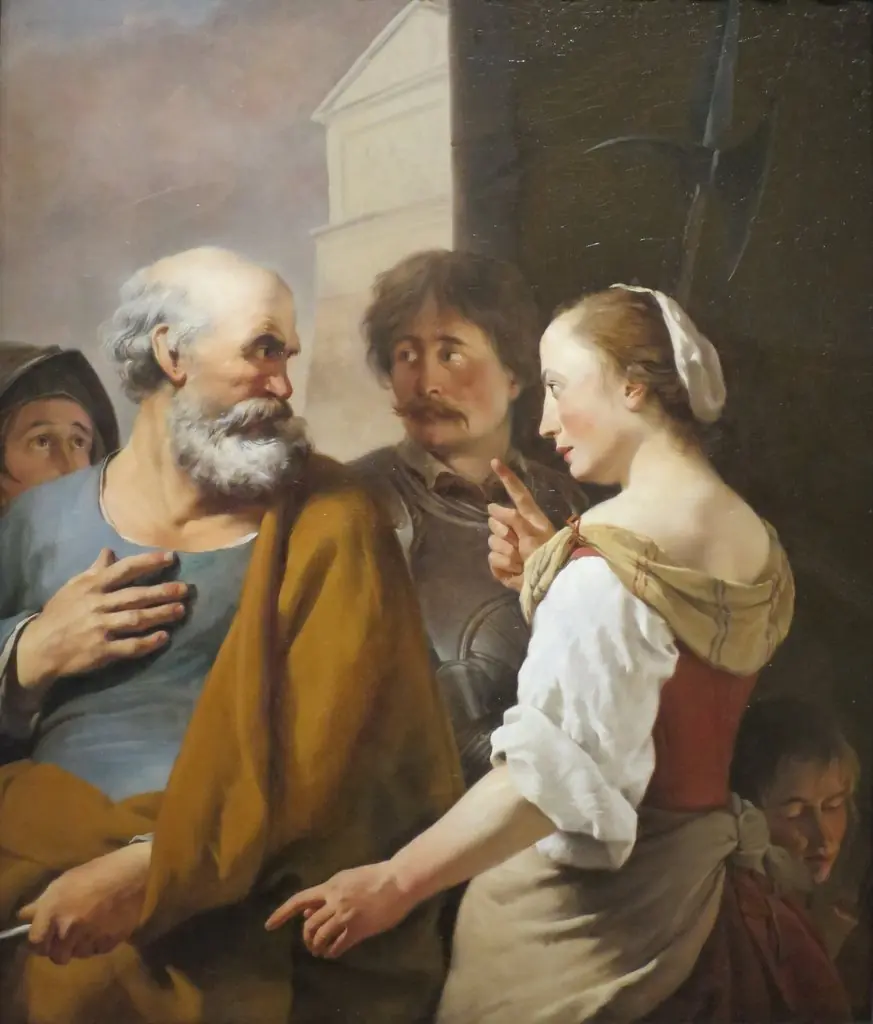
The painting illustrates the Denial of Peter as recounted in the Gospel of Luke 22:55-57, where a servant girl recognizes Peter by the fire and accuses him of being Christ's follower. The composition is structured around a small fire in the lower center, its flames and sparks rising to illuminate the nocturnal scene. At right, the maidservant leans forward with extended arm and pointed index finger, her white headscarf and blouse catching the firelight as she confronts the seated figure of Peter at left. Peter, clad in a metal breastplate over a yellow-green shirt, looks upward toward his accuser with hands resting on a stone ledge, his posture suggesting defensive withdrawal. To Peter's left, an older bearded man in shadow clasps his hands near his chest, while at far right a younger figure sits hunched with head in hand, wrapped in a dark cloak with red inner lining, perhaps already anticipating the consequences of the denial. In the upper right background, two additional figures peer from behind a structure, one wearing a red cap, in a secondary scene depicting Christ's arrest. A figure in this background scene stares directly out at the viewer, implicating the observer in Peter's act of denial. This device derives from Albrecht Dürer's Small Passion: Pilate Washing his Hands of 1512, where a similar figure serves the same function. The palette of browns, blacks, and warm yellows, dominated by the fire's glow, reinforces the nocturnal setting and the moral darkness of Peter's betrayal.
Technique & Style
The painting is executed in oil on canvas, a support that allowed ter Brugghen the flexibility to work at a substantial scale of 132.3 by 178 centimeters. The technique displays strong chiaroscuro, with faces, hands, and fabrics illuminated against deep shadows, creating a dramatic tension appropriate to the subject. The brushwork shows smooth, blended handling on skin surfaces, contrasting with more textured treatment in the fire and fabrics, a differentiation that guides the viewer's attention toward the human drama. The composition demonstrates ter Brugghen's mature style, which the English Wikipedia source characterizes as a marked departure from his earlier painting through its emphasis on light play, baroque quality, and resolved sensibility. The sparseness of the composition eliminates the traditional motif of two sleeping guards, focusing instead on the psychological confrontation between accuser and accused. The soldier supporting himself on his hands, perhaps in the act of rising, relates to a semi-recumbent figure in the left foreground of Caravaggio's The Martyrdom of Saint Matthew in the Contarelli Chapel, Rome, installed in July 1600, which ter Brugghen could have known during his documented presence in Rome by April 1607. The second soldier to the right derives from The Resurrection of Christ in Dürer's Small Passion. The maidservant's accusing arm finds its closest parallel in a fragment of a Denial at Stourhead, while the female model reappears in The Concert and Girl Blowing on a Firebrand of approximately 1626-1627, suggesting ter Brugghen's reuse of effective models and poses across multiple works.
History & Provenance
The Denial of Saint Peter is dated 1628, placing it in the last three years of ter Brugghen's life; he died in 1629. A related work, The Liberation of Peter at the Staatliche Museum, Schwerin, is signed and dated 1629, and the strong stylistic similarities between the two paintings suggest that Denial belongs to this same late period. The painting's provenance can be traced to the collection of Reedtz-Thott at Guanø Castle near Næstved, Denmark, by about 1750. It was owned by Baron Kjeld Thor Tage Otto Reedtz-Thott (1839-1923), 2nd Baron Guanø, by at least 1914, and descended to Baron Axel Reedtz-Thott, who sold it to a London dealer in the late 1960s. By 1968, it was with Wildenstein & Co., New York, and was purchased by the Art Institute of Chicago in February 1969 from the Charles H. and Mary F. S. Worcester Collection. The painting is now accessioned in the permanent collection of the Art Institute of Chicago.
Context
Hendrick ter Brugghen was a central figure among the Dutch Caravaggisti, the Northern European painters who absorbed and transformed the innovations of Caravaggio during the early seventeenth century. His documented presence in Rome by April 1607 placed him in direct contact with Caravaggio's revolutionary works, including The Martyrdom of Saint Matthew in the Contarelli Chapel. The Denial of Saint Peter demonstrates how ter Brugghen, decades after his Italian sojourn, continued to engage with Caravaggesque principles while developing a distinctly personal and mature style. The painting's critical significance lies in its synthesis of Italianate dramatic lighting with Northern European compositional and iconographic traditions, particularly the explicit debt to Albrecht Dürer's Small Passion series. The work's baroque qualities, its emphasis on the play of light, and its resolved sensibility distinguish it from ter Brugghen's earlier productions and align it with the broader developments in European painting of the late 1620s. The painting also relates to two other versions of the subject attributed to ter Brugghen: one in the Shipley Art Gallery in Gateshead, England, which appropriates Dürer's composition directly and in reverse, and another nearly identical painting in the National Museum of Lublin, Poland. These multiple versions indicate the subject's hold on ter Brugghen's imagination and possibly on his clientele. The reuse of the female model across The Concert and Girl Blowing on a Firebrand suggests a workshop practice of employing effective models across different compositions.
Legacy
The Denial of Saint Peter occupies a significant position in the oeuvre of Hendrick ter Brugghen as a demonstration of his mature style and his sustained engagement with Caravaggesque principles late in his career. The painting's acquisition by the Art Institute of Chicago in 1969 secured its place in a major American public collection, ensuring its accessibility for scholarly study and public appreciation. The work has contributed to understanding of the Dutch Caravaggisti as more than mere imitators of Italian models, but as artists who synthesized Northern and Southern European traditions into distinctive personal styles. The explicit connections drawn between ter Brugghen's composition and Dürer's Small Passion have informed scholarship on the persistence and transformation of Renaissance print sources in Baroque painting. The painting's value also resides in its documentation of ter Brugghen's working methods, including his reuse of models and his adaptation of figures from both Caravaggio and Dürer. The two related versions in Gateshead and Lublin continue to prompt discussion of attribution, workshop practice, and the market for religious subjects in the Dutch Republic. As a late work by an artist who died in 1629 at approximately forty years of age, The Denial of Saint Peter represents the unrealized potential of a career cut short, while simultaneously demonstrating the full achievement of ter Brugghen's artistic maturity.
Own this work as a print
Artist & collection
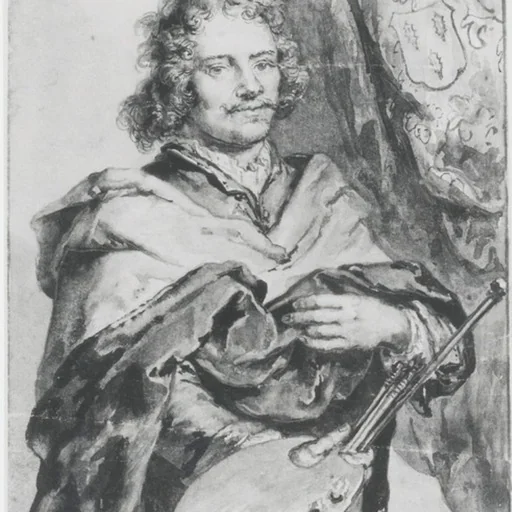
Artist
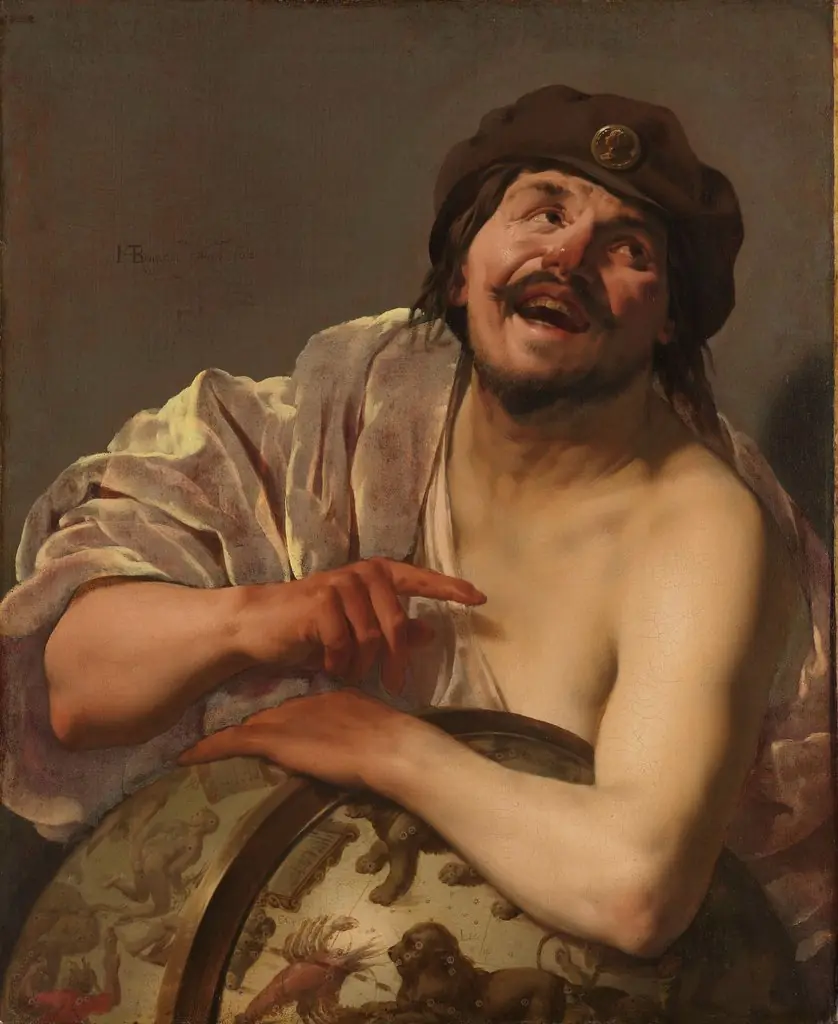
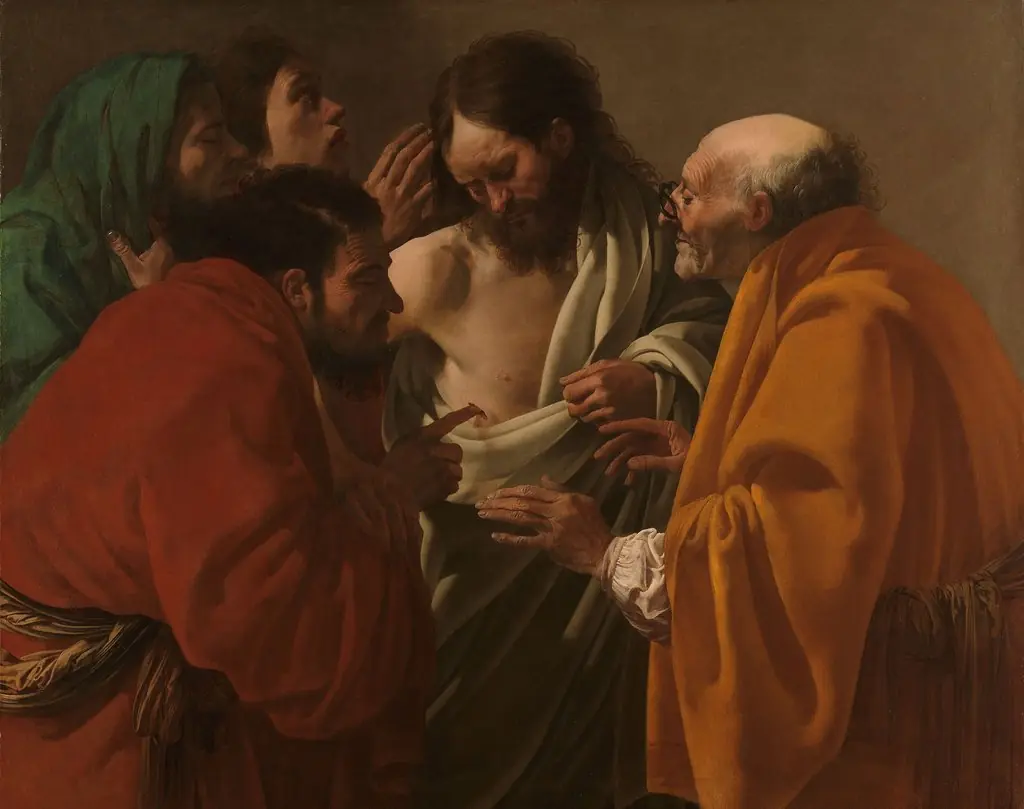
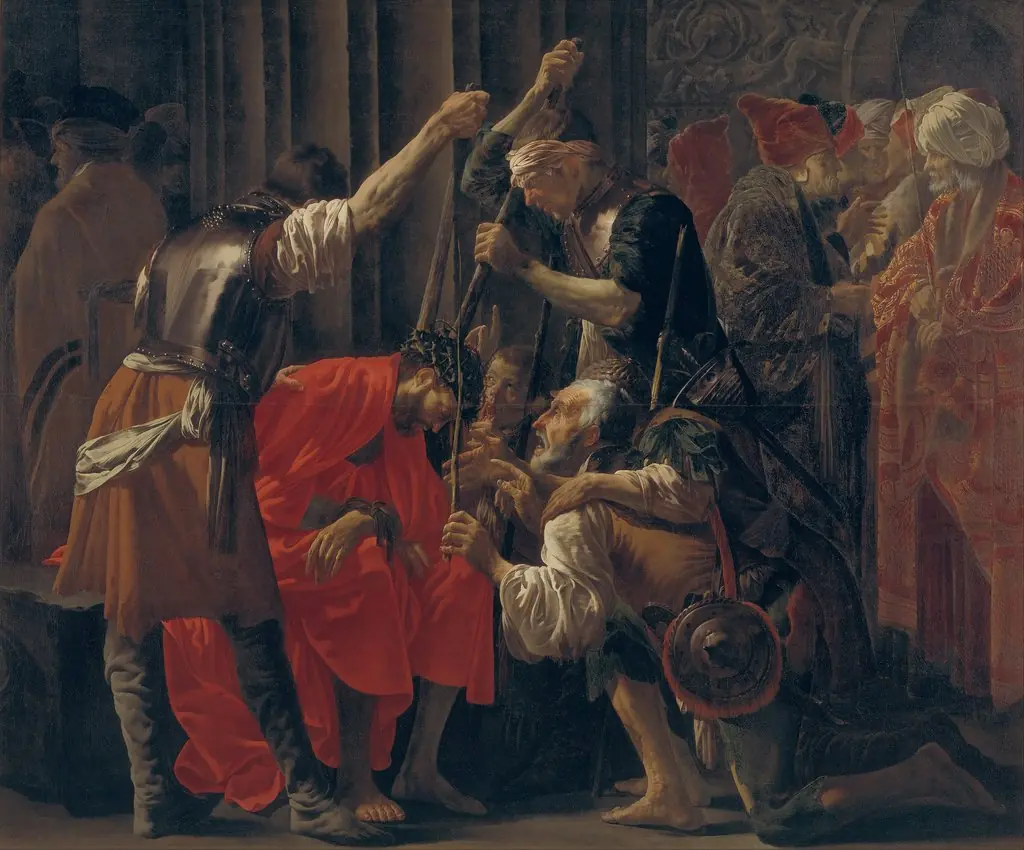
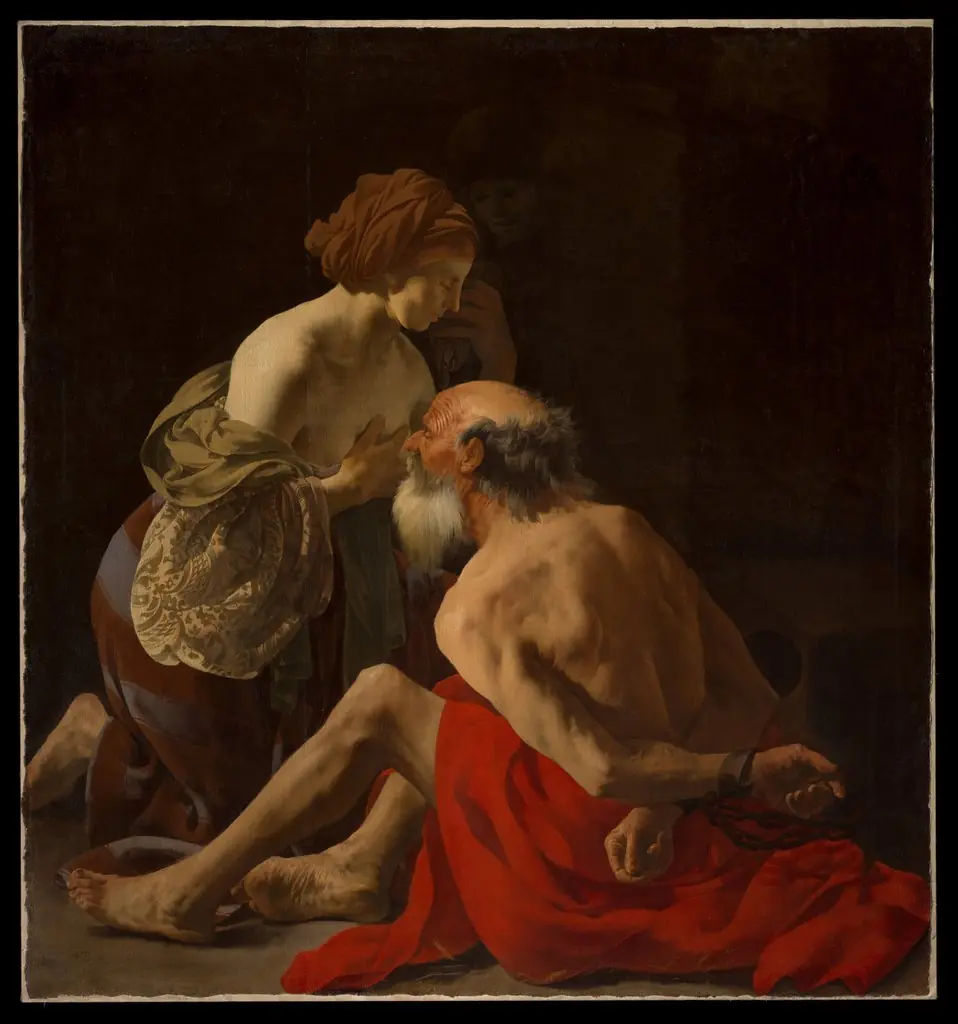
Hendrick Jansz ter Brugghen (or Terbrugghen; 1588 – 1 November 1629) was a Dutch painter of genre scenes and religious subjects.