Artwork
Crucifixion with a Donor
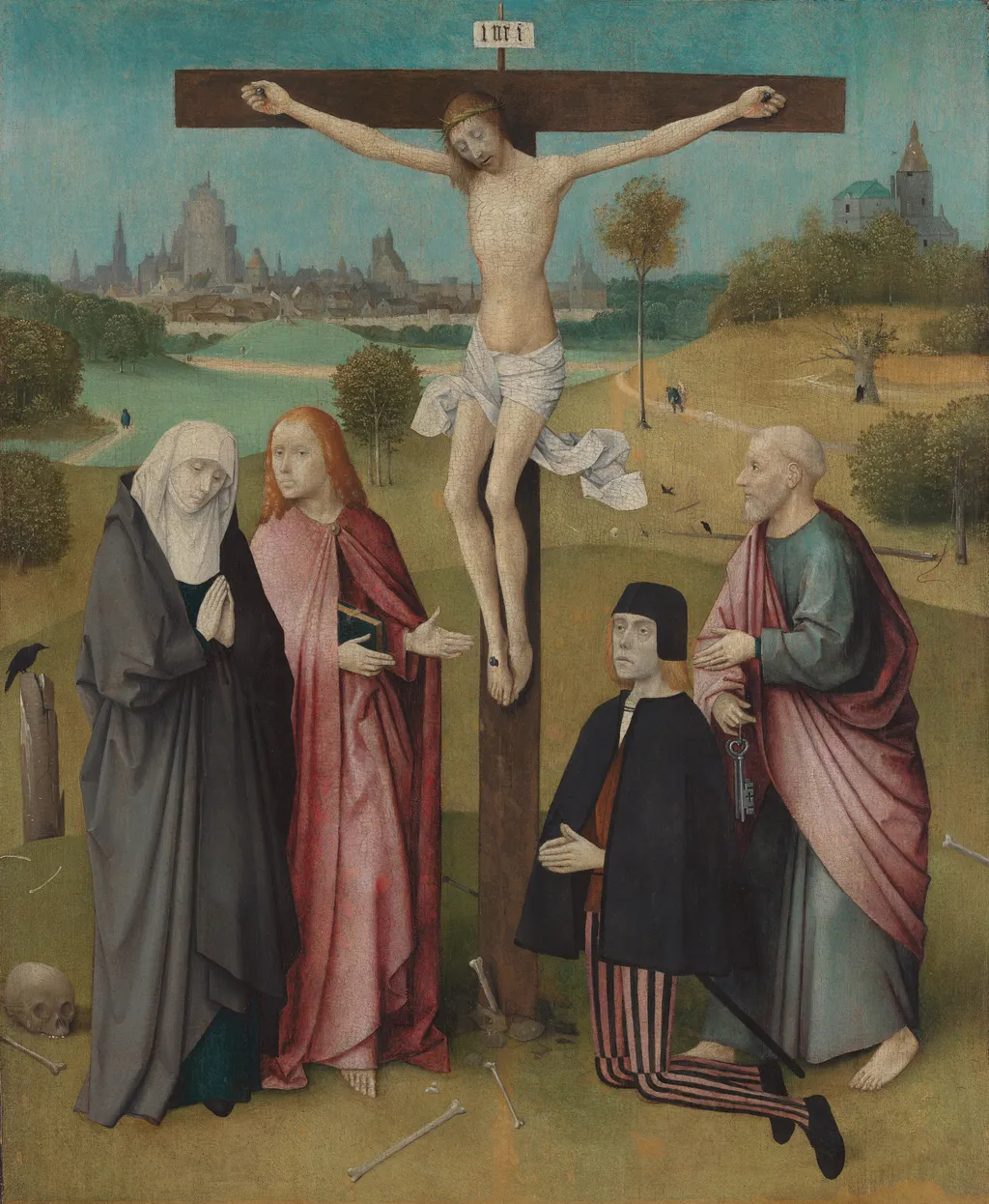
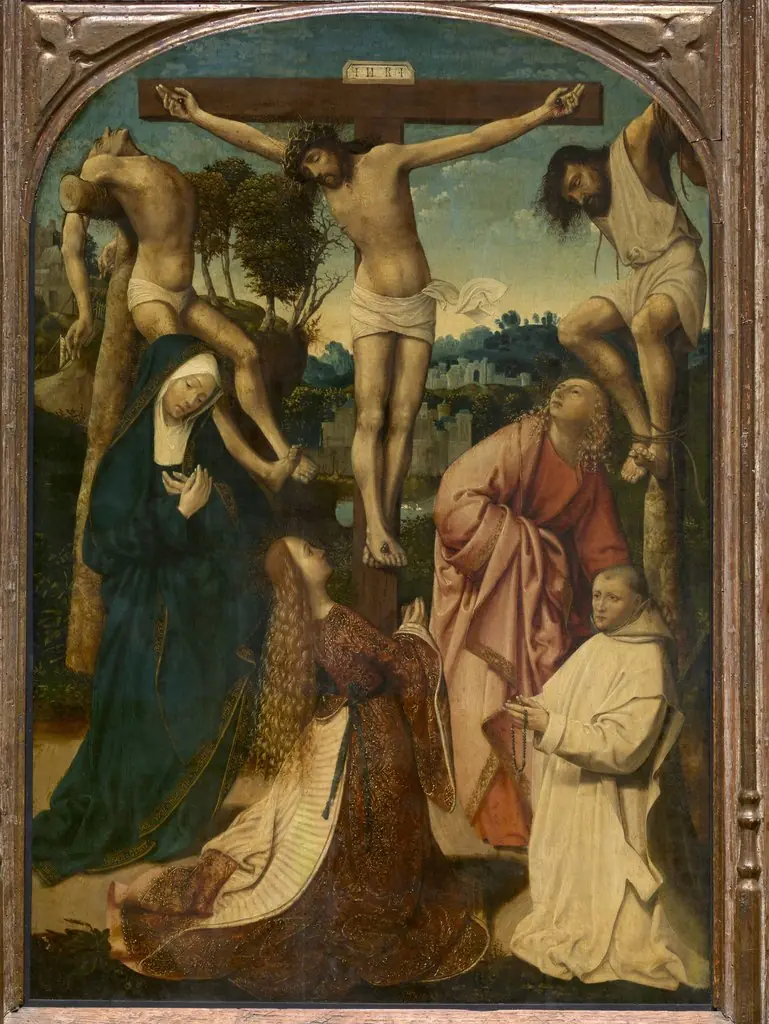
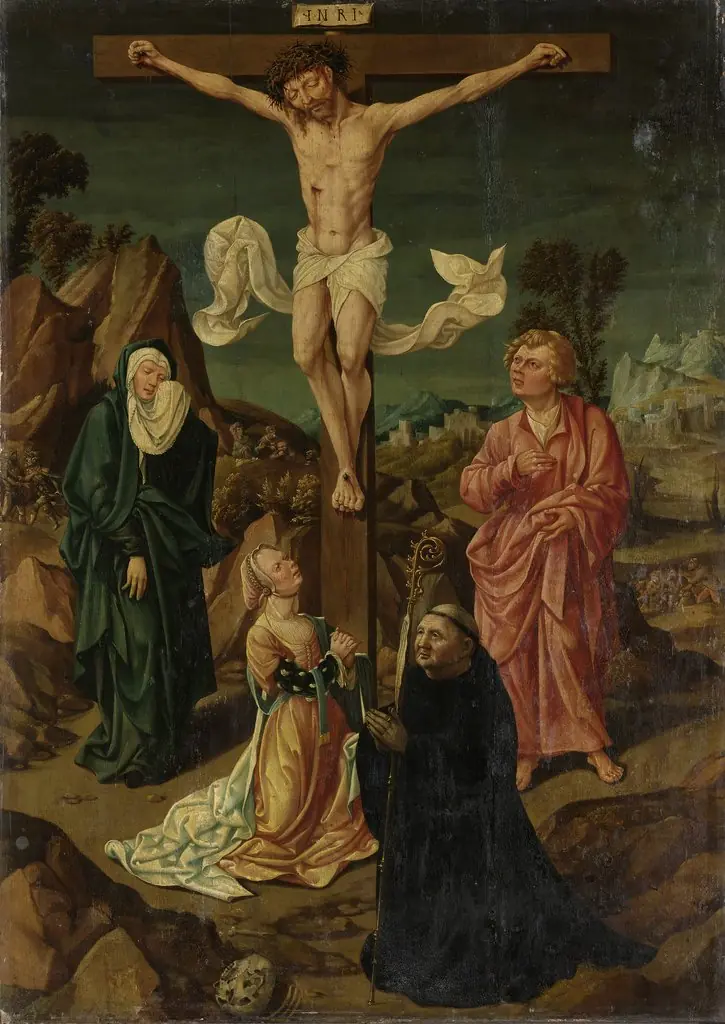
Crucifixion with a Donor is an oil painting by the Northern Renaissance artist Hieronymus Bosch. It dates from 1493 and is held in the collection of the Royal Museums of Fine Arts of Belgium.
About this work
If you’re curious about more Netherlandish art, check out the museum: Royal Museums of Fine Arts of Belgium.
Crucifixion with a Donor is an oil painting by Hieronymus Bosch, dated around 1485. It was created with oil paint on oak panels.
The work is thought to have been painted between 1480 and 1485, placing it early in Bosch’s career. Today it hangs in Brussels at the Royal Museums of Fine Arts of Belgium. It is executed on oak, a common support for paintings of the time.
If you’re curious about more Netherlandish art, check out the museum: Royal Museums of Fine Arts of Belgium.
Overview
Crucifixion with a Donor is an oil painting on oak panel by the Netherlandish artist Hieronymus Bosch, completed around 1483 or shortly thereafter. Measuring 74.7 by 61 centimetres, the work depicts the Crucifixion of Christ with attendant saints and a kneeling donor portrait. It is held in the Oldmasters Museum, part of the Royal Museums of Fine Arts of Belgium in Brussels, where it entered the collection in August 1952. The painting occupies a significant place in Bosch's oeuvre as an early work that demonstrates his engagement with Flemish tradition while already hinting at the distinctive visual imagination that would characterise his mature career. Dendrochronological analysis has been crucial in establishing its date, overturning earlier assumptions that it was a youthful work from the mid-1470s.
Subject & Meaning
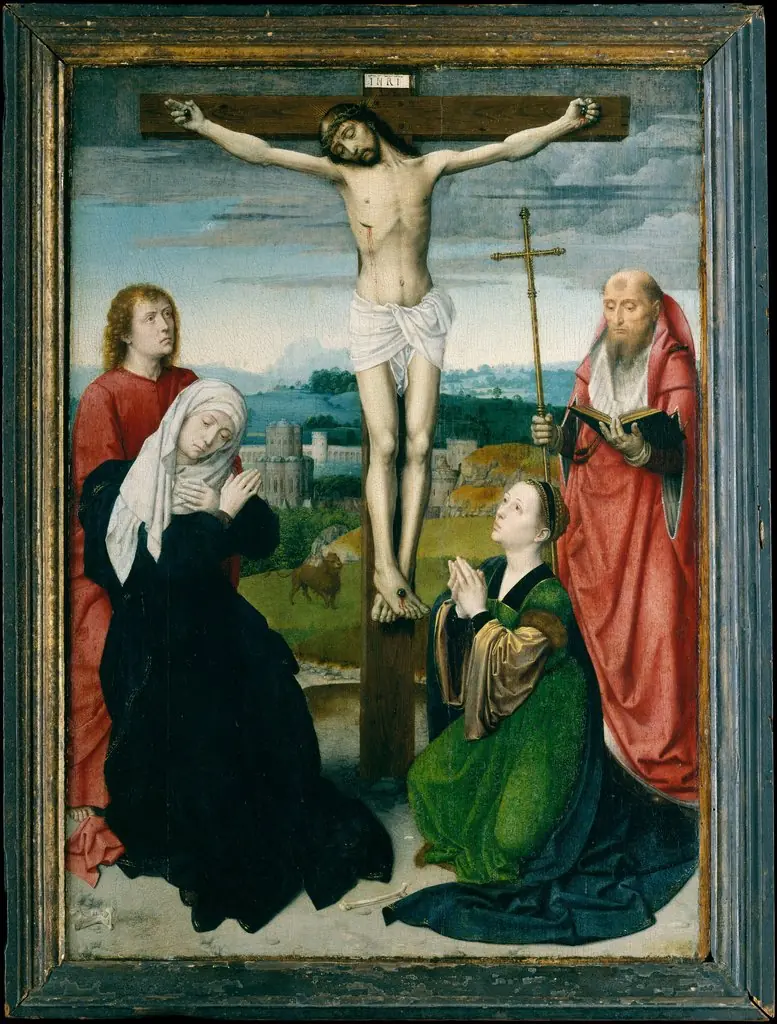
The central subject is the Crucifixion of Jesus, identified by the INRI plaque above his head. Christ wears a white perizoma and is flanked by four standing figures: at the left, the Virgin Mary in dark blue with hands clasped in prayer, and beside her the apostle John in a pink robe with red cloak, holding a book and extending his hand toward the cross. At the right, a kneeling donor in black coat and striped pink hose looks outward, presented by Saint Peter, who stands behind him holding the keys of heaven and gesturing toward the donor. The donor's pale complexion suggests he may have been deceased at the time of commission, making the panel a votive work pleading for his soul's salvation. His probable name was Peter or a similar variant, given his presentation by his name saint. At the foot of the cross, scattered bones and a skull serve as memento mori, reminding viewers of their own mortality. The background landscape contains a winding river, trees, distant figures, and a city with Gothic spires, possibly representing 's-Hertogenbosch. A withered tree with renewed foliage at the far right carries dual symbolism: Christ's death and resurrection, and the sinner's hope of eternal life through repentance. Roger-Henri Marijnissen has noted the psychological connections between the figures, describing "lines of thought, genuine psychological bonds" that animate the otherwise silent, still composition.
Technique & Style
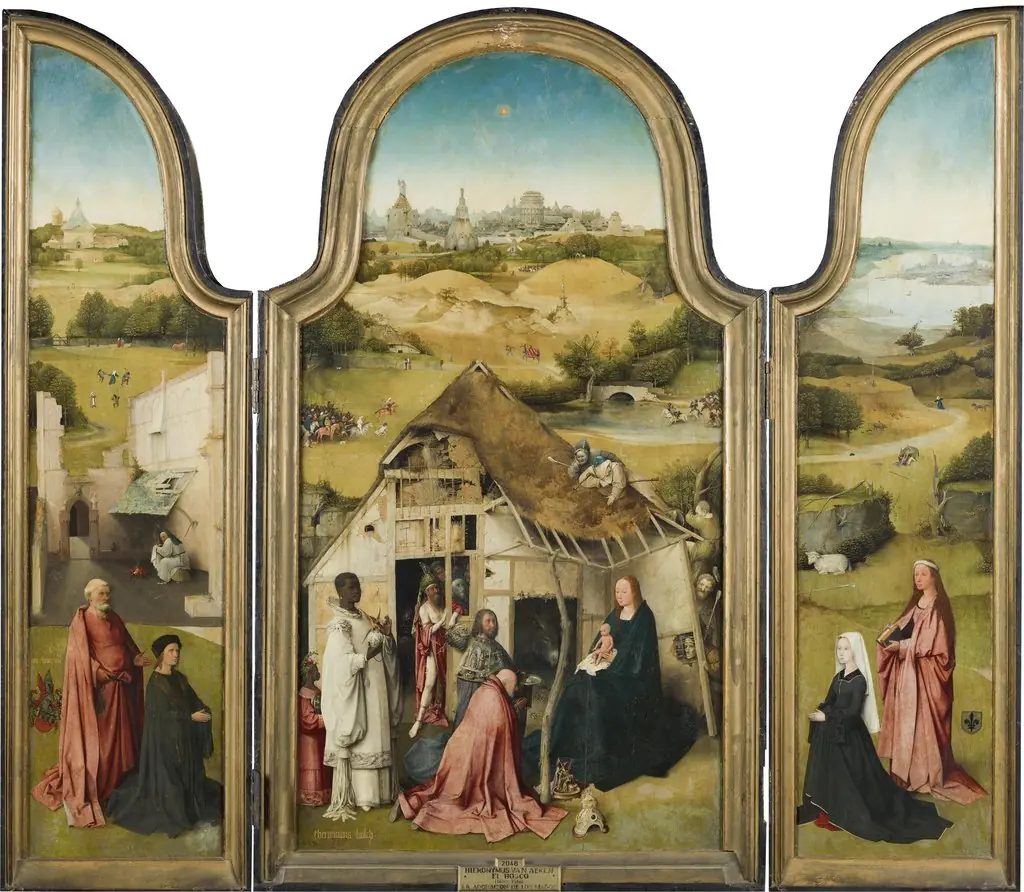
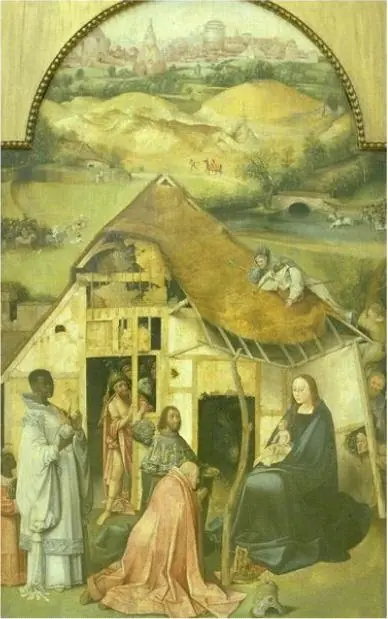
The painting is executed in oil on oak panel. Its surface shows fine craquelure throughout. The colour palette is muted, consisting of soft blues, pinks, greens, and earth tones. The composition is broadly symmetrical and frontal, with shallow space and even, diffuse light. Max Friedländer observed connections to Rogier van der Weyden in the angularity of the figures and the fluttering of Christ's loincloth. Charles de Tolnay noted that the type of Christ figure also appears in a 1444 mural in Sint-Jan in 's-Hertogenbosch, possibly connected to Bosch's grandfather Jan van Aken, indicating Bosch's grounding in local tradition rather than in the more monumental examples of Jan van Eyck or Geertgen tot Sint Jans. The landscape treatment anticipates Bosch's later working methods, with green tones deepening into bluish atmospheric haze toward the horizon, demonstrating what Italian sources describe as extraordinary atmospheric sensitivity. Bernard Vermet has noted that the landscape construction resembles that of the Adoration of the Magi triptych in the Prado, Madrid. The composition's rejection of strict symmetry and its insistence on stillness and silence represent original departures from conventional Crucifixion imagery.
History & Provenance
The painting's earliest documented mention dates to April 1664 in 's-Hertogenbosch, where a painting on panel depicting "the crucifixion of Christ, done by Jeronimus Bos" with its wooden frame was recorded; this may correspond to the present work. The painting was later in the collection of Édouard Fétis (1812-1909) in Brussels, then passed to the collection of the Franchomme-Van Halteren couple, also in Brussels. In August 1952, the widow Franchomme-Van Halteren sold it to the Royal Museums of Fine Arts of Belgium. It has been exhibited on several notable occasions: at the Académie royale in Brussels in 1886; at the Exposition des primitifs septentrionaux at the Royal Museums of Fine Arts in May-June 1923; at a retrospective of Flemish landscape painting in Brussels in 1926; at Museum Boymans in Rotterdam in 1936 for the Jeroen Bosch exhibition; at the Royal Museums of Fine Arts in Brussels in 1937; and at the Worcester Art Museum in Massachusetts in 1939. A restoration in 1966-1967 revealed that the donor portrait had been overpainted at some point, probably with a Mary Magdalene, after the work lost its original function following the donor's death.
Context
The dating of Crucifixion with a Donor has been among the most debated aspects of the work. Early scholars including Jacques Combe (1946), Robert Delevoy (1960), Leo van Puyvelde (1962), and Erik Larsen (1998) favoured a date of 1475-1477, considering it a youthful work. Others such as Carl Linfert (1959) and Mia Cinotti (1966) proposed 1480-1485. Dendrochronological research by Pascale Fraiture of the University of Liège definitively established that the work could not have been painted before 1483, meaning Bosch was approximately thirty-three years old or older at its completion. This overturns the notion of it as a juvenile work. Ludwig von Baldass had dated it around 1480 based on the donor's costume, a dating now considered too early. The painting's probable origin in 's-Hertogenbosch is supported by the cityscape in the background and its affinities with the Sint-Jan mural. Some scholars have connected it to a Crucifixion fresco in the cathedral of Saint John in 's-Hertogenbosch, today attributed to Bosch's grandfather, though hard proof for this connection is lacking. The work demonstrates Bosch's early adherence to local tradition, which de Tolnay argued allowed him later to develop his uniquely innovative visual language. Vermet has not excluded some workshop involvement in its execution.
Legacy
Crucifixion with a Donor remains a foundational work for understanding Bosch's artistic development. It illustrates the transition from Early Netherlandish conventions toward his personal vision, with the landscape already showing the atmospheric sensitivity and symbolic complexity that would define his mature paintings. The work's value for scholars lies particularly in its demonstration that Bosch's originality emerged not from direct engagement with the most celebrated Flemish masters but from a deep roots in local tradition, which he subsequently transformed. The dendrochronological dating has reshaped understanding of Bosch's chronology, pushing back the timeline of his early career and suggesting a longer gestation period for his distinctive style. The painting continues to be studied as evidence of how devotional portraiture and landscape could be integrated within traditional religious subjects, and how even conventional compositions could be infused with psychological depth and symbolic resonance. Its permanent place in the Royal Museums of Fine Arts of Belgium ensures its accessibility for continued research and public appreciation.
Own this work as a print
Artist & collection
Artist
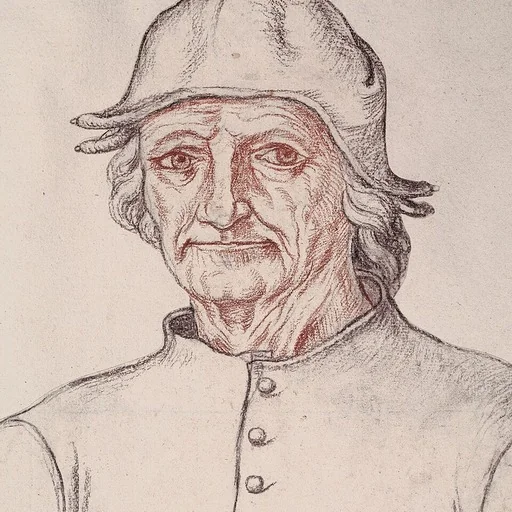
Hieronymus Bosch (; Dutch:; born Jheronimus van Aken; c. 1450 – 9 August 1516) was a Dutch painter from Brabant. He is one of the most notable representatives of the Early Netherlandish painting school. His work,…

Museum
Royal Museums of Fine Arts of Belgium
Continue through works from the same source collection.