Artwork
The Art of Painting
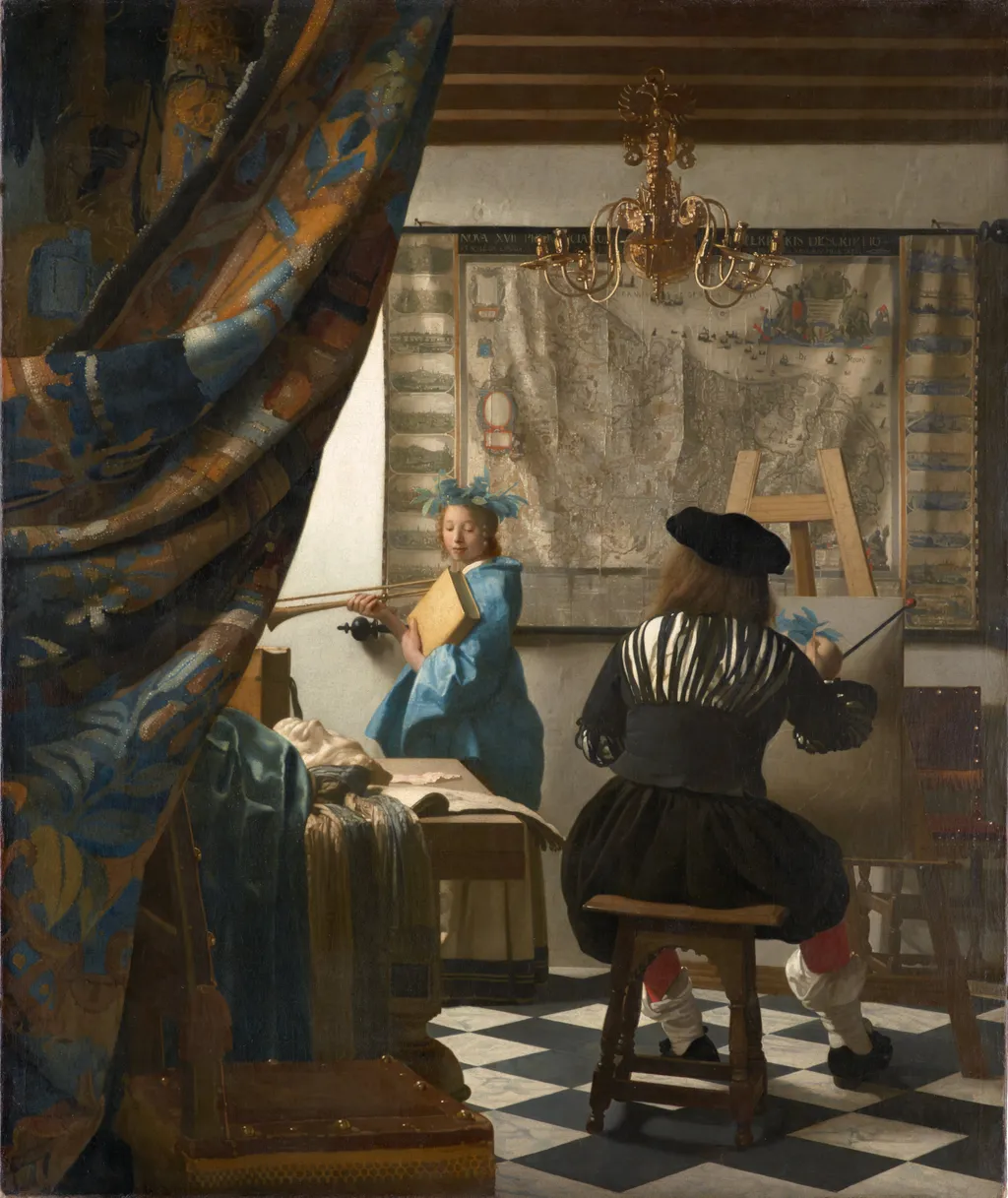
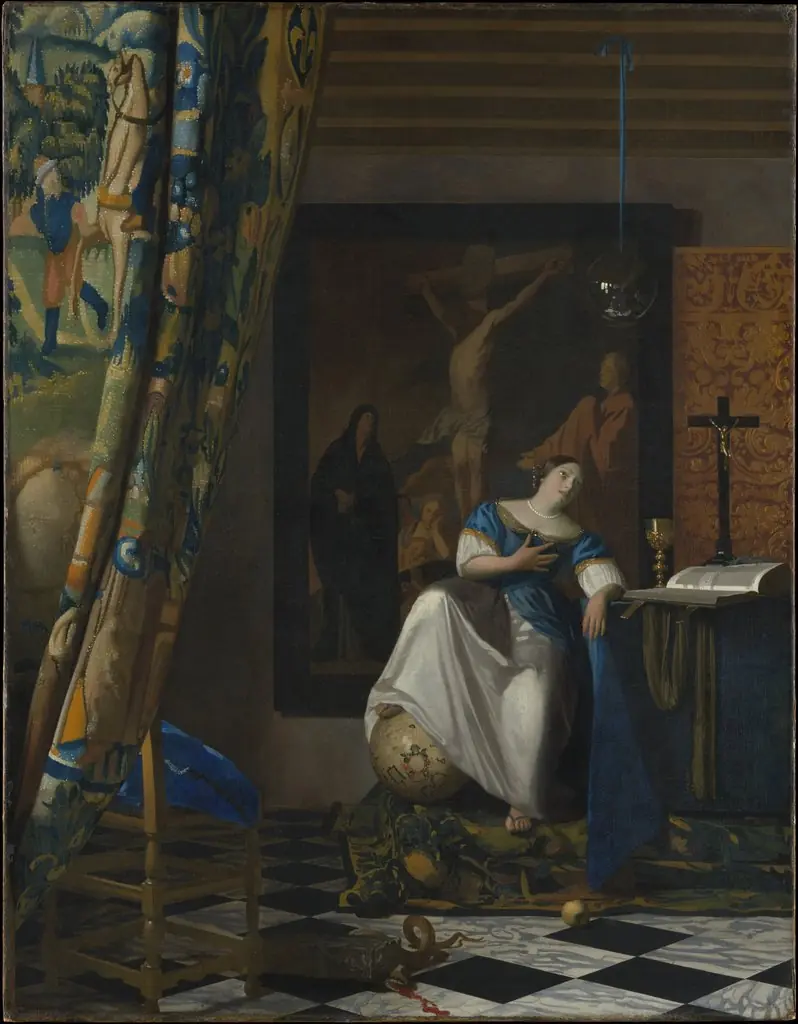
The Art of Painting is an oil painting by the Baroque artist Johannes Vermeer. It dates from 1667 and is held in the collection of the Kunsthistorisches Museum.
About this work
Here’s a fresh rewrite that meets all constraints:
This painting shows a painter at work. It’s an oil on canvas by Johannes Vermeer, finished around 1667. It lives in the Kunsthistorisches Museum in Vienna.
The artist painted himself from behind, focused on his craft. A model sits nearby, draped in a blue and gold outfit. The artist holds a sketchbook and palette.
Look up Johannes Vermeer next.
Subject & Meaning
The overall composition has been described as Vermeer’s summation of his art, integrating naturalistic technique with complex allegorical meaning.
The painting is widely interpreted as an allegory of painting itself, aligning with Cesare Ripa’s emblems in Iconologia. The female figure has been linked to Clio, muse of History, wearing a laurel wreath and holding a trumpet and a book, attributes consistent with Ripa’s prescriptions for History personified.
The map of the Seventeen Provinces behind her, published by Claes Janszoon Visscher in 1636, is read as an emblem of Dutch geography and history. Its prominent crease has been interpreted as symbolizing the political division between the northern Dutch Republic and the southern provinces under Habsburg rule, though some scholars caution against overemphasizing political readings.
The double‑headed eagle in the chandelier has been associated with Habsburg authority, while the plaster mask and open sketchbook on the table have been connected to artistic imitation and the liberal arts. The overall composition has been described as Vermeer’s summation of his art, integrating naturalistic technique with complex allegorical meaning.
Technique & Style
Executed in oil on canvas, this work measures 120 by 100 cm, ranking among the artist's largest creations. The composition demonstrates a virtuoso command of perspective, anchored by a black-and-white marble tiled floor and a vanishing point located just below the model. Technical analysis, including X-ray imaging, reveals a small pinhole at this focal spot, indicating the artist used a string and chalk to map out geometric guidelines before painting.
The surface displays an illusionistic handling of light, particularly in the rendering of the golden chandelier, the heavy tapestry repoussoir, and the textured map on the rear wall. Each object is depicted with distinct material effects, showing how different surfaces absorb or reflect illumination. The painter figure is shown working on a grey-primed canvas, capturing the moment of artistic conception with a mahlstick in hand.
History & Provenance
Created in Delft around 1667, The Art of Painting was never sold by Johannes Vermeer during his lifetime, despite his financial difficulties. Following his death in 1675, his widow Catharina Bolnes transferred the work to her mother, Maria Thins, in 1676 in an attempt to shield it from creditors, a transfer contested by the estate's executor, the scientist Antoni van Leeuwenhoek. Long misattributed to Pieter de Hooch, the painting later passed to Gottfried van Swieten and was acquired by Count Johann Rudolf Czernin in 1813, remaining with the Czernin family.
In November 1940 Adolf Hitler purchased it from Count Jaromir Czernin for 1.65 million Reichsmark through Hans Posse. Recovered from the Altaussee salt mine in 1945, it was handed to Austria in 1946 and has since been held by the Kunsthistorisches Museum in Vienna. In 2011 an Austrian restitution committee ruled the wartime sale had not been coercive.
Context
Scholars have long debated whether The Art of Painting functions as a literal studio scene or an allegory of the art of painting itself. Early recognition of its allegorical ambition came in 1868, when Théophile Thoré-Bürger, credited with reviving interest in Vermeer, singled it out as the Dutch master’s most interesting work, linking it to broader traditions of emblem books such as Cesare Ripa’s Iconologia.
Twentieth-century art historians deepened the allegorical reading: Svetlana Alpers described the painting as unique and ambitious, while Walter Liedtke emphasized its virtuoso display of invention and execution in an imagined studio. Albert Blankert later praised its flawless integration of naturalistic technique, luminous space, and complex composition. Interpretations of the robed model have variously identified her as Fama, Pictura, or Clio, the Muse of History, owing to attributes like the laurel wreath and trumpet, aligning with Ripa’s prescriptions.
Some readings link poetry and history via the map of the Seventeen Provinces and the chandelier’s Habsburg double-headed eagle, though Liedtke cautions against reductive political readings.
The work’s status as Vermeer’s own studio statement is underscored by its retention until his death; his widow’s 1676 attempt to shield it from creditors underscores its personal significance. Its later notoriety grew after its reattribution in the 1860s, and its wartime history, seized by Hitler in 1940 and restituted in 1945, has cemented its place among canonical European masterpieces.
Legacy
The Art of Painting has long been regarded as a cornerstone of Vermeer's oeuvre and a touchstone in the historiography of Dutch art. In 1868, the French critic Thoré-Bürger, the scholar credited with rediscovering Vermeer, called it his most interesting work, and subsequent commentators have reinforced that assessment: Svetlana Alpers described it as unique and ambitious, Walter Liedtke characterized it as a virtuoso display of invention and execution staged in an imaginary studio, and Albert Blankert wrote that no other Vermeer integrates naturalistic technique, illuminated space, and complex composition so flawlessly. The painting also left a direct mark on twentieth-century art: Salvador Dalí explicitly referenced it in his 1934 surrealist composition Le Spectre de Vermeer de Delft, in which the back-turned figure of Vermeer is reimagined as a piece of furniture.
More broadly, Michel Butor included it among the 105 decisive works of Western painting in his musée imaginaire, securing its place in the canon of European art history.
Overview
The Art of Painting, also known by titles such as The Allegory of Painting, is a significant oil on canvas work by the Dutch artist Johannes Vermeer. Created around 1667, this 17th-century piece depicts a painter engaged in his craft within a studio setting. It is currently held by the Austrian Republic and displayed in the Kunsthistorisches Museum in Vienna, representing a key example of Vermeer's detailed interior scenes.
Own this work as a print
Artist & collection
Artist
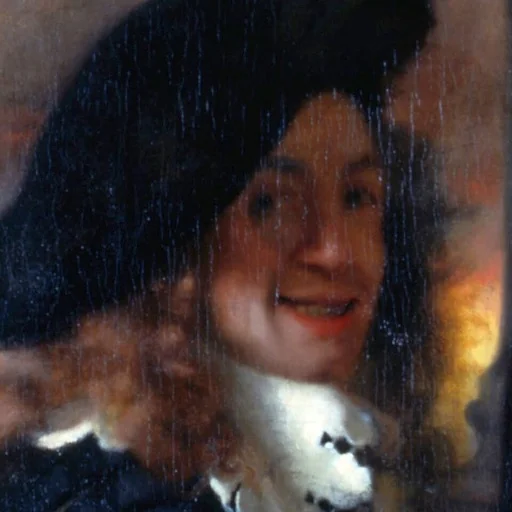
Johannes Vermeer ( vər-MEER, vər-MAIR, Dutch:; see below; also known as Jan Vermeer; October 1632 – 15 December 1675) was a Dutch painter who specialized in domestic interior scenes of middle-class life.