Artwork
Tempi Madonna
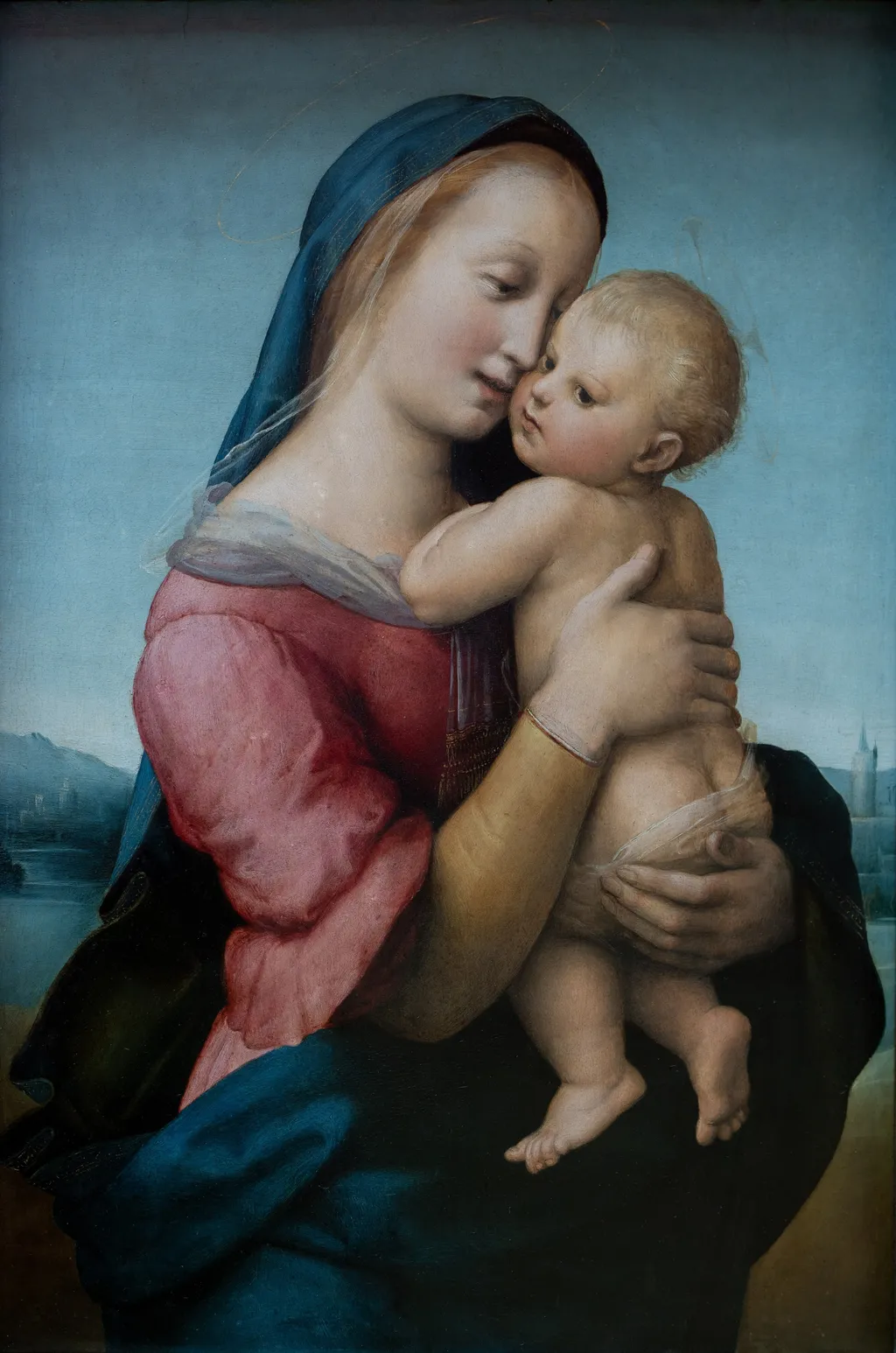
Tempi Madonna is an oil painting by the High Renaissance artist Raphael. It dates from 1508 and is held in the collection of the Bavarian State Painting Collections.
About this work
Subject & Meaning
The composition is characterized by a spiral motion, emphasized by the sinuous drapery of the Virgin's mantle and the naturalistic movement of the figures.
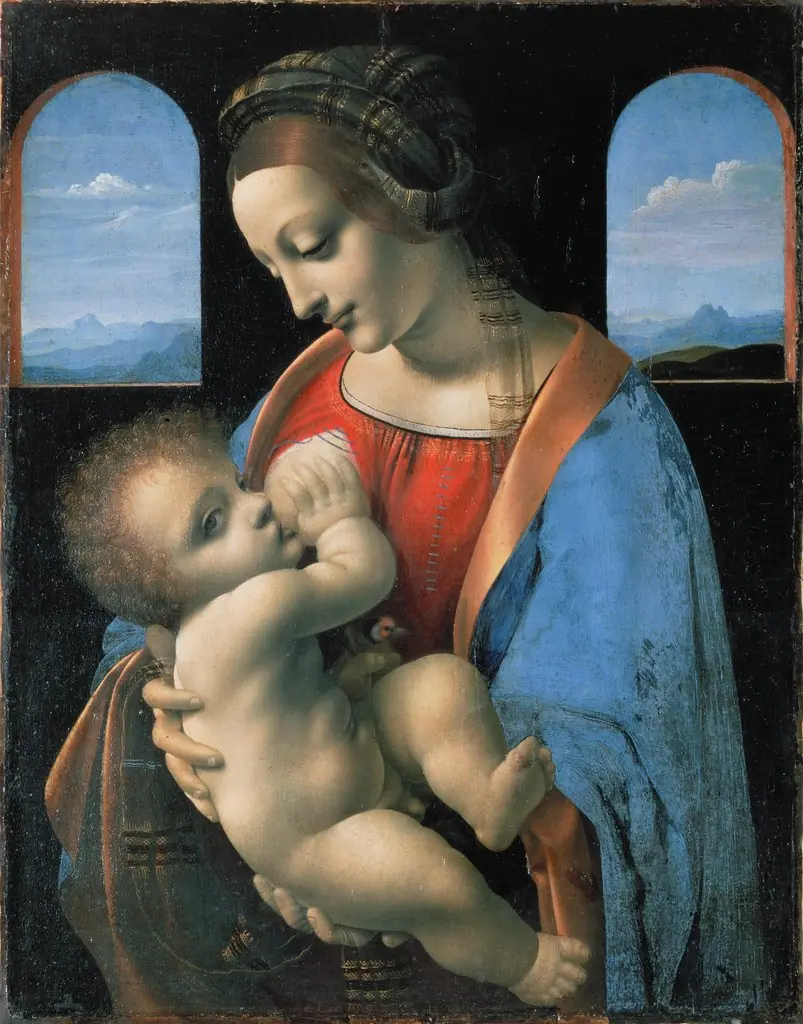
The Tempi Madonna depicts the Virgin Mary and the Christ Child as the sole figures, adhering to the traditional iconography of the Madonna and Child. Raphael portrays the Virgin standing in a half-length view, holding the infant tightly against her with their cheeks touching, a compositional detail derived from Byzantine prototypes of the Virgin Eleousa. This intimate gesture, combined with the Virgin's lowered gaze and the Child's direct look at the viewer, transforms the scene into an idealized representation of maternal tenderness and affection.
The composition is characterized by a spiral motion, emphasized by the sinuous drapery of the Virgin's mantle and the naturalistic movement of the figures. While the background features a minimal landscape with distant hills and water, the focus remains on the emotional connection between mother and son. The work synthesizes High Renaissance ideals, elevating natural human interaction into a vision of perfected beauty and divine love.
History & Provenance
The Tempi Madonna is dated to 1508, produced toward the close of Raphael's Florentine period, and was created for the Tempi family in Florence. An eighteenth-century document records the painting as belonging to the Tempi family of Florence, who retained it until 1829. Crown Prince Ludwig of Bavaria pursued the work for roughly two decades, corresponding with the Grand Duke of Baden to retain his agent, the engraver Metzger, in Florence, and raising his offer from 6,000 to 16,000 Roman scudi.
The purchase was finalized on 9 February 1829. Ludwig I kept the painting in the Cecilia Chapel of the royal residence until 1835, after which it entered the Alte Pinakothek in Munich, where it remains as royal private property within the Bavarian State Painting Collections.
The Tempi Madonna is held in the Alte Pinakothek, Munich, as part of the Bavarian State Painting Collections.
It is inventoried as Alte Pinakothek, inv. no. 7769. The painting entered the collection in 1829 after its acquisition by Ludwig I of Bavaria from the Tempi family of Florence.
Context
Art historians classify the Tempi Madonna as a defining work of Raphael's late Florentine period, dated to 1508. Scholars regard it as one of the most beautiful Madonna representations of the early 16th century, marking the conclusion of the artist's development in Florence alongside the Madonna del Granduca. The composition is frequently analyzed for its synthesis of High Renaissance ideals, where naturalism is elevated through idealized beauty and proportion.
Critics note the work's dynamic, spiral-like movement and the intimate interaction between the figures, which combines compositional elegance with deep emotionality. Stylistic analysis often traces the grouping of the faces to lost reliefs by Donatello, specifically citing prototypes like the Madonna Pazzi. This integration of sculptural references with a luminous, atmospheric background demonstrates Raphael's ability to merge artistic perfection with a sense of lifelike spontaneity.
Legacy
The Tempi Madonna is regarded as one of the finest Madonna compositions of the early sixteenth century, marking the close of Raphael's Florentine period alongside the slightly earlier Madonna del Granduca. German-language scholarship describes it as belonging to "die schönsten Madonnendarstellungen des frühen 16. Jahrhunderts," praising Raphael's ability to unite compositional beauty with emotional intimacy, idealizing motherly love itself.
The work's composition draws on a lost relief by Donatello, known through copies, with the cheek-to-cheek pose of mother and child echoing Byzantine Virgin Eleousa prototypes as well as Donatello's Madonna Pazzi and a tondo in the Miracle of the Speaking Newborn altarpiece. Italian commentary highlights the extraordinary balance between artistic perfection and naturalism, while the spiraling movement of the mantle and embrace unifies the group. The painting's enduring prestige is reflected in its acquisition history: Crown Prince Ludwig of Bavaria pursued it for roughly two decades, raising his offer from 6,000 to 16,000 Roman scudi before the purchase was concluded on 9 February 1829.
The painting remains part of the Bavarian State Painting Collections at the Alte Pinakothek, where it continues to be cited as a touchstone of Raphael's early Madonnas.
Overview
Raphael's Tempi Madonna, an oil painting from the Italian High Renaissance, is thought to have been completed around 1508, marking the close of his Florentine period. This work depicts the Virgin Mary tenderly embracing the Christ Child, a common theme for the artist. Originally commissioned by the Tempi family, it now resides in the Alte Pinakothek in Munich, having been acquired by Ludwig I of Bavaria in 1829.
Technique & Style
Raphael employed oil paint with smooth, layered applications to achieve a refined surface. The artist skillfully manipulated light and shadow, a technique known as chiaroscuro, to give the figures a sense of volume and depth. This precise illumination, particularly on the child's face and the Virgin's arm, creates a three-dimensional quality, enhancing the naturalism of the tender embrace.
Own this work as a print
Artist & collection

Artist
Raphael was born Raffaello Sanzio in Urbino on April 6, 1483, the son of Giovanni Santi, a painter and poet attached to the ducal court.