Artwork
Saint Benedict Orders Saint Maurus to the Rescue of Saint Placidus
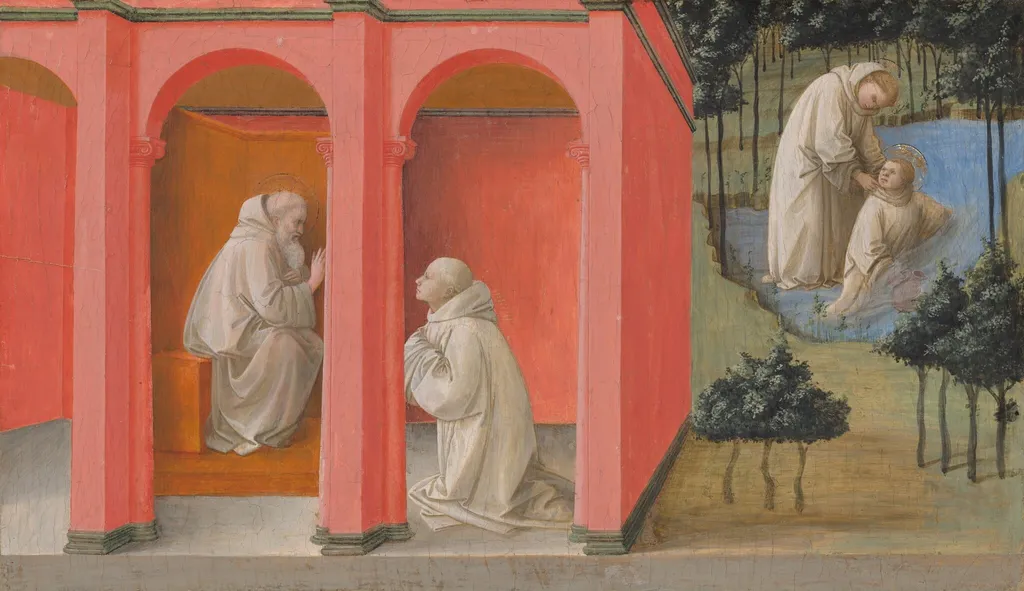
Saint Benedict Orders Saint Maurus to the Rescue of Saint Placidus is a tempera painting by the Early Renaissance artist Filippo, Fra Lippi. It dates from 1448 and is held in the collection of the National Gallery of Art.
About this work
Subject & Meaning
The didactic clarity of the action, with eloquent gestures and dynamic movement, is characteristic of Fra Filippo Lippi's narrative style.
The painting illustrates an episode from the second book of Pope Gregory the Great's Dialogues, in which Saint Benedict, while in his cell, miraculously senses that the young Saint Placidus has fallen into a lake while drawing water and is being swept away by the current. Benedict urgently summons Saint Maurus, ordering him to run to Placidus's rescue. The composition is divided into two narrative moments: on the left, beneath a pink portico rendered in sharp perspective, Benedict speaks to Maurus, while on the right, in a bird's-eye landscape, Maurus rushes across the water to save the drowning Placidus.
The scene carries clear monastic symbolism, presenting Benedict's gift of prophecy and the obedience of his disciple Maurus as models of Benedictine spiritual discipline. The didactic clarity of the action, with eloquent gestures and dynamic movement, is characteristic of Fra Filippo Lippi's narrative style.
Technique & Style
Filippo Lippi executed Saint Benedict Orders Saint Maurus to the Rescue of Saint Placidus in tempera on panel, a medium typical of mid-fifteenth-century Florentine painting. The support measures approximately 41.9 × 71.5 cm and consists of a single wooden panel prepared with a traditional gesso ground. Lippi's handling is characterized by subtle chiaroscuro, modelling figures with soft transitions between light and shadow to create a sense of volumetric solidity.
The composition employs linear perspective to structure the architectural setting, while the landscape recedes with an almost aerial viewpoint, enhancing spatial depth. Stylistically, the work reflects Lippi's debt to Fra Angelico in its essential clarity and spiritual tone, yet distinguishes itself through dynamic figural gestures and narrative immediacy, with accents such as the bright pink portico adding visual emphasis. The panel remains part of the National Gallery of Art's collection.
History & Provenance
The panel is one of the predella scenes from the main altarpiece of the church of San Bernardo in Arezzo, executed by Filippo Lippi around 1448. After the altarpiece was dismantled in the eighteenth century, the predella remained in the adjacent Olivetan monastery at least until 1767. By 1873 it had entered the Milanese trade, passing through Michele Cavaleri to Enrico Cernuschi in Paris.
It later belonged to Édouard Aynard of Lyons and was sold at the 1913 Galerie Georges Petit auction to Hoentschel, subsequently moving to Mme Douine's Château de la Boissière. Acquired in New York by Wildenstein in December 1942, it was purchased by the Samuel H. Kress Foundation in 1943 and donated to the National Gallery of Art, Washington, in 1952, where it remains as part of the Samuel H. Kress Collection.
Overview
Fra Filippo Lippi's 'Saint Benedict Orders Saint Maurus to the Rescue of Saint Placidus,' painted in 1448 in tempera on panel, illustrates a miraculous episode from the life of St. Benedict of Nursia. The composition is divided into two distinct narrative zones within an architectural and natural landscape. On the left, set against pink columns and arches, St. Benedict stands under an archway, issuing a command to St. Maurus, who kneels before him in obedience.
This group represents the moment Benedict instructs Maurus to save the drowning St. Placidus. To the right, the scene shifts to the water's edge where St. Maurus is depicted walking on the surface of the lake to reach the boy, St. Placidus, who is struggling in the water. The painting demonstrates Lippi's early mastery of spatial depth and his integration of classical architectural elements with religious narrative, characteristic of his work during the mid-15th century in Florence.
The work serves as a visual exegesis of the Rule of St. Benedict, specifically highlighting the themes of obedience and divine intervention.
Context
This panel is not a standalone work but originally formed part of a more extensive artistic commission. Such multi-panel or integrated artworks were common in the 15th century, often serving as altarpieces or predella panels that narrated the lives of saints or biblical stories. Its original placement would have contributed to a broader visual and theological program.

Artist & collection



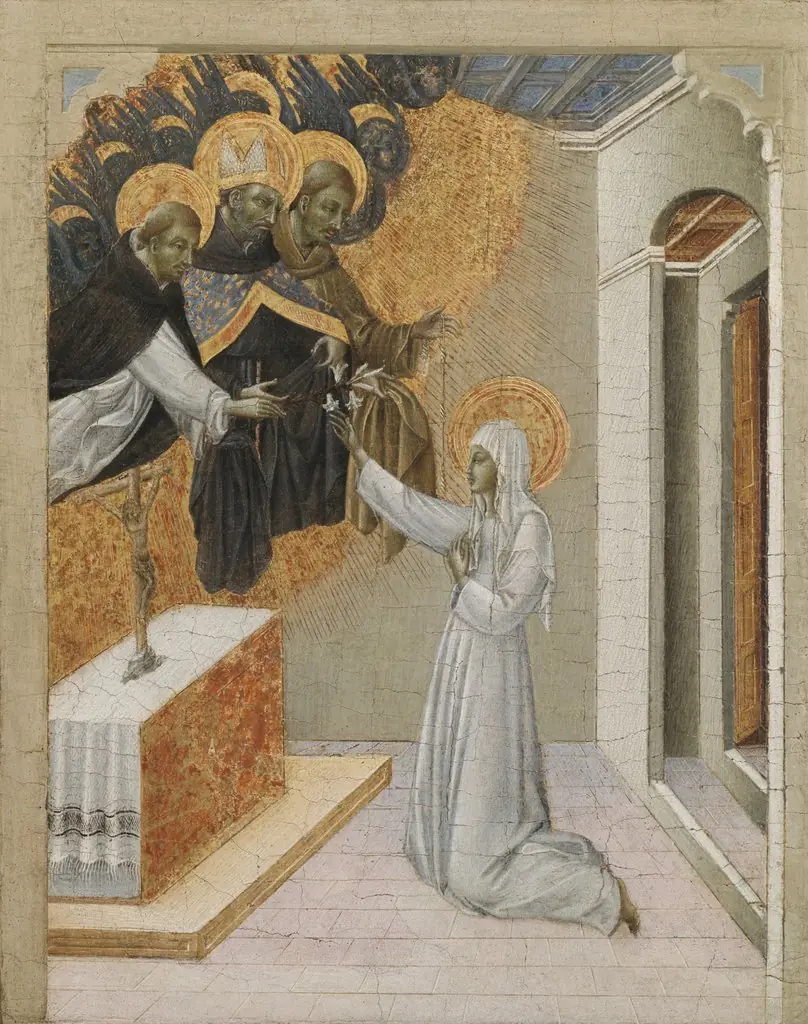 Predella Panel from an Altarpiece: St. Catherine of Siena Invested with the Dominican Habit
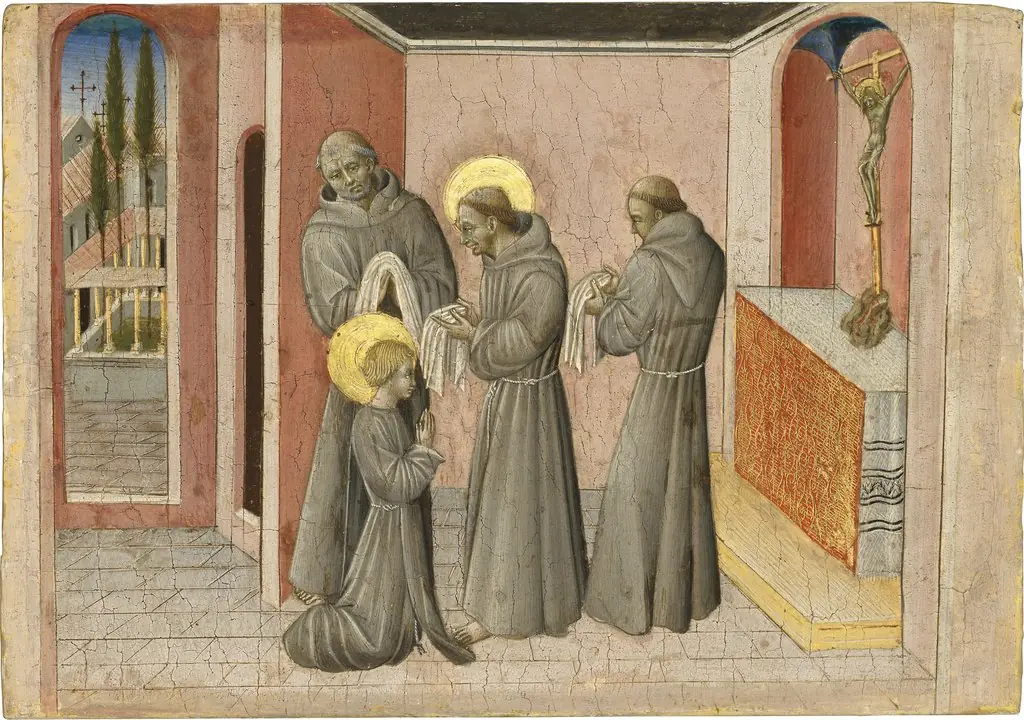 The Investiture of Saint Clare: the Saint receiving the clothes of her Order from Saint Francis
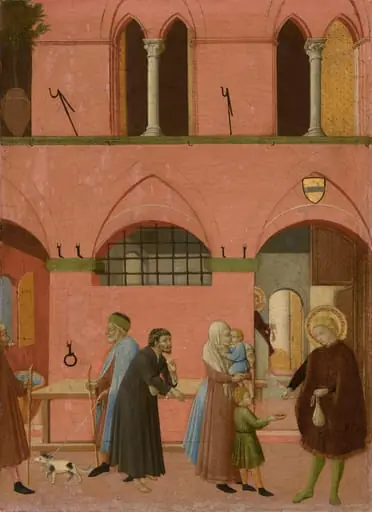 Saint Anthony Distributing His Wealth to the Poor
![The Papacy Offered to Saint Gregory the Great [?], by Fra Angelico](https://artifactworldgallery.com/img/fra-angelico--the-papacy-offered-to-saint-gregory-the-great--6c28505dc47c9093-w320.webp) The Papacy Offered to Saint Gregory the Great [?]
The Papacy Offered to Saint Gregory the Great [?]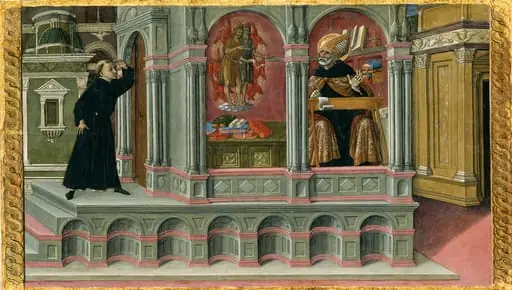 Saint Augustine's Vision of Saints Jerome and John the Baptist
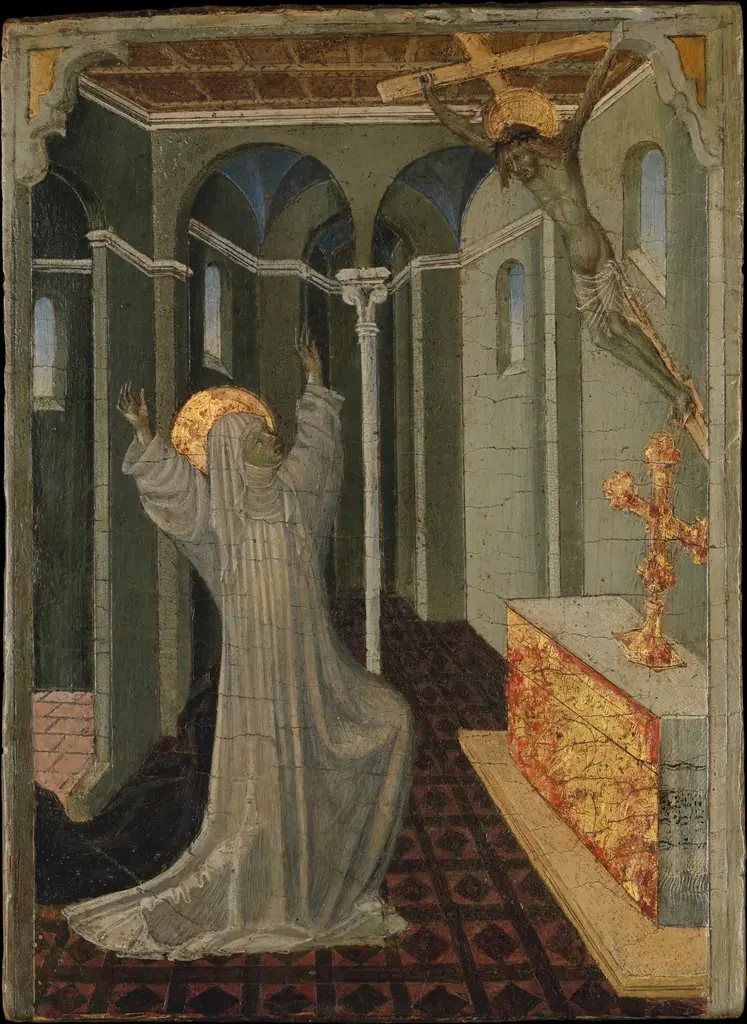 Saint Catherine of Siena Receiving the Stigmata
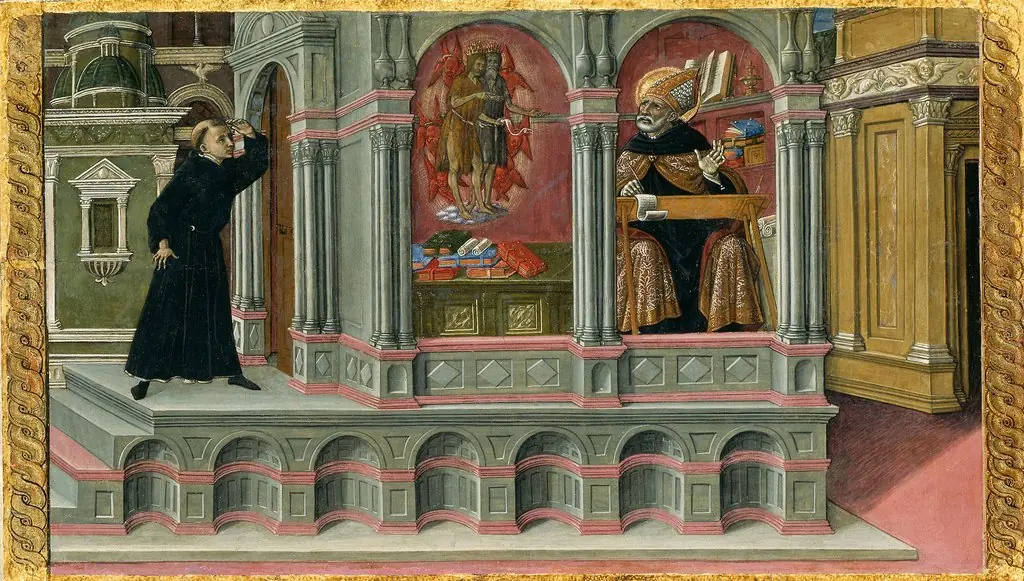 Saint Augustine's Vision of Saints Jerome and John the Baptist
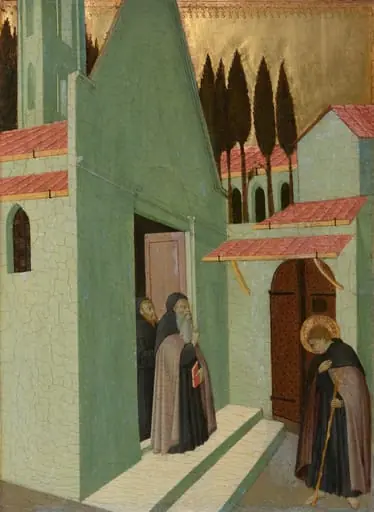 Saint Anthony Leaving His Monastery
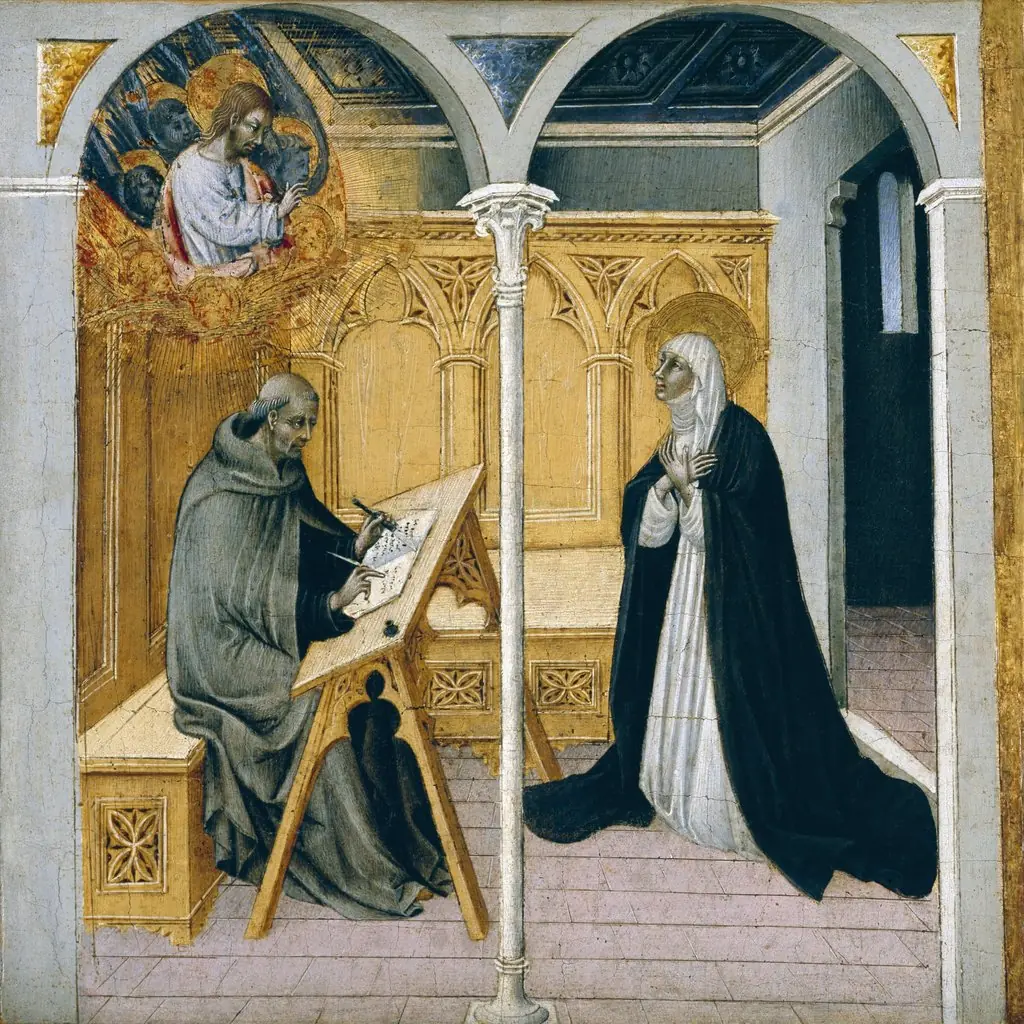 Saint Catherine of Siena Dictating Her Dialogues
 The Meeting of Saint Anthony and Saint Paul
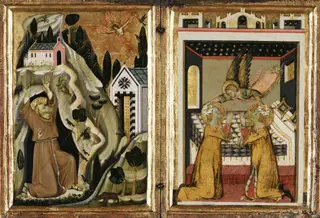 The Stigmatization of St. Francis, and Angel Crowning Saints Cecilia and Valerian
- Saint Nicholas of Tolentino Rescuing a Boy from Drowning