Artwork
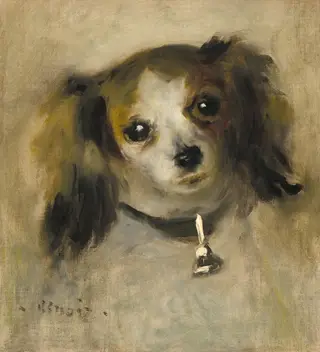
A King Charles Spaniel
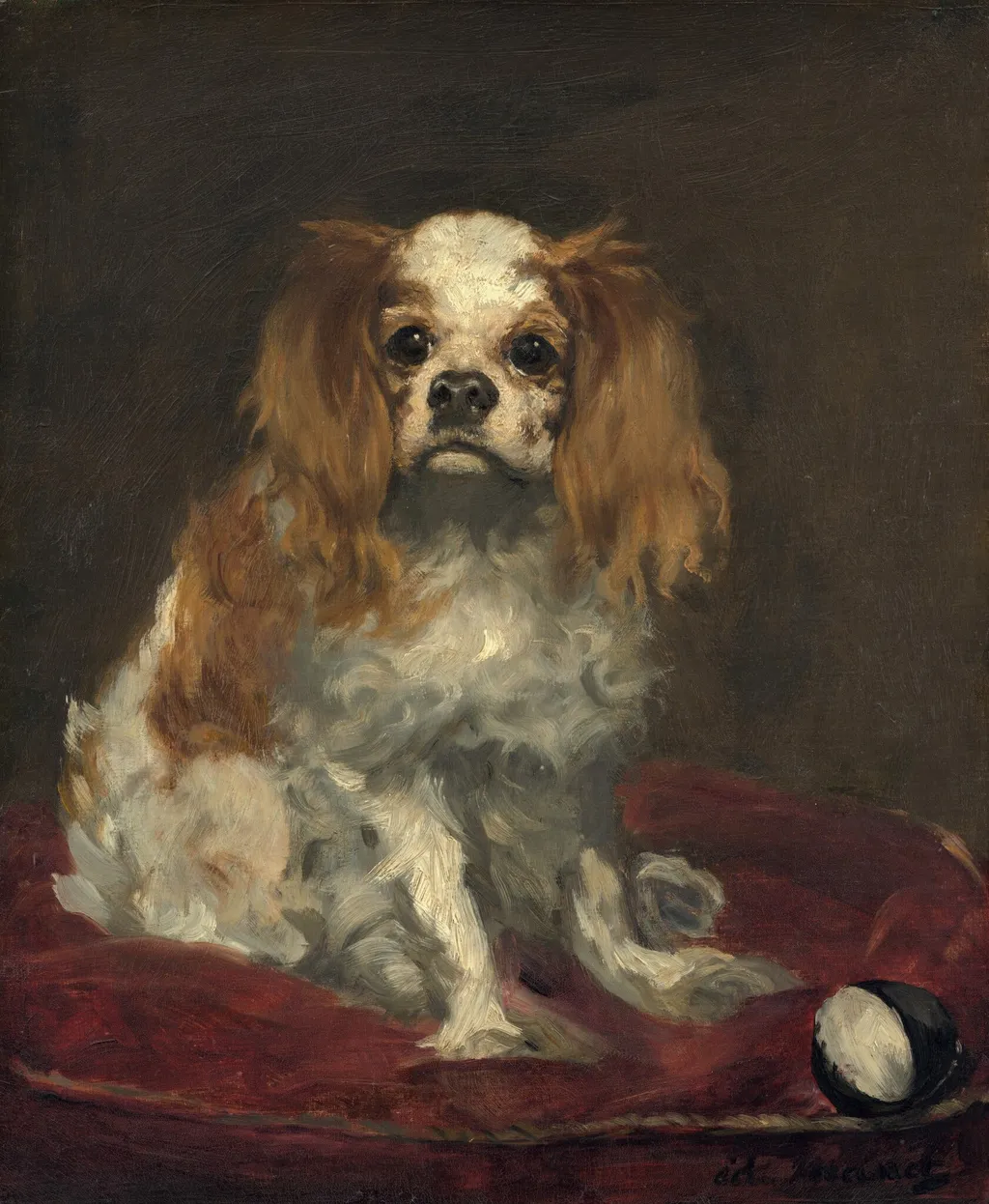
A King Charles Spaniel is an oil painting by the Impressionist artist Édouard Manet. It dates from 1866 and is held in the collection of the National Gallery of Art.
- Inscription
- Inscribed:lower right: ed. Manet
About this work
Technique & Style
The handling eschews fine detail in favor of a lively, almost sketch-like immediacy that underscores the animal’s presence without recourse to academic finish.
The work is an oil painting on linen support, executed in 1866 by Édouard Manet. The canvas measures 46 cm in height and 38 cm in width, handled with a fluid, direct brushwork typical of Manet’s mid-1860s manner. The composition emphasizes the dog’s rounded head and attentive gaze through broad, unmodulated areas of color and softly blended transitions in the fur, while the background remains broadly sketched to concentrate attention on the subject.
The handling eschews fine detail in favor of a lively, almost sketch-like immediacy that underscores the animal’s presence without recourse to academic finish.
The painting’s materials, linen support and oil paint, are consistent with Manet’s practice in small-scale portraits of the period, where he favored a relatively light ground and rapid, responsive application to capture character and atmosphere.
History & Provenance
Created in 1866, Édouard Manet's oil on linen portrait of a King Charles Spaniel first entered the collection of Maurice Leclanché in Paris by 1902. The work remained with Leclanché until 1910, when it passed through the Bernheim-Jeune gallery in Paris to Dr. Julius Elias in Berlin. Following Dr. Elias's death, the painting was inherited by his wife, Julie Elias, who emigrated to Norway in 1938 and died there in 1943.
After her death, three Impressionist works, including this spaniel portrait, were exported from Norway to the United Kingdom in 1949 with the assistance of Eilif Moe. The painting was subsequently sold by Frank Partridge & Sons to Wildenstein and Co., which sold it on November 24, 1958, to Ailsa Mellon Bruce in New York. She bequeathed the work to the National Gallery of Art in Washington, D.C., in 1970.
The painting is in the collection of the National Gallery of Art, Washington, D.C., where it arrived as a bequest from Ailsa Mellon Bruce in 1970. Its provenance traces Maurice Leclanché in Paris (by 1902–1910), then Bernheim‑Jeune, Dr. Julius Elias in Berlin, his wife Julie Elias (who moved to Oslo), and Eilif Moe in Lillehammer by 1946, before passing through Frank Partridge & Sons, Wildenstein & Co., and finally to Bruce in 1958. The work was lent by Moe for an exhibition in Oslo in 1946.
Overview
Painted in 1866, A King Charles Spaniel is an oil on linen portrait by the French artist Édouard Manet. The work depicts a small, brown-and-white spaniel seated upright on a vibrant red cushion, positioned against a stark, dark background that isolates the subject. To the dog's left rests a small black ball on the floor.
Manet employs loose, visible brushstrokes to render the animal's thick fur, capturing a sense of texture and immediacy characteristic of his transition toward Impressionism. The dog's expression is calm yet alert, engaging the viewer directly. Executed during a pivotal period in Manet's career, the painting reflects his interest in modern life and his departure from traditional academic finish in favor of a more direct, painterly approach.
While the breed depicted predates the formal 1903 Kennel Club classification that unified various toy spaniel types, the work serves as a specific study of the animal's form and presence within Manet's oeuvre, demonstrating his ability to treat a domestic subject with the same compositional rigor as his human portraits.
Subject & Meaning
The painting centers on a King Charles Spaniel, portrayed with a thick coat of brown and white fur. The dog's expression appears calm yet watchful, its eyes conveying a gentle alertness. Positioned on a plush red cushion, the animal is the sole focus of the composition, with a small black ball resting on the floor nearby, hinting at a moment of quiet repose or anticipation.
Own this work as a print
Artist & collection
Artist
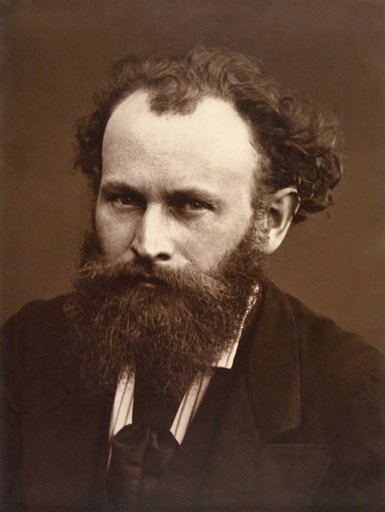
Édouard Manet was a French modernist painter. He was one of the first 19th-century artists to paint modern life, as well as a pivotal figure in the transition from Realism to Impressionism.