Artwork
At the Café (Au café)
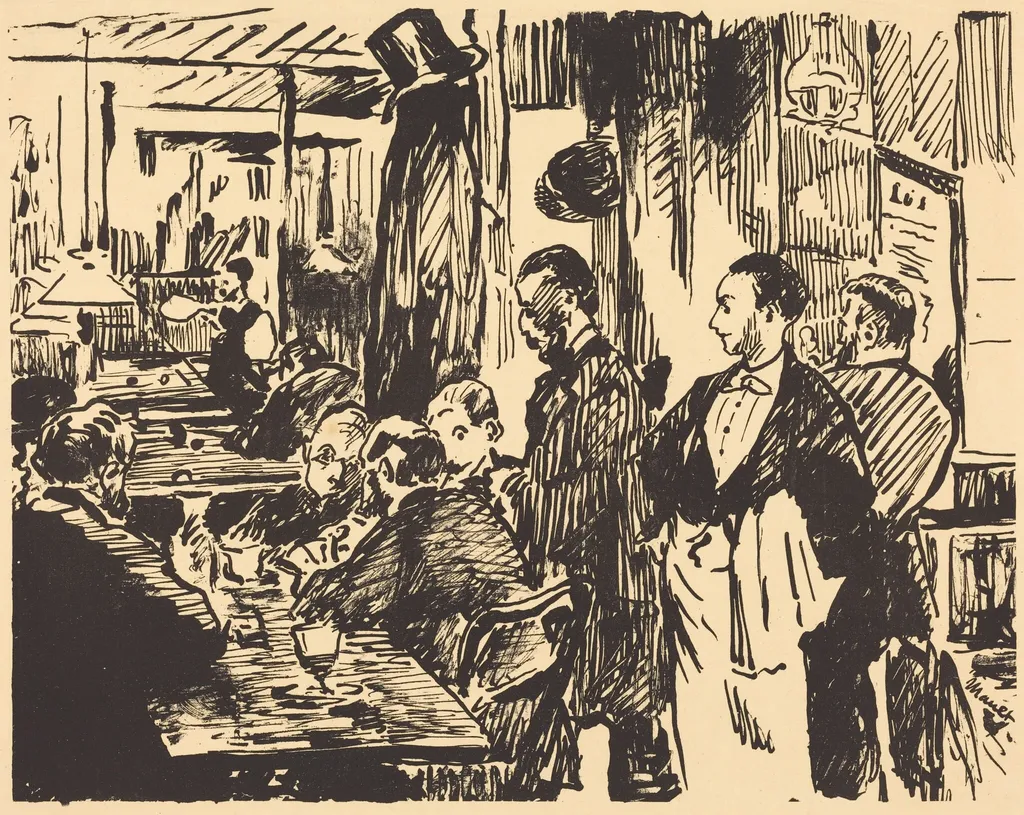
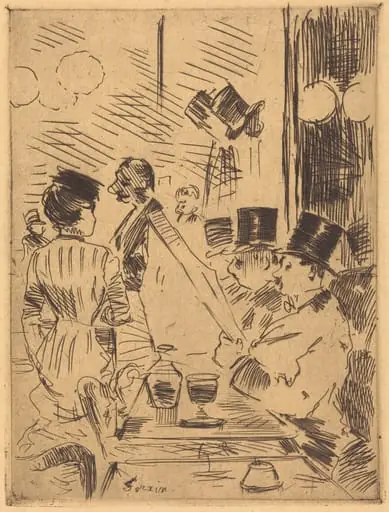
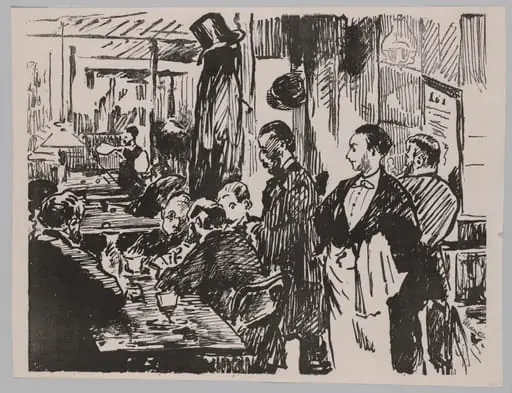
At the Café (Au café) is an ink print by the Impressionist artist Édouard Manet. It dates from 1869 and is held in the collection of the National Gallery of Art.
About this work
Overview
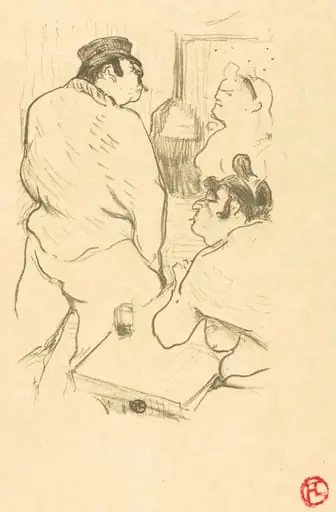
The print captures a bustling café tableau where five figures occupy a long table, one standing and conversing while the others sit with drinks and food.
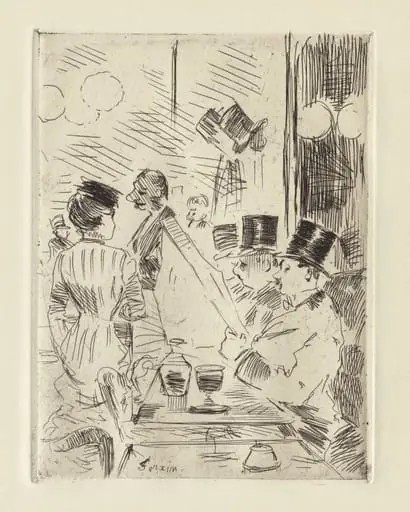
Edouard Manet’s 1869 lithograph At the Café (Au café) presents a compact interior scene rendered entirely in black. The print captures a bustling café tableau where five figures occupy a long table, one standing and conversing while the others sit with drinks and food. The composition is spare, with the surrounding space largely omitted, focusing attention on the arrangement of people and furnishings.
Subject & Meaning
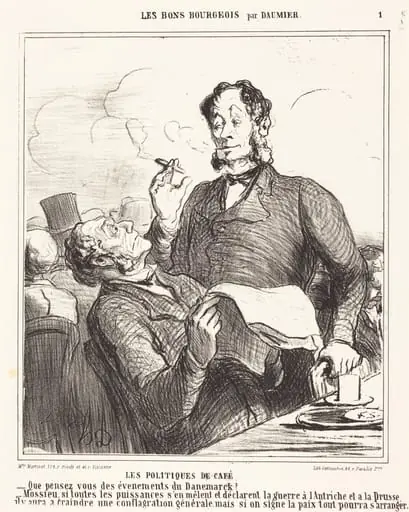
The work depicts a moment of everyday social interaction in a Parisian café, a setting frequently explored by artists of the period. By limiting detail to the silhouettes of patrons and their gestures, Manet emphasizes the collective atmosphere of conversation and leisure rather than individual identities, inviting viewers to sense the communal rhythm of urban life.
Technique & Style
Executed as a lithograph, the image relies on bold, unmodulated black lines to delineate chairs, tables, and figures. Manet’s handling is sketch‑like: facial features and clothing are reduced to simple strokes, suggesting immediacy and spontaneity. The minimal background and flat tonal range reflect the medium’s capacity for rapid, expressive drawing rather than detailed rendering.
History & Provenance
Created in 1869, the print belongs to the later phase of Manet’s career when he increasingly experimented with graphic media. While specific ownership records are limited, the lithograph has been catalogued among Manet’s prints and appears in several museum collections, illustrating his interest in reproducing contemporary scenes through reproducible techniques.
Own this work as a print
Artist & collection
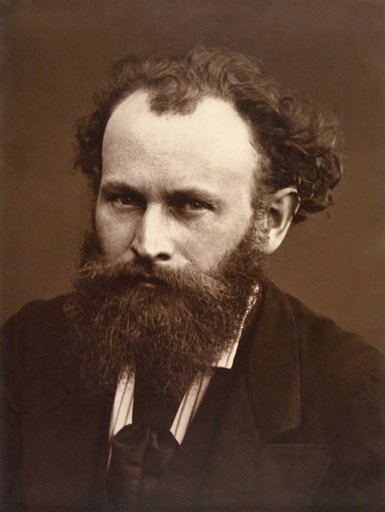
Artist
Édouard Manet was a French modernist painter. He was one of the first 19th-century artists to paint modern life, as well as a pivotal figure in the transition from Realism to Impressionism.