Artwork
Saint Barbara
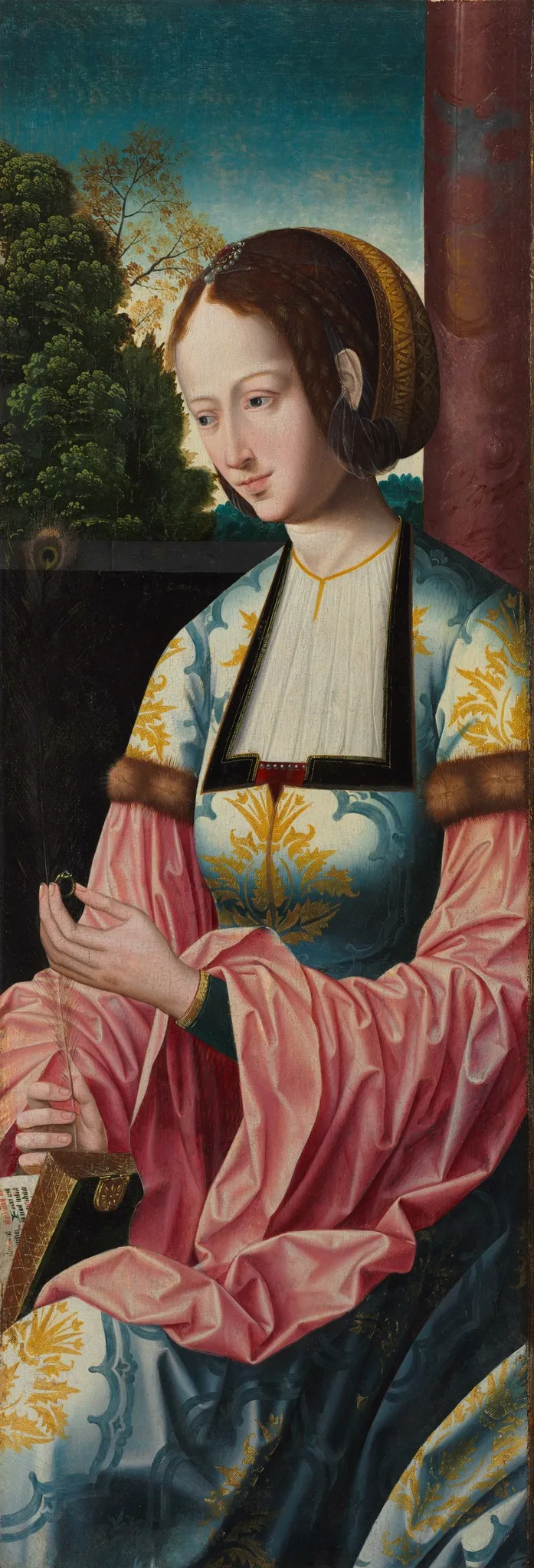
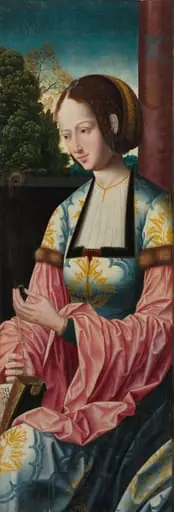
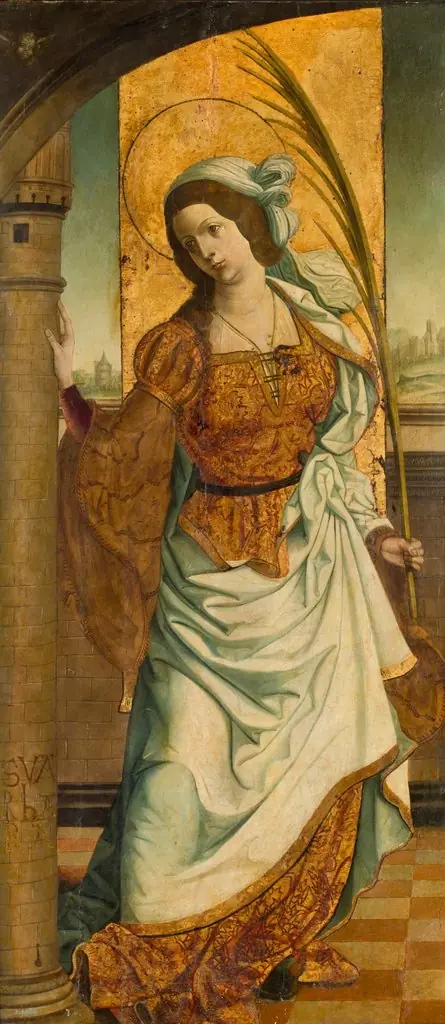
Saint Barbara is an oil painting by the Northern Renaissance artist Master of the Holy Blood. It dates from 1520 and is held in the collection of the Cleveland Museum of Art.
About this work
Subject & Meaning
The peacock feather, a motif sometimes included in depictions of Barbara, may allude to immortality or resurrection, themes associated with her martyrdom.
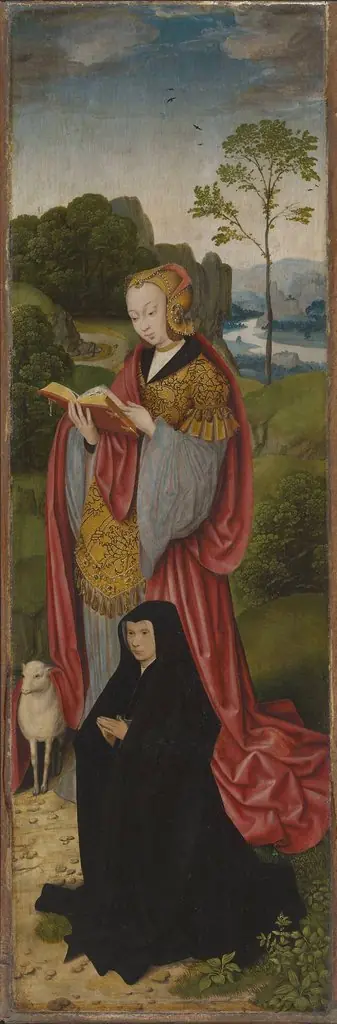
The panel depicts Saint Barbara, a third-century Christian martyr whose legend centers on her imprisonment by her pagan father and subsequent conversion. In the painting, she is shown holding a tower, a reference to the structure in which her father confined her; the tower symbolizes both her imprisonment and the three windows she added to honor the Trinity. Her serene expression and refined features align with Northern Renaissance conventions for female saints.
The peacock feather, a motif sometimes included in depictions of Barbara, may allude to immortality or resurrection, themes associated with her martyrdom. The vertical format and restrained palette focus attention on the saint’s contemplative state, underscoring her spiritual resolve.
Technique & Style
Created around 1520 by the Master of the Holy Blood in Bruges, this religious painting is executed in oil paint on a wooden panel support. The work measures 86.3 cm in height and 29.2 cm in width, presenting a vertical format typical of devotional images from the period. Stylistically, the piece depicts Saint Barbara alongside a peacock feather, rendered with the detailed realism characteristic of Netherlandish art.
The medium of oil on panel allowed for the precise modeling of textures and the luminous quality associated with the artist's workshop. The composition focuses on the saint as the main subject, utilizing the narrow dimensions of the panel to create an intimate, focused devotional experience.
History & Provenance
The painting Saint Barbara was created in 1520 by the Master of the Holy Blood, a Netherlandish artist active in Bruges. Executed in oil on panel, the work depicts the titular saint alongside a peacock feather. While the specific details of its original commission remain unrecorded in the available documentation, the piece has been dated to the early sixteenth century based on stylistic and historical analysis.
The artwork is currently held in the collection of the Cleveland Museum of Art, where it is cataloged with the accession number 1942.633.2. The painting measures 86.3 cm in height and 29.2 cm in width, reflecting the vertical format often associated with devotional images of the period. Its provenance prior to its acquisition by the museum is not detailed in the provided sources.
Saint Barbara, painted circa 1520 by the Master of the Holy Blood, is part of the Cleveland Museum of Art's collection, accession number 1942.633.2. The work is housed in the museum's permanent collection in Cleveland, Ohio. It is classified as a religious oil painting on panel, measuring 86.3 cm in height and 29.2 cm in width, produced in Bruges.
Exhibition records in the available sources do not list any specific exhibitions for this painting, indicating that it has not been featured in major public shows according to the documentation consulted.
Overview
This oil painting, titled Saint Barbara, was created in 1520 by the artist known as the Master of the Holy Blood. It represents a significant example of Northern Renaissance art, reflecting the artistic traditions of the Low Countries. The work is presently held in the collection of the Cleveland Museum of Art, offering insight into early 16th-century Netherlandish painting.
Artist & collection
Artist
Master of the Holy Blood (active 1510–1520) was an Early Netherlandish painter, whose workshop was located in Bruges (Belgium).