Artwork
蓮生法師図|Monk Renshō Riding His Horse Backwards
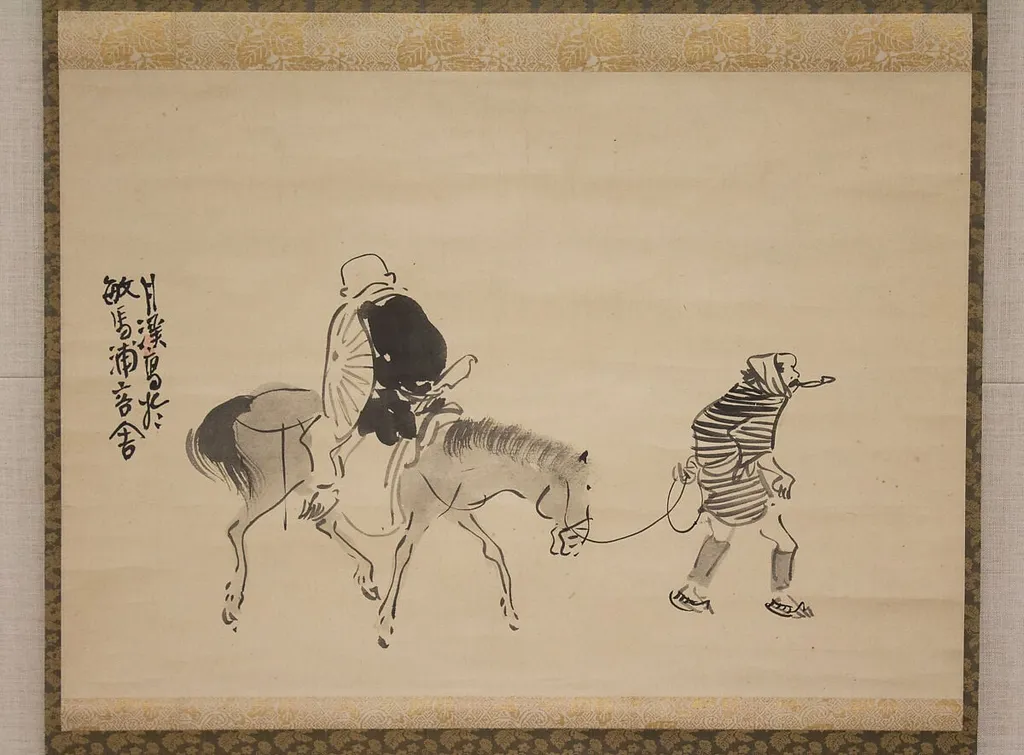
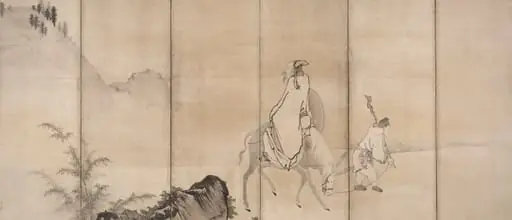
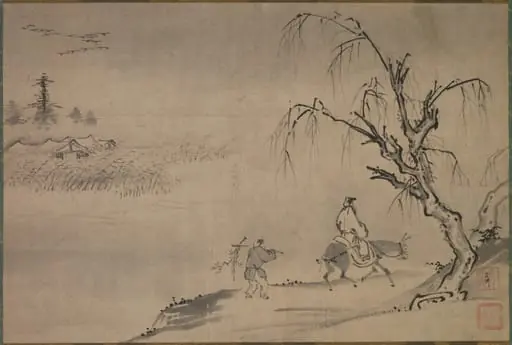
蓮生法師図|Monk Renshō Riding His Horse Backwards is an ink painting by the Nihonga artist Matsumura Goshun. It dates from 1782 and is held in the collection of the Metropolitan Museum of Art.
About this work
A monk rides backward on a calm, trotting horse, holding a fan instead of the reins. The reversal is a Zen joke, breaking rules the way Zen teaching often does. Renshō was known for his odd humor, and Matsumura Goshun painted the scene in 1782 in ink on paper.
Subject & Meaning
The iconography combines the human figure with the animal to illustrate a specific narrative moment involving this historical or legendary religious figure.
The artwork depicts Monk Renshō mounted on a horse, a scene characterized by the figure's unusual posture of riding backwards. As a religious painting created in 1783, the composition centers on the equestrian subject, portraying a man identified as a monk in an active, though unconventional, riding stance. The iconography combines the human figure with the animal to illustrate a specific narrative moment involving this historical or legendary religious figure.
The visual representation emphasizes the dynamic interaction between the rider and the horse, capturing a singular moment of equestrianism that defines the work's subject matter.
Technique & Style
The work titled 蓮生法師図|Monk Renshō Riding His Horse Backwards, executed by Matsumura Goshun in 1783, is a hanging scroll rendered in ink on paper. As recorded in the corpus entry, the piece belongs to the Paintings classification and falls within the religious genre, depicting an equestrian monk in motion. The scroll measures approximately 38 cm in height and 54.5 cm in width, dimensions confirmed by the Metropolitan Museum of Art catalogue.
Its formal qualities combine swift, calligraphic brushstrokes with a balanced composition that emphasizes the rider’s inverted posture, creating a dynamic yet restrained visual rhythm. The paper support is typical of Edo‑period hanging scrolls, and the work remains in the museum’s collection, though detailed conservation records are not provided.
History & Provenance
Matsumura Goshun's hanging scroll Monk Renshō Riding His Horse Backwards was created in 1783, executed in ink on paper as a religious painting. The work originated in Japan and entered the collection of the Metropolitan Museum of Art, where it is presently held. No further details regarding an original commission, intermediate ownership, or transfer history are documented in the available sources.
Monk Renshō Riding His Horse Backwards, painted by Matsumura Goshun in 1783, is held in the collection of the Metropolitan Museum of Art. The hanging scroll, executed in ink on paper, is catalogued within the museum's paintings holdings. Its dimensions are recorded as 38 by 54.5 centimeters.
No specific accession number, acquisition date, or prior exhibition history is documented in the available sources for this work.
Overview
Created in 1782 by Matsumura Goshun, 'Monk Renshō Riding His Horse Backwards' is a hanging scroll executed in ink on paper. The composition depicts the Zen monk Renshō mounted on a horse that trots calmly while facing backward, a deliberate inversion of natural order. Instead of holding reins, the monk grasps a fan, emphasizing a state of relaxed mastery over the animal.
This visual paradox serves as a Zen koan, using humor and absurdity to challenge conventional logic and illustrate the non-dualistic nature of enlightenment. Goshun, who studied under both Yosa Buson and Sesshū Tōyō before founding the Shijō school, frequently explored themes of eccentricity and spiritual wit in his work. This piece exemplifies his ability to blend literati painting techniques with the playful, iconoclastic spirit of Zen Buddhism.
The work stands as a significant example of late 18th-century Japanese religious art, where the artist uses the unexpected posture of the rider to provoke contemplation rather than mere amusement. The simplicity of the ink washes focuses attention on the narrative gesture, capturing a moment where the mundane and the spiritual intersect through the lens of Zen humor.
Context
Matsumura Goshun, the artist, was associated with a lineage that valued such playful interpretations of Zen philosophy. He studied under a prominent painter who also embraced lighthearted and unconventional expressions of spiritual ideas. This painting reflects a broader artistic and religious tradition where humor and paradox were employed to convey complex spiritual concepts, encouraging contemplation beyond surface appearances.
Artist & collection