Artwork
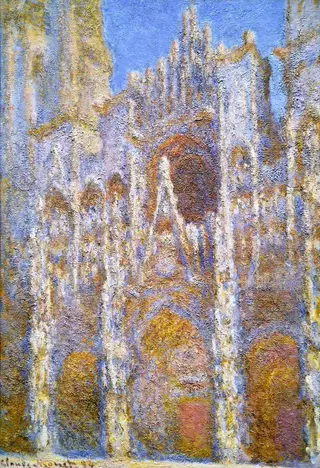
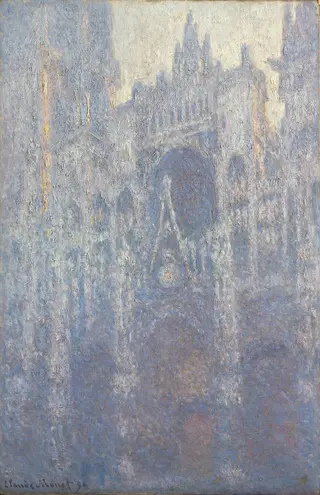
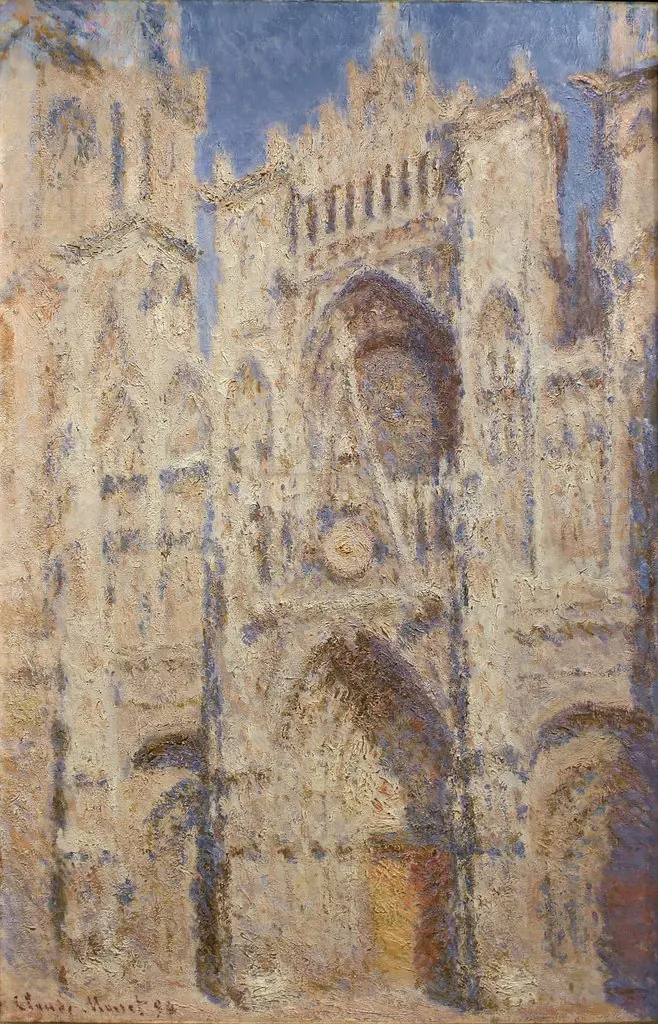
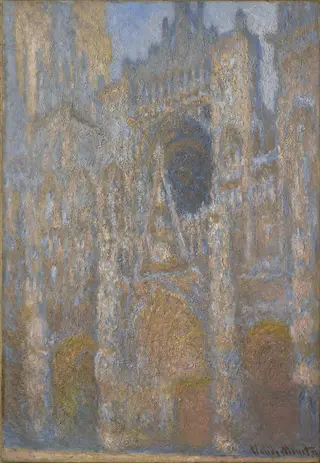
Rouen Cathedral, West Façade
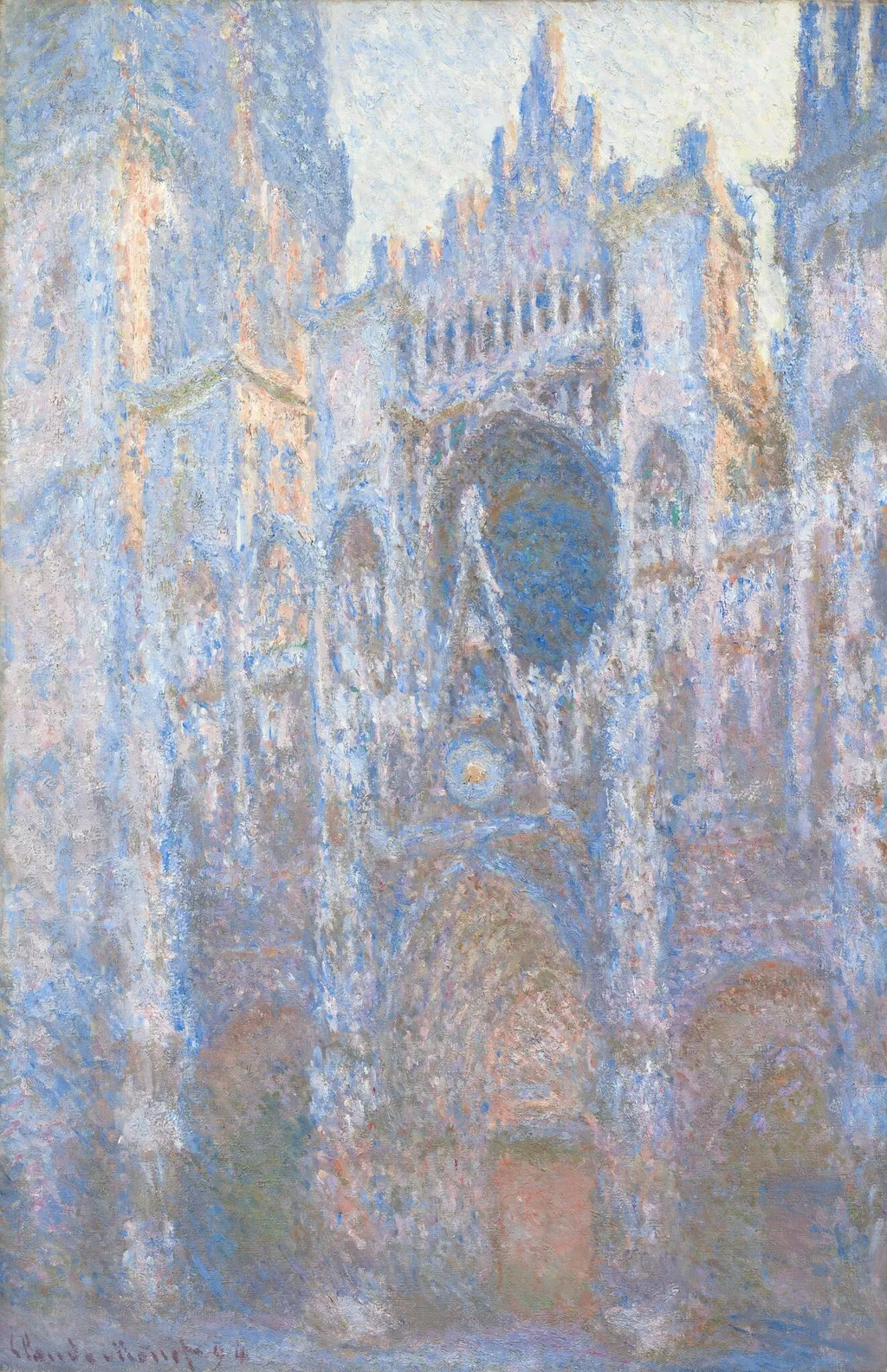
Rouen Cathedral, West Façade is an oil painting by the Impressionist artist Claude Monet. It dates from 1894 and is held in the collection of the National Gallery of Art.
- Inscription
- Inscribed:lower left: Claude Monet 94
About this work
Subject & Meaning
The painting captures the cathedral not merely as a religious or historical landmark, but as a canvas for shifting natural effects.
The work depicts the west façade of Rouen Cathedral, a Gothic structure in France, serving as the primary subject of the painting. Created in 1894, this piece is part of a larger series by Claude Monet dedicated to this specific architectural site. While the visual focus is the stone façade itself, the subject matter represents Monet's exploration of how light and atmospheric conditions alter the perception of a static monument.
The painting captures the cathedral not merely as a religious or historical landmark, but as a canvas for shifting natural effects. The subject is strictly the exterior elevation of the building, devoid of human figures or narrative scenes, emphasizing the interplay of shadow and illumination on the architectural forms.
Technique & Style
Executed in 1894, this work is an oil painting on canvas measuring 100.1 by 65.9 centimeters. As a component of the Rouen Cathedral series, the piece exemplifies the Impressionist movement through its depiction of the cathedral's west façade. The application of oil paint on a woven canvas support allows for the specific handling characteristic of Monet's approach to light and architecture during this period.
The formal qualities focus entirely on the architectural subject, utilizing the chosen materials to capture atmospheric effects rather than precise linear detail.
History & Provenance
Claude Monet executed this oil on canvas in 1894 as a component of his Rouen Cathedral series. Upon completion, the work remained with the artist before entering the collection of James F. Sutton in New York. Following Sutton's death in 1915, the painting passed to his wife by inheritance.
It was subsequently sold at the American Art Association in New York on October 26, 1933, where it was purchased by Wilbur L. Cummings of Greenwich, Connecticut. In 1935, Cummings sold the piece to Chester Dale of New York. The work ultimately entered the National Gallery of Art in Washington, D.C., in 1963 as part of Dale's bequest.
Legacy
Claude Monet's Rouen Cathedral, West Façade (1894) became a cornerstone of Impressionism's legacy, profoundly influencing later generations of artists and critics. The work's serial approach, capturing the cathedral under varying light and atmospheric conditions, challenged traditional notions of fixed representation, inspiring movements like Post-Impressionism and Abstract Expressionism to explore perception and temporality. Its critical reception solidified Monet's reputation as a master of color and light, with the series often cited as a pinnacle of Impressionist innovation.
Housed in the National Gallery of Art, Washington, D.C., the painting remains a touchstone for studies of optical effects and artistic technique, reinforcing its enduring impact on modern art.
Overview
Rouen Cathedral, West Façade is an oil on canvas painting by Claude Monet, executed in 1894. This work is part of the artist's renowned series depicting the Gothic cathedral in Rouen, France, where he focused on a single architectural subject to study the effects of changing light and atmospheric conditions. Monet painted the West Façade repeatedly at different times of day and seasons, capturing the interplay of sunlight and shadow on the stone surface.
The composition centers on the cathedral's portal and rose window, rendered with loose, visible brushstrokes that dissolve architectural details into a mosaic of color. This technique, characteristic of Impressionism, emphasizes the transient nature of light over precise structural definition. The series marked a significant evolution in Monet's career, moving away from traditional landscape painting toward a more abstract exploration of perception and color theory.
By isolating the façade against a neutral background, Monet eliminated extraneous elements to concentrate entirely on the luminous transformation of the stone. The 1894 date places this work at the culmination of his intensive study of the cathedral, which he began in 1892. These paintings are considered pivotal in the development of modern art, influencing subsequent movements such as Fauvism and Abstract Expressionism through their bold use of color and departure from realistic representation.
Own this work as a print
Artist & collection
Artist
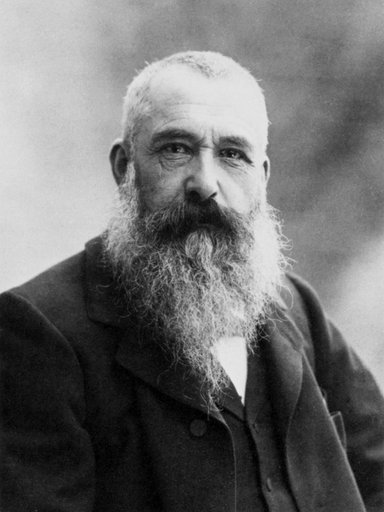
Oscar-Claude Monet was a French painter and founder of Impressionism who is seen as a key precursor to modernism, especially in his attempts to paint nature as he perceived it.