Artwork
Canigiani Holy Family
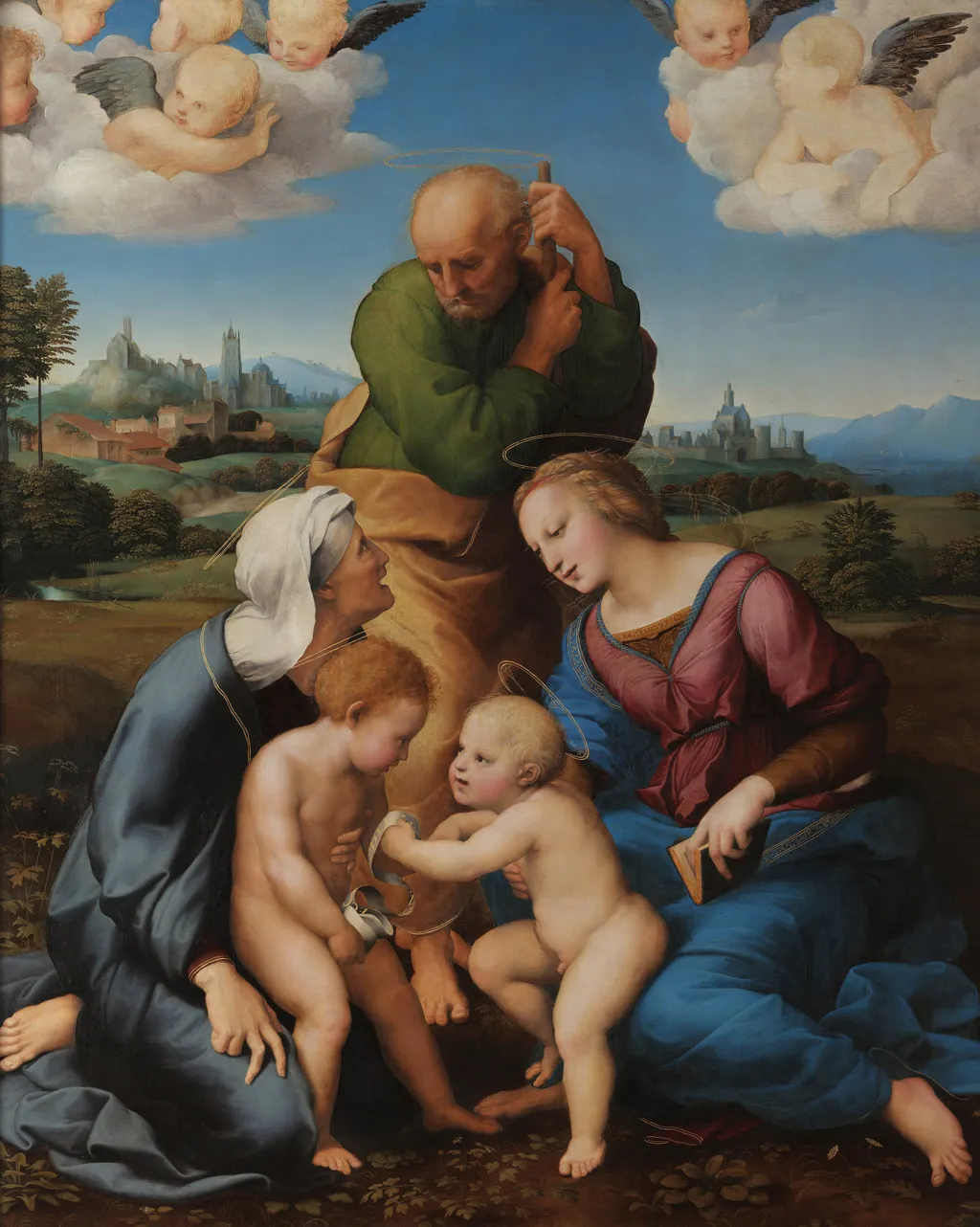
Canigiani Holy Family is an oil painting by the High Renaissance artist Raphael. It dates from 1505 and is held in the collection of the Alte Pinakothek.
About this work
Subject & Meaning
John the Baptist holds a scroll inscribed ECCE AGNUS DEI (“Behold the Lamb of God”), identifying him as the Precursor and foreshadowing Christ’s sacrifice.
The Canigiani Holy Family depicts the New Testament figures of the Holy Family, Mary, the Christ Child, Saint Joseph, Saint Elizabeth, and the young John the Baptist, arranged in a composition inspired by Leonardo da Vinci’s pyramidal arrangements within a landscape setting.
John the Baptist holds a scroll inscribed ECCE AGNUS DEI (“Behold the Lamb of God”), identifying him as the Precursor and foreshadowing Christ’s sacrifice. Mary is shown as a Madonna leggente, reading a book with a finger marking her place, a motif that underscores her contemplative role within the sacred narrative. Joseph stands at the apex of the triangular grouping, his staff grounding the scene, while the women and children occupy the base, their gazes and gestures forming an interlocking web of familial and spiritual connection.
The work conveys a serene, domestic intimacy within a sacred context, balancing theological gravity with human warmth. The landscape, rendered with atmospheric depth and Venetian-inflected colorism, situates the holy figures in a natural world that reflects divine order and harmony.
Technique & Style
The Canigiani Holy Family is an oil painting executed on a poplar wood panel, measuring 131 cm in height and 107 cm in width. Created during Raphael's Florentine period, the work features a pyramidal composition inspired by Leonardo da Vinci, with Saint Joseph standing at the apex. The artist employs vivid coloration and bright tonalities reminiscent of Giorgione, set against a landscape utilizing atmospheric perspective that recedes into the distance.
Formal handling is characterized by crisp lines and soft strokes that define distinct figures within a unified, serene arrangement. A signature, "RAPHAEL VRBINAS," is inscribed on the neckline of the Virgin's garment. Restoration history reveals that two groups of putti in the upper corners, originally painted but partially obscured by overpainting in the 18th century, were successfully uncovered and authenticated in 1982.
History & Provenance
Executed circa 1507–1508 during Raphael's Florentine period, this oil-on-poplar panel was commissioned by the wealthy banker Domenico di Bartolomeo Canigiani for his family's home altar, possibly to celebrate his 1507 marriage. Giorgio Vasari later recorded seeing the work in the possession of Canigiani's heirs. The painting subsequently entered the Medici collections before being gifted by Cosimo III de' Medici to Elector Palatine Johann Wilhelm in 1691 as part of the dowry for his marriage to Anna Maria Luisa de' Medici.
It adorned the electoral gallery in Düsseldorf until 1801, when it was transferred to Munich to safeguard it from Napoleonic confiscation. During the 18th century, two groups of putti in the upper corners were painted over; these original features were rediscovered and verified during a meticulous restoration in 1982.
The Canigiani Holy Family is held in the permanent collection of the Alte Pinakothek in Munich, Germany, under the stewardship of the Bavarian State Painting Collections. The work entered this institution after a complex provenance journey; originally commissioned by the Canigiani family in Florence, it later passed to the Medici collection. In 1691, Cosimo III of Tuscany gifted the painting to Johann Wilhelm, Elector Palatine, for his gallery in Düsseldorf.
To protect the artwork from Napoleon I, it was transferred to Munich in 1801, though some accounts specify the move occurred during 1805 or 1806 alongside the electoral collection.
Regarding its exhibition and physical history, two groups of cherubs in the upper corners were painted over in the 18th century, likely by restorer François-Louis Collins around 1755. These figures were considered non-original for over a century until a meticulous restoration in 1982 or 1983 revealed and authenticated them as part of Raphael's original composition.
Context
The Canigiani Holy Family, painted by Raphael around 1505–1508, reflects the High Renaissance emphasis on religious harmony and compositional balance. The work was commissioned by the affluent Florentine banking family of Domenico di Bartolomeo Canigiani, patrons who supported Raphael during his Florentine period and intended the piece for private devotional use on a home altar. Its iconography aligns with canonical depictions of the Holy Family, featuring the infant Jesus, Mary, Joseph, Saint Elizabeth, and the young John the Baptist, arranged in a pyramidal structure inspired by Leonardo da Vinci and enriched by the solemnity of Fra Bartolomeo.
The painting’s provenance traces from its creation in Florence to its acquisition by Johann Wilhelm von der Pfalz, Elector Palatine, before entering the Alte Pinakothek in Munich in 1805–1806. Subsequent restorations in the 1980s revealed original angelic figures previously obscured by 18th-century overpainting, confirming the work’s complex layered history. The attribution is confirmed by Raphael’s signature 'RAPHAEL URBINAS' inscribed on the Virgin’s garment, documented in multiple museum and scholarly sources.
Legacy
The Canigiani Holy Family became a reference point for later religious compositions due to its pyramidal structure and emotional clarity. Art historians note its influence on Baroque depictions of the Holy Family, particularly through Raphael’s integration of Leonardo’s compositional logic with Venetian colorism. The painting’s documented history, from its 1507 commission by the Canigiani family to its 19th-century acquisition by the Bavarian State Painting Collections, cemented its role in shaping European sacred art conventions.
Overview
Created around 1507–1508, this oil‑on‑wood work is attributed to Raphael, a leading figure of the High Renaissance. The composition presents a small group of five figures set against an open landscape, with a sky populated by cherubic angels. The painting now belongs to the permanent collection of the Alte Pinakothek in Munich.
Own this work as a print
Artist & collection
Artist
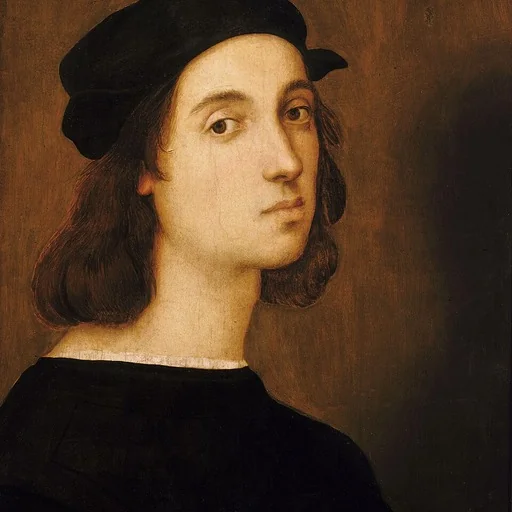
Raphael was born Raffaello Sanzio in Urbino on April 6, 1483, the son of Giovanni Santi, a painter and poet attached to the ducal court.

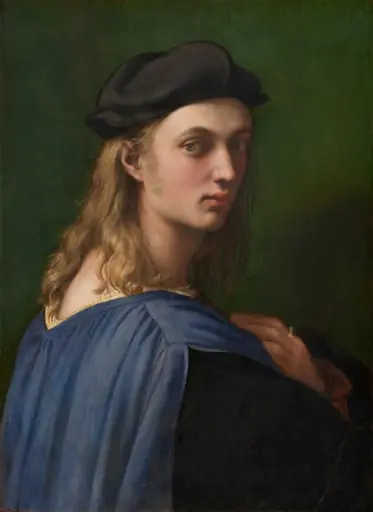
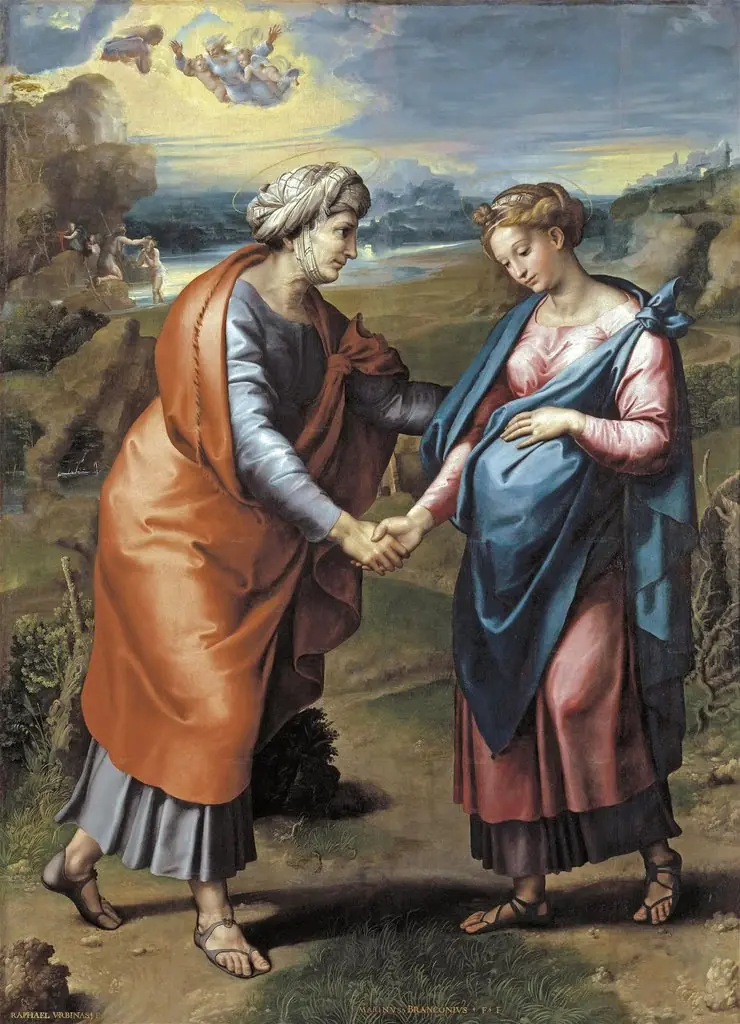
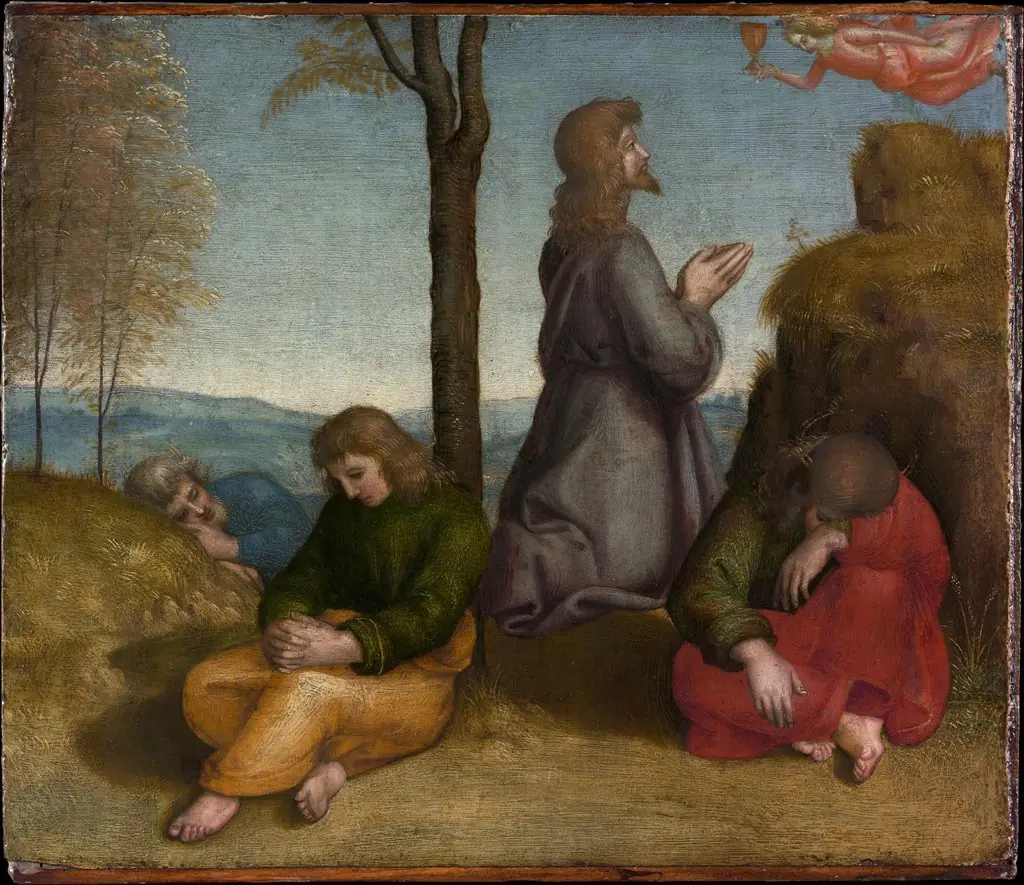
- The Holy Family
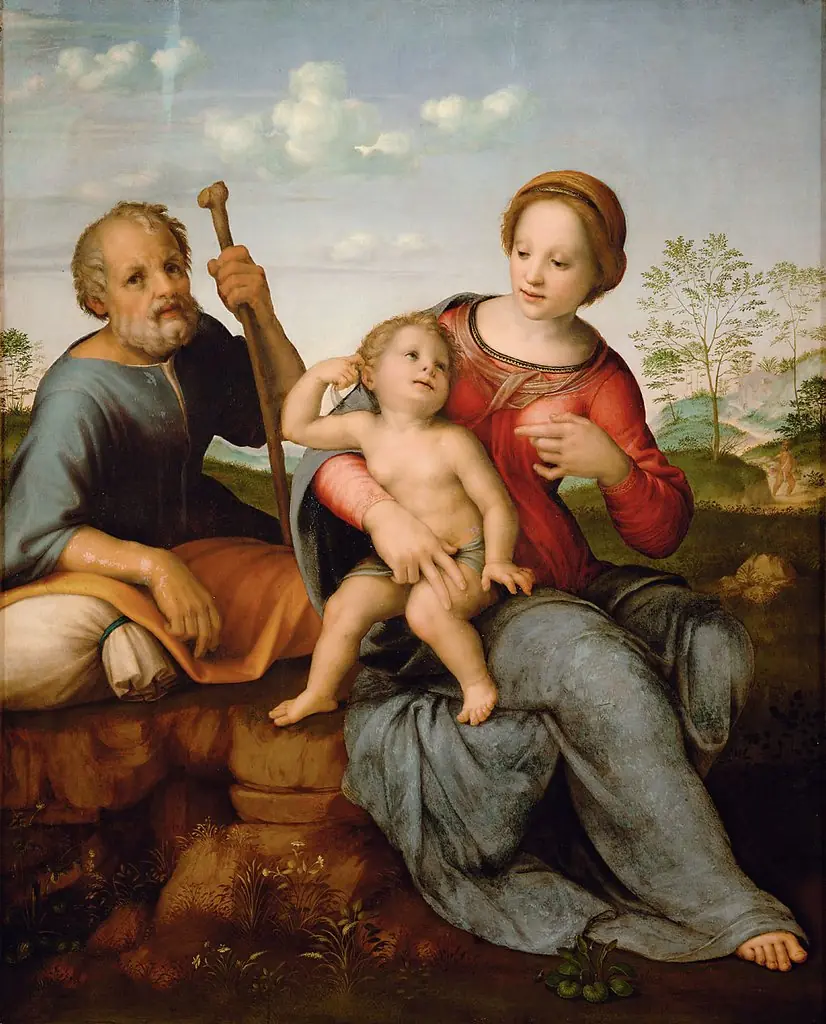 Holy Family in a Landscape
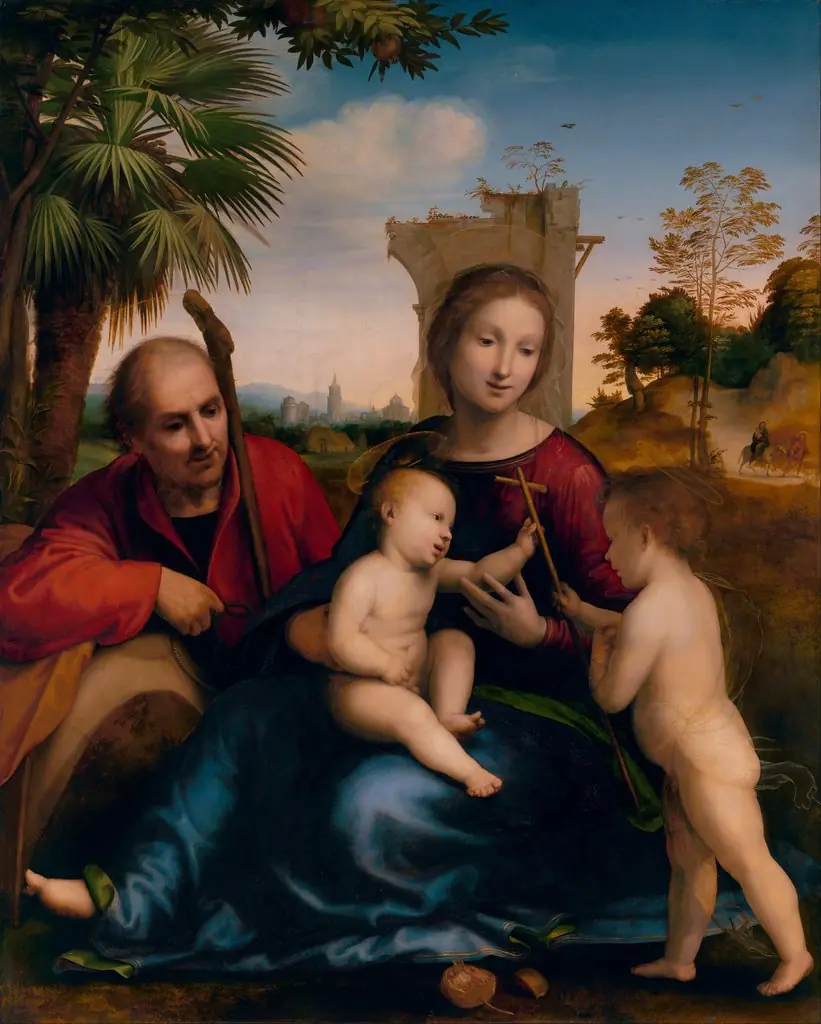 The Rest on the Flight into Egypt with St. John the Baptist
 The Holy Family
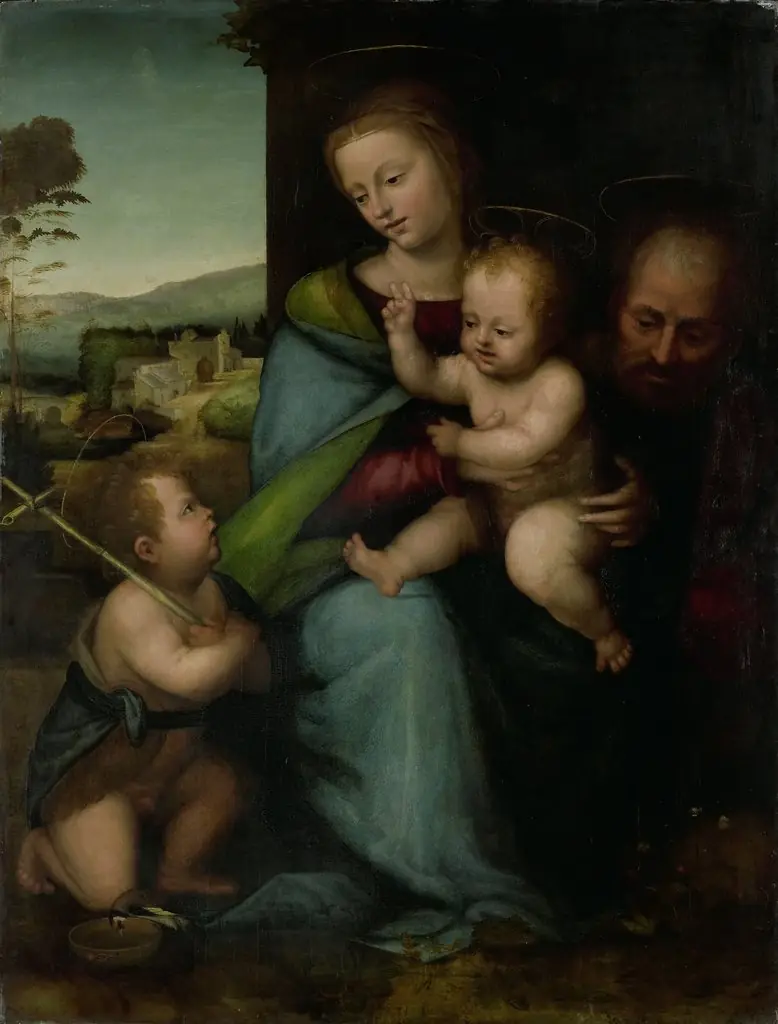 The Holy Family with the Infant John the Baptist
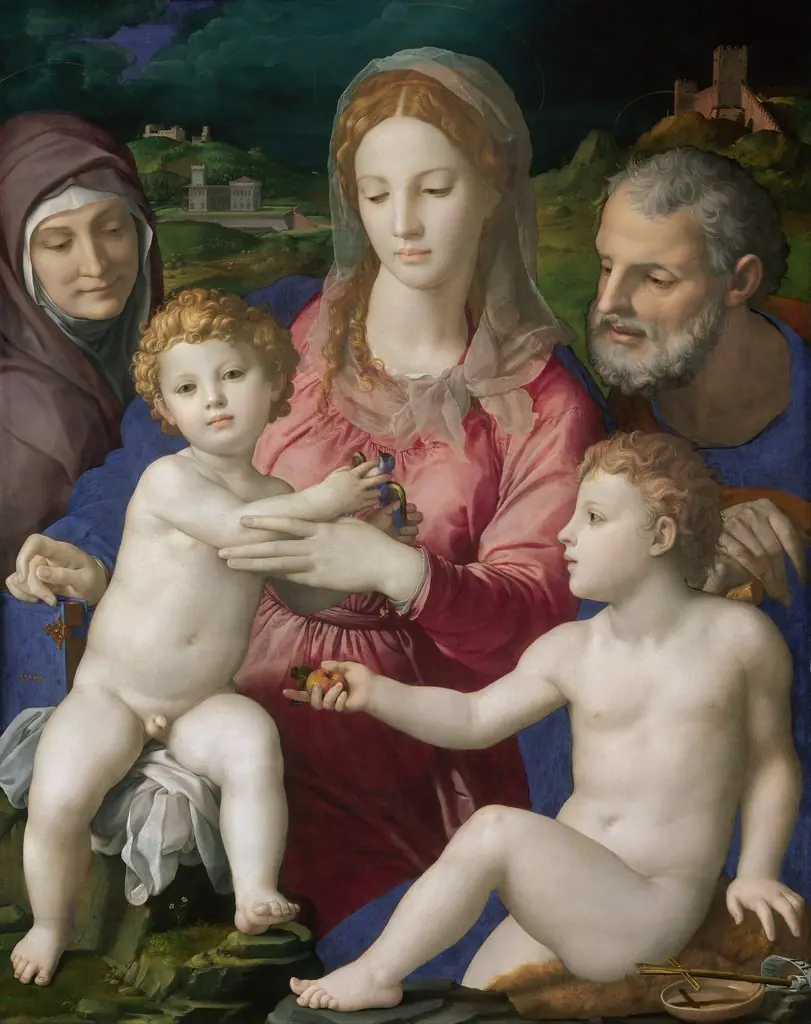 Holy Family with St. Anne and the Infant St. John
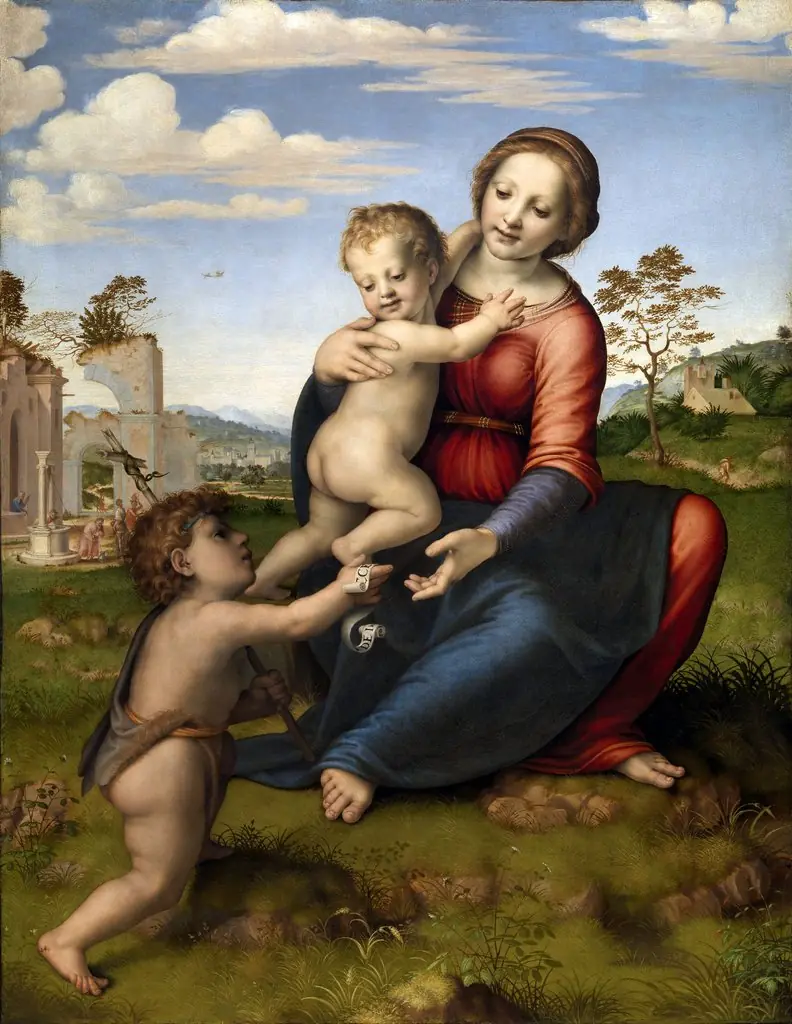 Madonna of the Well or Madonna and Child with the young St. John the Baptist
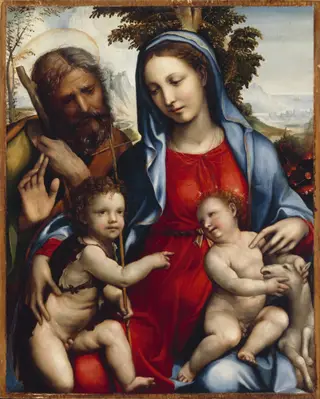 The Holy Family and St. John
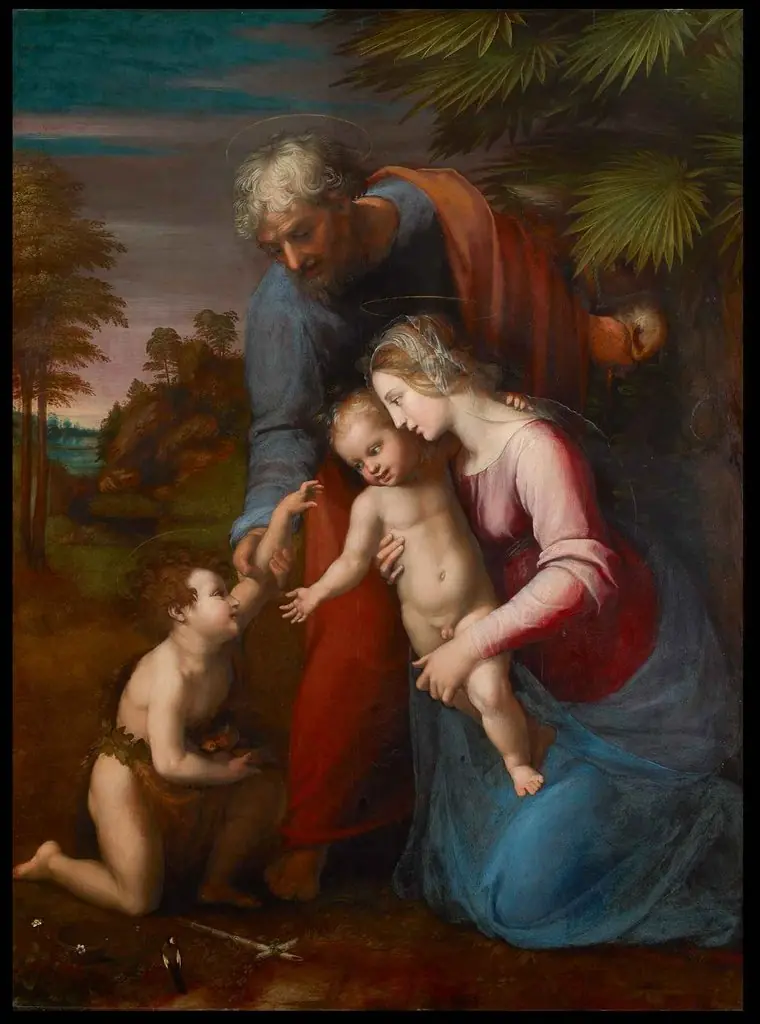 The Holy Family with Saint John the Baptist
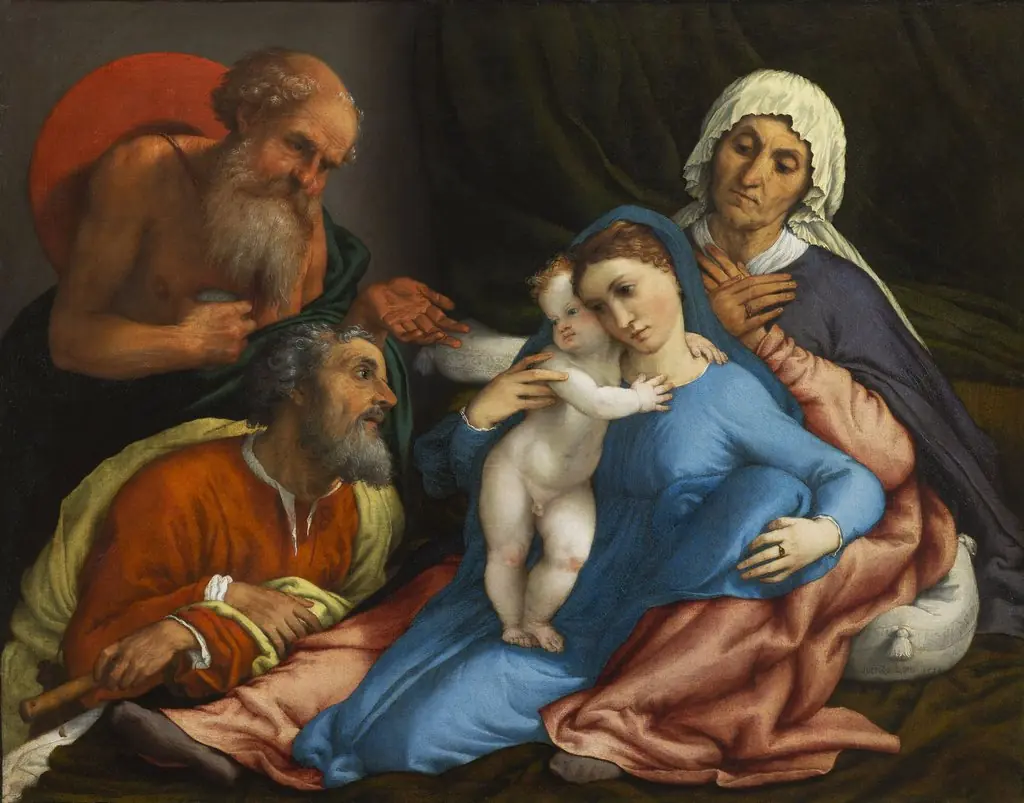 Madonna and Child with Saints
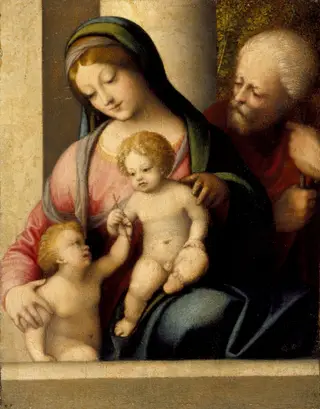 Holy Family with the Infant St. John
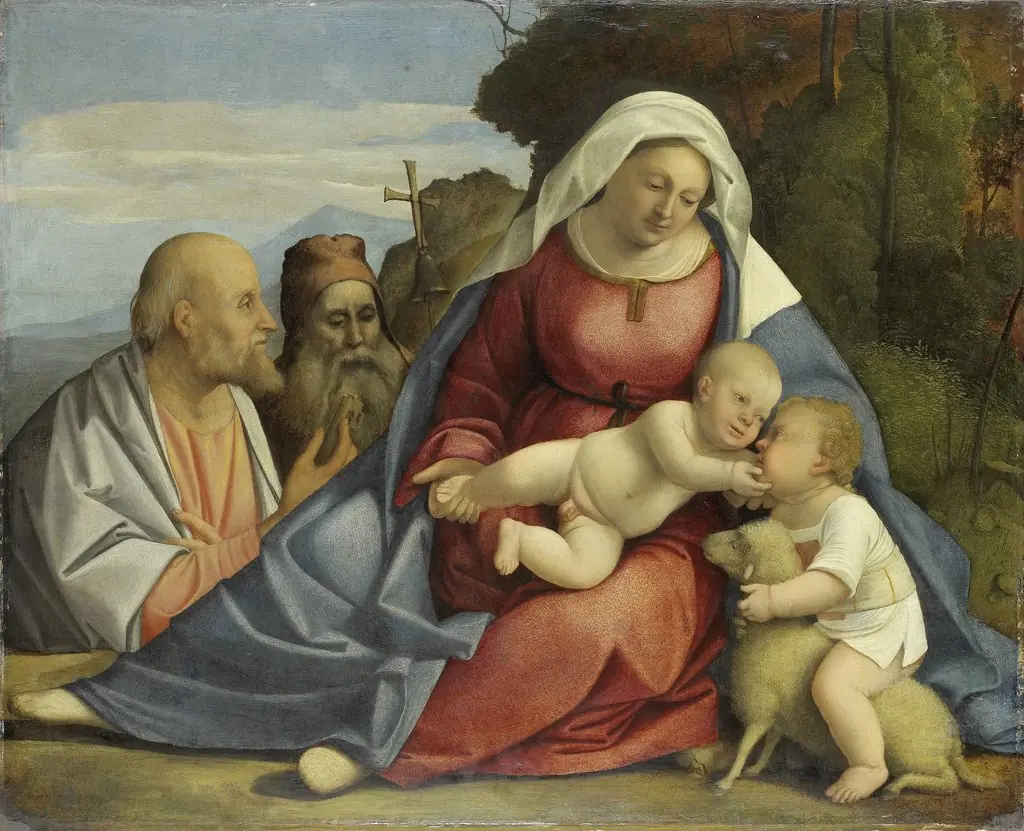 Virgin and Child with young John the Baptist, Saints Peter and Antony Abbot