Artwork
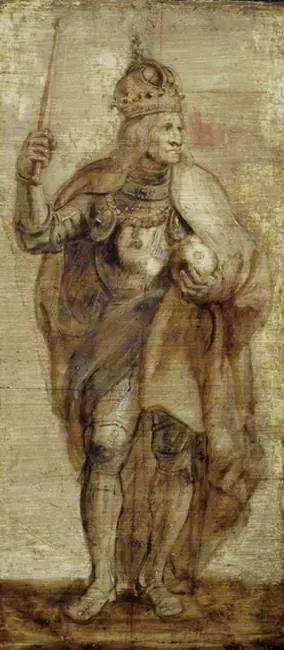
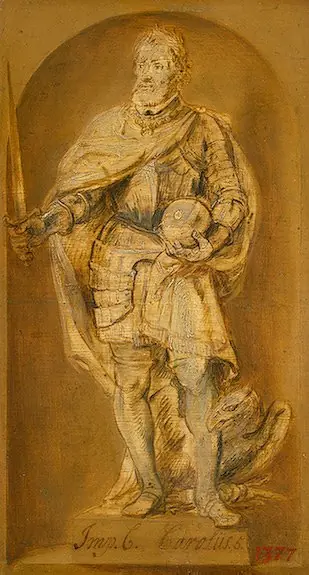
Statue of Albert I in a niche
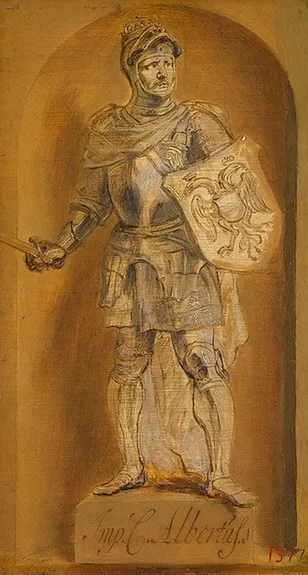
Statue of Albert I in a niche is an oil painting by the Flemish Baroque painting artist Peter Paul Rubens. It dates from 1634 and is held in the collection of the Hermitage Museum.
About this work
History & Provenance
It has been exhibited in the museum's permanent collection displays, including a 2019 showcase of Rubens' portraits.
Created in 1634 in Flanders, this oil painting on oak panel was executed by Peter Paul Rubens. The work depicts Albert I of Germany, portrayed with a sword, shield, and body armor. It currently forms part of the collection at the Hermitage Museum, where it is held as a portrait genre piece.
The specific dimensions of the panel are 38.5 cm in height and 21.5 cm in width. While the exact commission details and intermediate ownership history are not specified in the available records, the work's inception is firmly dated to the beginning of 1634.
The work is housed in the Hermitage Museum, which holds it under a documented inventory number. It has been exhibited in the museum's permanent collection displays, including a 2019 showcase of Rubens' portraits. The painting was created in 1634 in Flanders and entered the Hermitage collection shortly after its completion.
Context
The work was created by Peter Paul Rubens in 1634 and is classified as a portrait painting. It depicts Albert I of Germany wearing sword, shield, and body armor, reflecting the subject's military role. The painting is part of the Hermitage Museum collection in St. Petersburg and was executed on oak panel using oil paint in the Flemish artistic tradition.
Its creation coincides with Rubens's mature period, characterized by dynamic compositions and vivid realism, situating it within the broader trajectory of Baroque portraiture.
Overview
In 1634 Peter Paul Rubens produced an oil painting that presents a sculptural likeness of Albert I of Germany. The figure stands within a shallow niche, clad in full plate armor, brandishing a sword in the right hand and a shield in the left. The composition is set against a warm, golden backdrop that accentuates the cooler metallic tones of the statue.
Subject & Meaning
The work portrays Albert I, Holy Roman Emperor, as a martial ruler, emphasizing his role as protector and sovereign. By rendering the emperor as a statue, Rubens invokes classical ideals of timeless authority while the armor and weapons underscore the political and military responsibilities associated with his reign.
Technique & Style
Rubens employs the dramatic chiaroscuro typical of Flemish Baroque, using strong contrasts of light and shadow to model the three‑dimensional form of the statue. His palette balances warm background hues with cool metallic tones, and the brushwork conveys both the texture of armor and the softness of flesh, reflecting his characteristic blend of realism and dynamism.
Artist & collection
Artist
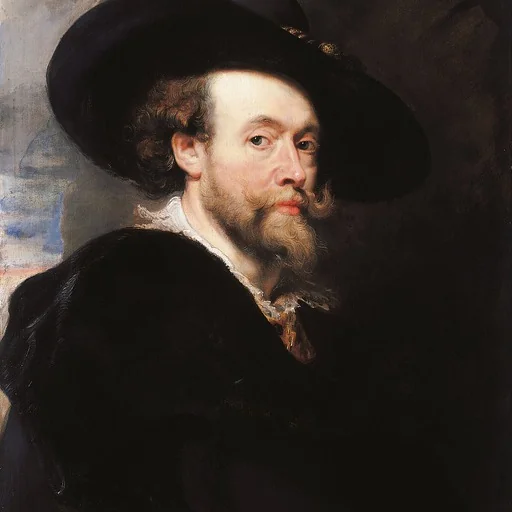
Sir Peter Paul Rubens ( ROO-bənz; Dutch:; 28 June 1577 – 30 May 1640) was a Flemish artist and diplomat.