Artwork
Statue of Ceres
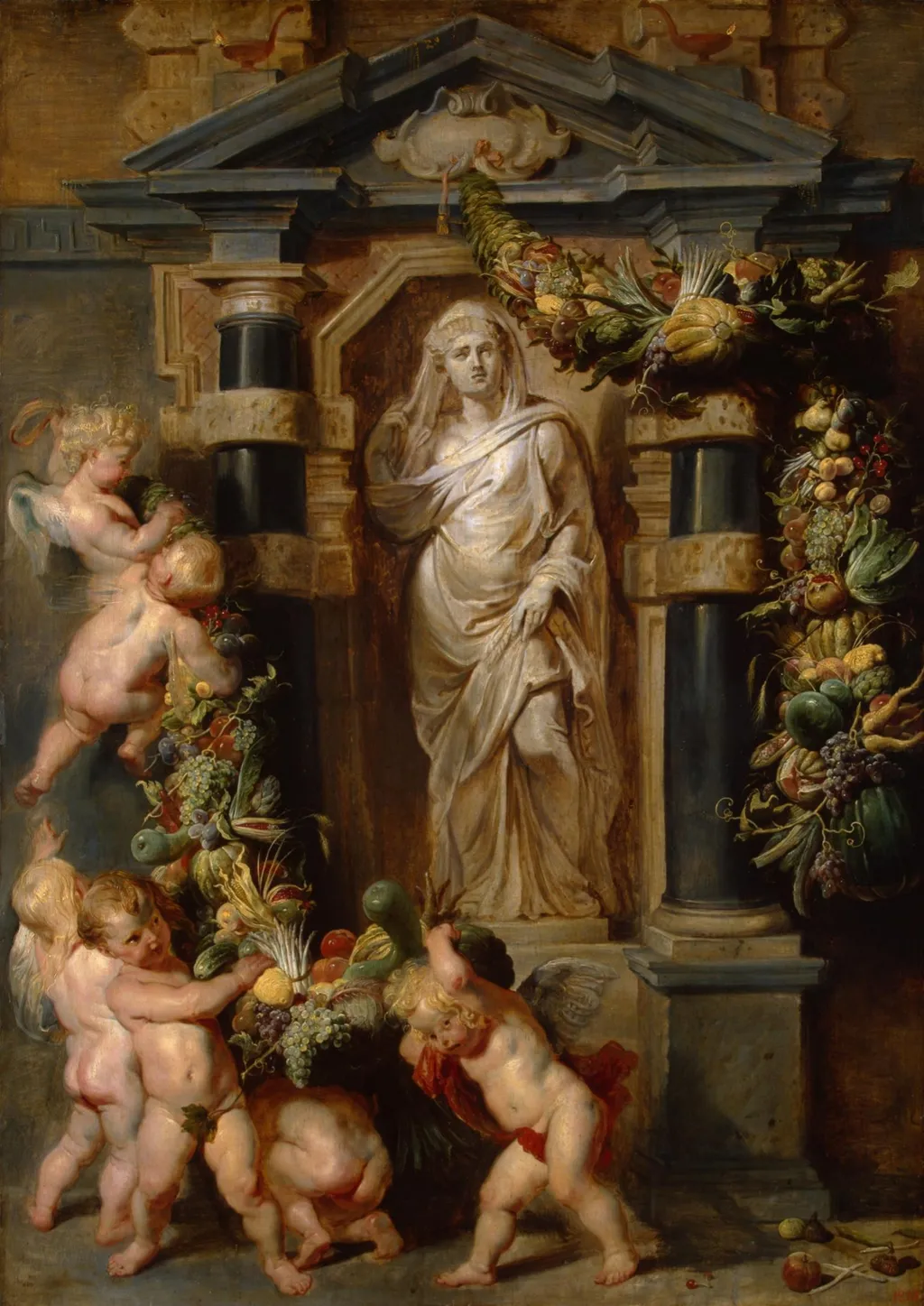
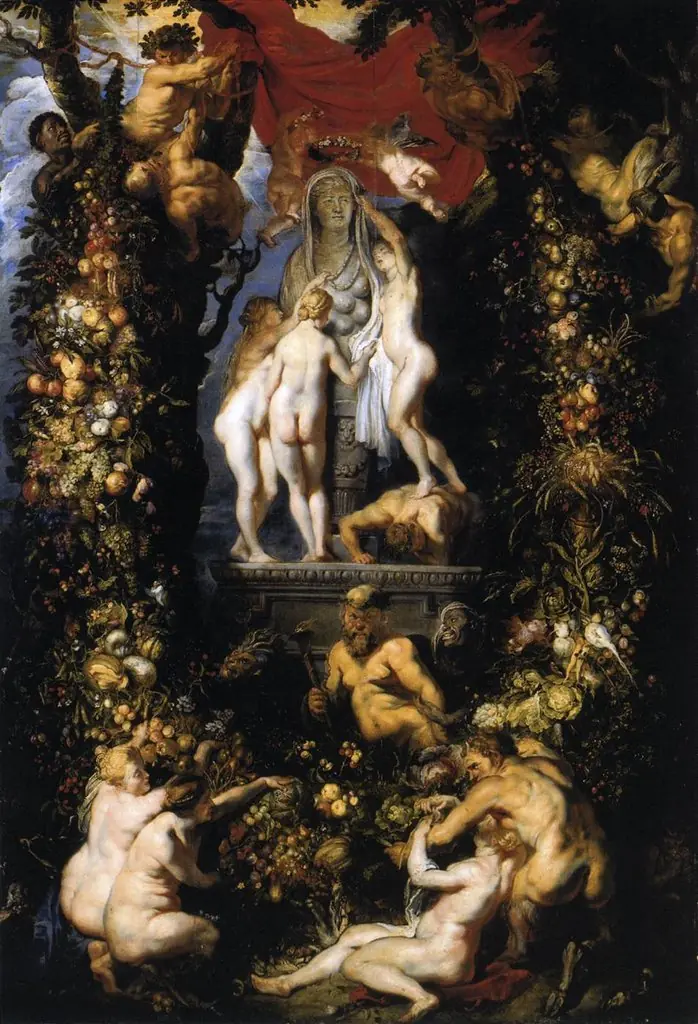
Statue of Ceres is an oil painting by the Flemish Baroque painting artist Peter Paul Rubens. It dates from 1615 and is held in the collection of the Hermitage Museum.
About this work
This painting shows small cherubs offering flowers to a statue of Ceres, the Roman goddess tied to harvest and growth. Peter Paul Rubens made it around 1615 using oil paint on oak. The bright colors and soft light make the scene feel alive.
It hangs in the State Hermitage Museum today. The little putti add charm and movement to the quiet statue.
Look up Peter Paul Rubens next.
Overview
The Statue of Ceres is an oil on panel painting by Peter Paul Rubens, created circa 1615, with the garland of fruit and vegetables contributed by Frans Snyders.
The Statue of Ceres is an oil on panel painting by Peter Paul Rubens, created circa 1615, with the garland of fruit and vegetables contributed by Frans Snyders. Measuring 90.5 by 65.5 centimetres, this mythological work depicts a marble statue of the Roman goddess Ceres set within a classical architectural niche, surrounded by playful putti bearing abundant produce. The painting has been held in the Hermitage Museum in St. Petersburg since 1768 and represents a significant achievement in Rubens's so-called Classicist period, demonstrating his synthesis of antique inspiration with Baroque vitality. The collaboration between Rubens and Snyders on this work exemplifies the specialized division of labour common in Flemish studios of the era, while the painting's enduring popularity is attested by numerous copies and a second autograph version now in a private Swiss collection.
Subject & Meaning
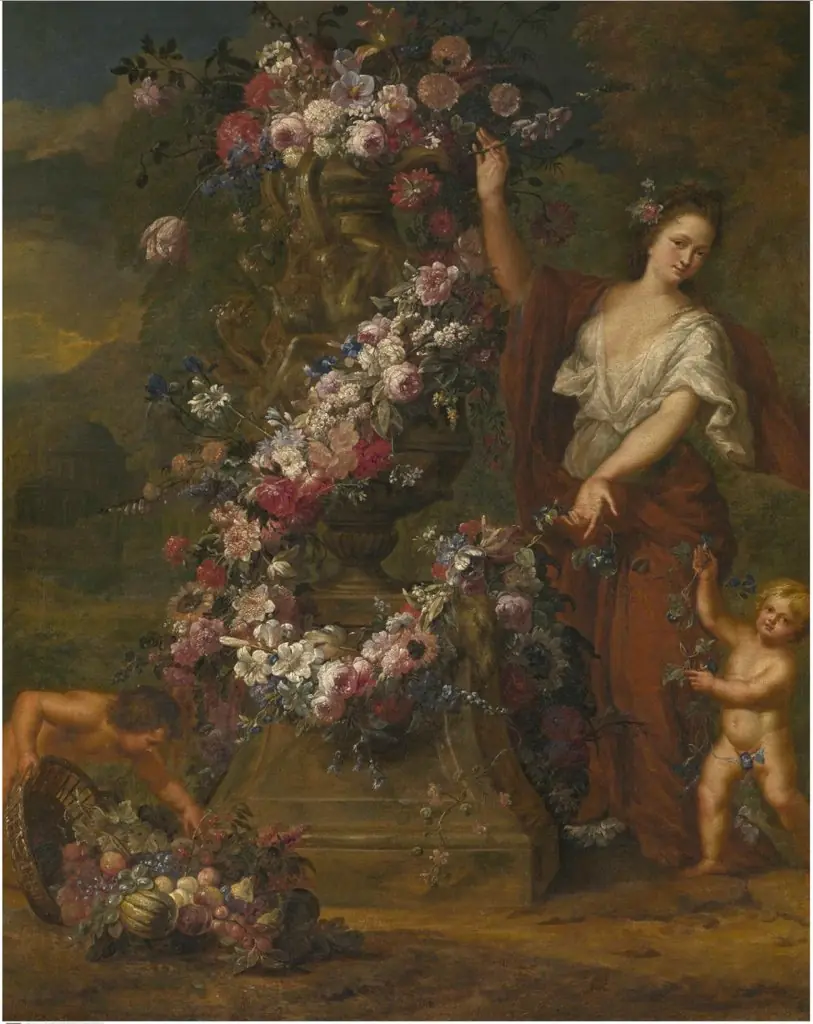
The central subject is Ceres, the Roman goddess of agriculture, grain, and earthly fertility, equivalent to the Greek Demeter. Rubens depicts her not as a living figure but as a classical marble statue: draped in heavy folds, serene in expression, one hand raised near her head and the other gathering her mantle. This sculptural presentation carries layered significance. On one level, it proclaims reverence for antiquity; the statue is understood to derive from a Hellenistic prototype that Rubens studied in the Borghese collection in Rome. On another level, the frozen divinity becomes a foil for the animated life that surrounds her. Multiple putti, plump winged children, clamber about the niche, hoisting and wrestling with garlands of fruits, vegetables, and grains that cascade from the pediment. Their flushed, rounded flesh and playful exertions embody the very fertility that Ceres presides over, translating abstract divine patronage into tangible sensory pleasure. The cornucopia of produce, grapes, melons, gourds, and grains, proclaims agricultural bounty and political stability, values that Baroque patrons prized. The putti's ritualistic decoration of the goddess's shrine also evokes festival and worship, suggesting that abundance flows from proper devotion to natural and divine order.
Technique & Style
The painting is executed in oil on oak panel, a support Rubens favoured even when many contemporaries had shifted to canvas. The medium allows for the smooth, polished rendering of skin and marble alongside more textured handling of leaves and fruits. The palette is dominated by warm earth tones, creamy whites for the statue and putti, deep greens, and rich reds and purples of the fruit, all illuminated by light falling from the upper left. This lighting creates dramatic contrasts, casting deep shadows in the architectural recesses while highlighting the rounded forms of shining flesh. The brushwork varies considerably across the surface: smooth and almost imperceptible on the marble goddess, more vigorous on foliage and produce. The composition is vertical and symmetrical, with the statue forming a stable central axis and the putti introducing dynamic movement below. The architectural setting, a grand niche with triangular pediment, fluted dark columns, and entablature, demonstrates Rubens's skill in illusionistic construction. The overall effect belongs to Rubens's Classicist phase, characterized by clear compositional structure, plastic solidity of figures, and clear, radiant colour. X-ray studies of the Herm version reveal that certain elements, including grape vine leaves and drapery partially covering the putti, were added at a late stage, indicating an evolving creative process even within the finished work.
History & Provenance
The painting is dated to circa 1615, a period when Rubens was deeply engaged with classical themes and frequently collaborated with fellow artists. The work was co-signed by Rubens and Frans Snyders, his friend and frequent collaborator, with Snyders responsible for the garland of fruit. In 1760, the painting was sold in The Hague for 1210 guilders. Eight years later, in 1768, it was acquired in Brussels from the collection of Carl de Coben (also recorded as Count Karl Kobenzl) for the Hermitage Museum, purchased on behalf of Catherine the Great. This acquisition formed part of the museum's ambitious programme of assembling Western European masterpieces. The painting entered the Hermitage collection and remains there today, displayed in the New Hermitage in Room 233. Its acquisition history illustrates the international circulation of Flemish Baroque paintings and the discerning collecting practices of the Russian imperial court. A second autograph version, now in the collection of Mr. Hermann Beyeler in Switzerland, was once in the Filippi collection in Hamburg; this version, © 2000-2025, is executed in a more sketch-like manner and shows the putti completely nude, suggesting it was painted in the years 1615-1617 as a reworking rather than a mere duplication.
Context
The Statue of Ceres emerges from Rubens's mature Antwerp period, when the artist, born in 1577 and trained in the classical tradition under Otto van Veen, had established himself as the preeminent painter of the Flemish Baroque. His immersion in Italian art during his stay in Rome from 1600 to 1608, particularly his study of Hellenistic sculpture and the works of Michelangelo and Caravaggio, profoundly shaped his approach to the human form and dramatic composition. The painting reflects the broader Baroque interest in classical antiquity, yet it also participates in the specifically Flemish tradition of collaborative specialization, wherein masters like Rubens and Snyders combined their respective excellences. The choice of Ceres as subject aligns with Rubens's humanist erudition and his patrons' desire for imagery that celebrated prosperity and good governance. Critical reception has emphasized the work's embodiment of healthy, full-bodied life as the main goal of Rubens's art. Scholars have particularly noted how the painting stages a competition between media: sculpture's static nobility versus painting's capacity to animate, to render both the coldness of marble and the warmth of living flesh. The Hermitage version's greater finish, compared to the Beyeler version's sketch-like quality, has prompted discussion about Rubens's working methods and the status of repetition in his practice. Art historians including Natalia Ivanovna Gritsai of the State Hermitage have contributed authoritative studies to this discourse.
Legacy
The immediate success of the Statue of Ceres is documented by the numerous copies executed in both paintings and engravings that circulated widely. This replication testifies to the composition's popularity and its effectiveness as a model of Baroque classicism. The existence of two autograph versions, the Hermitage painting and the Beyeler version, offers a rare opportunity to study Rubens's practice of revising and reworking his own compositions, a phenomenon that has enriched scholarly understanding of his creative process. The painting's influence extends to its demonstration of collaborative practice in the Flemish studio system, with Snyders's contribution of the fruit garland establishing a model of specialized cooperation that would be emulated throughout the century. In the broader cultural imagination, the work has come to epitomize Rubens's ability to reconcile antique gravitas with sensuous vitality, a synthesis that defined the Flemish Baroque. Its residence in the Hermitage since 1768 has ensured its place in one of the world's most visited collections, while its occasional display alongside the Beyeler version, as in exhibitions at the New Hermitage, continues to generate scholarly and public interest. The painting remains a touchstone for discussions of Rubens's classicism, his dialogue with sculpture, and the Baroque celebration of abundance.
Own this work as a print
Artist & collection
Artist
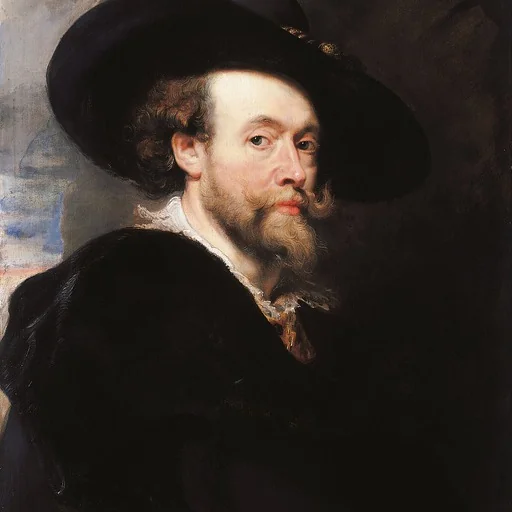
Sir Peter Paul Rubens ( ROO-bənz; Dutch:; 28 June 1577 – 30 May 1640) was a Flemish artist and diplomat.